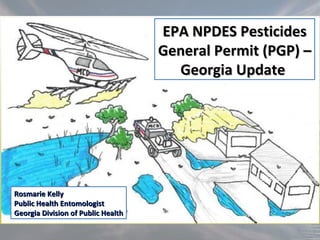
EPA NPDES Pesticides General Permit (PGP) –  Georgia Update   Rosmarie Kelly Public Health Entomologist Georgia Division of Public Health
October 31, 2011 NPDES permits under the Clean Water Act will be required to make pesticide applications legally allowed under FIFRA for pesticide applications made to  waters of the U.S.
Background    EPA has never issued permits for pesticide applications made under FIFRA (1947; Amended 1972, 1976)   FIFRA regulates registration, labeling, mixing, loading, and application. Environmental groups were concerned that labels do not require: IPM methods Records for non-restricted pesticides Monitoring Minimal fines
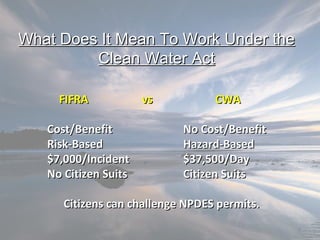
What Does It Mean To Work Under the Clean Water Act FIFRA   vs CWA Cost/Benefit No Cost/Benefit Risk-Based Hazard-Based $7,000/Incident $37,500/Day No Citizen Suits Citizen Suits Citizens can challenge NPDES permits.
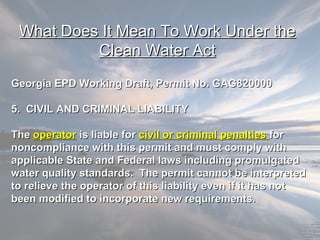
What Does It Mean To Work Under the Clean Water Act Georgia EPD Working Draft, Permit No. GAG820000 5.  CIVIL AND CRIMINAL LIABILITY The  operator  is liable for  civil or criminal penalties  for noncompliance with this permit and must comply with applicable State and Federal laws including promulgated water quality standards.  The permit cannot be interpreted to relieve the operator of this liability even if it has not been modified to incorporate new requirements.
Yes, it is  STILL   only a draft!
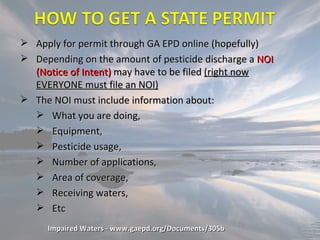
Apply for permit through GA EPD online (hopefully) Depending on the amount of pesticide discharge a  NOI (Notice of Intent)  may have to be filed  (right now EVERYONE must file an NOI) The NOI must include information about:  What you are doing,  Equipment,  Pesticide usage,  Number of applications,  Area of coverage,  Receiving waters,  Etc Impaired Waters - www.gaepd.org/Documents/305b
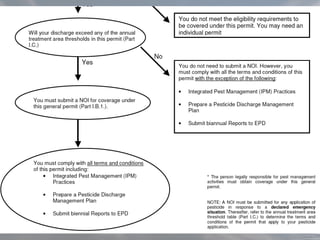
PGP Flowchart
We have asked for an increase in acreage for the annual threshold.
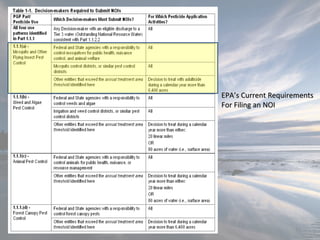
EPA’s Current Requirements For Filing an NOI
Right now larviciding acres are counted as part of the 6400 acres threshold ( get out your calculators ). EPD hopes to only use adulticiding acres to determine thresholds Larvicide only programs – automatically covered by permit
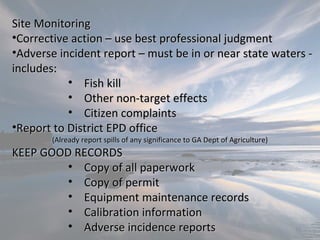
Site Monitoring Corrective action – use best professional judgment Adverse incident report – must be in or near state waters - includes: Fish kill Other non-target effects Citizen complaints Report to District EPD office (Already report spills of any significance to GA Dept of Agriculture) KEEP GOOD RECORDS Copy of all paperwork Copy of permit Equipment maintenance records Calibration information Adverse incidence reports
Programs exceeding the annual threshold are also required to have a Pesticide Discharge Management Plan. MUST INCLUDE: Pesticide Discharge Management Team. Pest Management Area Description. Control Measure Description. Schedules and Procedures.
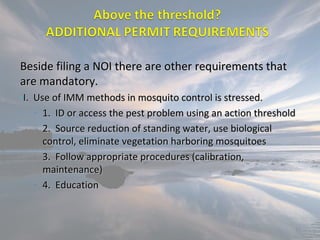
Beside filing a NOI there are other requirements that are mandatory. I.  Use of IMM methods in mosquito control is stressed. 1.  ID or access the pest problem using an action threshold 2.  Source reduction of standing water, use biological control, eliminate vegetation harboring mosquitoes 3.  Follow appropriate procedures (calibration, maintenance) 4.  Education
Reporting.   An biennial report will be required We have asked that reporting be removed as a requirement.
Conclusions http://www.GAmosquito.org GA EPD has shown a willingness to work with mosquito control in Georgia and with the GMCA GA EPD is very ignorant about mosquito control practices and they are quite  comfortable with their ignorance A whole lot of programs in Georgia are totally clueless that there is an upcoming permit requirement  There is an extension until October, so no permit is needed this year…
Legislative Fix On March 31, 2011, HR 872 was passed in the house.  The Reducing Regulatory Burdens Act of 2011 would eliminate the need to file an NOI and work under an NPDES permit.   The AMCA, as well as other organizations, are working on a companion bill to be passed in the Senate, to bring about a “regulatory fix” so that the requirement to work under an NPDES permit would be eliminated.
Senator Pat Roberts (Kansas) has introduced Senate Bill, S 718.  This is NOT exactly a companion bill to HR 872, but a partial fix, and a means to begin seriously debating this issue. AMCA Washington Day – May 9-11, 2011 Legislative Fix
ANY QUESTIONS? NPDES Update E-List Dr Rosmarie Kelly Georgia Division of Public Health 404-657-2912 [email_address] EPD Jill Bingham [email_address] EPD Gigi Steele [email_address]

GA NPDES Permit Information

  • 1.
    EPA NPDES PesticidesGeneral Permit (PGP) – Georgia Update Rosmarie Kelly Public Health Entomologist Georgia Division of Public Health
  • 2.
    October 31, 2011NPDES permits under the Clean Water Act will be required to make pesticide applications legally allowed under FIFRA for pesticide applications made to waters of the U.S.
  • 3.
    Background  EPA has never issued permits for pesticide applications made under FIFRA (1947; Amended 1972, 1976)  FIFRA regulates registration, labeling, mixing, loading, and application. Environmental groups were concerned that labels do not require: IPM methods Records for non-restricted pesticides Monitoring Minimal fines
  • 4.
    What Does ItMean To Work Under the Clean Water Act FIFRA vs CWA Cost/Benefit No Cost/Benefit Risk-Based Hazard-Based $7,000/Incident $37,500/Day No Citizen Suits Citizen Suits Citizens can challenge NPDES permits.
  • 5.
    What Does ItMean To Work Under the Clean Water Act Georgia EPD Working Draft, Permit No. GAG820000 5. CIVIL AND CRIMINAL LIABILITY The operator is liable for civil or criminal penalties for noncompliance with this permit and must comply with applicable State and Federal laws including promulgated water quality standards. The permit cannot be interpreted to relieve the operator of this liability even if it has not been modified to incorporate new requirements.
  • 6.
    Yes, it is STILL only a draft!
  • 7.
    Apply for permitthrough GA EPD online (hopefully) Depending on the amount of pesticide discharge a NOI (Notice of Intent) may have to be filed (right now EVERYONE must file an NOI) The NOI must include information about: What you are doing, Equipment, Pesticide usage, Number of applications, Area of coverage, Receiving waters, Etc Impaired Waters - www.gaepd.org/Documents/305b
  • 8.
  • 10.
    We have askedfor an increase in acreage for the annual threshold.
  • 11.
  • 13.
    Right now larvicidingacres are counted as part of the 6400 acres threshold ( get out your calculators ). EPD hopes to only use adulticiding acres to determine thresholds Larvicide only programs – automatically covered by permit
  • 15.
    Site Monitoring Correctiveaction – use best professional judgment Adverse incident report – must be in or near state waters - includes: Fish kill Other non-target effects Citizen complaints Report to District EPD office (Already report spills of any significance to GA Dept of Agriculture) KEEP GOOD RECORDS Copy of all paperwork Copy of permit Equipment maintenance records Calibration information Adverse incidence reports
  • 16.
    Programs exceeding theannual threshold are also required to have a Pesticide Discharge Management Plan. MUST INCLUDE: Pesticide Discharge Management Team. Pest Management Area Description. Control Measure Description. Schedules and Procedures.
  • 17.
    Beside filing aNOI there are other requirements that are mandatory. I. Use of IMM methods in mosquito control is stressed. 1. ID or access the pest problem using an action threshold 2. Source reduction of standing water, use biological control, eliminate vegetation harboring mosquitoes 3. Follow appropriate procedures (calibration, maintenance) 4. Education
  • 18.
    Reporting. An biennial report will be required We have asked that reporting be removed as a requirement.
  • 19.
    Conclusions http://www.GAmosquito.org GAEPD has shown a willingness to work with mosquito control in Georgia and with the GMCA GA EPD is very ignorant about mosquito control practices and they are quite comfortable with their ignorance A whole lot of programs in Georgia are totally clueless that there is an upcoming permit requirement There is an extension until October, so no permit is needed this year…
  • 20.
    Legislative Fix OnMarch 31, 2011, HR 872 was passed in the house. The Reducing Regulatory Burdens Act of 2011 would eliminate the need to file an NOI and work under an NPDES permit.   The AMCA, as well as other organizations, are working on a companion bill to be passed in the Senate, to bring about a “regulatory fix” so that the requirement to work under an NPDES permit would be eliminated.
  • 21.
    Senator Pat Roberts(Kansas) has introduced Senate Bill, S 718. This is NOT exactly a companion bill to HR 872, but a partial fix, and a means to begin seriously debating this issue. AMCA Washington Day – May 9-11, 2011 Legislative Fix
  • 22.
    ANY QUESTIONS? NPDESUpdate E-List Dr Rosmarie Kelly Georgia Division of Public Health 404-657-2912 [email_address] EPD Jill Bingham [email_address] EPD Gigi Steele [email_address]