Norma DC Joson
Entomologist III
Department of Health
DENGUE VECTOR
SURVEILLANCE
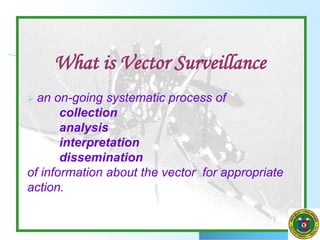
What is Vector Surveillance
 an on-going systematic process of
collection
analysis
interpretation
dissemination
of information about the vector for appropriate
action.
MOSQUITO VECTORS
Aedes
CulexAnopheles
Mansonia
General :
To obtain information about the
mosquito for proper action.
Specific :
•To establish presence/absence of the vector.
•To determine major mosquito breeding sites.
•To monitor high risk areas.
•To monitor seasonal population fluctuations.
•To monitor mosquito population w/c will serve as a
warning for an impending outbreak.
•To recommend immediate prevention & control
measures when necessary.
•To assess impact of interventions.
Objectives
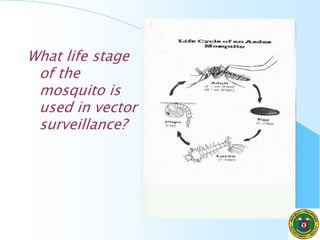
What life stage
of the
mosquito is
used in vector
surveillance?
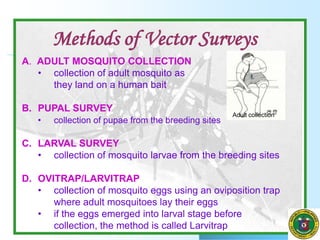
A. ADULT MOSQUITO COLLECTION
• collection of adult mosquito as
they land on a human bait
B. PUPAL SURVEY
• collection of pupae from the breeding sites
C. LARVAL SURVEY
• collection of mosquito larvae from the breeding sites
D. OVITRAP/LARVITRAP
• collection of mosquito eggs using an oviposition trap
where adult mosquitoes lay their eggs
• if the eggs emerged into larval stage before
collection, the method is called Larvitrap
Methods of Vector Surveys
Adult collection
A. PREPARATORY PHASE
1. Organize & mobilize a Dengue Watch
Team/Task Force/Brigade.
2. Prepare a spot map of the barangay.
3. Prepare entomological supplies needed
4. Group the team into 4 to cover 25 houses per
group.
5. Coordinate with local officials prior to the
activity.
Strategies / Activities
B. FIELD COLLECTION
1. Inspect all houses w/in 300m radius of index house
2. Inspect all water-holding containers
• artificial : drums, tires, tin cans, bottles, flower
vase, roof gutter, coconut shell
• natural : leaf axils, tree holes, bamboo stumps
3. Label as to kind, location & type of container
4. Indicate containers w/o larvae in the survey form
5. Collect adult mosquitoes, if any.
6. Conduct on the spot health education to the
household/owner.
Strategies / Activities
What are the
common
breeding
sites of
Aedes
mosquitoes?
C. LABORATORY
1. Prepare laboratory materials, equipment &
other supplies
2. Mount & identify the larvae under the
microscope
3. Identify adult mosquitoes, if any, using a
stereoscope or magnifying lens
4. Determine larval indices.
5. Analyze & interpret findings.
Strategies / Activities
RAPID MOUNTING OF
MOSQUITO LARVAE
1. Kill the larvae in 600C hot water.
2. Transfer larvae into 70% alcohol
solution.
3. Transfer larvae into 95% alcohol
solution.
4. Clear larvae using xylene.
5. Put larvae on clean slides, wipe
excess water w/ filter or tissue
paper.
6. Mount the larvae using a
mounting medium.
7. Examine specimen under the
microscope.
A. ADULT MOSQUITO
ADULT BITING INDEX (ABI) or HUMAN
LANDING RATE (HBR)
 used to determine adult mosquito density
through human bareleg catches
ABI = no. of Aedes sp. collected x 60
no. of human baits
Interpretation :
ADULT DENSITY
>2/human/hr = high risk
<2/human/hr = low risk
Mosquito Indices
B. PUPAL SURVEY
PUPAL INDEX
 used to calculate adult mosquito
production
 used for special assessment & studies, not
for routine surveys
PI = no. of Aedes sp. collected x 100%
no. of houses inspected
Mosquito Indices
B. LARVAE
B.1 LARVAL INDICES – from larval surveys
House Index
Container Index
Breteau Index
B.2 LARVITRAP INDEX (LI) – from traps
LI = no. of traps (indoor/outdoor) (+) for
Aedes sp x 100
total no. of traps set
Interpretation :
LI (rural) >20% & LI (urban) >10% =
dengue sensitive areas
Mosquito Indices
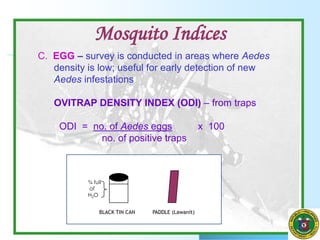
C. EGG – survey is conducted in areas where Aedes
density is low; useful for early detection of new
Aedes infestations
OVITRAP DENSITY INDEX (ODI) – from traps
ODI = no. of Aedes eggs x 100
no. of positive traps
Mosquito Indices
BLACK TIN CAN PADDLE (Lawanit)
¾ full
of
H2O
A. HOUSE/PREMISE INDEX (HI)
HI = no. of houses (+) for Aedes sp. x 100%
no. of houses inspected
B. CONTAINER INDEX (CI)
CI = no. of containers (+) for Aedes sp. X 100%
no. of containers inspected
C. BRETEAU INDEX (BI)
BI = no. of positive containers x 100
total no. of houses inspected
Larval Survey
COMPUTATION OF RESULTS
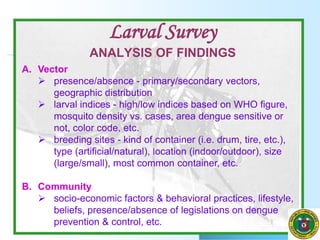
A. Vector
 presence/absence - primary/secondary vectors,
geographic distribution
 larval indices - high/low indices based on WHO figure,
mosquito density vs. cases, area dengue sensitive or
not, color code, etc.
 breeding sites - kind of container (i.e. drum, tire, etc.),
type (artificial/natural), location (indoor/outdoor), size
(large/small), most common container, etc.
B. Community
 socio-economic factors & behavioral practices, lifestyle,
beliefs, presence/absence of legislations on dengue
prevention & control, etc.
Larval Survey
ANALYSIS OF FINDINGS
Priority 1 - localities where an outbreak of
DF/DHF had occurred
Priority 2 - localities w/ high larval indices
HI >5% and/or BI >20
Priority 3 - localities w/ relatively low larval
indices
HI <5% and/or BI <20
Priority 4 - localities where there are no dengue
cases and low Aedes densities.
Priotization of Areas
w/in 24 hrs of the 1st case from an outbreak locality
following an outbreak based on priority classification
of the locality
high risk areas (Priority 1 & 2) = monthly/
quarterly in 100% of houses
low risk areas (Priority 3 & 4) = monthly/
quarterly in at least 20% of houses
before and after interventions
when there is suspect of insecticide resistance
When to Conduct Larval Surveys
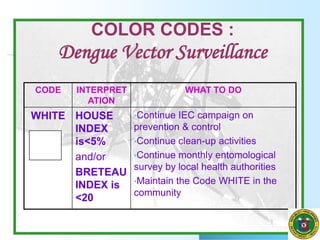
COLOR CODES :
Dengue Vector Surveillance
CODE INTERPRET
ATION
WHAT TO DO
WHITE HOUSE
INDEX
is<5%
and/or
BRETEAU
INDEX is
<20
•Continue IEC campaign on
prevention & control
•Continue clean-up activities
•Continue monthly entomological
survey by local health authorities
•Maintain the Code WHITE in the
community
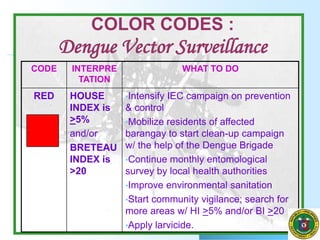
COLOR CODES :
Dengue Vector Surveillance
CODE INTERPRE
TATION
WHAT TO DO
RED HOUSE
INDEX is
>5%
and/or
BRETEAU
INDEX is
>20
•Intensify IEC campaign on prevention
& control
•Mobilize residents of affected
barangay to start clean-up campaign
w/ the help of the Dengue Brigade
•Continue monthly entomological
survey by local health authorities
•Improve environmental sanitation
•Start community vigilance; search for
more areas w/ HI >5% and/or BI >20
•Apply larvicide.
Who will benefit from the
Information
Program Planners &
Managers
Field Health Workers
Local Government Units
Community
Researchers
Media
Other Sectors of Society
Funding agencies
Thank you!!!

Dengue vector surveillance final

  • 1.
    Norma DC Joson EntomologistIII Department of Health DENGUE VECTOR SURVEILLANCE
  • 2.
    What is VectorSurveillance  an on-going systematic process of collection analysis interpretation dissemination of information about the vector for appropriate action.
  • 3.
  • 4.
    General : To obtaininformation about the mosquito for proper action. Specific : •To establish presence/absence of the vector. •To determine major mosquito breeding sites. •To monitor high risk areas. •To monitor seasonal population fluctuations. •To monitor mosquito population w/c will serve as a warning for an impending outbreak. •To recommend immediate prevention & control measures when necessary. •To assess impact of interventions. Objectives
  • 5.
    What life stage ofthe mosquito is used in vector surveillance?
  • 6.
    A. ADULT MOSQUITOCOLLECTION • collection of adult mosquito as they land on a human bait B. PUPAL SURVEY • collection of pupae from the breeding sites C. LARVAL SURVEY • collection of mosquito larvae from the breeding sites D. OVITRAP/LARVITRAP • collection of mosquito eggs using an oviposition trap where adult mosquitoes lay their eggs • if the eggs emerged into larval stage before collection, the method is called Larvitrap Methods of Vector Surveys Adult collection
  • 7.
    A. PREPARATORY PHASE 1.Organize & mobilize a Dengue Watch Team/Task Force/Brigade. 2. Prepare a spot map of the barangay. 3. Prepare entomological supplies needed 4. Group the team into 4 to cover 25 houses per group. 5. Coordinate with local officials prior to the activity. Strategies / Activities
  • 8.
    B. FIELD COLLECTION 1.Inspect all houses w/in 300m radius of index house 2. Inspect all water-holding containers • artificial : drums, tires, tin cans, bottles, flower vase, roof gutter, coconut shell • natural : leaf axils, tree holes, bamboo stumps 3. Label as to kind, location & type of container 4. Indicate containers w/o larvae in the survey form 5. Collect adult mosquitoes, if any. 6. Conduct on the spot health education to the household/owner. Strategies / Activities
  • 9.
  • 10.
    C. LABORATORY 1. Preparelaboratory materials, equipment & other supplies 2. Mount & identify the larvae under the microscope 3. Identify adult mosquitoes, if any, using a stereoscope or magnifying lens 4. Determine larval indices. 5. Analyze & interpret findings. Strategies / Activities
  • 11.
    Strategies / Activities RAPIDMOUNTING OF MOSQUITO LARVAE 1. Kill the larvae in 600C hot water. 2. Transfer larvae into 70% alcohol solution. 3. Transfer larvae into 95% alcohol solution. 4. Clear larvae using xylene. 5. Put larvae on clean slides, wipe excess water w/ filter or tissue paper. 6. Mount the larvae using a mounting medium. 7. Examine specimen under the microscope.
  • 12.
    A. ADULT MOSQUITO ADULTBITING INDEX (ABI) or HUMAN LANDING RATE (HBR)  used to determine adult mosquito density through human bareleg catches ABI = no. of Aedes sp. collected x 60 no. of human baits Interpretation : ADULT DENSITY >2/human/hr = high risk <2/human/hr = low risk Mosquito Indices
  • 13.
    B. PUPAL SURVEY PUPALINDEX  used to calculate adult mosquito production  used for special assessment & studies, not for routine surveys PI = no. of Aedes sp. collected x 100% no. of houses inspected Mosquito Indices
  • 14.
    B. LARVAE B.1 LARVALINDICES – from larval surveys House Index Container Index Breteau Index B.2 LARVITRAP INDEX (LI) – from traps LI = no. of traps (indoor/outdoor) (+) for Aedes sp x 100 total no. of traps set Interpretation : LI (rural) >20% & LI (urban) >10% = dengue sensitive areas Mosquito Indices
  • 15.
    C. EGG –survey is conducted in areas where Aedes density is low; useful for early detection of new Aedes infestations OVITRAP DENSITY INDEX (ODI) – from traps ODI = no. of Aedes eggs x 100 no. of positive traps Mosquito Indices BLACK TIN CAN PADDLE (Lawanit) ¾ full of H2O
  • 16.
    A. HOUSE/PREMISE INDEX(HI) HI = no. of houses (+) for Aedes sp. x 100% no. of houses inspected B. CONTAINER INDEX (CI) CI = no. of containers (+) for Aedes sp. X 100% no. of containers inspected C. BRETEAU INDEX (BI) BI = no. of positive containers x 100 total no. of houses inspected Larval Survey COMPUTATION OF RESULTS
  • 17.
    A. Vector  presence/absence- primary/secondary vectors, geographic distribution  larval indices - high/low indices based on WHO figure, mosquito density vs. cases, area dengue sensitive or not, color code, etc.  breeding sites - kind of container (i.e. drum, tire, etc.), type (artificial/natural), location (indoor/outdoor), size (large/small), most common container, etc. B. Community  socio-economic factors & behavioral practices, lifestyle, beliefs, presence/absence of legislations on dengue prevention & control, etc. Larval Survey ANALYSIS OF FINDINGS
  • 18.
    Priority 1 -localities where an outbreak of DF/DHF had occurred Priority 2 - localities w/ high larval indices HI >5% and/or BI >20 Priority 3 - localities w/ relatively low larval indices HI <5% and/or BI <20 Priority 4 - localities where there are no dengue cases and low Aedes densities. Priotization of Areas
  • 19.
    w/in 24 hrsof the 1st case from an outbreak locality following an outbreak based on priority classification of the locality high risk areas (Priority 1 & 2) = monthly/ quarterly in 100% of houses low risk areas (Priority 3 & 4) = monthly/ quarterly in at least 20% of houses before and after interventions when there is suspect of insecticide resistance When to Conduct Larval Surveys
  • 20.
    COLOR CODES : DengueVector Surveillance CODE INTERPRET ATION WHAT TO DO WHITE HOUSE INDEX is<5% and/or BRETEAU INDEX is <20 •Continue IEC campaign on prevention & control •Continue clean-up activities •Continue monthly entomological survey by local health authorities •Maintain the Code WHITE in the community
  • 21.
    COLOR CODES : DengueVector Surveillance CODE INTERPRE TATION WHAT TO DO RED HOUSE INDEX is >5% and/or BRETEAU INDEX is >20 •Intensify IEC campaign on prevention & control •Mobilize residents of affected barangay to start clean-up campaign w/ the help of the Dengue Brigade •Continue monthly entomological survey by local health authorities •Improve environmental sanitation •Start community vigilance; search for more areas w/ HI >5% and/or BI >20 •Apply larvicide.
  • 22.
    Who will benefitfrom the Information Program Planners & Managers Field Health Workers Local Government Units Community Researchers Media Other Sectors of Society Funding agencies
  • 23.