Insecticides and
rodenticides
Insecticide
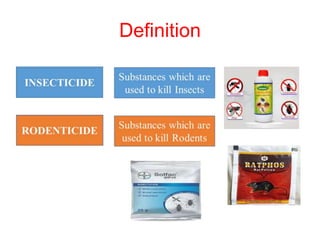
Definition
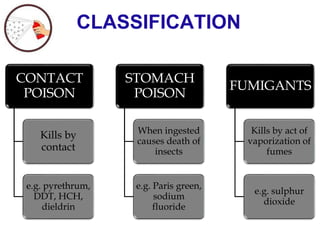
CLASSIFICATION
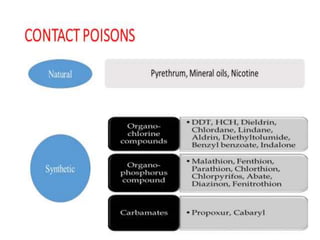
CONTACT
POISON
Kills by
contact
e.g. pyrethrum,
DDT, HCH,
dieldrin
STOMACH
POISON
When ingested
causes death of
insects
e.g. Paris green,
sodium
fluoride
FUMIGANTS
Kills by act of
vaporization of
fumes
e.g. sulphur
dioxide
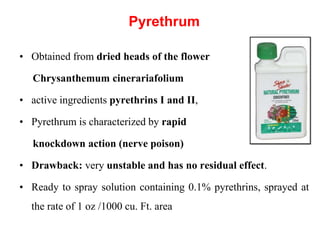
Pyrethrum
• Obtained from dried heads of the flower
Chrysanthemum cinerariafolium
• active ingredients pyrethrins I and II,
• Pyrethrum is characterized by rapid
knockdown action (nerve poison)
• Drawback: very unstable and has no residual effect.
• Ready to spray solution containing 0.1% pyrethrins, sprayed at
the rate of 1 oz /1000 cu. Ft. area
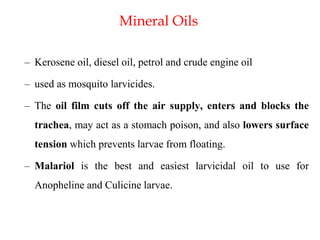
Mineral Oils
– Kerosene oil, diesel oil, petrol and crude engine oil
– used as mosquito larvicides.
– The oil film cuts off the air supply, enters and blocks the
trachea, may act as a stomach poison, and also lowers surface
tension which prevents larvae from floating.
– Malariol is the best and easiest larvicidal oil to use for
Anopheline and Culicine larvae.
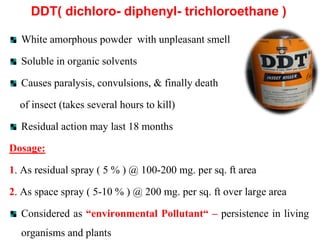
DDT( dichloro- diphenyl- trichloroethane )
White amorphous powder with unpleasant smell
Soluble in organic solvents
Causes paralysis, convulsions, & finally death
of insect (takes several hours to kill)
Residual action may last 18 months
Dosage:
1. As residual spray ( 5 % ) @ 100-200 mg. per sq. ft area
2. As space spray ( 5-10 % ) @ 200 mg. per sq. ft over large area
Considered as “environmental Pollutant“ – persistence in living
organisms and plants
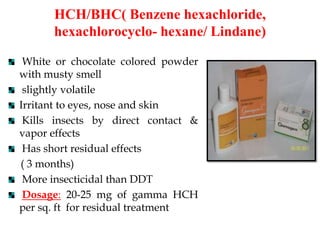
HCH/BHC( Benzene hexachloride,
hexachlorocyclo- hexane/ Lindane)
White or chocolate colored powder
with musty smell
slightly volatile
Irritant to eyes, nose and skin
Kills insects by direct contact &
vapor effects
Has short residual effects
( 3 months)
More insecticidal than DDT
Dosage: 20-25 mg of gamma HCH
per sq. ft for residual treatment
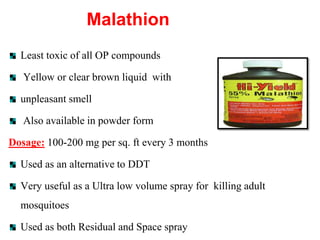
Malathion
Least toxic of all OP compounds
Yellow or clear brown liquid with
unpleasant smell
Also available in powder form
Dosage: 100-200 mg per sq. ft every 3 months
Used as an alternative to DDT
Very useful as a Ultra low volume spray for killing adult
mosquitoes
Used as both Residual and Space spray
Paris green
Also called copper aceto-arsenite
Emerald green microcrystalline powder,
insoluble in water but soluble in other
organic solvents
Acts as stomach poison
Used as an alternative to DDT for killing anopheles larva
Dosage:
Sprayed as 2% dust over breeding places once a week for
effective control
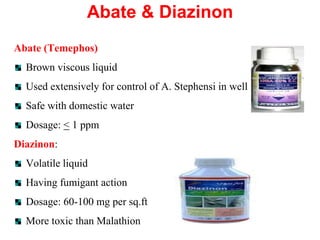
Abate & Diazinon
Abate (Temephos)
Brown viscous liquid
Used extensively for control of A. Stephensi in well
Safe with domestic water
Dosage: < 1 ppm
Diazinon:
Volatile liquid
Having fumigant action
Dosage: 60-100 mg per sq.ft
More toxic than Malathion
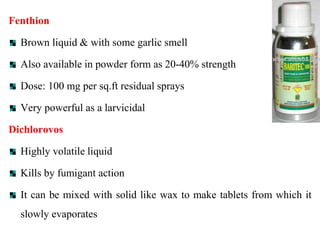
Fenthion
Brown liquid & with some garlic smell
Also available in powder form as 20-40% strength
Dose: 100 mg per sq.ft residual sprays
Very powerful as a larvicidal
Dichlorovos
Highly volatile liquid
Kills by fumigant action
It can be mixed with solid like wax to make tablets from which it
slowly evaporates
Propoxur
Used as an alternative to DDT in areas
where resistance is developed
Synthetic pyrethroids
Used to reduce the crisis of natural
pyrethrum
e.g.: tetramethrin, resethrin, prothrin
Space spray
• Outdoor spraying of
insecticides to kill adult
insects.
Indoor Residual spray
• Involves coating the walls
and other surfaces of a
house with a residual
insecticide. For several

months, the insecticide
will kill mosquitoes and
other insects that come in
contact with these
surfaces.
https://www.youtube.com/watch
?v=u4m6cIEv1LU
https://www.youtube.com/watch?v=
BzLWxEcoHb4
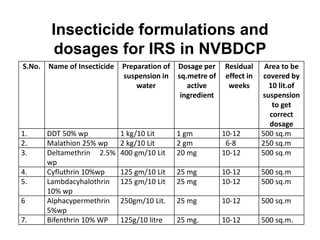
Insecticide formulations and
dosages for IRS in NVBDCP
S.No. Name of Insecticide Preparation of
suspension in
water
Dosage per
sq.metre of
active
ingredient
Residual
effect in
weeks
Area to be
covered by
10 lit.of
suspension
to get
correct
dosage
1. DDT 50% wp 1 kg/10 Lit 1 gm 10-12 500 sq.m
2. Malathion 25% wp 2 kg/10 Lit 2 gm 6-8 250 sq.m
3. Deltamethrin 2.5%
wp
400 gm/10 Lit 20 mg 10-12 500 sq.m
4. Cyfluthrin 10%wp 125 gm/10 Lit 25 mg 10-12 500 sq.m
5. Lambdacyhalothrin
10% wp
125 gm/10 Lit 25 mg 10-12 500 sq.m
6 Alphacypermethrin
5%wp
250gm/10 Lit. 25 mg 10-12 500 sq.m
7. Bifenthrin 10% WP 125g/10 litre 25 mg. 10-12 500 sq.m.
Insecticide Resistance
“Development of ability of insect to tolerate doses of toxicants
which would be lethal to majority of the individuals in normal
population of same species”
Biological or Genetic factors responsible
Prolong use in inadequate doses
Resistant to DDT & its analogue (OC) & HCH & its analogue
(OC)
Double resistance / Cross resistance
Use of OP compound in place of OC compound
TOXICITY OF
INSECTICIDE
ORGANOCHLORINE COMPOUND
ORGANOPHOSPHURUS COMPOUND
ORGANOCHLORINE COMPOUND
All are nerve poison & DDT is least toxic
Symptoms;
Nerve excitability, Tremors & Convulsion
Lethal doses:
1. DDT_ 250mg per kg of body weight
2. Gamma HCH_ twice toxic then DDT
3. Diedrine is 5-8 times more toxic then DDT
Treatment:
• Stomach washout
• Barbiturates
Organophosphorus compound
M/A:
Inhibition of cholinesterase enzyme which catalyses degradation of
acetyl choline in the synapse causing accumulation of same.
Symptoms:
Headache, giddiness, apprehension
Restlessness, cold sweating, salivation
Uncontrolled urination & defecation
Unconsciousness
Ataxia, Coma
Death
Treatment of OP poisoning
Immediate removal from the site of exposure
Identify the source of exposure (inhalation/contact )
Hospitalization of symptomatic patient
Drugs used:
Atropine
Pralidoxime
BZD
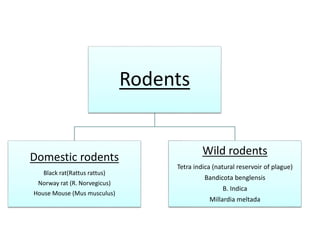
Rodents
Domestic rodents
Black rat(Rattus rattus)
Norway rat (R. Norvegicus)
House Mouse (Mus musculus)
Wild rodents
Tetra indica (natural reservoir of plague)
Bandicota benglensis
B. Indica
Millardia meltada
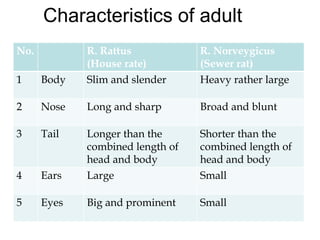
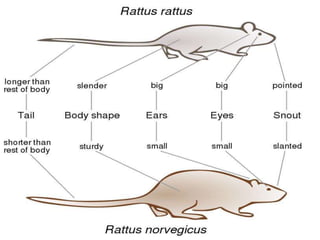
Characteristics of adult
No. R. Rattus
(House rate)
R. Norveygicus
(Sewer rat)
1 Body Slim and slender Heavy rather large
2 Nose Long and sharp Broad and blunt
3 Tail Longer than the
combined length of
head and body
Shorter than the
combined length of
head and body
4 Ears Large Small
5 Eyes Big and prominent Small
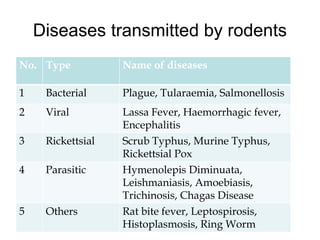
Diseases transmitted by rodents
No. Type Name of diseases
1 Bacterial Plague, Tularaemia, Salmonellosis
2 Viral Lassa Fever, Haemorrhagic fever,
Encephalitis
3 Rickettsial Scrub Typhus, Murine Typhus,
Rickettsial Pox
4 Parasitic Hymenolepis Diminuata,
Leishmaniasis, Amoebiasis,
Trichinosis, Chagas Disease
5 Others Rat bite fever, Leptospirosis,
Histoplasmosis, Ring Worm
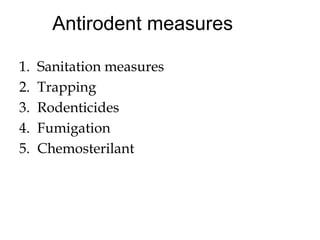
Antirodent measures
1. Sanitation measures
2. Trapping
3. Rodenticides
4. Fumigation
5. Chemosterilant
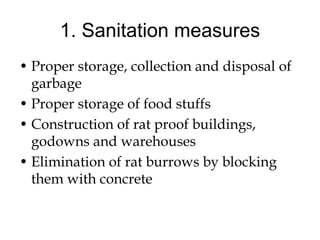
1. Sanitation measures
• Proper storage, collection and disposal of
garbage
• Proper storage of food stuffs
• Construction of rat proof buildings,
godowns and warehouses
• Elimination of rat burrows by blocking
them with concrete
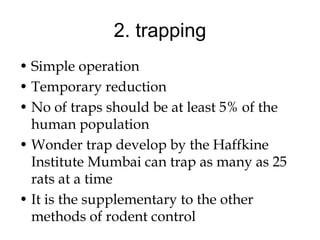
2. trapping
• Simple operation
• Temporary reduction
• No of traps should be at least 5% of the
human population
• Wonder trap develop by the Haffkine
Institute Mumbai can trap as many as 25
rats at a time
• It is the supplementary to the other
methods of rodent control
3. Rodenticides
• Single dose rodenticides
1. Those require ordinary care
• Red squill
• Norbromide
• Zinc phospide
2. Those requiring maximal precautions
• Sodium fluorocetate
• Fluoroacetamide
• Strychnine
3. Too dangerous for use
• Arsenic trioxide
• Phosphorus
3. Rodenticides
• Multiple dose rodenticide
• Warfarin
• diphacinone
• coumafuryl
• Pindone
• Commonly use poison is Barium
carbonate, Zinc phosphide
• Zinc phosphide is recommended for large
scale use
4. Fumigation
• It is effective method of destroying both rats and
rat fleas
• Fumigants used in anti rat campaigns are calcium
cyanide (cyanogas/cymag), carbon disulphide,
methyl bromide, sulphur dioxide etc.
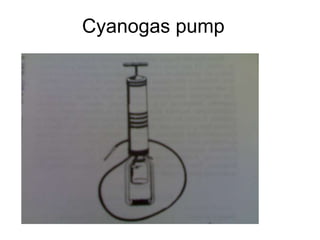
• Cyanogas is pumped into rat burrows by foot
pump called the “Cyanogas pump”
• After pumping 2 ounce of the poison burrows are
promptly sealed with wet mud
• On contact with moisture cyanogas powder gives
of Hydrogen cyanide gas
Cyanogas pump
5. chemosteriliant
• Chemosteriliant is a chemical that can
cause temporary of permanent sterility in
either sex or both sexes
• Still in the experimental stage
Summary
1) Anti-Larval Measures: Use of Abate, Fenthion etc
2) Anti-Adult Measures
a) Residual spray ---------------- DDT, Malathion etc.
b) Space spray--------------------- Pyrethrum (2%)
3) Rodenticide: Zinc phosphide and Barium Carbonate
Thank You

Mosquito Control Measures, Insecticides rodents dipesh.ppt

  • 1.
  • 2.
  • 3.
  • 4.
    CLASSIFICATION CONTACT POISON Kills by contact e.g. pyrethrum, DDT,HCH, dieldrin STOMACH POISON When ingested causes death of insects e.g. Paris green, sodium fluoride FUMIGANTS Kills by act of vaporization of fumes e.g. sulphur dioxide
  • 6.
    Pyrethrum • Obtained fromdried heads of the flower Chrysanthemum cinerariafolium • active ingredients pyrethrins I and II, • Pyrethrum is characterized by rapid knockdown action (nerve poison) • Drawback: very unstable and has no residual effect. • Ready to spray solution containing 0.1% pyrethrins, sprayed at the rate of 1 oz /1000 cu. Ft. area
  • 7.
    Mineral Oils – Keroseneoil, diesel oil, petrol and crude engine oil – used as mosquito larvicides. – The oil film cuts off the air supply, enters and blocks the trachea, may act as a stomach poison, and also lowers surface tension which prevents larvae from floating. – Malariol is the best and easiest larvicidal oil to use for Anopheline and Culicine larvae.
  • 8.
    DDT( dichloro- diphenyl-trichloroethane ) White amorphous powder with unpleasant smell Soluble in organic solvents Causes paralysis, convulsions, & finally death of insect (takes several hours to kill) Residual action may last 18 months Dosage: 1. As residual spray ( 5 % ) @ 100-200 mg. per sq. ft area 2. As space spray ( 5-10 % ) @ 200 mg. per sq. ft over large area Considered as “environmental Pollutant“ – persistence in living organisms and plants
  • 9.
    HCH/BHC( Benzene hexachloride, hexachlorocyclo-hexane/ Lindane) White or chocolate colored powder with musty smell slightly volatile Irritant to eyes, nose and skin Kills insects by direct contact & vapor effects Has short residual effects ( 3 months) More insecticidal than DDT Dosage: 20-25 mg of gamma HCH per sq. ft for residual treatment
  • 10.
    Malathion Least toxic ofall OP compounds Yellow or clear brown liquid with unpleasant smell Also available in powder form Dosage: 100-200 mg per sq. ft every 3 months Used as an alternative to DDT Very useful as a Ultra low volume spray for killing adult mosquitoes Used as both Residual and Space spray
  • 11.
    Paris green Also calledcopper aceto-arsenite Emerald green microcrystalline powder, insoluble in water but soluble in other organic solvents Acts as stomach poison Used as an alternative to DDT for killing anopheles larva Dosage: Sprayed as 2% dust over breeding places once a week for effective control
  • 12.
    Abate & Diazinon Abate(Temephos) Brown viscous liquid Used extensively for control of A. Stephensi in well Safe with domestic water Dosage: < 1 ppm Diazinon: Volatile liquid Having fumigant action Dosage: 60-100 mg per sq.ft More toxic than Malathion
  • 13.
    Fenthion Brown liquid &with some garlic smell Also available in powder form as 20-40% strength Dose: 100 mg per sq.ft residual sprays Very powerful as a larvicidal Dichlorovos Highly volatile liquid Kills by fumigant action It can be mixed with solid like wax to make tablets from which it slowly evaporates
  • 14.
    Propoxur Used as analternative to DDT in areas where resistance is developed Synthetic pyrethroids Used to reduce the crisis of natural pyrethrum e.g.: tetramethrin, resethrin, prothrin
  • 15.
    Space spray • Outdoorspraying of insecticides to kill adult insects. Indoor Residual spray • Involves coating the walls and other surfaces of a house with a residual insecticide. For several months, the insecticide will kill mosquitoes and other insects that come in contact with these surfaces. https://www.youtube.com/watch ?v=u4m6cIEv1LU https://www.youtube.com/watch?v= BzLWxEcoHb4
  • 16.
    Insecticide formulations and dosagesfor IRS in NVBDCP S.No. Name of Insecticide Preparation of suspension in water Dosage per sq.metre of active ingredient Residual effect in weeks Area to be covered by 10 lit.of suspension to get correct dosage 1. DDT 50% wp 1 kg/10 Lit 1 gm 10-12 500 sq.m 2. Malathion 25% wp 2 kg/10 Lit 2 gm 6-8 250 sq.m 3. Deltamethrin 2.5% wp 400 gm/10 Lit 20 mg 10-12 500 sq.m 4. Cyfluthrin 10%wp 125 gm/10 Lit 25 mg 10-12 500 sq.m 5. Lambdacyhalothrin 10% wp 125 gm/10 Lit 25 mg 10-12 500 sq.m 6 Alphacypermethrin 5%wp 250gm/10 Lit. 25 mg 10-12 500 sq.m 7. Bifenthrin 10% WP 125g/10 litre 25 mg. 10-12 500 sq.m.
  • 17.
    Insecticide Resistance “Development ofability of insect to tolerate doses of toxicants which would be lethal to majority of the individuals in normal population of same species” Biological or Genetic factors responsible Prolong use in inadequate doses Resistant to DDT & its analogue (OC) & HCH & its analogue (OC) Double resistance / Cross resistance Use of OP compound in place of OC compound
  • 18.
  • 19.
    ORGANOCHLORINE COMPOUND All arenerve poison & DDT is least toxic Symptoms; Nerve excitability, Tremors & Convulsion Lethal doses: 1. DDT_ 250mg per kg of body weight 2. Gamma HCH_ twice toxic then DDT 3. Diedrine is 5-8 times more toxic then DDT Treatment: • Stomach washout • Barbiturates
  • 20.
    Organophosphorus compound M/A: Inhibition ofcholinesterase enzyme which catalyses degradation of acetyl choline in the synapse causing accumulation of same. Symptoms: Headache, giddiness, apprehension Restlessness, cold sweating, salivation Uncontrolled urination & defecation Unconsciousness Ataxia, Coma Death
  • 21.
    Treatment of OPpoisoning Immediate removal from the site of exposure Identify the source of exposure (inhalation/contact ) Hospitalization of symptomatic patient Drugs used: Atropine Pralidoxime BZD
  • 22.
    Rodents Domestic rodents Black rat(Rattusrattus) Norway rat (R. Norvegicus) House Mouse (Mus musculus) Wild rodents Tetra indica (natural reservoir of plague) Bandicota benglensis B. Indica Millardia meltada
  • 23.
    Characteristics of adult No.R. Rattus (House rate) R. Norveygicus (Sewer rat) 1 Body Slim and slender Heavy rather large 2 Nose Long and sharp Broad and blunt 3 Tail Longer than the combined length of head and body Shorter than the combined length of head and body 4 Ears Large Small 5 Eyes Big and prominent Small
  • 25.
    Diseases transmitted byrodents No. Type Name of diseases 1 Bacterial Plague, Tularaemia, Salmonellosis 2 Viral Lassa Fever, Haemorrhagic fever, Encephalitis 3 Rickettsial Scrub Typhus, Murine Typhus, Rickettsial Pox 4 Parasitic Hymenolepis Diminuata, Leishmaniasis, Amoebiasis, Trichinosis, Chagas Disease 5 Others Rat bite fever, Leptospirosis, Histoplasmosis, Ring Worm
  • 26.
    Antirodent measures 1. Sanitationmeasures 2. Trapping 3. Rodenticides 4. Fumigation 5. Chemosterilant
  • 27.
    1. Sanitation measures •Proper storage, collection and disposal of garbage • Proper storage of food stuffs • Construction of rat proof buildings, godowns and warehouses • Elimination of rat burrows by blocking them with concrete
  • 28.
    2. trapping • Simpleoperation • Temporary reduction • No of traps should be at least 5% of the human population • Wonder trap develop by the Haffkine Institute Mumbai can trap as many as 25 rats at a time • It is the supplementary to the other methods of rodent control
  • 29.
    3. Rodenticides • Singledose rodenticides 1. Those require ordinary care • Red squill • Norbromide • Zinc phospide 2. Those requiring maximal precautions • Sodium fluorocetate • Fluoroacetamide • Strychnine 3. Too dangerous for use • Arsenic trioxide • Phosphorus
  • 30.
    3. Rodenticides • Multipledose rodenticide • Warfarin • diphacinone • coumafuryl • Pindone • Commonly use poison is Barium carbonate, Zinc phosphide • Zinc phosphide is recommended for large scale use
  • 31.
    4. Fumigation • Itis effective method of destroying both rats and rat fleas • Fumigants used in anti rat campaigns are calcium cyanide (cyanogas/cymag), carbon disulphide, methyl bromide, sulphur dioxide etc. • Cyanogas is pumped into rat burrows by foot pump called the “Cyanogas pump” • After pumping 2 ounce of the poison burrows are promptly sealed with wet mud • On contact with moisture cyanogas powder gives of Hydrogen cyanide gas
  • 32.
  • 33.
    5. chemosteriliant • Chemosteriliantis a chemical that can cause temporary of permanent sterility in either sex or both sexes • Still in the experimental stage
  • 34.
    Summary 1) Anti-Larval Measures:Use of Abate, Fenthion etc 2) Anti-Adult Measures a) Residual spray ---------------- DDT, Malathion etc. b) Space spray--------------------- Pyrethrum (2%) 3) Rodenticide: Zinc phosphide and Barium Carbonate
  • 35.