Copyright © The McGraw-Hill Companies, Inc.
Permission required for reproduction or display.
PowerPoint to accompany
Krar • Gill • Smid
Technology of Machine Tools
6th
Edition
Surface Finish
Measurement
Unit 18
18-2
Objectives
• Interpret the surface finish symbols that
appear on a drawing
• Use a surface finish indicator to measure the
surface finish of a part
18-3
Surface Finish Measurement
• Modern technology demanding improved
surface finishes
– Often require additional operations: lapping or
honing
• System of symbols devised by ASA
– Provide standard system of determining and
indicating surface finish
– Inch unit is microinch (µin)
– Metric unit is micrometer (µm)
18-4
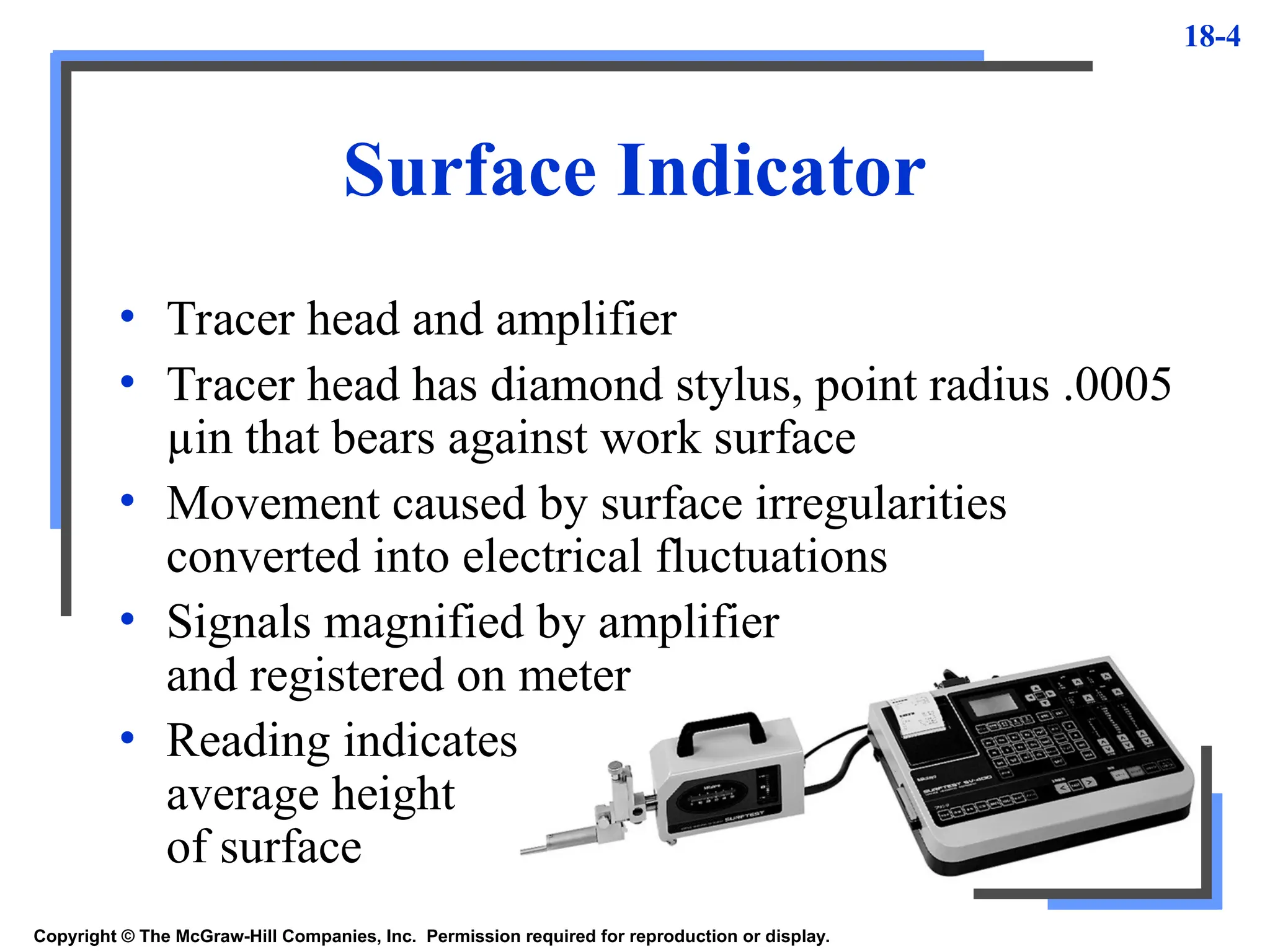
Surface Indicator
Copyright © The McGraw-Hill Companies, Inc. Permission required for reproduction or display.
• Tracer head and amplifier
• Tracer head has diamond stylus, point radius .0005
µin that bears against work surface
• Movement caused by surface irregularities
converted into electrical fluctuations
• Signals magnified by amplifier
and registered on meter
• Reading indicates
average height
of surface
18-5
Copyright © The McGraw-Hill Companies, Inc. Permission required for reproduction or display.
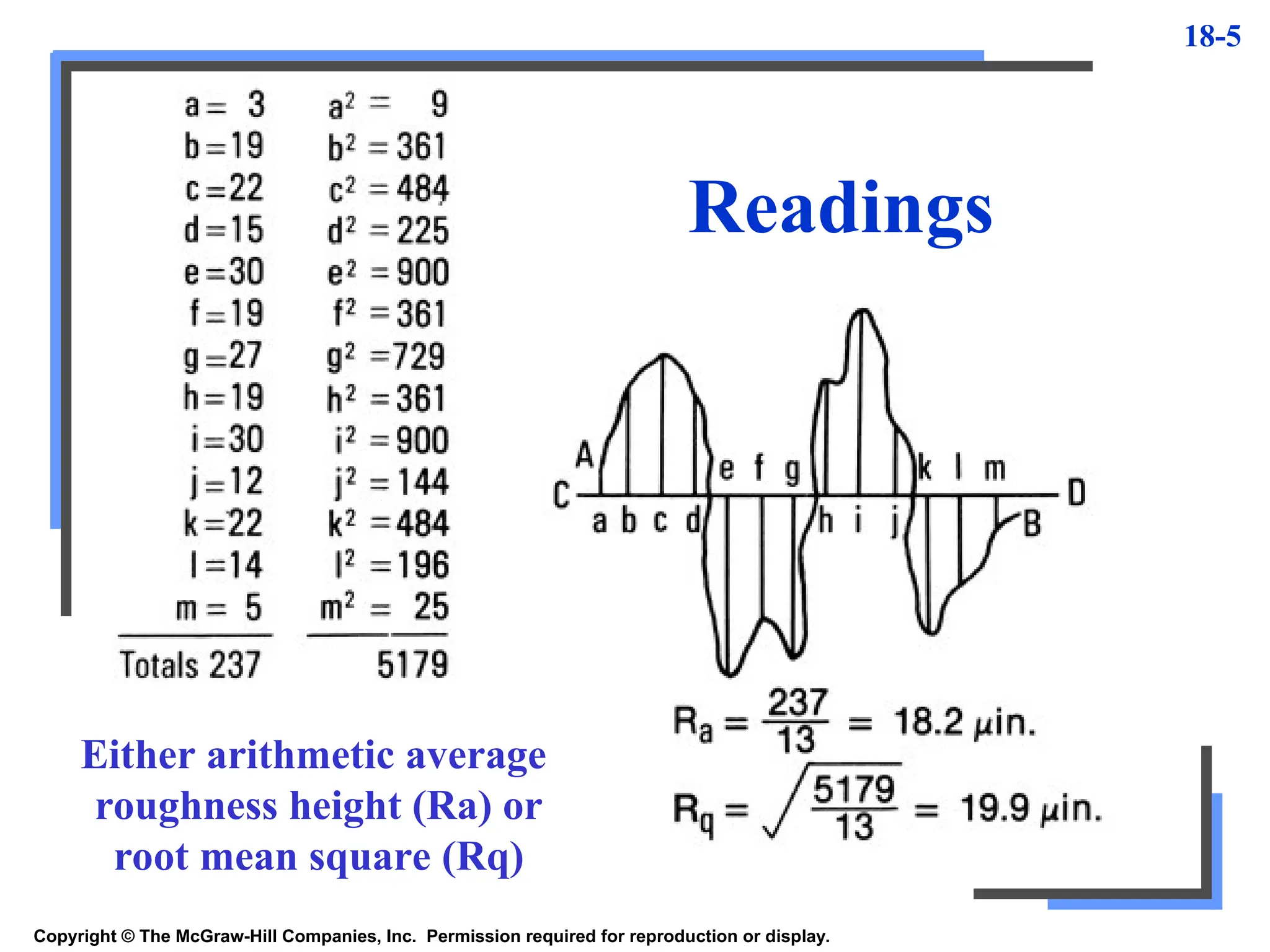
Readings
Either arithmetic average
roughness height (Ra) or
root mean square (Rq)
18-6
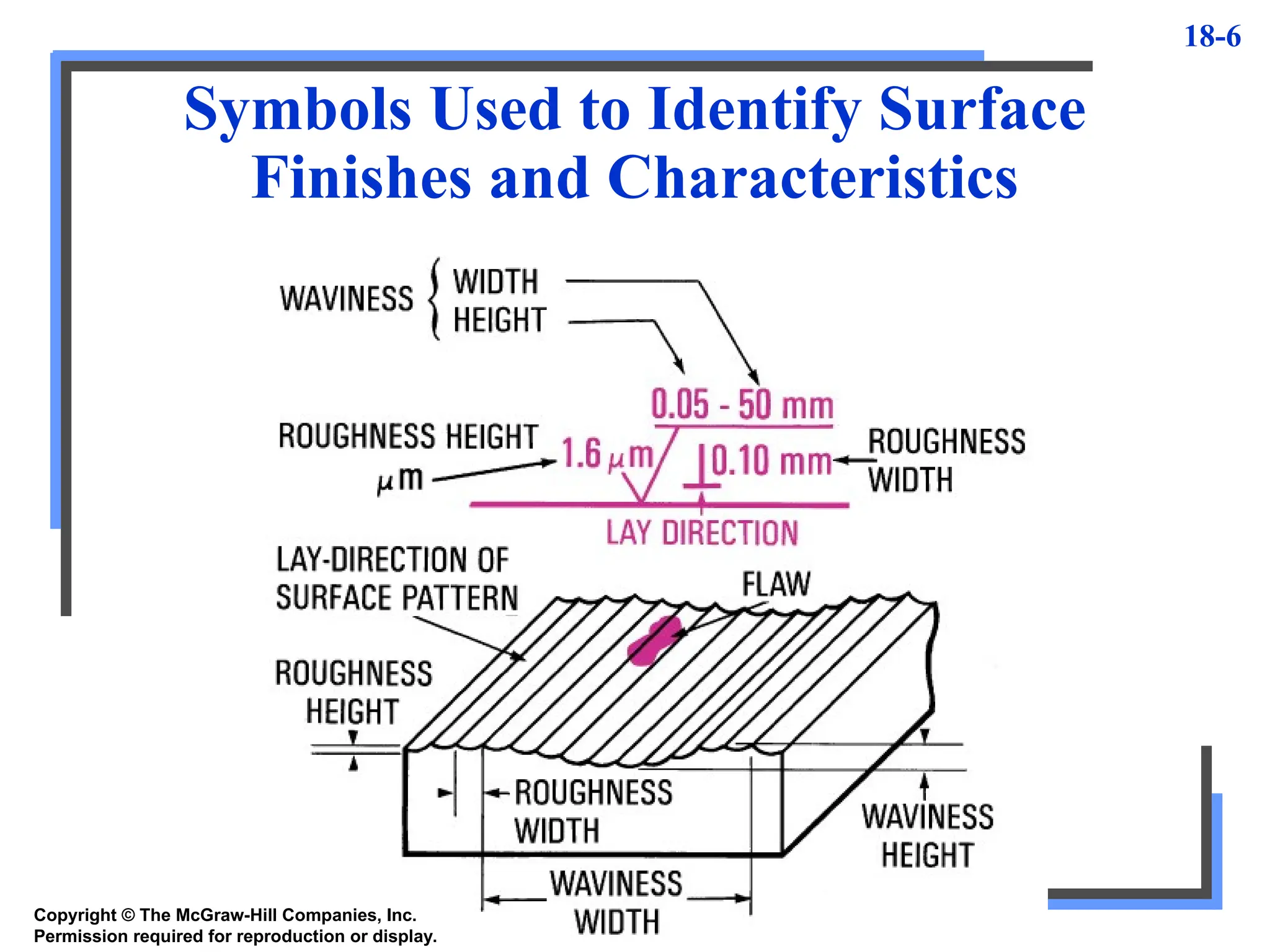
Symbols Used to Identify Surface
Finishes and Characteristics
Copyright © The McGraw-Hill Companies, Inc.
Permission required for reproduction or display.
18-7
Surface Finish Definitions
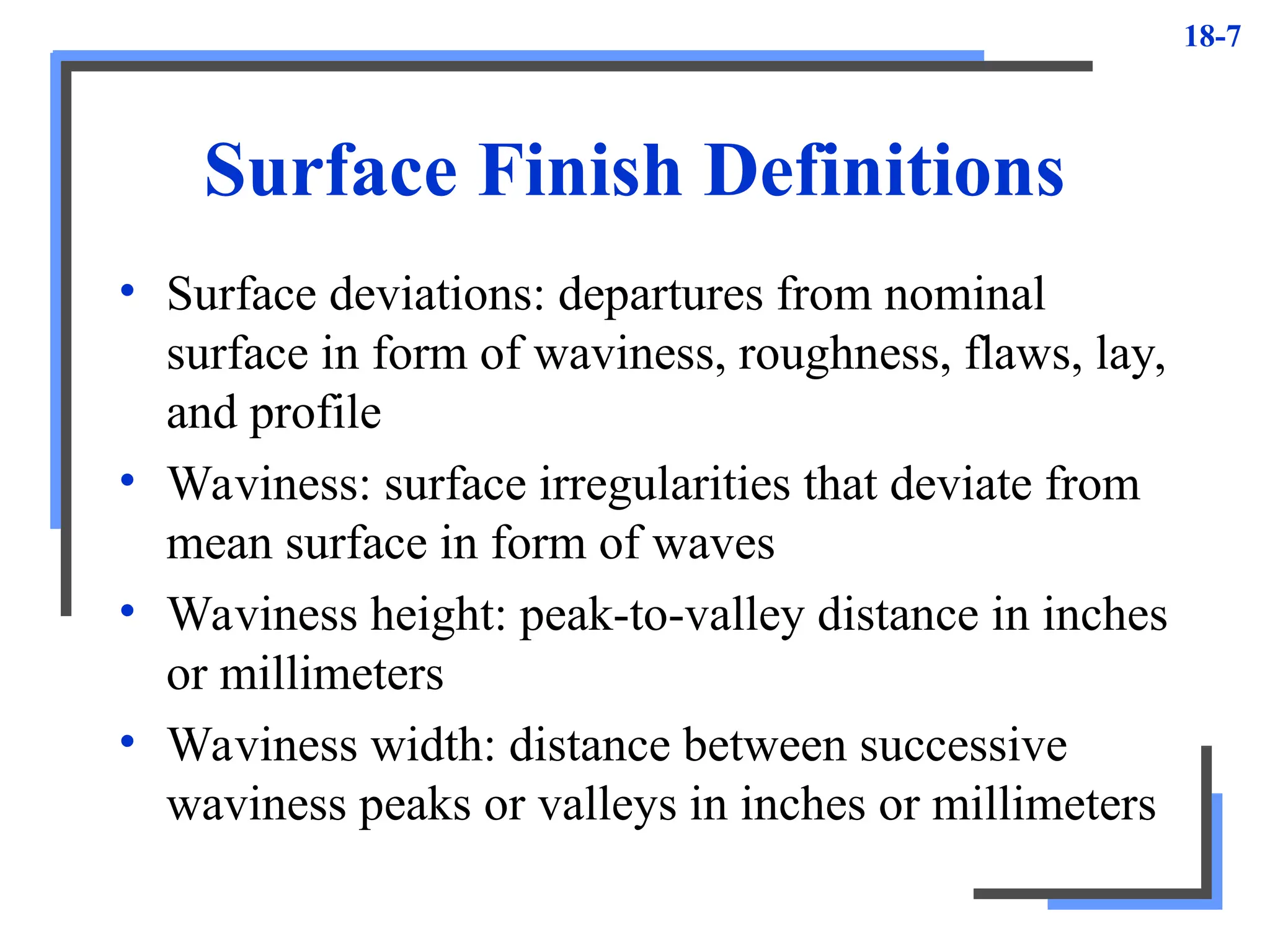
• Surface deviations: departures from nominal
surface in form of waviness, roughness, flaws, lay,
and profile
• Waviness: surface irregularities that deviate from
mean surface in form of waves
• Waviness height: peak-to-valley distance in inches
or millimeters
• Waviness width: distance between successive
waviness peaks or valleys in inches or millimeters
18-8
Surface Finish Definitions
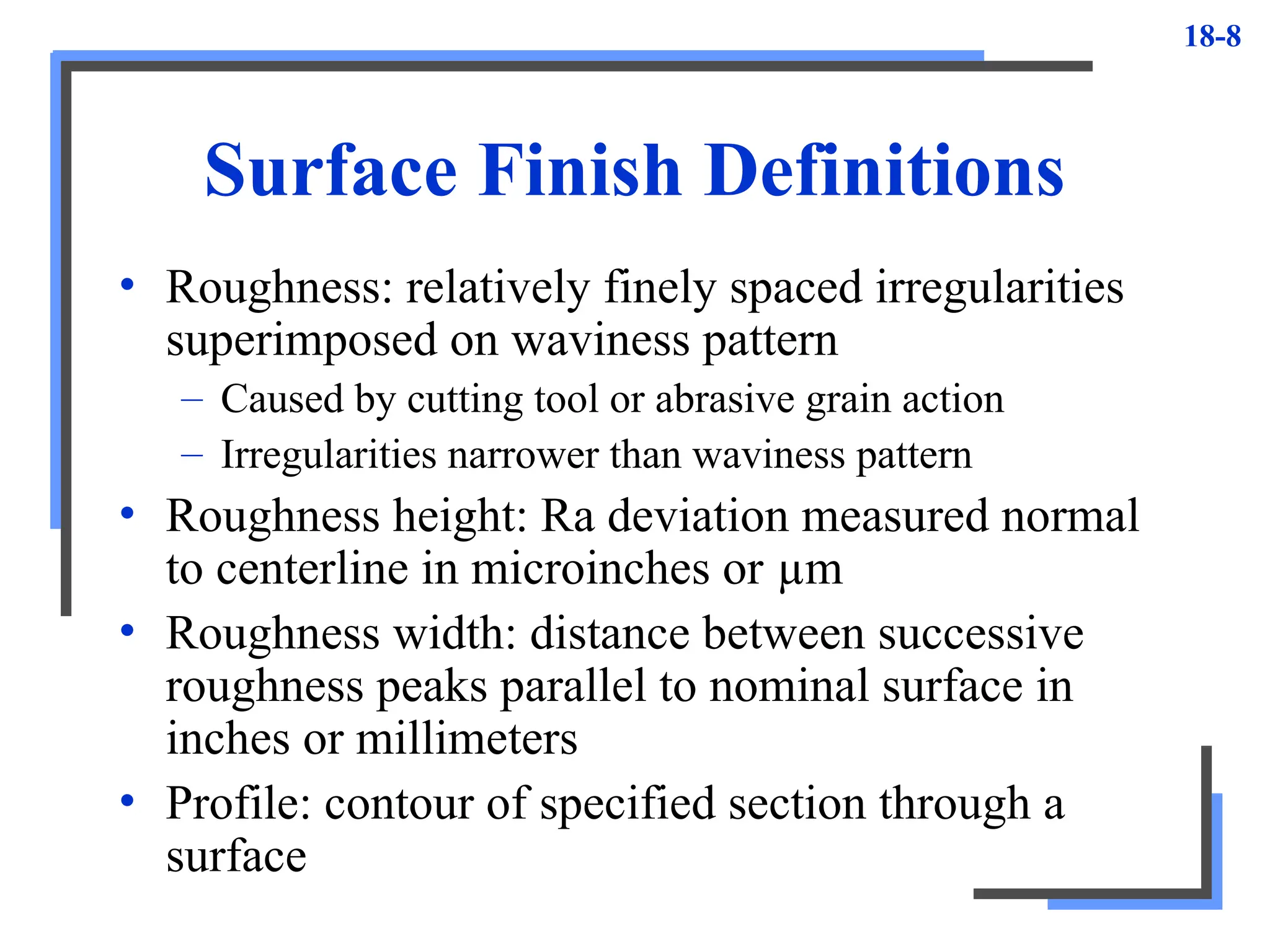
• Roughness: relatively finely spaced irregularities
superimposed on waviness pattern
– Caused by cutting tool or abrasive grain action
– Irregularities narrower than waviness pattern
• Roughness height: Ra deviation measured normal
to centerline in microinches or µm
• Roughness width: distance between successive
roughness peaks parallel to nominal surface in
inches or millimeters
• Profile: contour of specified section through a
surface
18-9
Surface Finish Definitions
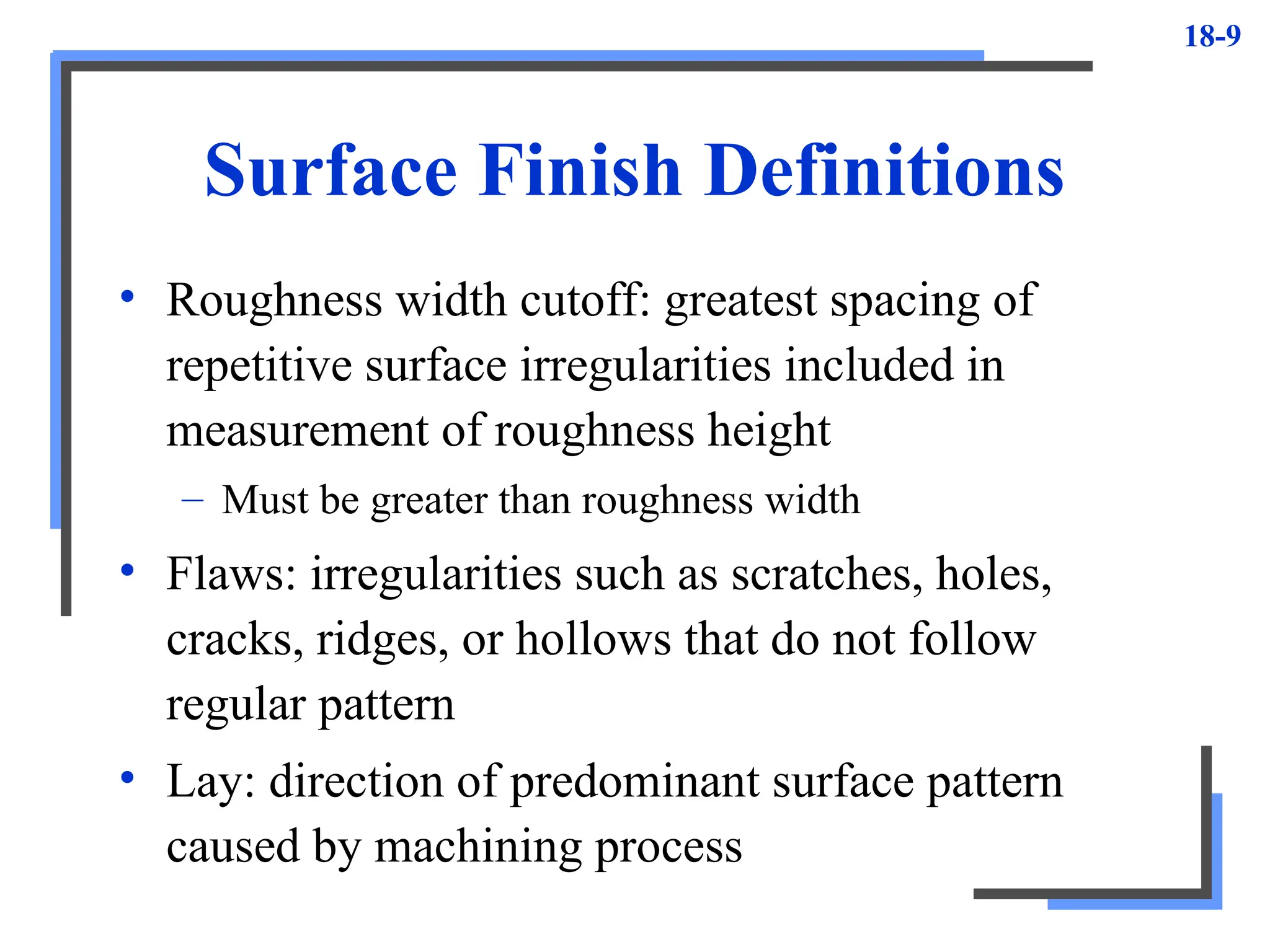
• Roughness width cutoff: greatest spacing of
repetitive surface irregularities included in
measurement of roughness height
– Must be greater than roughness width
• Flaws: irregularities such as scratches, holes,
cracks, ridges, or hollows that do not follow
regular pattern
• Lay: direction of predominant surface pattern
caused by machining process
18-10
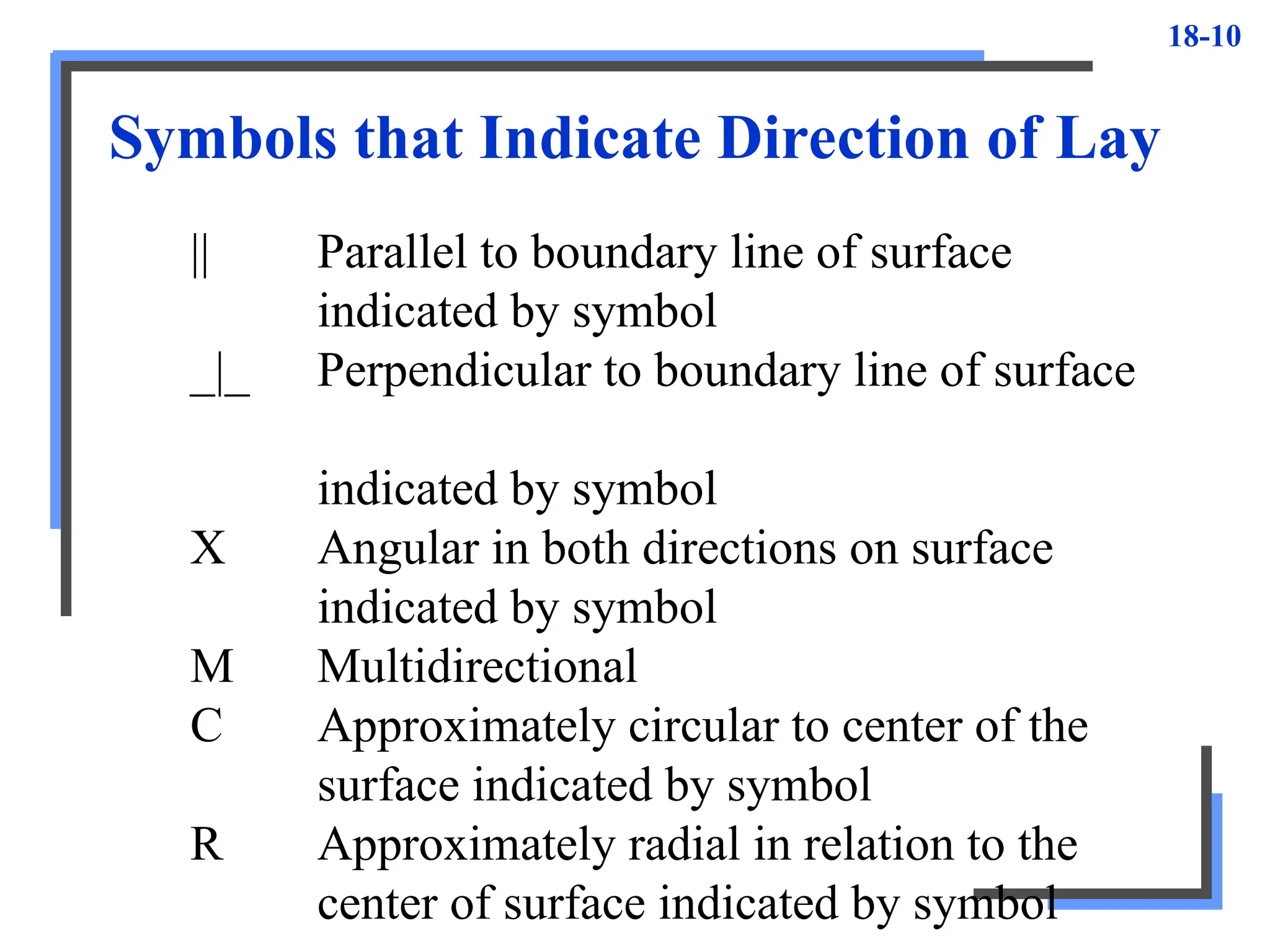
Symbols that Indicate Direction of Lay
|| Parallel to boundary line of surface
indicated by symbol
_|_ Perpendicular to boundary line of surface
indicated by symbol
X Angular in both directions on surface
indicated by symbol
M Multidirectional
C Approximately circular to center of the
surface indicated by symbol
R Approximately radial in relation to the
center of surface indicated by symbol
18-11
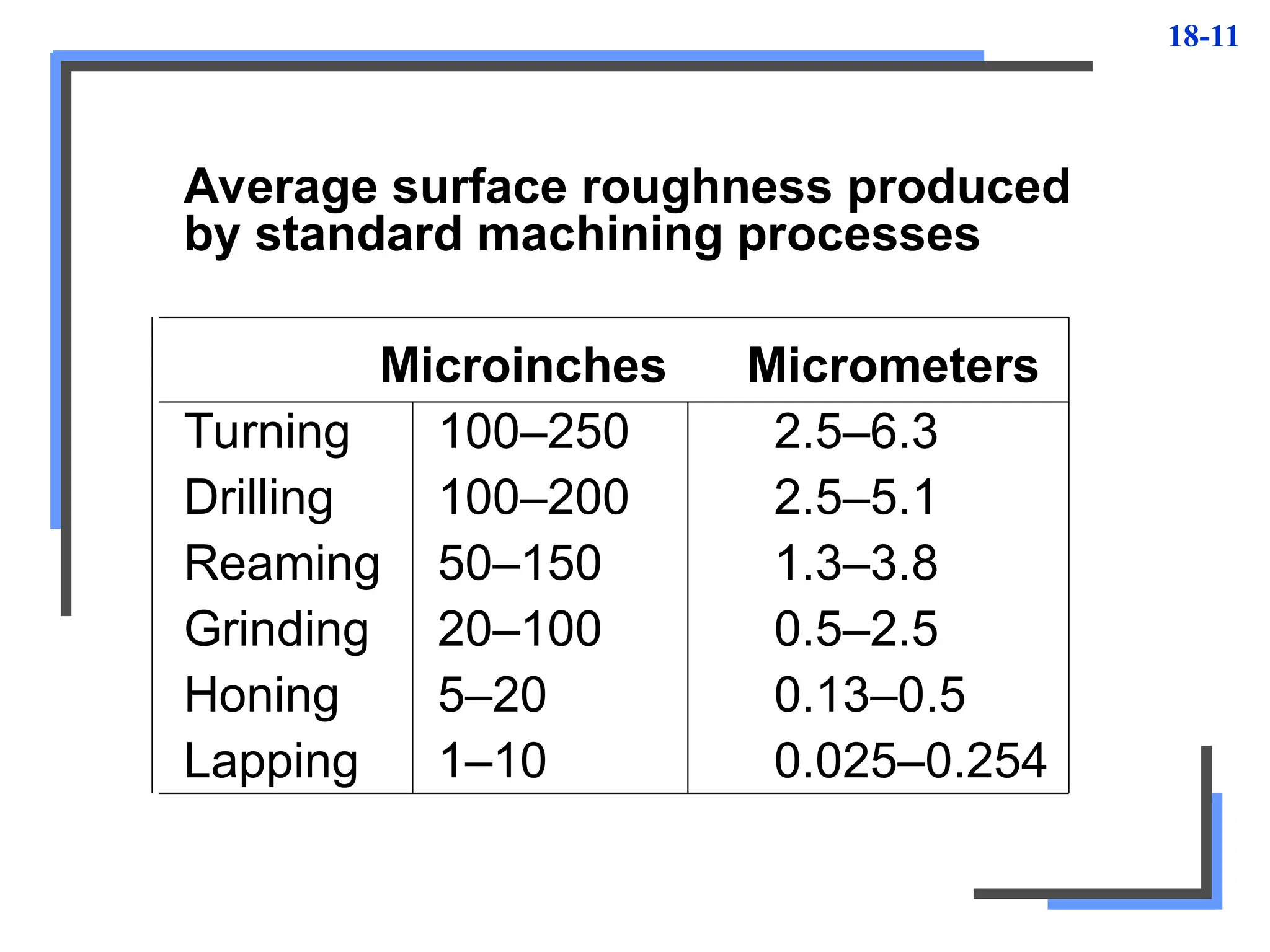
Average surface roughness produced
by standard machining processes
Microinches Micrometers
Turning 100–250 2.5–6.3
Drilling 100–200 2.5–5.1
Reaming 50–150 1.3–3.8
Grinding 20–100 0.5–2.5
Honing 5–20 0.13–0.5
Lapping 1–10 0.025–0.254
18-12
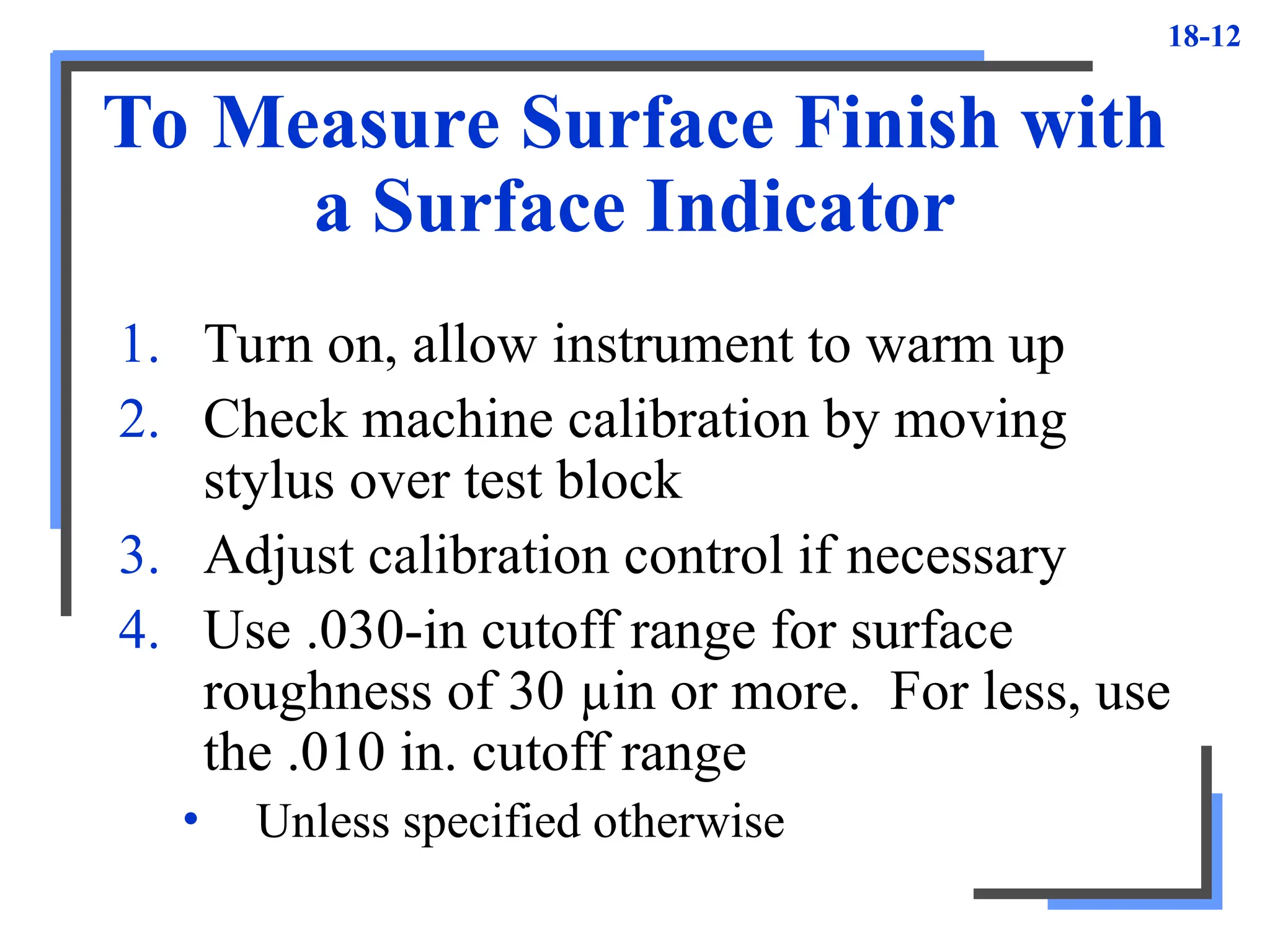
To Measure Surface Finish with
a Surface Indicator
1. Turn on, allow instrument to warm up
2. Check machine calibration by moving
stylus over test block
3. Adjust calibration control if necessary
4. Use .030-in cutoff range for surface
roughness of 30 µin or more. For less, use
the .010 in. cutoff range
• Unless specified otherwise
18-13
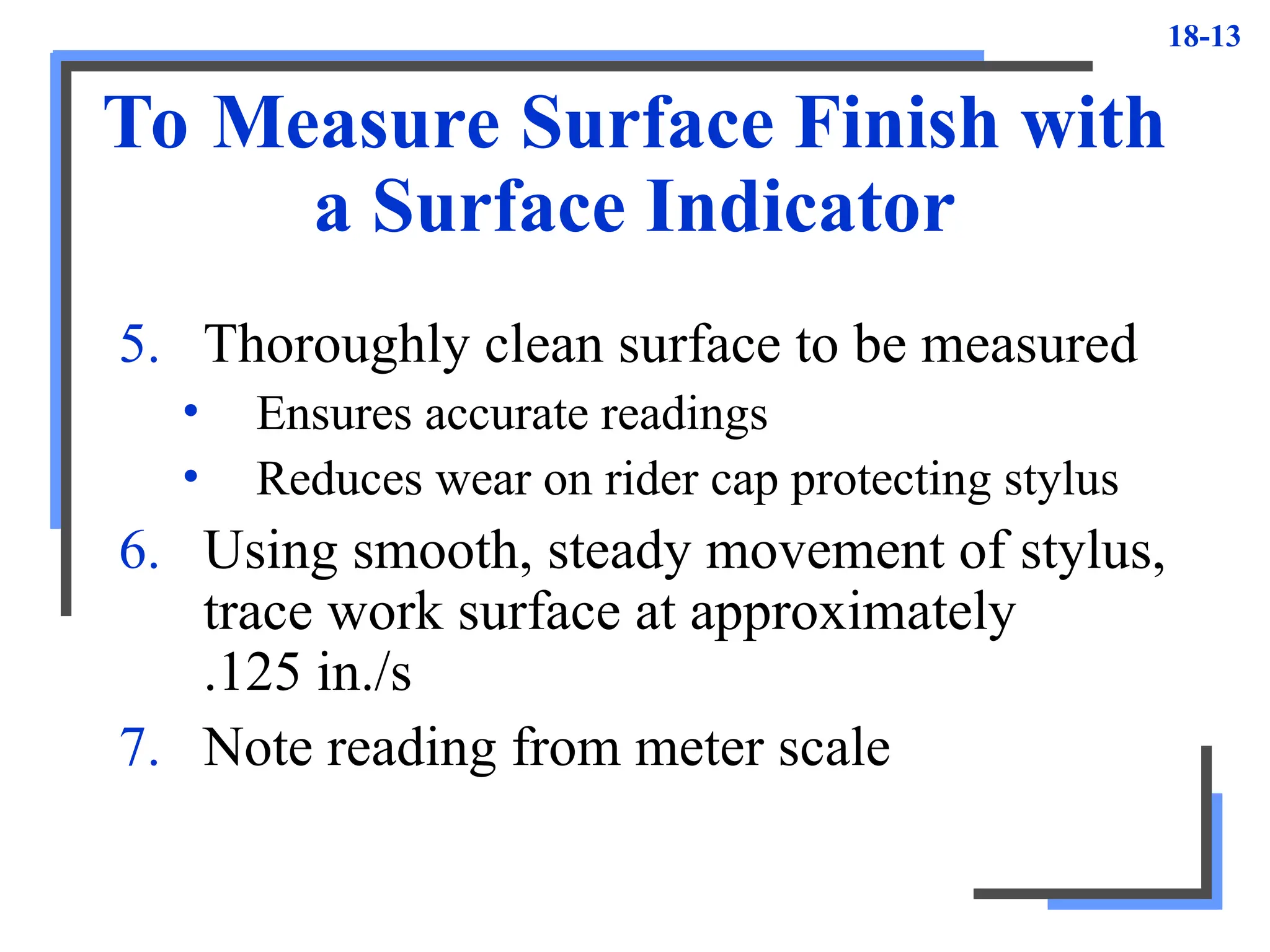
To Measure Surface Finish with
a Surface Indicator
5. Thoroughly clean surface to be measured
• Ensures accurate readings
• Reduces wear on rider cap protecting stylus
6. Using smooth, steady movement of stylus,
trace work surface at approximately
.125 in./s
7. Note reading from meter scale
18-14
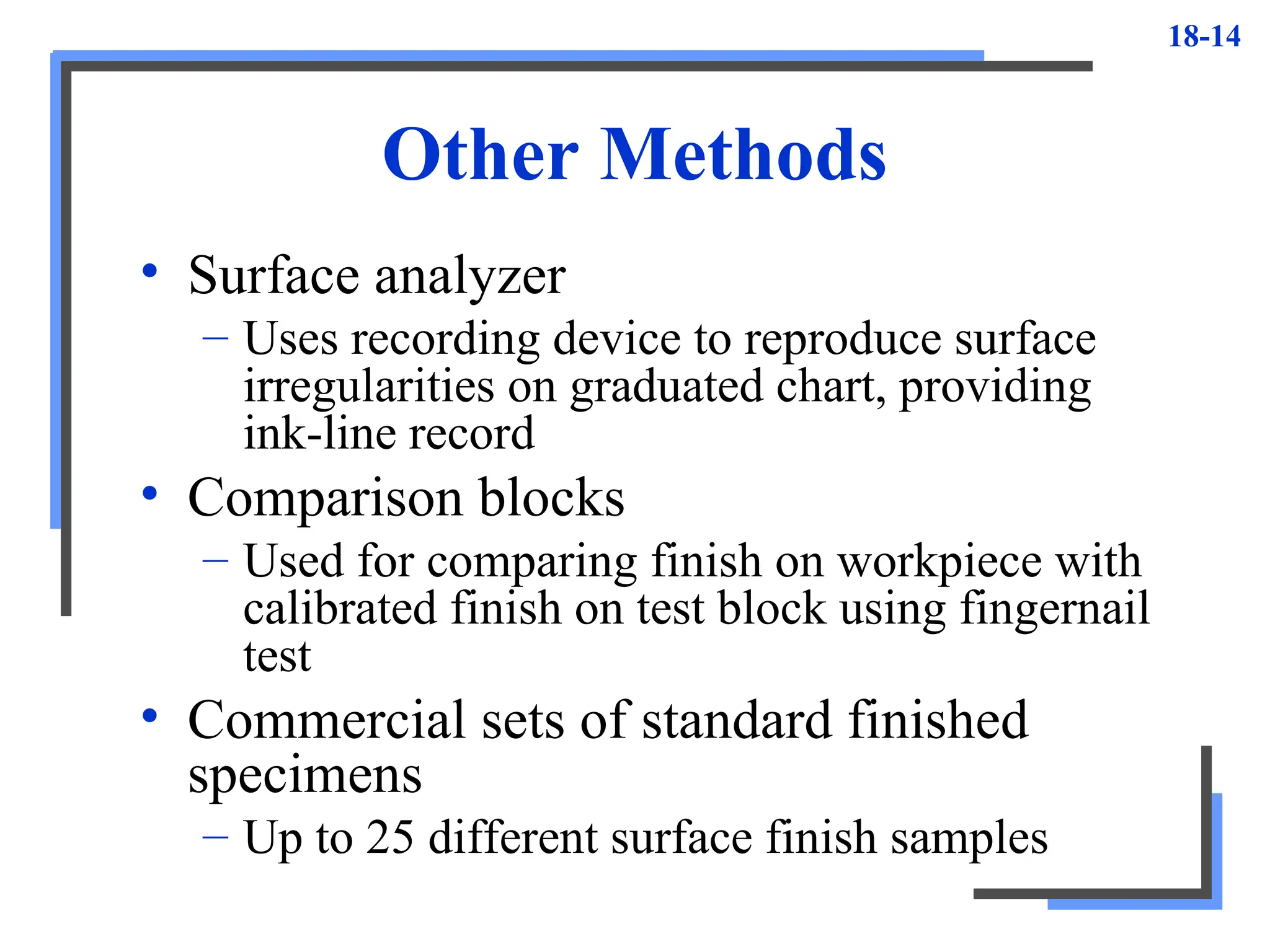
Other Methods
• Surface analyzer
– Uses recording device to reproduce surface
irregularities on graduated chart, providing
ink-line record
• Comparison blocks
– Used for comparing finish on workpiece with
calibrated finish on test block using fingernail
test
• Commercial sets of standard finished
specimens
– Up to 25 different surface finish samples
Section 18 Notes of Surface Finish and Measurement

  • 1.
    Copyright © TheMcGraw-Hill Companies, Inc. Permission required for reproduction or display. PowerPoint to accompany Krar • Gill • Smid Technology of Machine Tools 6th Edition Surface Finish Measurement Unit 18
  • 2.
    18-2 Objectives • Interpret thesurface finish symbols that appear on a drawing • Use a surface finish indicator to measure the surface finish of a part
  • 3.
    18-3 Surface Finish Measurement •Modern technology demanding improved surface finishes – Often require additional operations: lapping or honing • System of symbols devised by ASA – Provide standard system of determining and indicating surface finish – Inch unit is microinch (µin) – Metric unit is micrometer (µm)
  • 4.
    18-4 Surface Indicator Copyright ©The McGraw-Hill Companies, Inc. Permission required for reproduction or display. • Tracer head and amplifier • Tracer head has diamond stylus, point radius .0005 µin that bears against work surface • Movement caused by surface irregularities converted into electrical fluctuations • Signals magnified by amplifier and registered on meter • Reading indicates average height of surface
  • 5.
    18-5 Copyright © TheMcGraw-Hill Companies, Inc. Permission required for reproduction or display. Readings Either arithmetic average roughness height (Ra) or root mean square (Rq)
  • 6.
    18-6 Symbols Used toIdentify Surface Finishes and Characteristics Copyright © The McGraw-Hill Companies, Inc. Permission required for reproduction or display.
  • 7.
    18-7 Surface Finish Definitions •Surface deviations: departures from nominal surface in form of waviness, roughness, flaws, lay, and profile • Waviness: surface irregularities that deviate from mean surface in form of waves • Waviness height: peak-to-valley distance in inches or millimeters • Waviness width: distance between successive waviness peaks or valleys in inches or millimeters
  • 8.
    18-8 Surface Finish Definitions •Roughness: relatively finely spaced irregularities superimposed on waviness pattern – Caused by cutting tool or abrasive grain action – Irregularities narrower than waviness pattern • Roughness height: Ra deviation measured normal to centerline in microinches or µm • Roughness width: distance between successive roughness peaks parallel to nominal surface in inches or millimeters • Profile: contour of specified section through a surface
  • 9.
    18-9 Surface Finish Definitions •Roughness width cutoff: greatest spacing of repetitive surface irregularities included in measurement of roughness height – Must be greater than roughness width • Flaws: irregularities such as scratches, holes, cracks, ridges, or hollows that do not follow regular pattern • Lay: direction of predominant surface pattern caused by machining process
  • 10.
    18-10 Symbols that IndicateDirection of Lay || Parallel to boundary line of surface indicated by symbol _|_ Perpendicular to boundary line of surface indicated by symbol X Angular in both directions on surface indicated by symbol M Multidirectional C Approximately circular to center of the surface indicated by symbol R Approximately radial in relation to the center of surface indicated by symbol
  • 11.
    18-11 Average surface roughnessproduced by standard machining processes Microinches Micrometers Turning 100–250 2.5–6.3 Drilling 100–200 2.5–5.1 Reaming 50–150 1.3–3.8 Grinding 20–100 0.5–2.5 Honing 5–20 0.13–0.5 Lapping 1–10 0.025–0.254
  • 12.
    18-12 To Measure SurfaceFinish with a Surface Indicator 1. Turn on, allow instrument to warm up 2. Check machine calibration by moving stylus over test block 3. Adjust calibration control if necessary 4. Use .030-in cutoff range for surface roughness of 30 µin or more. For less, use the .010 in. cutoff range • Unless specified otherwise
  • 13.
    18-13 To Measure SurfaceFinish with a Surface Indicator 5. Thoroughly clean surface to be measured • Ensures accurate readings • Reduces wear on rider cap protecting stylus 6. Using smooth, steady movement of stylus, trace work surface at approximately .125 in./s 7. Note reading from meter scale
  • 14.
    18-14 Other Methods • Surfaceanalyzer – Uses recording device to reproduce surface irregularities on graduated chart, providing ink-line record • Comparison blocks – Used for comparing finish on workpiece with calibrated finish on test block using fingernail test • Commercial sets of standard finished specimens – Up to 25 different surface finish samples