Supraglottic Airway
Devices -
Laryngeal Mask Airway
Modarator :- Dr. Jasmitha Madam
Speaker :- Dr. Ganta Ranganath
1
Scope
• Introduction
• Types & classification
• How to use
• Care and cleaning
• Indications
• Complications
• Advantages
• Disadvantages
• Other Supraglottic airways
2
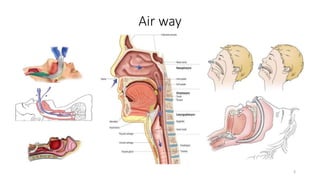
Air way
3
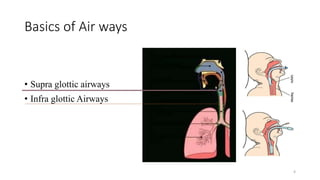
Basics of Air ways
• Supra glottic airways
• Infra glottic Airways
4
Introduction
• They have become standard fixture in airway management
• They fill the niche between face mask and tracheal tube.
• Both anatomical and degree of invasiveness
• They sit out side of trachea but provide hands free gas tight airway
5
Indications for LMA insertion
• Elective intubation
• Alternative to mask anesthesia, short elective procedures
• Relative indication for professional singers
• Difficult airway
• Essential drug cart item in both anticipated and non anticipated difficult airway
• Rescue device in both failed intubation and ventilation
• For those cant intubate and cant ventilate situation (CICV) requiring crico-thyroidoty
preparation
• Cardiac arrest
• AHA guidelines 2000 suggest LMA as an acceptable alternative to intubation in arrest
• Conduit for intubation
• Act as conduit for intubation with help of fibro-optic or bougie in failed intubation
• Bridge for Extubation
6
Contraindication for LMA insertion
• A patient with risk of aspiration
• Patients with upper airway obstruction
• Patients with restricted mouth opening
• Patients with disrupted airway
• Patients who are morbidly obese, pregnancy with more than 14 weeks,
drugs which delay gastric emptying such as opioids.
• Patients with reduced lung compliance
• Mnemonic RODS -Restrictive mouth opening, Obstruction upper
airway, Disruption in airway, Stiff lung
7
8
9
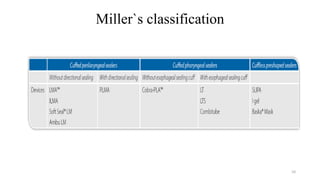
Miller`s classification
10
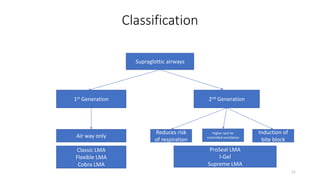
Classification
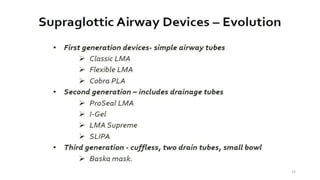
Supraglottic airways
1st Generation 2nd Generation
Air way only
Reduces risk
of respiration
Higher seal for
controlled ventilation
Induction of
bite block
Classic LMA
Flexible LMA
Cobra LMA
ProSeal LMA
I-Gel
Supreme LMA
11
12
Types
• LMA – Classic
• LMA – Unique
• LMA – Flexible
• LMA – Fastrach
• LMA – Ctrach
• LMA i-Gel
• LMA – ProSeal
• SLIPA
• Baska Mask
13
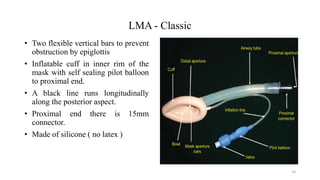
LMA - Classic
• Two flexible vertical bars to prevent
obstruction by epiglottis
• Inflatable cuff in inner rim of the
mask with self sealing pilot balloon
to proximal end.
• A black line runs longitudinally
along the posterior aspect.
• Proximal end there is 15mm
connector.
• Made of silicone ( no latex )
14
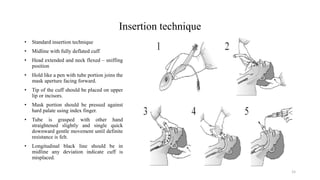
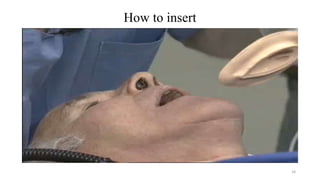
Insertion technique
• Standard insertion technique
• Midline with fully deflated cuff
• Head extended and neck flexed – sniffing
position
• Hold like a pen with tube portion joins the
mask aperture facing forward.
• Tip of the cuff should be placed on upper
lip or incisors.
• Mask portion should be pressed against
hard palate using index finger.
• Tube is grasped with other hand
straightened slightly and single quick
downward gentle movement until definite
resistance is felt.
• Longitudinal black line should be in
midline any deviation indicate cuff is
misplaced.
15
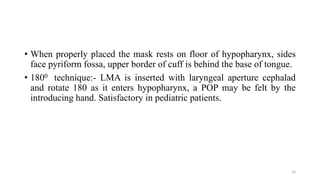
• When properly placed the mask rests on floor of hypopharynx, sides
face pyriform fossa, upper border of cuff is behind the base of tongue.
• 1800 technique:- LMA is inserted with laryngeal aperture cephalad
and rotate 180 as it enters hypopharynx, a POP may be felt by the
introducing hand. Satisfactory in pediatric patients.
16
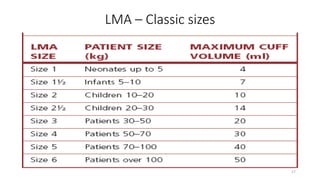
LMA – Classic sizes
17
How to insert
18
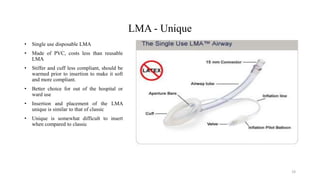
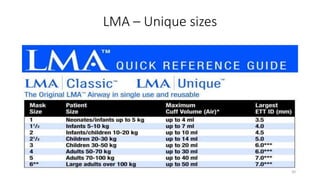
LMA - Unique
• Single use disposable LMA
• Made of PVC, costs less than reusable
LMA
• Stiffer and cuff less compliant, should be
warmed prior to insertion to make it soft
and more compliant.
• Better choice for out of the hospital or
ward use
• Insertion and placement of the LMA
unique is similar to that of classic
• Unique is somewhat difficult to insert
when compared to classic
19
LMA – Unique sizes
20
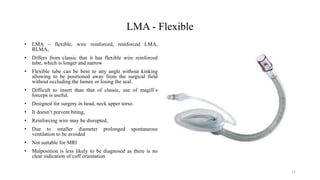
LMA - Flexible
• LMA – flexible, wire reinforced, reinforced LMA,
RLMA,
• Differs from classic that it has flexible wire reinforced
tube, which is longer and narrow
• Flexible tube can be bent to any angle without kinking
allowing to be positioned away from the surgical field
without occluding the lumen or losing the seal.
• Difficult to insert than that of classic, use of magill`s
forceps is useful.
• Designed for surgery in head, neck upper torso.
• It doesn’t prevent biting,
• Reinforcing wire may be disrupted,
• Due to smaller diameter prolonged spontaneous
ventilation to be avoided
• Not suitable for MRI
• Malposition is less likely to be diagnosed as there is no
clear indication of cuff orientation
21
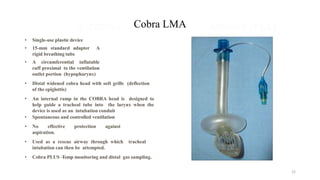
Cobra LMA
• Single-use plastic device
• 15-mm standard adapter A
rigid breathing tube
• A circumferential inflatable
cuff proximal to the ventilation
outlet portion (hypopharynx)
• Distal widened cobra head with soft grills (deflection
of the epiglottis)
• An internal ramp in the COBRA head is designed to
help guide a tracheal tube into the larynx when the
device is used as an intubation conduit
• Spontaneous and controlled ventilation
• No effective protection against
aspiration.
• Used as a rescue airway through which tracheal
intubation can then be attempted.
• Cobra PLUS –
Temp monitoring and distal gas sampling.
22
2nd Generation LMA
• LMA Fastrach
• LMA Ctrach
• LMA Supreme
• LMA ProSeal
• i-Gel
• SLIPA
23
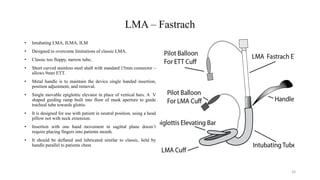
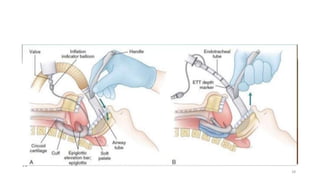
LMA – Fastrach
• Intubating LMA, ILMA, ILM
• Designed to overcome limitations of classic LMA.
• Classic too floppy, narrow tube,
• Short curved stainless steel shaft with standard 15mm connector –
allows 9mm ETT.
• Metal handle is to maintain the device single handed insertion,
position adjustment, and removal.
• Single movable epiglottic elevator in place of vertical bars. A V
shaped guiding ramp built into floor of mask aperture to guide
tracheal tube towards glottis.
• It is designed for use with patient in neutral position, using a head
pillow not with neck extension.
• Insertion with one hand movement in sagittal plane doesn’t
require placing fingers into patients mouth.
• It should be deflated and lubricated similar to classic, held by
handle parallel to patients chest.
24
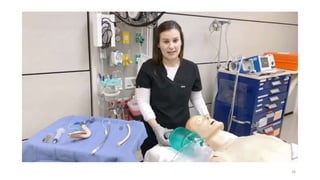
• Mask tip should be positioned against the hard palate immediately posterior
to upper incisors.
• Slide back and forth over the palate to distribute the lubricant.
• Inserted along the hard palate and posterior pharyngeal wall.
• Handle should not be used a lever.
• Curved part of the metal tube should be advanced without rotation until it
reaches the patients chin.
• After contacting with chin the devise is rotated inward.
• Here also handle should not be used as it may press the tongue.
• Tracheal tube recommended with use of this LMA is made of silicone, wire
reinforced cuffed with tapered end with blunt tip.
25
26
Chandy`s Maneuver
• It can improve lung ventilation and intubation.
• Step 1 includes the positioning of ILMA in such a way to maximize
the ventilation, done by holding the ILMA by handle and moving back
and forth in sagittal plane to observe tidal volume or Capnographic
wave form.
• If the patient is breathing spontaneously at the end of ILMA an airway
whistle can be attached and observe for maximum whistle.
• Step 2 facilitates the intubation by grasping the handle and forwarding
LMA by lifting action by 2-3 mm without levering on upper incisors.
27
28
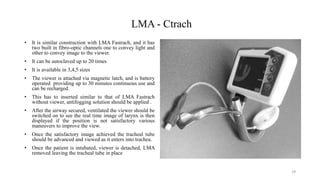
LMA - Ctrach
• It is similar construction with LMA Fastrach, and it has
two built in fibro-optic channels one to convey light and
other to convey image to the viewer.
• It can be autoclaved up to 20 times
• It is available in 3,4,5 sizes
• The viewer is attached via magnetic latch, and is battery
operated providing up to 30 minutes continuous use and
can be recharged.
• This has to inserted similar to that of LMA Fastrach
without viewer, antifogging solution should be applied .
• After the airway secured, ventilated the viewer should be
switched on to see the real time image of larynx is then
displayed if the position is not satisfactory various
maneuvers to improve the view.
• Once the satisfactory image achieved the tracheal tube
should be advanced and viewed as it enters into trachea.
• Once the patient is intubated, viewer is detached, LMA
removed leaving the tracheal tube in place
29
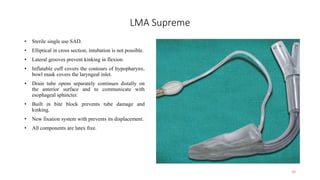
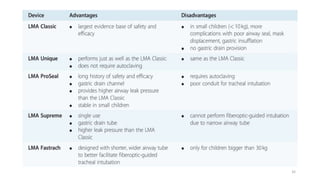
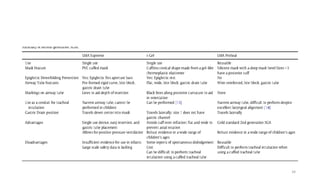
LMA Supreme
• Sterile single use SAD.
• Elliptical in cross section, intubation is not possible.
• Lateral grooves prevent kinking in flexion.
• Inflatable cuff covers the contours of hypopharynx,
bowl mask covers the laryngeal inlet.
• Drain tube opens separately continues distally on
the anterior surface and to communicate with
esophageal sphincter.
• Built in bite block prevents tube damage and
kinking.
• New fixation system with prevents its displacement.
• All components are latex free.
30
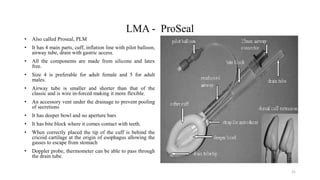
LMA - ProSeal
• Also called Proseal, PLM
• It has 4 main parts, cuff, inflation line with pilot balloon,
airway tube, drain with gastric access.
• All the components are made from silicone and latex
free.
• Size 4 is preferable for adult female and 5 for adult
males.
• Airway tube is smaller and shorter than that of the
classic and is wire in-forced making it more flexible.
• An accessory vent under the drainage to prevent pooling
of secretions
• It has deeper bowl and no aperture bars
• It has bite block where it comes contact with teeth.
• When correctly placed the tip of the cuff is behind the
cricoid cartilage at the origin of esophagus allowing the
gasses to escape from stomach
• Doppler probe, thermometer can be able to pass through
the drain tube.
31
32
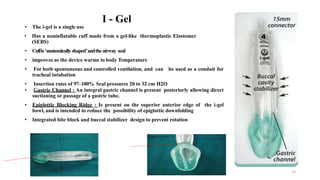
I - Gel
• The i-gel is a single use
• Has a noninflatable cuff made from a gel-like thermoplastic Elastomer
(SEBS)
• Cuffis‘anatomicallyshaped’andtheairway seal
• improves as the device warms to body Temperature
• For both spontaneous and controlled ventilation, and can be used as a conduit for
tracheal intubation
• Insertion rates of 97–100% Seal pressures 20 to 32 cm H2O
• Gastric Channel : An integral gastric channel is present posteriorly allowing direct
suctioning or passage of a gastric tube.
• Epiglottic Blocking Ridge : Is present on the superior anterior edge of the i-gel
bowl, and is intended to reduce the possibility of epiglottic downfolding
• Integrated bite block and buccal stabilizer design to prevent rotation
33
34
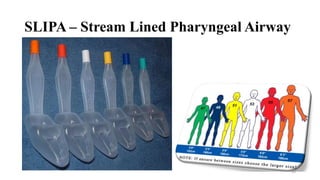
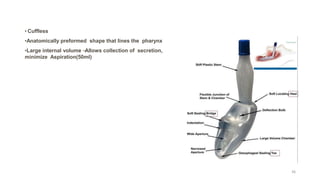
SLIPA – Stream Lined Pharyngeal Airway
35
• Cuffless
•Anatomically preformed shape that lines the pharynx
•Large internal volume –
Allows collection of secretion,
minimize Aspiration(50ml)
36
3rd Generation LMA
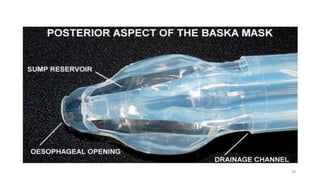
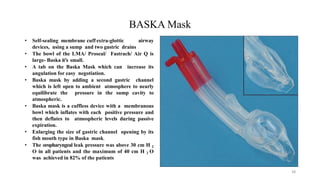
• BASKA Mask :- two drain tubes, cuff less, small bowl
37
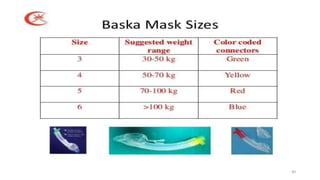
BASKA Mask
• Self-sealing membrane cuff extra-glottic airway
devices, using a sump and two gastric drains
• The bowl of the LMA/ Proseal/ Fastrach/ Air Q is
large- Baska it’s small.
• A tab on the Baska Mask which can increase its
angulation for easy negotiation.
• Baska mask by adding a second gastric channel
which is left open to ambient atmosphere to nearly
equilibrate the pressure in the sump cavity to
atmospheric.
• Baska mask is a cuffless device with a membranous
bowl which inflates with each positive pressure and
then deflates to atmospheric levels during passive
expiration.
• Enlarging the size of gastric channel opening by its
fish mouth type in Baska mask.
• The oropharyngeal leak pressure was above 30 cm H 2
O in all patients and the maximum of 40 cm H 2 O
was achieved in 82% of the patients
38
39
40
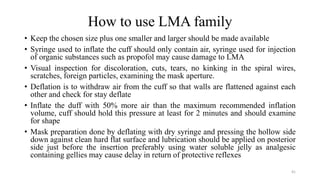
How to use LMA family
• Keep the chosen size plus one smaller and larger should be made available
• Syringe used to inflate the cuff should only contain air, syringe used for injection
of organic substances such as propofol may cause damage to LMA
• Visual inspection for discoloration, cuts, tears, no kinking in the spiral wires,
scratches, foreign particles, examining the mask aperture.
• Deflation is to withdraw air from the cuff so that walls are flattened against each
other and check for stay deflate
• Inflate the duff with 50% more air than the maximum recommended inflation
volume, cuff should hold this pressure at least for 2 minutes and should examine
for shape
• Mask preparation done by deflating with dry syringe and pressing the hollow side
down against clean hard flat surface and lubrication should be applied on posterior
side just before the insertion preferably using water soluble jelly as analgesic
containing gellies may cause delay in return of protective reflexes
41
• Insertion of LMA require adequate general or topical anesthesia to obtund
airway reflexes, absence of motor response to jaw thrust is a reliable
method for assessing adequacy on LMA insertion.
• Awake placement of LMA can be inserted by using topical anesthesia of
upper airway or nerve blocks. Mask insertion should be coordinated with
swallowing
• After placement cuff should be inflated to approximately to 60 cm of water,
cuff pressure gauge is recommended for proper inflation pressure. Cuff
pressure can be estimated by feeling the tension in pilot balloon, spherical
balloon indicates too much gas in the cuff
• Cuff should be inflated with out holding the tube for 3 to 5 seconds unless it
is unstable. This causes slight upward movement of airway tube and slight
bulging in front of neck, there should be oval swelling in the neck and no
cuff visible in the oral cavity
42
43
• Using greater than recommended volumes will not improve the seal against
larynx.
• Leak pressure of LMA should be greater than 20 cm of water with positive
pressure ventilation and in spontaneous ventilation it should be more than
10 cm of water.
• Indications for LMA proper positioning are normal breath sounds, chest
movements, pressure volume loops, co2 waveforms, if patient is breathing
spontaneously shows normal reservoir bag excursions and absence of
obstruction, fibro-optic endoscope
• If airway is obstructed due to incorrect mask position, downfolded
epiglottis, overinflated cuff need to remove and reinsert the LMA
• Bite block or roll gauze should be inserted into the mouth to prevent patient
from biting the tube and to improve stability.
• Oral airway should not be used as both are designed to be placed in the
midline
• LMA should be secured with tape taking care not to twist by affixing the
tape to maxilla winding over the cephalad and down around caudal side.
44
• Intra operatively airway patency, correct LMA orientation should be verified at
regular intervals, signs of abdomen distension and epigastric auscultation should
be done.
• N2O and CO2 can diffuse in to cuff causing rise of intracuff pressure may cause
airway obstruction. It can be avoided by inflating the cuff with N2O.
• Cuff pressure should be checked periodically, peak airway pressure should be kept
below 20 cm of H2O.
• Sudden increase in leakage, snoring and other often signals need for relaxant,
though other causes like displacement, lighter plane of anesthesia.
• Emergence of anesthesia it is important to keep bite block or roll gauze left in
place until the LMA is removed, it should be either removed with the patient in a
deep level of anesthesia or when full recovery of airway reflexes has occurred.
• LMA should not be removed in lighter planes, if cough and swallowing reflexes
are not present secretions in upper pharynx may flood in to larynx provoking
laryngospasm, gagging.
• LMA removal In deep anesthesia decrease incidence of coughing, breath holding,
bronchospasm.
Care and cleaning
• As soon as after the use the reusable LMA should be gently cleaned with warm
water dilute 8-10% sodium bicarbonate solution until all visible material is
removed..
• Inflation valve should not be exposed to any cleaning solution as it may cause
valve failure.
• Pipe cleaning brush to be used in case of LMA proseal to clean the drain tube.
• Water should not be allowed to enter the cuff, autoclaving water in the cuff causes
irreversible damage.
• LMA can be autoclaved at temperatures up to 1350 centigrade and higher
temperature can damage the LMA.
• LMA should be allowed to cool down to room temperature, as autoclaving impairs
bond between the connector and tube
• Liquid chemical agents such as glutaraldehyde, phenol based cleaners, iodine
containing compounds or quaternary compounds should not be used to clean or
sterilize LMA, they adsorbed into LMA cause pharyngitis, laryngitis and shorten
the life of LMA.
45
Life span
• With careful and strict adherence to cleaning and sterilization LMA
lasts about 40 for LMA Classic.
• Repeated use decrease in elasticity and increase in cuff permeability
• Dead space associated with LMA is less than that of face mask greater
than that of tracheal tube.
• EtCO2 measured in LMA is as accurate as tracheal tube.
• LMA offers less resistance than that of the tracheal tube and work of
breathing is similar to that of face mask.
46
Useful situations
• Difficult facemask
• Difficult or failed intubation
• Ophthalmic surgeries
• Tracheal procedures
• Endoscopy
• Transesophageal echocardiography
• Ventilatory support with out
intubation
• Head and neck procedures
• Pediatric patients
• Professional singers
• Remote anesthesia
• Supplementing regional block
• Resuscitation
• Laser surgery
• Neurosurgery
• Unstable cervical spine
• Extubation
47
Complications
• Aspiration of gastric contents
• Gastric distension
• Foreign body aspiration
• Airway obstruction
• Trauma
• Posterior spinal ligament rupture
• Dislodgement
• Devise issues
• Nerve injury
• Bronchospasm
• Pulmonary edema
48
Advantages of using LMA
• Ease of insertion
• Smooth awakening
• Low operating room pollution
• Avoiding complications of intubation
• Avoiding face mask complications
• Protection from barotrauma
• Cost effectiveness
49
Disadvantages of using LMA
• Unsuitable situations
• Less reliable airway
• Requirement of paralysis or obtunded airway reflexes
• Lost airway management skills
50
Other supraglottic airways
• Soft seal laryngeal mask
• Ambu laryngeal mask
• Intubating laryngeal airway
• Laryngeal tube airway
• Perilaryngeal airway
51
52

Supraglottic Airway Devices -.pptx

  • 1.
    Supraglottic Airway Devices - LaryngealMask Airway Modarator :- Dr. Jasmitha Madam Speaker :- Dr. Ganta Ranganath 1
  • 2.
    Scope • Introduction • Types& classification • How to use • Care and cleaning • Indications • Complications • Advantages • Disadvantages • Other Supraglottic airways 2
  • 3.
  • 4.
    Basics of Airways • Supra glottic airways • Infra glottic Airways 4
  • 5.
    Introduction • They havebecome standard fixture in airway management • They fill the niche between face mask and tracheal tube. • Both anatomical and degree of invasiveness • They sit out side of trachea but provide hands free gas tight airway 5
  • 6.
    Indications for LMAinsertion • Elective intubation • Alternative to mask anesthesia, short elective procedures • Relative indication for professional singers • Difficult airway • Essential drug cart item in both anticipated and non anticipated difficult airway • Rescue device in both failed intubation and ventilation • For those cant intubate and cant ventilate situation (CICV) requiring crico-thyroidoty preparation • Cardiac arrest • AHA guidelines 2000 suggest LMA as an acceptable alternative to intubation in arrest • Conduit for intubation • Act as conduit for intubation with help of fibro-optic or bougie in failed intubation • Bridge for Extubation 6
  • 7.
    Contraindication for LMAinsertion • A patient with risk of aspiration • Patients with upper airway obstruction • Patients with restricted mouth opening • Patients with disrupted airway • Patients who are morbidly obese, pregnancy with more than 14 weeks, drugs which delay gastric emptying such as opioids. • Patients with reduced lung compliance • Mnemonic RODS -Restrictive mouth opening, Obstruction upper airway, Disruption in airway, Stiff lung 7
  • 8.
  • 9.
  • 10.
  • 11.
    Classification Supraglottic airways 1st Generation2nd Generation Air way only Reduces risk of respiration Higher seal for controlled ventilation Induction of bite block Classic LMA Flexible LMA Cobra LMA ProSeal LMA I-Gel Supreme LMA 11
  • 12.
  • 13.
    Types • LMA –Classic • LMA – Unique • LMA – Flexible • LMA – Fastrach • LMA – Ctrach • LMA i-Gel • LMA – ProSeal • SLIPA • Baska Mask 13
  • 14.
    LMA - Classic •Two flexible vertical bars to prevent obstruction by epiglottis • Inflatable cuff in inner rim of the mask with self sealing pilot balloon to proximal end. • A black line runs longitudinally along the posterior aspect. • Proximal end there is 15mm connector. • Made of silicone ( no latex ) 14
  • 15.
    Insertion technique • Standardinsertion technique • Midline with fully deflated cuff • Head extended and neck flexed – sniffing position • Hold like a pen with tube portion joins the mask aperture facing forward. • Tip of the cuff should be placed on upper lip or incisors. • Mask portion should be pressed against hard palate using index finger. • Tube is grasped with other hand straightened slightly and single quick downward gentle movement until definite resistance is felt. • Longitudinal black line should be in midline any deviation indicate cuff is misplaced. 15
  • 16.
    • When properlyplaced the mask rests on floor of hypopharynx, sides face pyriform fossa, upper border of cuff is behind the base of tongue. • 1800 technique:- LMA is inserted with laryngeal aperture cephalad and rotate 180 as it enters hypopharynx, a POP may be felt by the introducing hand. Satisfactory in pediatric patients. 16
  • 17.
  • 18.
  • 19.
    LMA - Unique •Single use disposable LMA • Made of PVC, costs less than reusable LMA • Stiffer and cuff less compliant, should be warmed prior to insertion to make it soft and more compliant. • Better choice for out of the hospital or ward use • Insertion and placement of the LMA unique is similar to that of classic • Unique is somewhat difficult to insert when compared to classic 19
  • 20.
  • 21.
    LMA - Flexible •LMA – flexible, wire reinforced, reinforced LMA, RLMA, • Differs from classic that it has flexible wire reinforced tube, which is longer and narrow • Flexible tube can be bent to any angle without kinking allowing to be positioned away from the surgical field without occluding the lumen or losing the seal. • Difficult to insert than that of classic, use of magill`s forceps is useful. • Designed for surgery in head, neck upper torso. • It doesn’t prevent biting, • Reinforcing wire may be disrupted, • Due to smaller diameter prolonged spontaneous ventilation to be avoided • Not suitable for MRI • Malposition is less likely to be diagnosed as there is no clear indication of cuff orientation 21
  • 22.
    Cobra LMA • Single-useplastic device • 15-mm standard adapter A rigid breathing tube • A circumferential inflatable cuff proximal to the ventilation outlet portion (hypopharynx) • Distal widened cobra head with soft grills (deflection of the epiglottis) • An internal ramp in the COBRA head is designed to help guide a tracheal tube into the larynx when the device is used as an intubation conduit • Spontaneous and controlled ventilation • No effective protection against aspiration. • Used as a rescue airway through which tracheal intubation can then be attempted. • Cobra PLUS – Temp monitoring and distal gas sampling. 22
  • 23.
    2nd Generation LMA •LMA Fastrach • LMA Ctrach • LMA Supreme • LMA ProSeal • i-Gel • SLIPA 23
  • 24.
    LMA – Fastrach •Intubating LMA, ILMA, ILM • Designed to overcome limitations of classic LMA. • Classic too floppy, narrow tube, • Short curved stainless steel shaft with standard 15mm connector – allows 9mm ETT. • Metal handle is to maintain the device single handed insertion, position adjustment, and removal. • Single movable epiglottic elevator in place of vertical bars. A V shaped guiding ramp built into floor of mask aperture to guide tracheal tube towards glottis. • It is designed for use with patient in neutral position, using a head pillow not with neck extension. • Insertion with one hand movement in sagittal plane doesn’t require placing fingers into patients mouth. • It should be deflated and lubricated similar to classic, held by handle parallel to patients chest. 24
  • 25.
    • Mask tipshould be positioned against the hard palate immediately posterior to upper incisors. • Slide back and forth over the palate to distribute the lubricant. • Inserted along the hard palate and posterior pharyngeal wall. • Handle should not be used a lever. • Curved part of the metal tube should be advanced without rotation until it reaches the patients chin. • After contacting with chin the devise is rotated inward. • Here also handle should not be used as it may press the tongue. • Tracheal tube recommended with use of this LMA is made of silicone, wire reinforced cuffed with tapered end with blunt tip. 25
  • 26.
  • 27.
    Chandy`s Maneuver • Itcan improve lung ventilation and intubation. • Step 1 includes the positioning of ILMA in such a way to maximize the ventilation, done by holding the ILMA by handle and moving back and forth in sagittal plane to observe tidal volume or Capnographic wave form. • If the patient is breathing spontaneously at the end of ILMA an airway whistle can be attached and observe for maximum whistle. • Step 2 facilitates the intubation by grasping the handle and forwarding LMA by lifting action by 2-3 mm without levering on upper incisors. 27
  • 28.
  • 29.
    LMA - Ctrach •It is similar construction with LMA Fastrach, and it has two built in fibro-optic channels one to convey light and other to convey image to the viewer. • It can be autoclaved up to 20 times • It is available in 3,4,5 sizes • The viewer is attached via magnetic latch, and is battery operated providing up to 30 minutes continuous use and can be recharged. • This has to inserted similar to that of LMA Fastrach without viewer, antifogging solution should be applied . • After the airway secured, ventilated the viewer should be switched on to see the real time image of larynx is then displayed if the position is not satisfactory various maneuvers to improve the view. • Once the satisfactory image achieved the tracheal tube should be advanced and viewed as it enters into trachea. • Once the patient is intubated, viewer is detached, LMA removed leaving the tracheal tube in place 29
  • 30.
    LMA Supreme • Sterilesingle use SAD. • Elliptical in cross section, intubation is not possible. • Lateral grooves prevent kinking in flexion. • Inflatable cuff covers the contours of hypopharynx, bowl mask covers the laryngeal inlet. • Drain tube opens separately continues distally on the anterior surface and to communicate with esophageal sphincter. • Built in bite block prevents tube damage and kinking. • New fixation system with prevents its displacement. • All components are latex free. 30
  • 31.
    LMA - ProSeal •Also called Proseal, PLM • It has 4 main parts, cuff, inflation line with pilot balloon, airway tube, drain with gastric access. • All the components are made from silicone and latex free. • Size 4 is preferable for adult female and 5 for adult males. • Airway tube is smaller and shorter than that of the classic and is wire in-forced making it more flexible. • An accessory vent under the drainage to prevent pooling of secretions • It has deeper bowl and no aperture bars • It has bite block where it comes contact with teeth. • When correctly placed the tip of the cuff is behind the cricoid cartilage at the origin of esophagus allowing the gasses to escape from stomach • Doppler probe, thermometer can be able to pass through the drain tube. 31
  • 32.
  • 33.
    I - Gel •The i-gel is a single use • Has a noninflatable cuff made from a gel-like thermoplastic Elastomer (SEBS) • Cuffis‘anatomicallyshaped’andtheairway seal • improves as the device warms to body Temperature • For both spontaneous and controlled ventilation, and can be used as a conduit for tracheal intubation • Insertion rates of 97–100% Seal pressures 20 to 32 cm H2O • Gastric Channel : An integral gastric channel is present posteriorly allowing direct suctioning or passage of a gastric tube. • Epiglottic Blocking Ridge : Is present on the superior anterior edge of the i-gel bowl, and is intended to reduce the possibility of epiglottic downfolding • Integrated bite block and buccal stabilizer design to prevent rotation 33
  • 34.
  • 35.
    SLIPA – StreamLined Pharyngeal Airway 35
  • 36.
    • Cuffless •Anatomically preformedshape that lines the pharynx •Large internal volume – Allows collection of secretion, minimize Aspiration(50ml) 36
  • 37.
    3rd Generation LMA •BASKA Mask :- two drain tubes, cuff less, small bowl 37
  • 38.
    BASKA Mask • Self-sealingmembrane cuff extra-glottic airway devices, using a sump and two gastric drains • The bowl of the LMA/ Proseal/ Fastrach/ Air Q is large- Baska it’s small. • A tab on the Baska Mask which can increase its angulation for easy negotiation. • Baska mask by adding a second gastric channel which is left open to ambient atmosphere to nearly equilibrate the pressure in the sump cavity to atmospheric. • Baska mask is a cuffless device with a membranous bowl which inflates with each positive pressure and then deflates to atmospheric levels during passive expiration. • Enlarging the size of gastric channel opening by its fish mouth type in Baska mask. • The oropharyngeal leak pressure was above 30 cm H 2 O in all patients and the maximum of 40 cm H 2 O was achieved in 82% of the patients 38
  • 39.
  • 40.
  • 41.
    How to useLMA family • Keep the chosen size plus one smaller and larger should be made available • Syringe used to inflate the cuff should only contain air, syringe used for injection of organic substances such as propofol may cause damage to LMA • Visual inspection for discoloration, cuts, tears, no kinking in the spiral wires, scratches, foreign particles, examining the mask aperture. • Deflation is to withdraw air from the cuff so that walls are flattened against each other and check for stay deflate • Inflate the duff with 50% more air than the maximum recommended inflation volume, cuff should hold this pressure at least for 2 minutes and should examine for shape • Mask preparation done by deflating with dry syringe and pressing the hollow side down against clean hard flat surface and lubrication should be applied on posterior side just before the insertion preferably using water soluble jelly as analgesic containing gellies may cause delay in return of protective reflexes 41
  • 42.
    • Insertion ofLMA require adequate general or topical anesthesia to obtund airway reflexes, absence of motor response to jaw thrust is a reliable method for assessing adequacy on LMA insertion. • Awake placement of LMA can be inserted by using topical anesthesia of upper airway or nerve blocks. Mask insertion should be coordinated with swallowing • After placement cuff should be inflated to approximately to 60 cm of water, cuff pressure gauge is recommended for proper inflation pressure. Cuff pressure can be estimated by feeling the tension in pilot balloon, spherical balloon indicates too much gas in the cuff • Cuff should be inflated with out holding the tube for 3 to 5 seconds unless it is unstable. This causes slight upward movement of airway tube and slight bulging in front of neck, there should be oval swelling in the neck and no cuff visible in the oral cavity 42
  • 43.
    43 • Using greaterthan recommended volumes will not improve the seal against larynx. • Leak pressure of LMA should be greater than 20 cm of water with positive pressure ventilation and in spontaneous ventilation it should be more than 10 cm of water. • Indications for LMA proper positioning are normal breath sounds, chest movements, pressure volume loops, co2 waveforms, if patient is breathing spontaneously shows normal reservoir bag excursions and absence of obstruction, fibro-optic endoscope • If airway is obstructed due to incorrect mask position, downfolded epiglottis, overinflated cuff need to remove and reinsert the LMA • Bite block or roll gauze should be inserted into the mouth to prevent patient from biting the tube and to improve stability. • Oral airway should not be used as both are designed to be placed in the midline • LMA should be secured with tape taking care not to twist by affixing the tape to maxilla winding over the cephalad and down around caudal side.
  • 44.
    44 • Intra operativelyairway patency, correct LMA orientation should be verified at regular intervals, signs of abdomen distension and epigastric auscultation should be done. • N2O and CO2 can diffuse in to cuff causing rise of intracuff pressure may cause airway obstruction. It can be avoided by inflating the cuff with N2O. • Cuff pressure should be checked periodically, peak airway pressure should be kept below 20 cm of H2O. • Sudden increase in leakage, snoring and other often signals need for relaxant, though other causes like displacement, lighter plane of anesthesia. • Emergence of anesthesia it is important to keep bite block or roll gauze left in place until the LMA is removed, it should be either removed with the patient in a deep level of anesthesia or when full recovery of airway reflexes has occurred. • LMA should not be removed in lighter planes, if cough and swallowing reflexes are not present secretions in upper pharynx may flood in to larynx provoking laryngospasm, gagging. • LMA removal In deep anesthesia decrease incidence of coughing, breath holding, bronchospasm.
  • 45.
    Care and cleaning •As soon as after the use the reusable LMA should be gently cleaned with warm water dilute 8-10% sodium bicarbonate solution until all visible material is removed.. • Inflation valve should not be exposed to any cleaning solution as it may cause valve failure. • Pipe cleaning brush to be used in case of LMA proseal to clean the drain tube. • Water should not be allowed to enter the cuff, autoclaving water in the cuff causes irreversible damage. • LMA can be autoclaved at temperatures up to 1350 centigrade and higher temperature can damage the LMA. • LMA should be allowed to cool down to room temperature, as autoclaving impairs bond between the connector and tube • Liquid chemical agents such as glutaraldehyde, phenol based cleaners, iodine containing compounds or quaternary compounds should not be used to clean or sterilize LMA, they adsorbed into LMA cause pharyngitis, laryngitis and shorten the life of LMA. 45
  • 46.
    Life span • Withcareful and strict adherence to cleaning and sterilization LMA lasts about 40 for LMA Classic. • Repeated use decrease in elasticity and increase in cuff permeability • Dead space associated with LMA is less than that of face mask greater than that of tracheal tube. • EtCO2 measured in LMA is as accurate as tracheal tube. • LMA offers less resistance than that of the tracheal tube and work of breathing is similar to that of face mask. 46
  • 47.
    Useful situations • Difficultfacemask • Difficult or failed intubation • Ophthalmic surgeries • Tracheal procedures • Endoscopy • Transesophageal echocardiography • Ventilatory support with out intubation • Head and neck procedures • Pediatric patients • Professional singers • Remote anesthesia • Supplementing regional block • Resuscitation • Laser surgery • Neurosurgery • Unstable cervical spine • Extubation 47
  • 48.
    Complications • Aspiration ofgastric contents • Gastric distension • Foreign body aspiration • Airway obstruction • Trauma • Posterior spinal ligament rupture • Dislodgement • Devise issues • Nerve injury • Bronchospasm • Pulmonary edema 48
  • 49.
    Advantages of usingLMA • Ease of insertion • Smooth awakening • Low operating room pollution • Avoiding complications of intubation • Avoiding face mask complications • Protection from barotrauma • Cost effectiveness 49
  • 50.
    Disadvantages of usingLMA • Unsuitable situations • Less reliable airway • Requirement of paralysis or obtunded airway reflexes • Lost airway management skills 50
  • 51.
    Other supraglottic airways •Soft seal laryngeal mask • Ambu laryngeal mask • Intubating laryngeal airway • Laryngeal tube airway • Perilaryngeal airway 51
  • 52.