Presenter : Dr.Kumar
Moderator: Dr.
Chaitanya
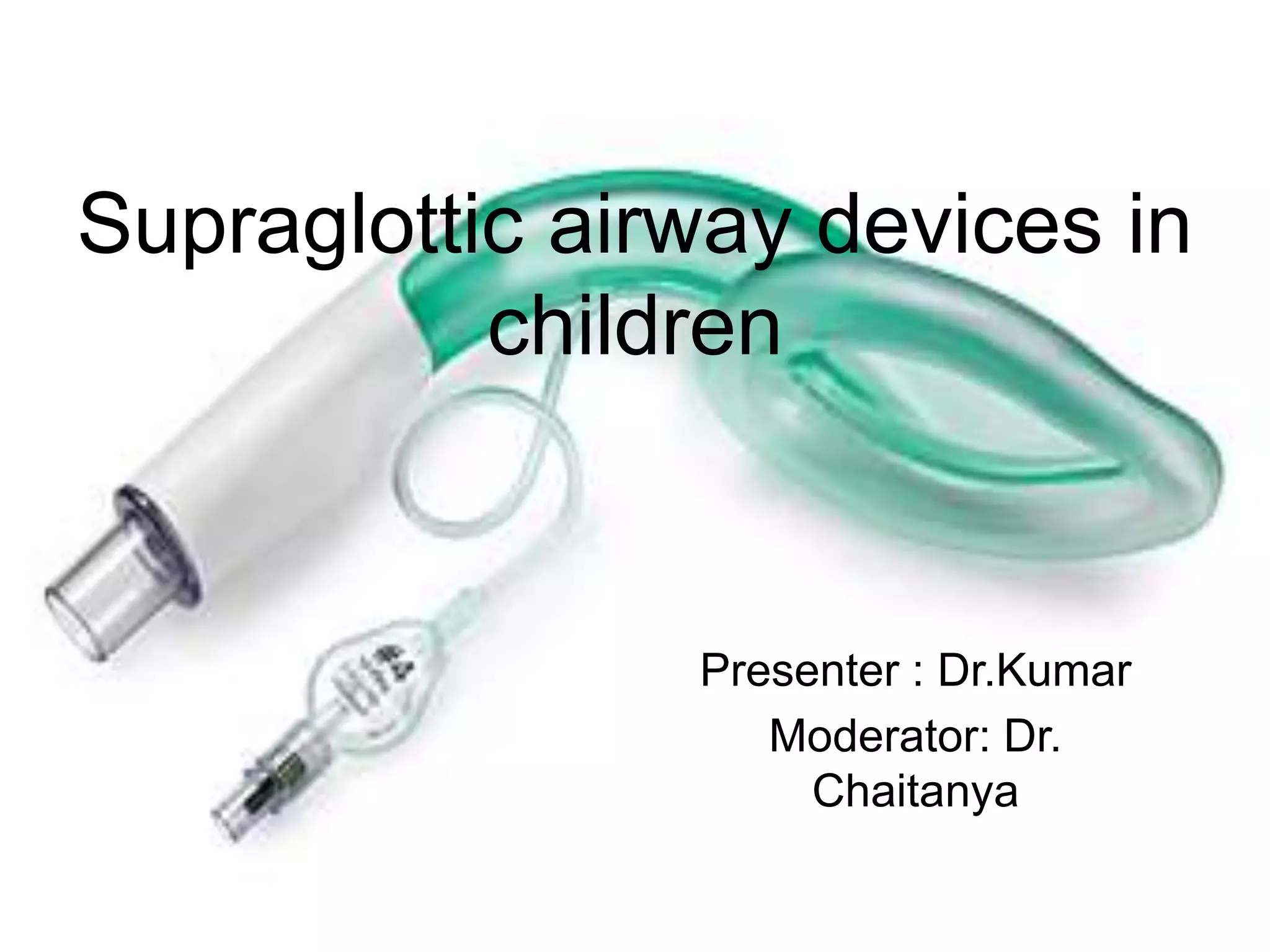
Supraglottic airway devices in
children
History
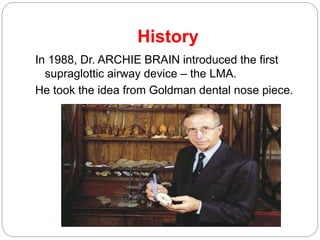
In 1988, Dr. ARCHIE BRAIN introduced the first
supraglottic airway device – the LMA.
He took the idea from Goldman dental nose piece.
Definition
 Supraglottic airway management devices
comprise a family of medical devices that
facilitate oxygenation and ventilation without
endotracheal intubation.
 The word “supraglottic” means “above the glottis”
or “above the larynx”.
 Some of the authors refer to these products as
“extraglottic” devices.
 “Supraglottic airway” is a generic description for
devices that facilitate ventilation and oxygenation
with devices that do not penetrate the vocal
cords.
CLASSIFICATION FOR SUPRAGLOTTIC
AIRWAYS
BASED ON SEALING MECHANISMS
 Perilaryngeal sealers:The LMA family,
i-gel and air-Q Intubating Laryngeal Airway
(airQ ILA)
 Pharyngeal sealers: Combitube,the
Streamlined Liner of the Pharynx Airway (SLIPA),
Laryngeal Tube
 Both:The Cobra PerilaryngealAirway (CobraPLA)
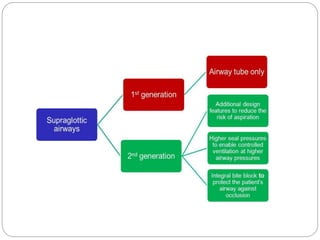
CLASSIFICATION OF SUPRAGLOTTIC
AIRWAY
BASED ON EVOLUTION
 First-generation devices: Simple airway tubes
1. The laryngeal mask airway [classic LMA (cLMA)],
2. flexible LMA (fLMA),
3. unique LMA (ULMA) and
4. The Cobra Perilaryngeal Airway (CobraPLA)
 Second-generation devices: With addition of
Drainage tube
1. Proseal LMA (PLMA),
2. i-gel, Laryngeal tube,
3. LMA Supreme,
4. Streamlined Liner of the Pharyngeal Airway
INDICATIONS
1-) Supraglottic devices have been recommended as
rescue airways in CVCI scenario.
2-) Procedures outside the operating room-
-Radiology and MRI
- Radiation Therapy
- Diagnostic and short therapeutic procedures in
children
- Cardiology
3-) Head and Neck surgeries
4-) Pulmonary medicine and Thoracic surgeries
- Bronchoscopy
- Laser surgery of the trachea
- Tracheobronchial stent placement
5-) Neurosurgery
CONTRAINDICATIONS
 Small oral aperture.
 Any oropharyngeal, pharyngeal or
hypopharyngeal mass.
 Esophageal pathology- caustic ingestion
 Full stomach patients, fasting not confirmed,
gross or morbid obesity
 SAD has limited value in patients of poor lung
compliance.
Advantages
 higher seal pressures (allowing higher ventilation
pressure),
 ease of insertion,
 the ability to drain gastric fluid and
 the ability to avoid cervical spine neck extension to
visualize the larynxThe ideal supraglottic device must be easy to
insert with an easy learning curve, with the
ability to ventilate at high peak pressures
without gastric distension having the provision
to drain the stomach.”
INSERTION OF LARYNGEAL
MASK AIRWAY
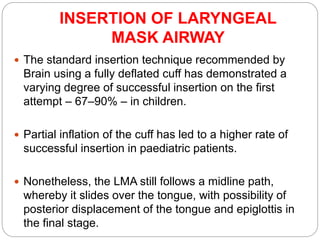
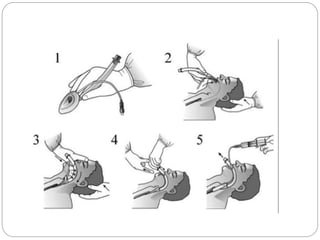
 The standard insertion technique recommended by
Brain using a fully deflated cuff has demonstrated a
varying degree of successful insertion on the first
attempt – 67–90% – in children.
 Partial inflation of the cuff has led to a higher rate of
successful insertion in paediatric patients.
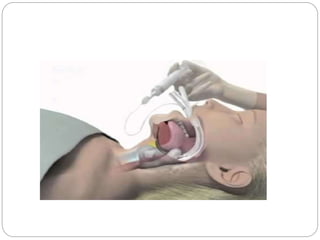
 Nonetheless, the LMA still follows a midline path,
whereby it slides over the tongue, with possibility of
posterior displacement of the tongue and epiglottis in
the final stage.
 Insertion of LMA by the lateral approach as
proposed by Kundraet al.,with a partially deflated
cuff, facilitates easier insertion with a higher
success rate.
 A rotation of the LMA by 45° pushes the tongue to
one side and the LMA slides down with a lesser
degree of mouth opening.
 The lateral approach takes less time, and a grade
1–2 endoscopic view with the fibreoptic
bronchoscope was seen in all cases.
 The study suggests a higher degree of injury to the
uvula and posterior pharyngeal wall when LMA is
inserted via a midline approach.
 Jaw thrust maneuver and laryngoscope-guided
placement have also been advocated to ease
placement of the classic LMA.
 The Proseal can also be inserted using the introducer
tool, which is similar to the technique used for the
intubating LMA.
 The laryngoscope-guided, gum elastic bougie-guided
Failure of insertion
 It is important to remember that the insertion of an
LMA, be it classic or otherwise, is successful only if
the child is adequately anaesthetized, either
breathing spontaneously or paralyzed and
ventilated.
 The most common causes of failure to effectively
ventilate with an LMA are inadequate depth of
anaesthesia and wrong size.
 Too small a size produces a large leak while too
large an LMA will not go beyond the posterior
CORRECT PLACEMENT OF LARYNGEAL
MASK
AIRWAY
 LMA (airway tube) coming out 1 cm on inflation of
cuff (classic)
 Good chest rise with manual ventilation
 End tidal carbon dioxide (ETCO2) showing square
wave
 No audible leak with peak airway pressure of 20 cm
H2O. A leak below 20 cm was considered a
malposition with PLMA.
 Gel displacement test for PLMA(done by placing a
blob of gel at the tip of the drain tube and noting the
airway pressure at which it was ejected)
 Expired tidal volume of more than 8 ml/kg
LARYNGEAL MASK AIRWAY IN
ANAESTHETISING
CHILDREN
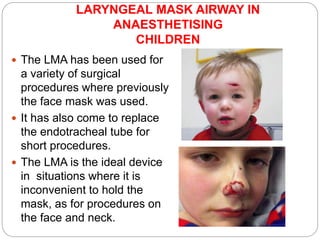
 The LMA has been used for
a variety of surgical
procedures where previously
the face mask was used.
 It has also come to replace
the endotracheal tube for
short procedures.
 The LMA is the ideal device
in situations where it is
inconvenient to hold the
mask, as for procedures on
the face and neck.
LARYNGEAL MASK AIRWAY AND
DIFFICULT AIRWAY
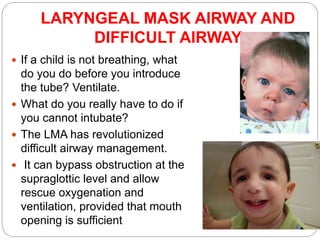
 If a child is not breathing, what
do you do before you introduce
the tube? Ventilate.
 What do you really have to do if
you cannot intubate?
 The LMA has revolutionized
difficult airway management.
 It can bypass obstruction at the
supraglottic level and allow
rescue oxygenation and
ventilation, provided that mouth
opening is sufficient
 This approach avoids excessive airway
instrumentation, minimizes the risk of trauma and
further airway obstruction by bleeding or oedema
and circumvents the ‘Can’t intubate can’t ventilate’
scenario.
 LMA has revolutionized difficult airway management
in children.
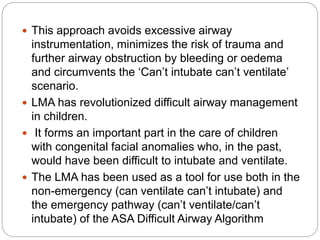
 It forms an important part in the care of children
with congenital facial anomalies who, in the past,
would have been difficult to intubate and ventilate.
 The LMA has been used as a tool for use both in the
non-emergency (can ventilate can’t intubate) and
the emergency pathway (can’t ventilate/can’t
intubate) of the ASA Difficult Airway Algorithm
ADVANTAGES OF LARYNGEAL MASK
AIRWAY OVER
THE ENDOTRACHEAL TUBE
 The ease of insertion that helps in providing a secure
airway rapidly is the outstanding feature.
 Laryngoscopy and muscle relaxants are not needed.
 Haemodynamic and intra ocular pressure (IOP)
changes are less when compared with the
endotracheal tube.
 Time for insertion is less.
 Incidence of sore throat is less.
 Is less-stimulating when compared with endotracheal
tube in a reactive airway
ADVANTAGES OVER
FACEMASK
 Fewer episodes of desaturation while using an LMA as
compared with face mask.
 Work of breathing (WOB) is less with the LMA.
 It is easier to obtain an airtight seal with an LMA.
 Better airway protection against regurgitation when compared
with the facemask.
 Children with a difficult mask fit do well with an LMA.
Oropharyngeal airway obstruction is avoided.
 The LMA insertion technique is easy to master and can be
taught to emergency personnel
LIMITATIONS AND COMPLICATIONS OF LMA
USE IN
CHILDREN
 Airway obstruction can occur due to malpositioning,
obstruction by the epiglottis, biting on the tube,
laryngospasm or kinking of the tube.
 Light plane of anaesthesia can also lead to laryngospasm
and airway obstruction in children.
 Lingual oedema following extubation can cause a
problem
 Aspiration of stomach contents is a potential
complication, especially in cases at high risk of
LARYNGEAL MASK AIRWAY IN
PAEDIATRIC
RESUSCITATION
 There is insufficient evidence to recommend for or
against the routine use of LMA during cardiac arrest.
 When endotracheal intubation is not possible, the
LMA is an acceptable adjunct for experienced
providers but it is associated with higher incidence of
complications in young children.
 Although the guidelines are cautious in their
recommendations for the LMA,those well versed in
LMA use will find it a valuable asset, especially in
LARYNGEAL MASK AIRWAY IN
CHILDREN
 The Laryngeal mask airway(LMA) North America
Inc. has formed a very important part of the airway
management of adults and, now, children.
 Early trials of the Pediatric LMA note that the design
was a scaled down version of the adult LMA and
not anatomically designed for children.
 Moreover, it was clear that the range of available
sizes was inadequate.
 Improvements in the design and availability of
suitable sizes (from the smallest size 1 for wt. 0–5 kg
to the older child, size 3 of weight 50 kg), together
with favourable clinical experiences have led to the
increasing use of LMA in children.
 As the LMA can be inserted easily without the use of
muscle relaxants and provides a secure airway, it is
increasingly used where a facemask was previously
used.
 It is seen to replace the tracheal tube in a lot of
situations as its use with controlled ventilation has
also become accepted practice (Proseal LMA).
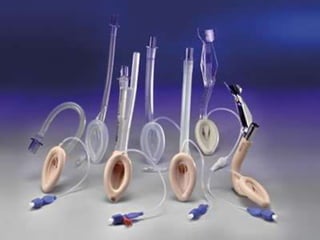
LMA FAMILY
The different types of LMA available are:
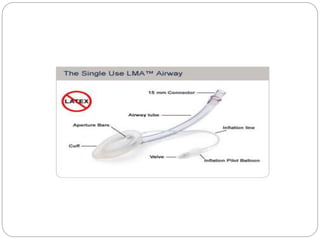
 LMA classic – available in seven sizes
 LMA Proseal – seven sizes: 1, 1.5, 2, 2.5, 3, 4
and 5
 LMA Unique – disposable version of classic LMA
 Intubating LMA Fastrach – 3, 4 and 5
 LMA Ctrach – 3, 4 and 5
 Flexible LMA – minimum size is 2
 Fastrach and CTrach are not available in
paediatric sizes, although there are reports of
their use in the older child.
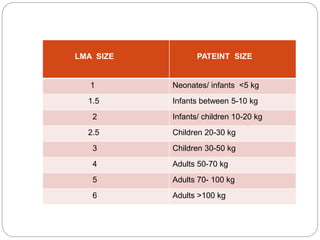
 The size of LMA to be used in a child is decided
by the weight of the child, and is often written on
the LMA tube close to the distal end along with
the cuff volume to be used.
CLASSIC LARYNGEAL MASK
AIRWAY
 When placed properly, the cuff of the LMA sits
over the laryngeal inlet, providing a seal in the
pharynx that allows both spontaneous and
controlled ventilation.
 The LMA classic allows a peak pressure of 15 cm
water without a significant gas leak.
 The LMA classic does not protect against
regurgitation.
 The chances of regurgitation are higher with
controlled ventilation and/or if there is
malpositioning of the LMA with partial ventilation
of the stomach.
 It is preferable to use pressure control ventilation
for control ventilation in children if classic LMA
LMA SIZE PATEINT SIZE
1 Neonates/ infants <5 kg
1.5 Infants between 5-10 kg
2 Infants/ children 10-20 kg
2.5 Children 20-30 kg
3 Children 30-50 kg
4 Adults 50-70 kg
5 Adults 70- 100 kg
6 Adults >100 kg
PROSEAL LARYNGEAL MASK
AIRWAY
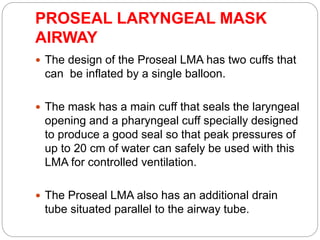
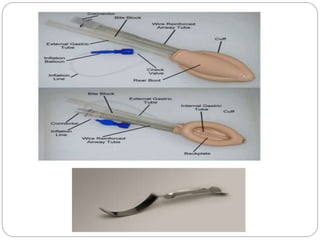
 The design of the Proseal LMA has two cuffs that
can be inflated by a single balloon.
 The mask has a main cuff that seals the laryngeal
opening and a pharyngeal cuff specially designed
to produce a good seal so that peak pressures of
up to 20 cm of water can safely be used with this
LMA for controlled ventilation.
 The Proseal LMA also has an additional drain
tube situated parallel to the airway tube.
 When correctly positioned, the proximal end of this
tube faces the upper oesophageal sphincter.
 A feeding tube inserted through this will directly go
through the oesophagus into the stomach.
 So accurate is this that the ability to pass a stomach
tube is one of the tests of correct positioning of the
Proseal.
 The double cuff arrangement allows a higher seal
than the classic LMA for a given intracuff pressure.
 The drain tube communicates with the upper
oesophageal sphincter and permits venting of the
stomach and blind insertion of standard gastric tubes
in any patient position without use of laryngoscopy or
magills forceps.
 Gastric inflation causing tenting of the diaphragm is
an impediment to respiration.
 This is an important issue of concern while using the
classic LMA for prolonged periods, especially in
infants, more so during controlled ventilation.
 This problem is solved in the Proseal that can now be
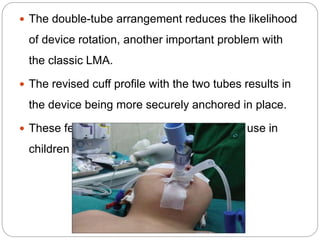
 The double-tube arrangement reduces the likelihood
of device rotation, another important problem with
the classic LMA.
 The revised cuff profile with the two tubes results in
the device being more securely anchored in place.
 These features make the Proseal ideal for use in
children
FLEXIBLE LARYNGEAL MASK
AIRWAY
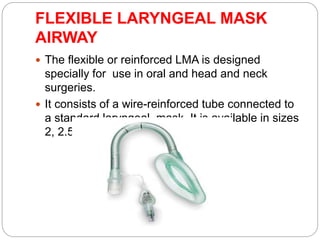
 The flexible or reinforced LMA is designed
specially for use in oral and head and neck
surgeries.
 It consists of a wire-reinforced tube connected to
a standard laryngeal mask. It is available in sizes
2, 2.5, 3, 4 and 5.
 In each size, the cuff is the same as the classic
LMA, but the tube is longer and of smaller
diameter than the classic.
 The flexi LMA allows positioning away from the
surgical field without losing the seal and is
resistant to kinking.
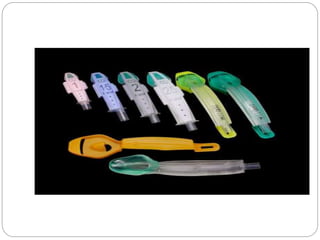
I-GEL AIRWAY
 The i-gel is a single-use, supraglottic airway
management device that is made from a medical
grade thermoplastic elastomer.
 i-gel has been designed to create a non-inflatable,
anatomical seal of the pharyngeal, laryngeal and
perilaryngeal structures while avoiding compression
trauma.
 i-gel is currently available in seven sizes and is
supplied in a colour-coded polypropylene “protective
 It contains both airway and drainage tubes, and an
integral bite block.
 The i-gel device, due to its stability, allows the child to
be placed in the lateral decubitus position to perform
caudal anaesthesia, without this causing a leak or the
displacement of the supralaryngeal device.
 i-gel is very easy to insert and that no learning curve is
needed before a high success insertion rate is obtained
and appears to be safe for paediatric management
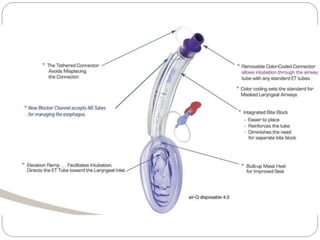
AIR-Q INTUBATING LARYNGEAL
AIRWAY
 The air-Q™ Intubating Laryngeal Airway (ILA) is a
supraglottic device used for both airway maintenance
during routine anaesthesia and as a conduit for tracheal
intubation for patients with a difficult airway.
 the ILA was designed primarily to allow for the passage of
conventional cuffed tracheal tubes when used for blind
tracheal intubation, and has the option for subsequent
removal
 The air-Q ILA is available in six sizes (1, 1.5, 2, 2.5, 3.5,
4.5) for single use
 Sizing of the paediatric air-Q ILA is similar to the LMA, in
 The ILA is currently the only available supraglottic
device in paediatric patients designed to act as a
conduit for tracheal intubation with cuffed tracheal
tubes.
 Sizing of the paediatric air-Q ILA is similar to the
LMA, in that it is weight-based:
1. A size 1 is designed for patients <5 kg,
2. size 1.5 for 5–10 kg,
3. size 2 for 10–20 kg
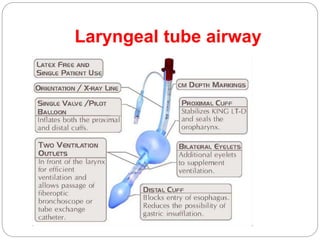
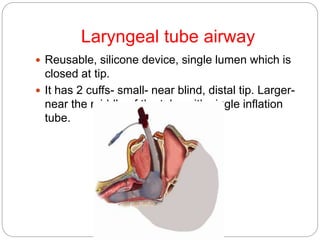
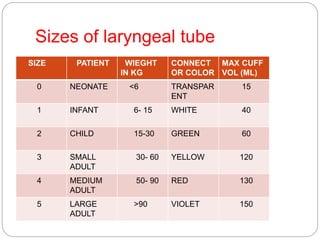
Laryngeal tube airway
 Reusable, silicone device, single lumen which is
closed at tip.
 It has 2 cuffs- small- near blind, distal tip. Larger-
near the middle of the tube with single inflation
tube.
Sizes of laryngeal tube
SIZE PATIENT WIEGHT
IN KG
CONNECT
OR COLOR
MAX CUFF
VOL (ML)
0 NEONATE <6 TRANSPAR
ENT
15
1 INFANT 6- 15 WHITE 40
2 CHILD 15-30 GREEN 60
3 SMALL
ADULT
30- 60 YELLOW 120
4 MEDIUM
ADULT
50- 90 RED 130
5 LARGE
ADULT
>90 VIOLET 150
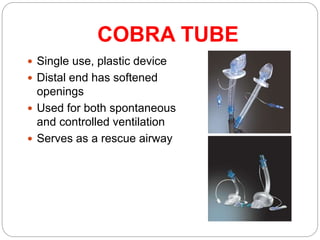
COBRA TUBE
 Single use, plastic device
 Distal end has softened
openings
 Used for both spontaneous
and controlled ventilation
 Serves as a rescue airway
conclusion
 No single device meets all the criteria for the ideal
SAD.
 Second-generation SADs are likely to provide
better airway protection, and their use is
increasing in clinical practice.
 Airway providers should be skilled with several
devices and techniques, including various SAD
devices, to be considered competent in airway
management.
Supra glottic airway children

Supra glottic airway children

  • 1.
    Presenter : Dr.Kumar Moderator:Dr. Chaitanya Supraglottic airway devices in children
  • 2.
    History In 1988, Dr.ARCHIE BRAIN introduced the first supraglottic airway device – the LMA. He took the idea from Goldman dental nose piece.
  • 3.
    Definition  Supraglottic airwaymanagement devices comprise a family of medical devices that facilitate oxygenation and ventilation without endotracheal intubation.  The word “supraglottic” means “above the glottis” or “above the larynx”.  Some of the authors refer to these products as “extraglottic” devices.  “Supraglottic airway” is a generic description for devices that facilitate ventilation and oxygenation with devices that do not penetrate the vocal cords.
  • 4.
    CLASSIFICATION FOR SUPRAGLOTTIC AIRWAYS BASEDON SEALING MECHANISMS  Perilaryngeal sealers:The LMA family, i-gel and air-Q Intubating Laryngeal Airway (airQ ILA)  Pharyngeal sealers: Combitube,the Streamlined Liner of the Pharynx Airway (SLIPA), Laryngeal Tube  Both:The Cobra PerilaryngealAirway (CobraPLA)
  • 5.
    CLASSIFICATION OF SUPRAGLOTTIC AIRWAY BASEDON EVOLUTION  First-generation devices: Simple airway tubes 1. The laryngeal mask airway [classic LMA (cLMA)], 2. flexible LMA (fLMA), 3. unique LMA (ULMA) and 4. The Cobra Perilaryngeal Airway (CobraPLA)  Second-generation devices: With addition of Drainage tube 1. Proseal LMA (PLMA), 2. i-gel, Laryngeal tube, 3. LMA Supreme, 4. Streamlined Liner of the Pharyngeal Airway
  • 7.
    INDICATIONS 1-) Supraglottic deviceshave been recommended as rescue airways in CVCI scenario. 2-) Procedures outside the operating room- -Radiology and MRI - Radiation Therapy - Diagnostic and short therapeutic procedures in children - Cardiology 3-) Head and Neck surgeries 4-) Pulmonary medicine and Thoracic surgeries - Bronchoscopy - Laser surgery of the trachea - Tracheobronchial stent placement 5-) Neurosurgery
  • 8.
    CONTRAINDICATIONS  Small oralaperture.  Any oropharyngeal, pharyngeal or hypopharyngeal mass.  Esophageal pathology- caustic ingestion  Full stomach patients, fasting not confirmed, gross or morbid obesity  SAD has limited value in patients of poor lung compliance.
  • 9.
    Advantages  higher sealpressures (allowing higher ventilation pressure),  ease of insertion,  the ability to drain gastric fluid and  the ability to avoid cervical spine neck extension to visualize the larynxThe ideal supraglottic device must be easy to insert with an easy learning curve, with the ability to ventilate at high peak pressures without gastric distension having the provision to drain the stomach.”
  • 10.
    INSERTION OF LARYNGEAL MASKAIRWAY  The standard insertion technique recommended by Brain using a fully deflated cuff has demonstrated a varying degree of successful insertion on the first attempt – 67–90% – in children.  Partial inflation of the cuff has led to a higher rate of successful insertion in paediatric patients.  Nonetheless, the LMA still follows a midline path, whereby it slides over the tongue, with possibility of posterior displacement of the tongue and epiglottis in the final stage.
  • 13.
     Insertion ofLMA by the lateral approach as proposed by Kundraet al.,with a partially deflated cuff, facilitates easier insertion with a higher success rate.  A rotation of the LMA by 45° pushes the tongue to one side and the LMA slides down with a lesser degree of mouth opening.  The lateral approach takes less time, and a grade 1–2 endoscopic view with the fibreoptic bronchoscope was seen in all cases.
  • 14.
     The studysuggests a higher degree of injury to the uvula and posterior pharyngeal wall when LMA is inserted via a midline approach.  Jaw thrust maneuver and laryngoscope-guided placement have also been advocated to ease placement of the classic LMA.  The Proseal can also be inserted using the introducer tool, which is similar to the technique used for the intubating LMA.  The laryngoscope-guided, gum elastic bougie-guided
  • 15.
    Failure of insertion It is important to remember that the insertion of an LMA, be it classic or otherwise, is successful only if the child is adequately anaesthetized, either breathing spontaneously or paralyzed and ventilated.  The most common causes of failure to effectively ventilate with an LMA are inadequate depth of anaesthesia and wrong size.  Too small a size produces a large leak while too large an LMA will not go beyond the posterior
  • 16.
    CORRECT PLACEMENT OFLARYNGEAL MASK AIRWAY  LMA (airway tube) coming out 1 cm on inflation of cuff (classic)  Good chest rise with manual ventilation  End tidal carbon dioxide (ETCO2) showing square wave  No audible leak with peak airway pressure of 20 cm H2O. A leak below 20 cm was considered a malposition with PLMA.  Gel displacement test for PLMA(done by placing a blob of gel at the tip of the drain tube and noting the airway pressure at which it was ejected)  Expired tidal volume of more than 8 ml/kg
  • 17.
    LARYNGEAL MASK AIRWAYIN ANAESTHETISING CHILDREN  The LMA has been used for a variety of surgical procedures where previously the face mask was used.  It has also come to replace the endotracheal tube for short procedures.  The LMA is the ideal device in situations where it is inconvenient to hold the mask, as for procedures on the face and neck.
  • 18.
    LARYNGEAL MASK AIRWAYAND DIFFICULT AIRWAY  If a child is not breathing, what do you do before you introduce the tube? Ventilate.  What do you really have to do if you cannot intubate?  The LMA has revolutionized difficult airway management.  It can bypass obstruction at the supraglottic level and allow rescue oxygenation and ventilation, provided that mouth opening is sufficient
  • 19.
     This approachavoids excessive airway instrumentation, minimizes the risk of trauma and further airway obstruction by bleeding or oedema and circumvents the ‘Can’t intubate can’t ventilate’ scenario.  LMA has revolutionized difficult airway management in children.  It forms an important part in the care of children with congenital facial anomalies who, in the past, would have been difficult to intubate and ventilate.  The LMA has been used as a tool for use both in the non-emergency (can ventilate can’t intubate) and the emergency pathway (can’t ventilate/can’t intubate) of the ASA Difficult Airway Algorithm
  • 20.
    ADVANTAGES OF LARYNGEALMASK AIRWAY OVER THE ENDOTRACHEAL TUBE  The ease of insertion that helps in providing a secure airway rapidly is the outstanding feature.  Laryngoscopy and muscle relaxants are not needed.  Haemodynamic and intra ocular pressure (IOP) changes are less when compared with the endotracheal tube.  Time for insertion is less.  Incidence of sore throat is less.  Is less-stimulating when compared with endotracheal tube in a reactive airway
  • 21.
    ADVANTAGES OVER FACEMASK  Fewerepisodes of desaturation while using an LMA as compared with face mask.  Work of breathing (WOB) is less with the LMA.  It is easier to obtain an airtight seal with an LMA.  Better airway protection against regurgitation when compared with the facemask.  Children with a difficult mask fit do well with an LMA. Oropharyngeal airway obstruction is avoided.  The LMA insertion technique is easy to master and can be taught to emergency personnel
  • 22.
    LIMITATIONS AND COMPLICATIONSOF LMA USE IN CHILDREN  Airway obstruction can occur due to malpositioning, obstruction by the epiglottis, biting on the tube, laryngospasm or kinking of the tube.  Light plane of anaesthesia can also lead to laryngospasm and airway obstruction in children.  Lingual oedema following extubation can cause a problem  Aspiration of stomach contents is a potential complication, especially in cases at high risk of
  • 23.
    LARYNGEAL MASK AIRWAYIN PAEDIATRIC RESUSCITATION  There is insufficient evidence to recommend for or against the routine use of LMA during cardiac arrest.  When endotracheal intubation is not possible, the LMA is an acceptable adjunct for experienced providers but it is associated with higher incidence of complications in young children.  Although the guidelines are cautious in their recommendations for the LMA,those well versed in LMA use will find it a valuable asset, especially in
  • 25.
    LARYNGEAL MASK AIRWAYIN CHILDREN  The Laryngeal mask airway(LMA) North America Inc. has formed a very important part of the airway management of adults and, now, children.  Early trials of the Pediatric LMA note that the design was a scaled down version of the adult LMA and not anatomically designed for children.  Moreover, it was clear that the range of available sizes was inadequate.
  • 26.
     Improvements inthe design and availability of suitable sizes (from the smallest size 1 for wt. 0–5 kg to the older child, size 3 of weight 50 kg), together with favourable clinical experiences have led to the increasing use of LMA in children.  As the LMA can be inserted easily without the use of muscle relaxants and provides a secure airway, it is increasingly used where a facemask was previously used.  It is seen to replace the tracheal tube in a lot of situations as its use with controlled ventilation has also become accepted practice (Proseal LMA).
  • 27.
    LMA FAMILY The differenttypes of LMA available are:  LMA classic – available in seven sizes  LMA Proseal – seven sizes: 1, 1.5, 2, 2.5, 3, 4 and 5  LMA Unique – disposable version of classic LMA  Intubating LMA Fastrach – 3, 4 and 5  LMA Ctrach – 3, 4 and 5  Flexible LMA – minimum size is 2
  • 28.
     Fastrach andCTrach are not available in paediatric sizes, although there are reports of their use in the older child.  The size of LMA to be used in a child is decided by the weight of the child, and is often written on the LMA tube close to the distal end along with the cuff volume to be used.
  • 29.
    CLASSIC LARYNGEAL MASK AIRWAY When placed properly, the cuff of the LMA sits over the laryngeal inlet, providing a seal in the pharynx that allows both spontaneous and controlled ventilation.  The LMA classic allows a peak pressure of 15 cm water without a significant gas leak.  The LMA classic does not protect against regurgitation.  The chances of regurgitation are higher with controlled ventilation and/or if there is malpositioning of the LMA with partial ventilation of the stomach.  It is preferable to use pressure control ventilation for control ventilation in children if classic LMA
  • 31.
    LMA SIZE PATEINTSIZE 1 Neonates/ infants <5 kg 1.5 Infants between 5-10 kg 2 Infants/ children 10-20 kg 2.5 Children 20-30 kg 3 Children 30-50 kg 4 Adults 50-70 kg 5 Adults 70- 100 kg 6 Adults >100 kg
  • 32.
    PROSEAL LARYNGEAL MASK AIRWAY The design of the Proseal LMA has two cuffs that can be inflated by a single balloon.  The mask has a main cuff that seals the laryngeal opening and a pharyngeal cuff specially designed to produce a good seal so that peak pressures of up to 20 cm of water can safely be used with this LMA for controlled ventilation.  The Proseal LMA also has an additional drain tube situated parallel to the airway tube.
  • 34.
     When correctlypositioned, the proximal end of this tube faces the upper oesophageal sphincter.  A feeding tube inserted through this will directly go through the oesophagus into the stomach.  So accurate is this that the ability to pass a stomach tube is one of the tests of correct positioning of the Proseal.  The double cuff arrangement allows a higher seal than the classic LMA for a given intracuff pressure.
  • 35.
     The draintube communicates with the upper oesophageal sphincter and permits venting of the stomach and blind insertion of standard gastric tubes in any patient position without use of laryngoscopy or magills forceps.  Gastric inflation causing tenting of the diaphragm is an impediment to respiration.  This is an important issue of concern while using the classic LMA for prolonged periods, especially in infants, more so during controlled ventilation.  This problem is solved in the Proseal that can now be
  • 36.
     The double-tubearrangement reduces the likelihood of device rotation, another important problem with the classic LMA.  The revised cuff profile with the two tubes results in the device being more securely anchored in place.  These features make the Proseal ideal for use in children
  • 37.
    FLEXIBLE LARYNGEAL MASK AIRWAY The flexible or reinforced LMA is designed specially for use in oral and head and neck surgeries.  It consists of a wire-reinforced tube connected to a standard laryngeal mask. It is available in sizes 2, 2.5, 3, 4 and 5.
  • 38.
     In eachsize, the cuff is the same as the classic LMA, but the tube is longer and of smaller diameter than the classic.  The flexi LMA allows positioning away from the surgical field without losing the seal and is resistant to kinking.
  • 39.
    I-GEL AIRWAY  Thei-gel is a single-use, supraglottic airway management device that is made from a medical grade thermoplastic elastomer.  i-gel has been designed to create a non-inflatable, anatomical seal of the pharyngeal, laryngeal and perilaryngeal structures while avoiding compression trauma.  i-gel is currently available in seven sizes and is supplied in a colour-coded polypropylene “protective
  • 41.
     It containsboth airway and drainage tubes, and an integral bite block.  The i-gel device, due to its stability, allows the child to be placed in the lateral decubitus position to perform caudal anaesthesia, without this causing a leak or the displacement of the supralaryngeal device.  i-gel is very easy to insert and that no learning curve is needed before a high success insertion rate is obtained and appears to be safe for paediatric management
  • 42.
    AIR-Q INTUBATING LARYNGEAL AIRWAY The air-Q™ Intubating Laryngeal Airway (ILA) is a supraglottic device used for both airway maintenance during routine anaesthesia and as a conduit for tracheal intubation for patients with a difficult airway.  the ILA was designed primarily to allow for the passage of conventional cuffed tracheal tubes when used for blind tracheal intubation, and has the option for subsequent removal  The air-Q ILA is available in six sizes (1, 1.5, 2, 2.5, 3.5, 4.5) for single use  Sizing of the paediatric air-Q ILA is similar to the LMA, in
  • 44.
     The ILAis currently the only available supraglottic device in paediatric patients designed to act as a conduit for tracheal intubation with cuffed tracheal tubes.  Sizing of the paediatric air-Q ILA is similar to the LMA, in that it is weight-based: 1. A size 1 is designed for patients <5 kg, 2. size 1.5 for 5–10 kg, 3. size 2 for 10–20 kg
  • 45.
  • 46.
    Laryngeal tube airway Reusable, silicone device, single lumen which is closed at tip.  It has 2 cuffs- small- near blind, distal tip. Larger- near the middle of the tube with single inflation tube.
  • 47.
    Sizes of laryngealtube SIZE PATIENT WIEGHT IN KG CONNECT OR COLOR MAX CUFF VOL (ML) 0 NEONATE <6 TRANSPAR ENT 15 1 INFANT 6- 15 WHITE 40 2 CHILD 15-30 GREEN 60 3 SMALL ADULT 30- 60 YELLOW 120 4 MEDIUM ADULT 50- 90 RED 130 5 LARGE ADULT >90 VIOLET 150
  • 48.
    COBRA TUBE  Singleuse, plastic device  Distal end has softened openings  Used for both spontaneous and controlled ventilation  Serves as a rescue airway
  • 49.
    conclusion  No singledevice meets all the criteria for the ideal SAD.  Second-generation SADs are likely to provide better airway protection, and their use is increasing in clinical practice.  Airway providers should be skilled with several devices and techniques, including various SAD devices, to be considered competent in airway management.