DYNAMIC
INTERCONNECTION
NETWORKS
Dr. Prasenjit Dey
Basics
2
 Interconnection networks consists of multiple processors
and memory modules
 The processors and memory modules can be connected
with each other in various ways
 These connections can be static or dynamic
 In static networks, connections are fixed links
 In dynamic network, connections are built on the fly as
required
Network properties
3
 Degree of a node (d)
 The number of edges incident on a node
 In-degree
 Out-degree
 In-Degree of a node
 The number of incoming edges of a node
 Out-Degree of a node
 The number of outgoing edges of a node
 Diameter of a node (D)
 The maximum shortest path between any two
nodes
 Network latency
 Worst-case time for a information to be
transferred
d = 5
In-degree = 3
Out-degree = 2
D = max(1,1,2,1,2,1)
= 2
1
2
3
4
Bisection of a network
4
 Bisection width
 The minimum number of wires that must be cut to divide the network
into two equal halves.
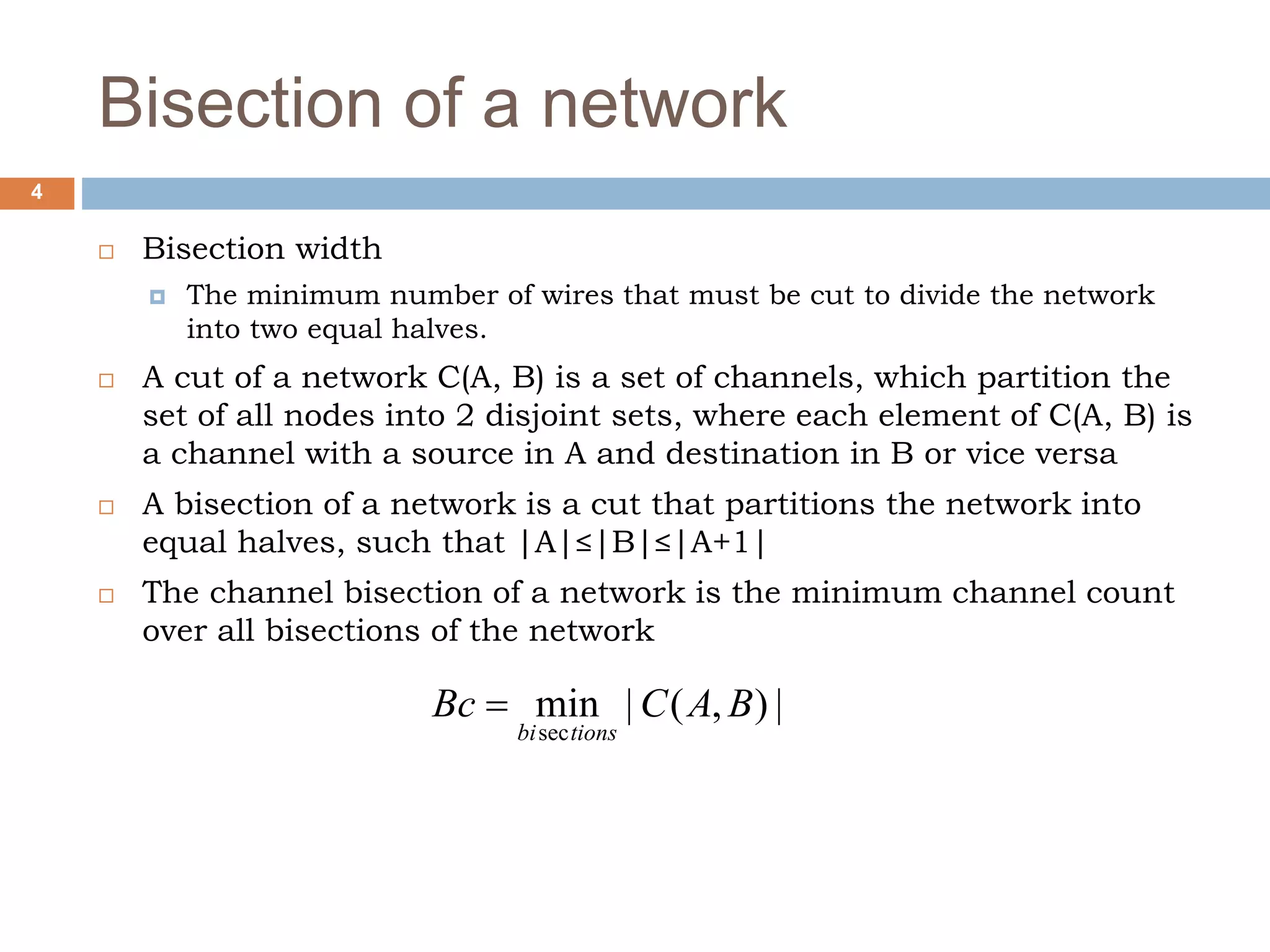
 A cut of a network C(A, B) is a set of channels, which partition the
set of all nodes into 2 disjoint sets, where each element of C(A, B) is
a channel with a source in A and destination in B or vice versa
 A bisection of a network is a cut that partitions the network into
equal halves, such that |A|≤|B|≤|A+1|
 The channel bisection of a network is the minimum channel count
over all bisections of the network
|
)
,
(
|
min
sec
B
A
C
Bc
tions
bi

Types of Interconnections
5
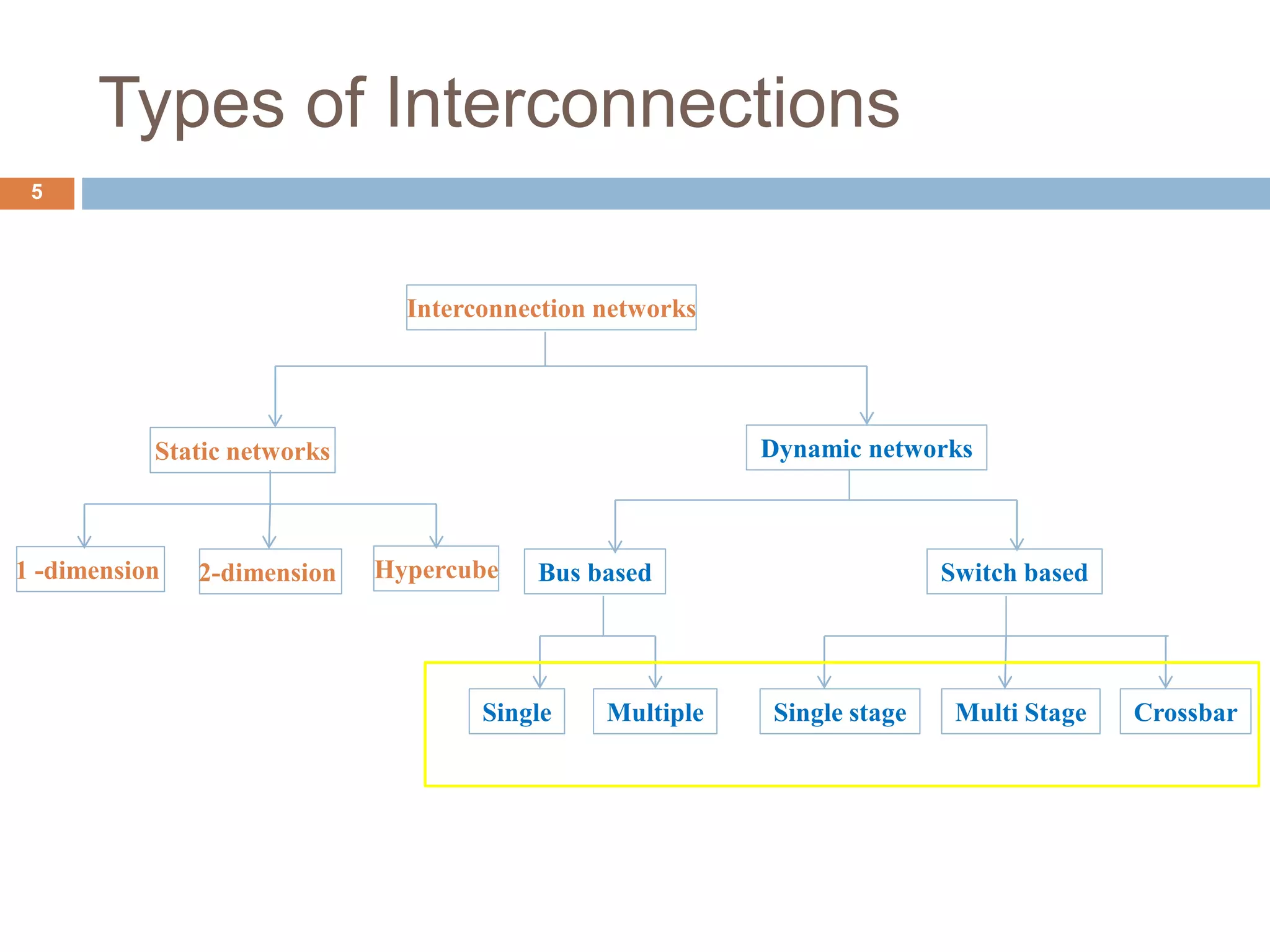
Interconnection networks
Static networks Dynamic networks
2-dimension Bus based
1 -dimension Hypercube Switch based
Single Multiple Single stage Multi Stage Crossbar
Bus based Interconnection
Networks
6
 All the processors and memory modules are interconnected
with each other by buses
 Two types of bus based networks
 Single bus networks
 Multiple bus networks
Single Bus Interconnected
Systems
7
 Multiple processors are interconnected by a single shared bus
 Each processor has its own cache, less traffic
 All processors communicate with a single shared memory
 Number of buses used is 1, so the network complexity is O(1)
 Maximum input to output delay is n, so time complexity is O(n)
P1 P2 P3 Pn
Shared
Memory
I/O
devices
Shared bus
Multiple Bus Interconnected
Systems
8
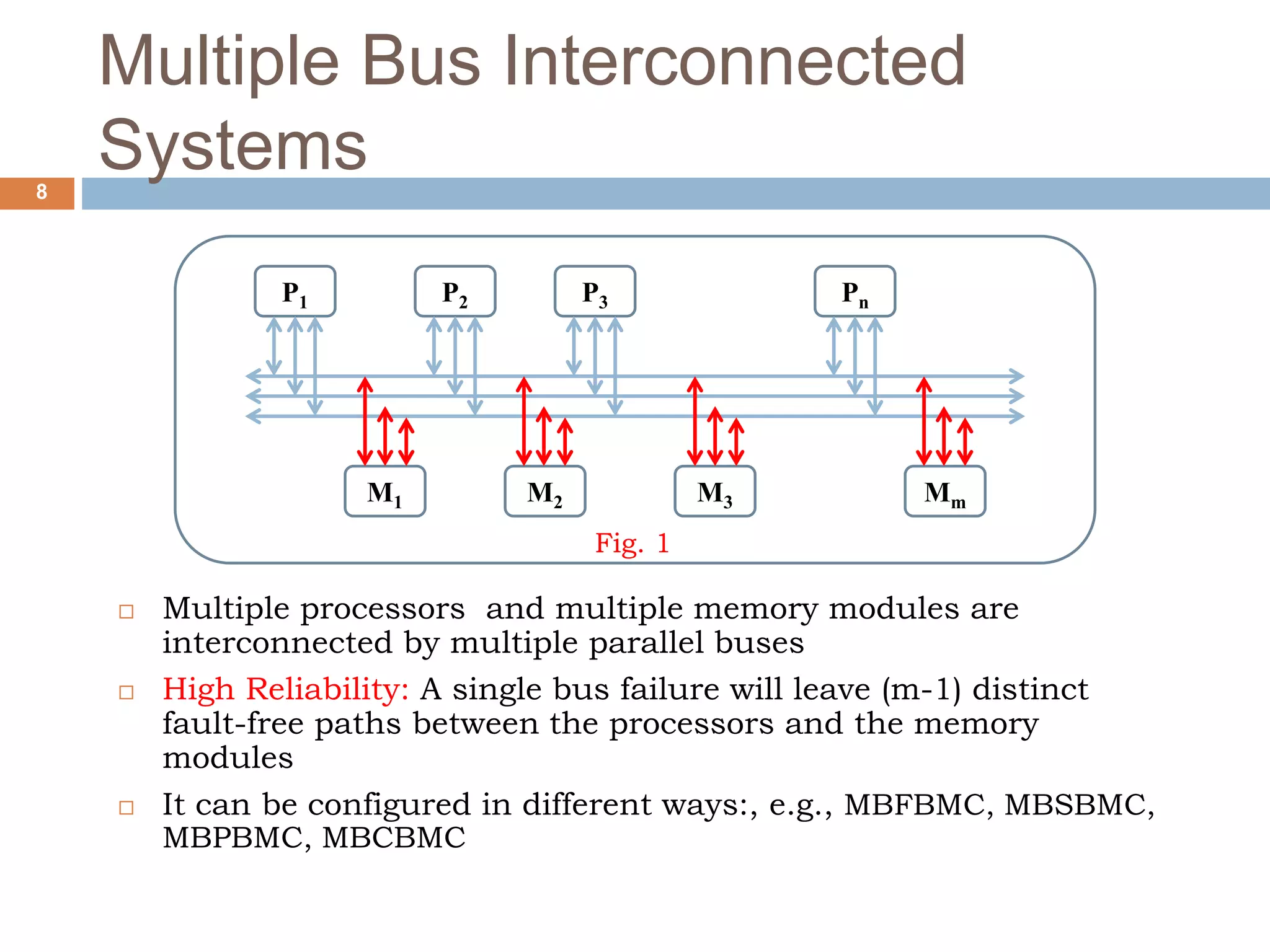
 Multiple processors and multiple memory modules are
interconnected by multiple parallel buses
 High Reliability: A single bus failure will leave (m-1) distinct
fault-free paths between the processors and the memory
modules
 It can be configured in different ways:, e.g., MBFBMC, MBSBMC,
MBPBMC, MBCBMC
P1 P2 P3 Pn
M1 M2 M3 Mm
Fig. 1
Multiple Bus Interconnected
Systems
9
 MBFBMC: multiple bus with full bus–memory connection
 All memory modules are connected with all buses (Fig. 1)
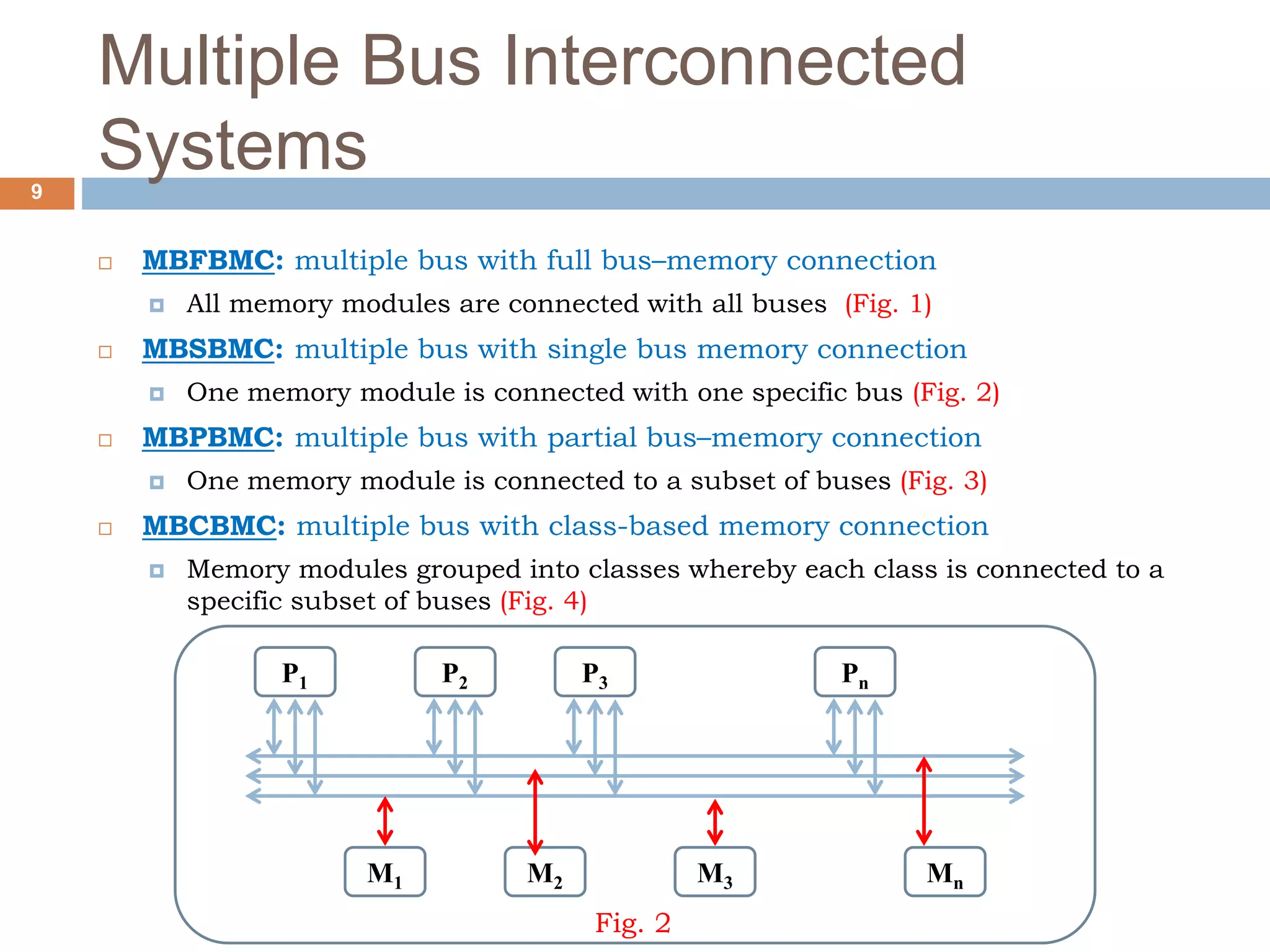
 MBSBMC: multiple bus with single bus memory connection
 One memory module is connected with one specific bus (Fig. 2)
 MBPBMC: multiple bus with partial bus–memory connection
 One memory module is connected to a subset of buses (Fig. 3)
 MBCBMC: multiple bus with class-based memory connection
 Memory modules grouped into classes whereby each class is connected to a
specific subset of buses (Fig. 4)
P1 P2 P3 Pn
M1 M2 M3 Mn
Fig. 2
Multiple Bus Interconnected
Systems
P1 P2 P3 Pn
M1 M2 M3 M4
Fig. 4
P1 P2 P3 Pn
M1 M2 M3 M4
Fig. 3
Class 1 Class 2
Switch-Based Interconnection
Networks
11
 All the processors and memory modules are interconnected
with each other via switches
 Types of switch based networks
 Crossbar Networks
 Single-Stage Networks
 Multistage Networks
Crossbar Networks
12
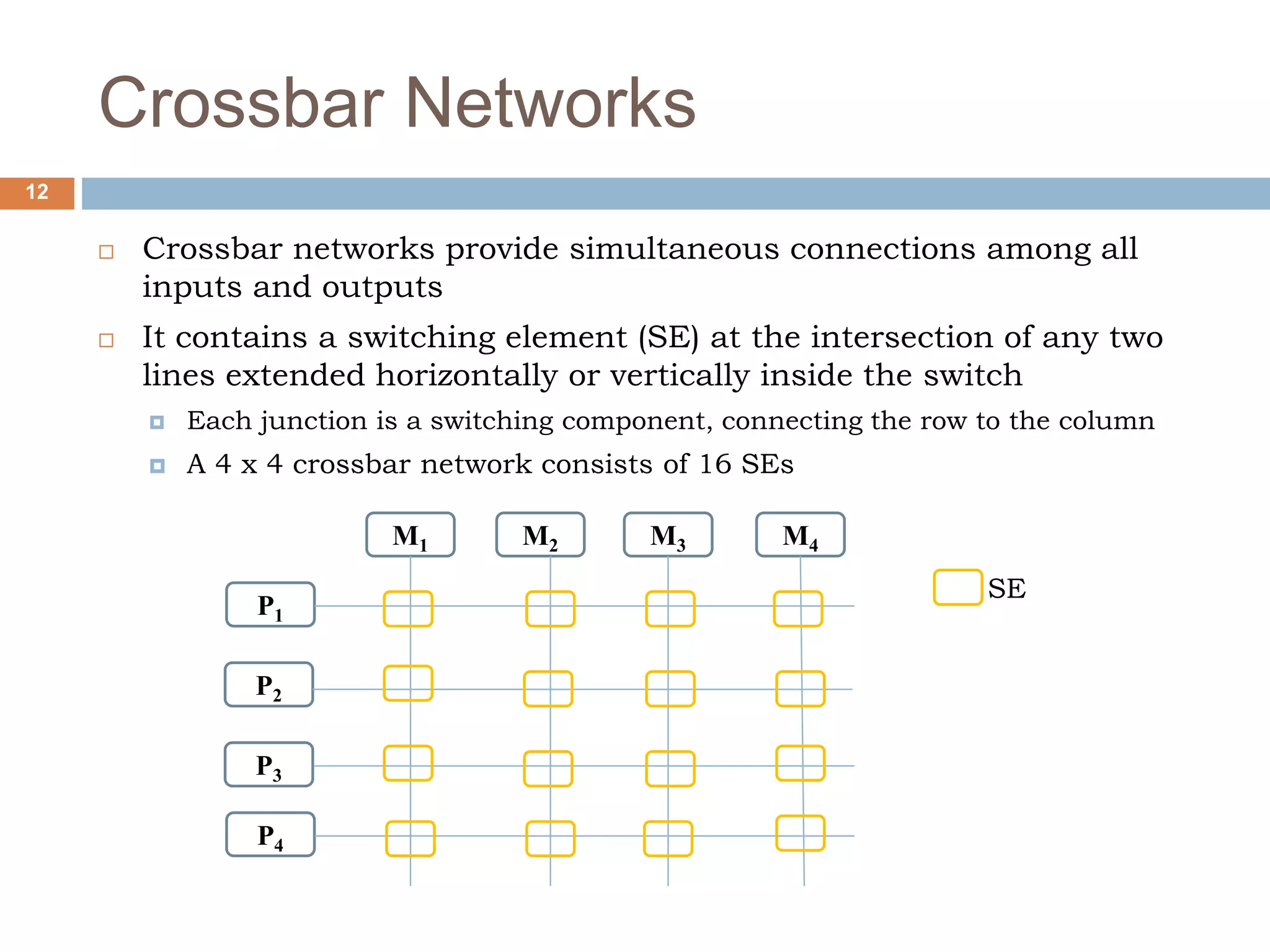
 Crossbar networks provide simultaneous connections among all
inputs and outputs
 It contains a switching element (SE) at the intersection of any two
lines extended horizontally or vertically inside the switch
 Each junction is a switching component, connecting the row to the column
 A 4 x 4 crossbar network consists of 16 SEs
P1
P2
P3
P4
M1 M2 M3 M4
SE
Crossbar Networks
13
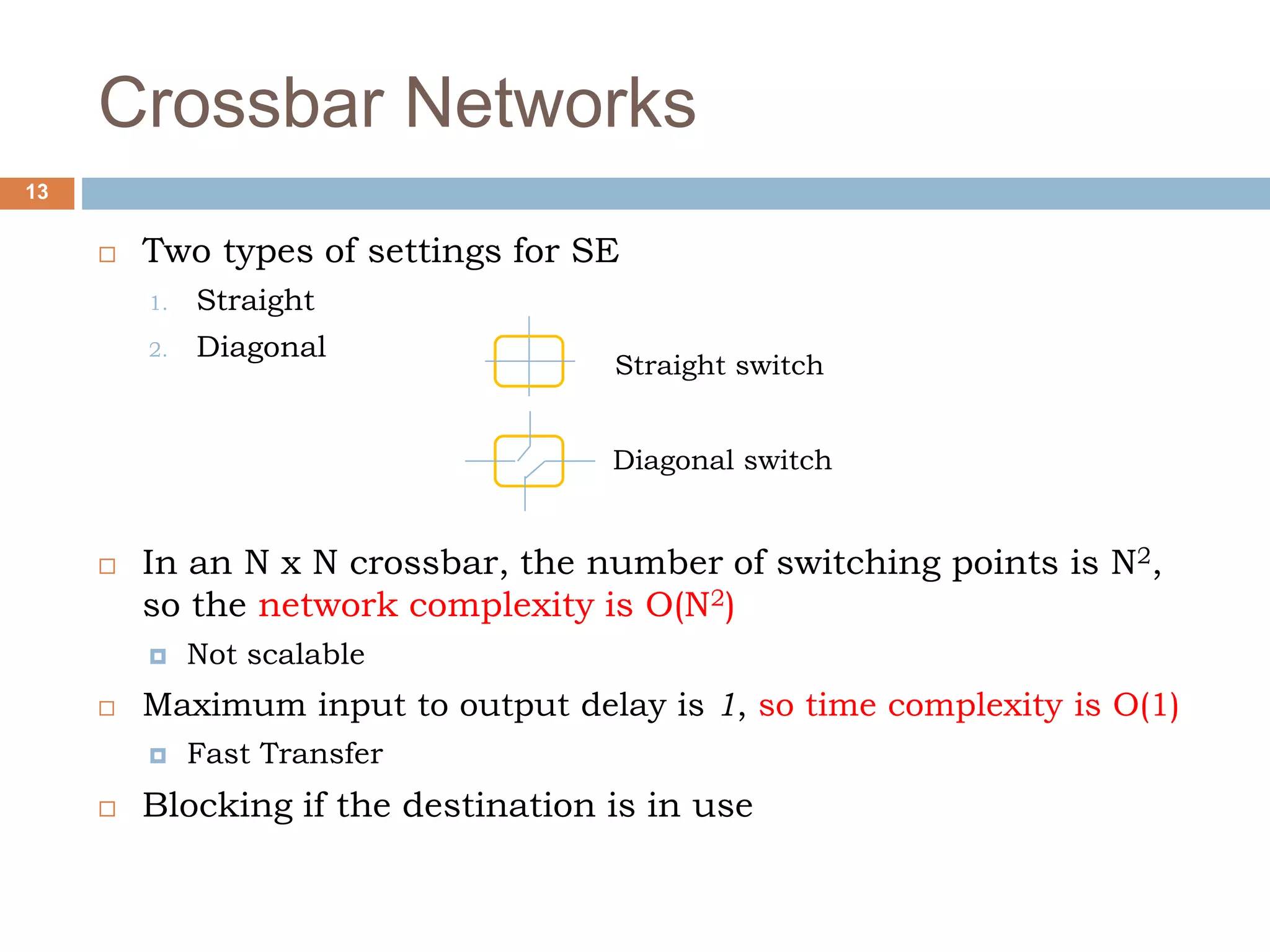
 Two types of settings for SE
1. Straight
2. Diagonal
 In an N x N crossbar, the number of switching points is N2,
so the network complexity is O(N2)
 Not scalable
 Maximum input to output delay is 1, so time complexity is O(1)
 Fast Transfer
 Blocking if the destination is in use
Straight switch
Diagonal switch
Switches
Switch size Permutation
connection
Legitimate states
2 × 2 2 4
4 × 4 24 256
8 × 8 40,320 16,777,216
N × N N! NN
14
 Permutation connection
 Each input can only be connected to a single output
 Legitimate state
 Each input can be connected to multiple outputs, but
each output can only be connected to a single input
Single Stage Networks
15
 In single stage Interconnection Networks (INs), a simple 2 x 2
switching element (SE) is used
 Four types of settings for SE
 Shuffle-Exchange interconnection pattern is used to
establish the connections between inputs and outputs
 For m-bit input address Pm-1, Pm-2, …, P1, P0
 Shuffle operation performs 1bit circular left shift on the bits
 Shuffle(Pm-1, Pm-2, …, P1, P0) = Pm-2, Pm-3, …, P0, Pm-1
 Exchange operation inverts the LSB
 Exchange(Pm-1, Pm-2, …, P1, P0) = Pm-1, Pm-2, …, P1, 𝑃0
*From Advanced Computer Architectures, K. Hwang, 1993.
16
 Single stage Shuffle-Exchange IN
 Perfect shuffle operation
 cyclic shift 1 place left
 000(0)  000(0)
 001(1)  010(2)
 010(2)  100(4)
 011(3)  110(6)
 100(4)  001(1)
 101(5)  011(3)
 110(6)  101(5)
 111(7)  111(7)
 Exchange operation
 Invert least significant bit
 E.g., 101(5)  100(4)
*From Ben Macey at http://www.ee.uwa.edu.au/~maceyb/aca319-2003
Single Stage Networks
Demonstration
17
 In an 8-input single stage IN, create a dynamic connection between
input 0 (000) and output (110) by using Shuffle–Exchange
interconnection pattern.
 The following sequence of shuffle/exchange operations is needed
 E(000)  001
 S(001)  010
 E(010)  011
 S(011)  110
Single Stage Networks
18
 For N number of inputs(processors) and N number of
outputs (memory modules), the number of SEs is N/2
 The maximum length of a path from an input to an output in
the network, measured by the number of SEs along the path,
is log2 N.
 In single stage IN, the network complexity is O(N)
 In single stage IN, the time complexity is O(N)
 A single path between the inputs (processors) and the
outputs (memory modules)
Multistage Networks
19
 Multistage Interconnection Network (MIN) are formed by
cascading multiple single stage IN each with a set of 2 x 2 SEs
 Stages are connected to each other using Inter Stage Connection
(ISC) Pattern
 The patterns can use any routing function
 E.g., Shuffle–Exchange, Butterfly, Cube, etc.
 Two types of MIN
 Single path MIN
 One unique path between any input/output pair
 Banyan network
 Multipath MIN
 Multiple paths between any input/output pair
 Delta network is a subset of Banyan network which shows self-
routing property
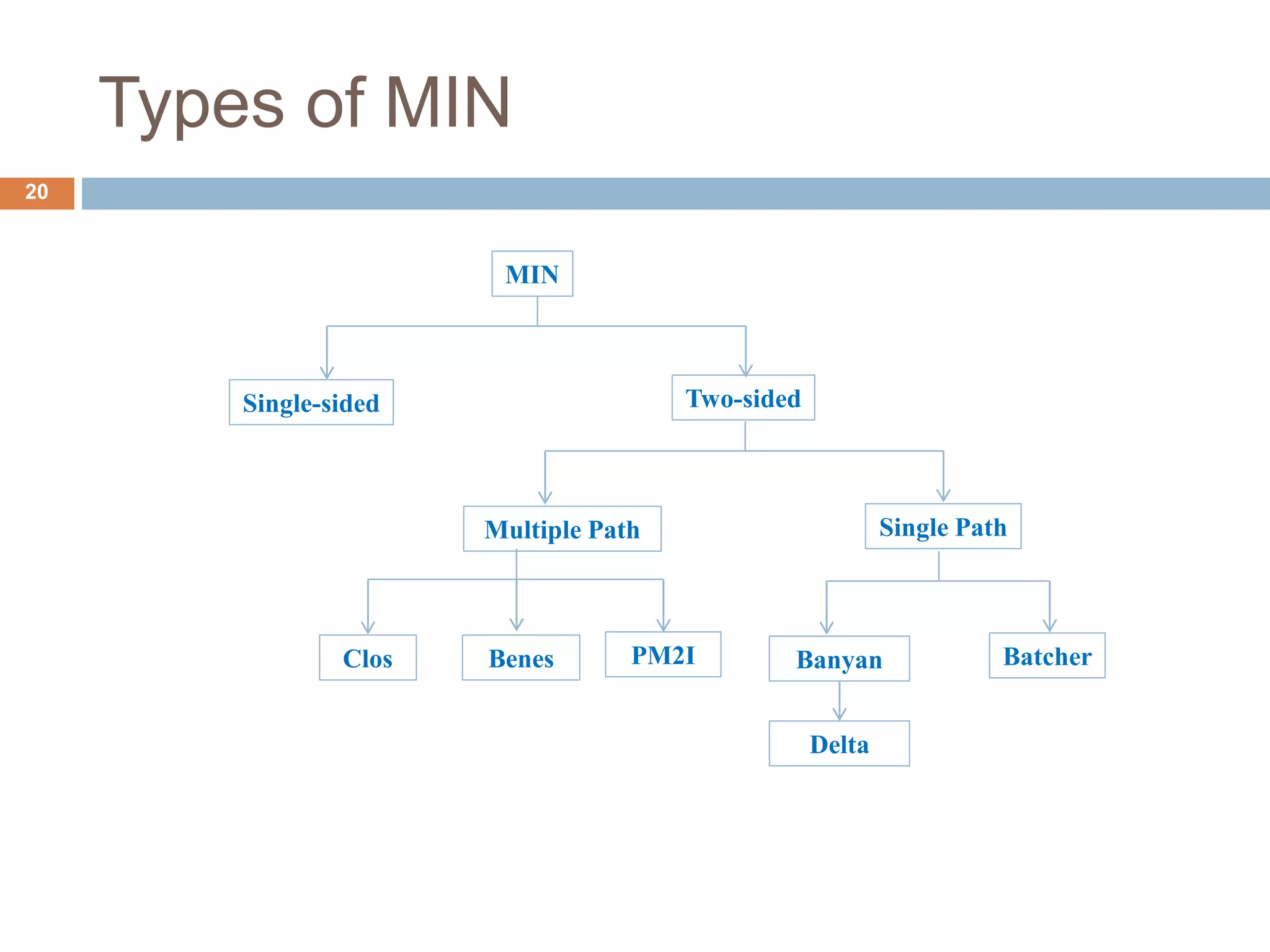
Types of MIN
20
MIN
Single-sided Two-sided
Multiple Path Single Path
Clos Benes PM2I Banyan Batcher
Delta
Multistage Networks
21
 Based on blocking, there are 3 types of MINs
 Nonblocking
 A network is called nonblocking if it is possible to establish a
connection between an input and an output regardless of what
other connections are currently in process
 Rearrangeable nonblocking
 A network is called rearrangeable nonblocking if it is possible to
establish all possible connections between inputs and outputs by
rearranging its existing connections
 Blocking interconnection
 A network is called blocking if some connections between inputs
and outputs block other input-output connections
 E.g., Omega network, Baseline network, Banyan network, etc.
Single Path: Omega network
22
Connect input (processor) 101 to output (memory module) 001
*From Ben Macey at http://www.ee.uwa.edu.au/~maceyb/aca319-2003
Algorithm
At stage k, look at the kth bit of the
destination address
If (kth bit == 0)
consider upper o/p port of the switch
Else
consider lower o/p port of the switch
Input = 101(5)
Shuffle(101) 011(3)
Consider upper port of switch B #1st bit of the
destination address at stage 1 is 0
Shuffle(010) 100(4)
Consider upper port of switch G #2nd bit of the
destination address at stage 2 is 0
Shuffle(100) 001(1)
Consider lower port of switch I #3rd bit of
the destination address at stage 3 is 1
 Suppose there is a connection from input 001 to output 100
 Try to establish a connection between input 011 and output 101
 It will make a collision at the upper output of 4th switch in 2nd
stage, therefore blocking the connection between input 011 and
output 101
Blocking in Omega network
Omega networks
24
 Uses 2 × 2 switches and perfect shuffle interconnect
pattern between the stages
 One unique path from each input to each output, no
redundant paths
 no fault tolerance and the possibility of blocking
 For N number of inputs and N number of outputs
 Number of stages is log2N (for 2 × 2 switches)
 Number of SEs per stage is N/2
 Total number of SEs is (N/2) log2(N)
 Number of permutations in a omega network is 2(N/2) log2(N)
Baseline networks
25
 This is another type of blocking network that can be generated
recursively
 The 1st stage N × N, the second (N/2) × (N/2), and so on
 Networks are topologically equivalent
 A network can be reproduced from the other networks by rearranging the
nodes at each stage.
*From Advanced Computer Architectures, K. Hwang, 1993.
 It is an 8 x 8 Benes network
 Here, the connection 110-100 blocks the connection between
input 100 and output 010
 However, by rearranging the 110-100 connection, it is possible
to establish a connection between input 100 and output 010
001
010
011
100
101
000
110
111
001
010
011
100
101
000
110
111
001
010
011
100
101
000
110
111
001
010
011
100
101
000
110
111
Multiple Path: Benes network
Performance Comparison
27
 Bus network
 Blocking
 Network complexity O(1)
 Network latency O(N)
 Crossbar network
 Non blocking
 Network complexity O(N2)
 Network latency O(1)
 Single stage IN
 Blocking
 Network complexity O(N)
 Network latency O(N)
 Multistage IN
 Blocking
 Network complexity O(N log2 N)
 Network latency O(log2 N)
28
Thank You

Dynamic interconnection networks

  • 1.
  • 2.
    Basics 2  Interconnection networksconsists of multiple processors and memory modules  The processors and memory modules can be connected with each other in various ways  These connections can be static or dynamic  In static networks, connections are fixed links  In dynamic network, connections are built on the fly as required
  • 3.
    Network properties 3  Degreeof a node (d)  The number of edges incident on a node  In-degree  Out-degree  In-Degree of a node  The number of incoming edges of a node  Out-Degree of a node  The number of outgoing edges of a node  Diameter of a node (D)  The maximum shortest path between any two nodes  Network latency  Worst-case time for a information to be transferred d = 5 In-degree = 3 Out-degree = 2 D = max(1,1,2,1,2,1) = 2 1 2 3 4
  • 4.
    Bisection of anetwork 4  Bisection width  The minimum number of wires that must be cut to divide the network into two equal halves.  A cut of a network C(A, B) is a set of channels, which partition the set of all nodes into 2 disjoint sets, where each element of C(A, B) is a channel with a source in A and destination in B or vice versa  A bisection of a network is a cut that partitions the network into equal halves, such that |A|≤|B|≤|A+1|  The channel bisection of a network is the minimum channel count over all bisections of the network | ) , ( | min sec B A C Bc tions bi 
  • 5.
    Types of Interconnections 5 Interconnectionnetworks Static networks Dynamic networks 2-dimension Bus based 1 -dimension Hypercube Switch based Single Multiple Single stage Multi Stage Crossbar
  • 6.
    Bus based Interconnection Networks 6 All the processors and memory modules are interconnected with each other by buses  Two types of bus based networks  Single bus networks  Multiple bus networks
  • 7.
    Single Bus Interconnected Systems 7 Multiple processors are interconnected by a single shared bus  Each processor has its own cache, less traffic  All processors communicate with a single shared memory  Number of buses used is 1, so the network complexity is O(1)  Maximum input to output delay is n, so time complexity is O(n) P1 P2 P3 Pn Shared Memory I/O devices Shared bus
  • 8.
    Multiple Bus Interconnected Systems 8 Multiple processors and multiple memory modules are interconnected by multiple parallel buses  High Reliability: A single bus failure will leave (m-1) distinct fault-free paths between the processors and the memory modules  It can be configured in different ways:, e.g., MBFBMC, MBSBMC, MBPBMC, MBCBMC P1 P2 P3 Pn M1 M2 M3 Mm Fig. 1
  • 9.
    Multiple Bus Interconnected Systems 9 MBFBMC: multiple bus with full bus–memory connection  All memory modules are connected with all buses (Fig. 1)  MBSBMC: multiple bus with single bus memory connection  One memory module is connected with one specific bus (Fig. 2)  MBPBMC: multiple bus with partial bus–memory connection  One memory module is connected to a subset of buses (Fig. 3)  MBCBMC: multiple bus with class-based memory connection  Memory modules grouped into classes whereby each class is connected to a specific subset of buses (Fig. 4) P1 P2 P3 Pn M1 M2 M3 Mn Fig. 2
  • 10.
    Multiple Bus Interconnected Systems P1P2 P3 Pn M1 M2 M3 M4 Fig. 4 P1 P2 P3 Pn M1 M2 M3 M4 Fig. 3 Class 1 Class 2
  • 11.
    Switch-Based Interconnection Networks 11  Allthe processors and memory modules are interconnected with each other via switches  Types of switch based networks  Crossbar Networks  Single-Stage Networks  Multistage Networks
  • 12.
    Crossbar Networks 12  Crossbarnetworks provide simultaneous connections among all inputs and outputs  It contains a switching element (SE) at the intersection of any two lines extended horizontally or vertically inside the switch  Each junction is a switching component, connecting the row to the column  A 4 x 4 crossbar network consists of 16 SEs P1 P2 P3 P4 M1 M2 M3 M4 SE
  • 13.
    Crossbar Networks 13  Twotypes of settings for SE 1. Straight 2. Diagonal  In an N x N crossbar, the number of switching points is N2, so the network complexity is O(N2)  Not scalable  Maximum input to output delay is 1, so time complexity is O(1)  Fast Transfer  Blocking if the destination is in use Straight switch Diagonal switch
  • 14.
    Switches Switch size Permutation connection Legitimatestates 2 × 2 2 4 4 × 4 24 256 8 × 8 40,320 16,777,216 N × N N! NN 14  Permutation connection  Each input can only be connected to a single output  Legitimate state  Each input can be connected to multiple outputs, but each output can only be connected to a single input
  • 15.
    Single Stage Networks 15 In single stage Interconnection Networks (INs), a simple 2 x 2 switching element (SE) is used  Four types of settings for SE  Shuffle-Exchange interconnection pattern is used to establish the connections between inputs and outputs  For m-bit input address Pm-1, Pm-2, …, P1, P0  Shuffle operation performs 1bit circular left shift on the bits  Shuffle(Pm-1, Pm-2, …, P1, P0) = Pm-2, Pm-3, …, P0, Pm-1  Exchange operation inverts the LSB  Exchange(Pm-1, Pm-2, …, P1, P0) = Pm-1, Pm-2, …, P1, 𝑃0 *From Advanced Computer Architectures, K. Hwang, 1993.
  • 16.
    16  Single stageShuffle-Exchange IN  Perfect shuffle operation  cyclic shift 1 place left  000(0)  000(0)  001(1)  010(2)  010(2)  100(4)  011(3)  110(6)  100(4)  001(1)  101(5)  011(3)  110(6)  101(5)  111(7)  111(7)  Exchange operation  Invert least significant bit  E.g., 101(5)  100(4) *From Ben Macey at http://www.ee.uwa.edu.au/~maceyb/aca319-2003 Single Stage Networks
  • 17.
    Demonstration 17  In an8-input single stage IN, create a dynamic connection between input 0 (000) and output (110) by using Shuffle–Exchange interconnection pattern.  The following sequence of shuffle/exchange operations is needed  E(000)  001  S(001)  010  E(010)  011  S(011)  110
  • 18.
    Single Stage Networks 18 For N number of inputs(processors) and N number of outputs (memory modules), the number of SEs is N/2  The maximum length of a path from an input to an output in the network, measured by the number of SEs along the path, is log2 N.  In single stage IN, the network complexity is O(N)  In single stage IN, the time complexity is O(N)  A single path between the inputs (processors) and the outputs (memory modules)
  • 19.
    Multistage Networks 19  MultistageInterconnection Network (MIN) are formed by cascading multiple single stage IN each with a set of 2 x 2 SEs  Stages are connected to each other using Inter Stage Connection (ISC) Pattern  The patterns can use any routing function  E.g., Shuffle–Exchange, Butterfly, Cube, etc.  Two types of MIN  Single path MIN  One unique path between any input/output pair  Banyan network  Multipath MIN  Multiple paths between any input/output pair  Delta network is a subset of Banyan network which shows self- routing property
  • 20.
    Types of MIN 20 MIN Single-sidedTwo-sided Multiple Path Single Path Clos Benes PM2I Banyan Batcher Delta
  • 21.
    Multistage Networks 21  Basedon blocking, there are 3 types of MINs  Nonblocking  A network is called nonblocking if it is possible to establish a connection between an input and an output regardless of what other connections are currently in process  Rearrangeable nonblocking  A network is called rearrangeable nonblocking if it is possible to establish all possible connections between inputs and outputs by rearranging its existing connections  Blocking interconnection  A network is called blocking if some connections between inputs and outputs block other input-output connections  E.g., Omega network, Baseline network, Banyan network, etc.
  • 22.
    Single Path: Omeganetwork 22 Connect input (processor) 101 to output (memory module) 001 *From Ben Macey at http://www.ee.uwa.edu.au/~maceyb/aca319-2003 Algorithm At stage k, look at the kth bit of the destination address If (kth bit == 0) consider upper o/p port of the switch Else consider lower o/p port of the switch Input = 101(5) Shuffle(101) 011(3) Consider upper port of switch B #1st bit of the destination address at stage 1 is 0 Shuffle(010) 100(4) Consider upper port of switch G #2nd bit of the destination address at stage 2 is 0 Shuffle(100) 001(1) Consider lower port of switch I #3rd bit of the destination address at stage 3 is 1
  • 23.
     Suppose thereis a connection from input 001 to output 100  Try to establish a connection between input 011 and output 101  It will make a collision at the upper output of 4th switch in 2nd stage, therefore blocking the connection between input 011 and output 101 Blocking in Omega network
  • 24.
    Omega networks 24  Uses2 × 2 switches and perfect shuffle interconnect pattern between the stages  One unique path from each input to each output, no redundant paths  no fault tolerance and the possibility of blocking  For N number of inputs and N number of outputs  Number of stages is log2N (for 2 × 2 switches)  Number of SEs per stage is N/2  Total number of SEs is (N/2) log2(N)  Number of permutations in a omega network is 2(N/2) log2(N)
  • 25.
    Baseline networks 25  Thisis another type of blocking network that can be generated recursively  The 1st stage N × N, the second (N/2) × (N/2), and so on  Networks are topologically equivalent  A network can be reproduced from the other networks by rearranging the nodes at each stage. *From Advanced Computer Architectures, K. Hwang, 1993.
  • 26.
     It isan 8 x 8 Benes network  Here, the connection 110-100 blocks the connection between input 100 and output 010  However, by rearranging the 110-100 connection, it is possible to establish a connection between input 100 and output 010 001 010 011 100 101 000 110 111 001 010 011 100 101 000 110 111 001 010 011 100 101 000 110 111 001 010 011 100 101 000 110 111 Multiple Path: Benes network
  • 27.
    Performance Comparison 27  Busnetwork  Blocking  Network complexity O(1)  Network latency O(N)  Crossbar network  Non blocking  Network complexity O(N2)  Network latency O(1)  Single stage IN  Blocking  Network complexity O(N)  Network latency O(N)  Multistage IN  Blocking  Network complexity O(N log2 N)  Network latency O(log2 N)
  • 28.