Download to read offline


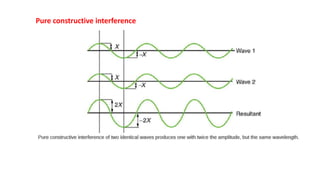

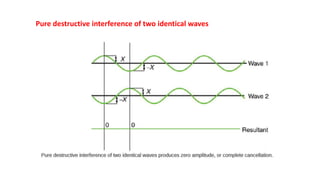
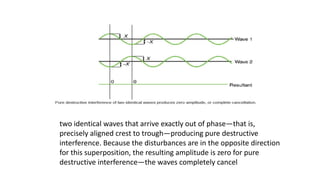
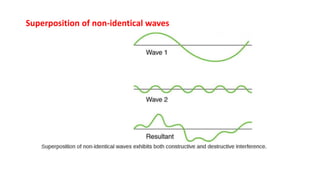
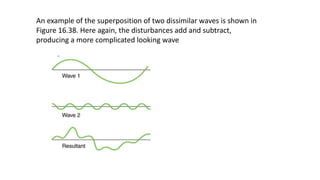


When two or more waves come together at the same point, they undergo superposition where their disturbances are added or subtracted. If the waves are identical and in phase, they constructively interfere and their amplitudes add to produce a larger wave. If identical waves are out of phase, they destructively interfere and completely cancel each other out. The superposition of non-identical waves results in a more complex interference pattern as the disturbances vary in both amplitude and phase.


