DISTANCE
ALBERTO M. CATALUNA, JR.
Distance is defined to be the
magnitude or size of
displacement between two positions
Note that the distance between
two positions is not the same
as the distance traveled
between them
Distance traveled is the total length of
the path traveled between two positions.
Distance has no direction and,
thus, no sign.
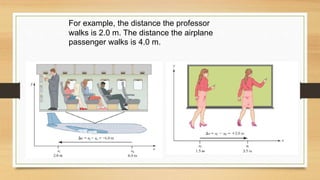
For example, the distance the professor
walks is 2.0 m. The distance the airplane
passenger walks is 4.0 m.
Check Your
Understanding
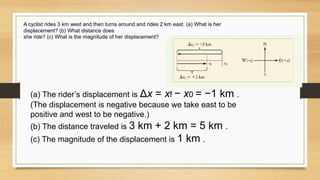
A cyclist rides 3 km west and then turns around
and rides 2 km east. (a) What is her
displacement? (b) What distance does
she ride? (c) What is the magnitude of her
displacement?
Solution
A cyclist rides 3 km west and then turns around and rides 2 km east. (a) What is her
displacement? (b) What distance does
she ride? (c) What is the magnitude of her displacement?
(a) The rider’s displacement is Δx = xf − x0 = −1 km .
(The displacement is negative because we take east to be
positive and west to be negative.)
(b) The distance traveled is 3 km + 2 km = 5 km .
(c) The magnitude of the displacement is 1 km .
A cyclist rides 3 km west and then turns around and rides 2 km east. (a) What is her
displacement? (b) What distance does
she ride? (c) What is the magnitude of her displacement?

Distance

  • 1.
  • 2.
    Distance is definedto be the magnitude or size of displacement between two positions
  • 3.
    Note that thedistance between two positions is not the same as the distance traveled between them
  • 4.
    Distance traveled isthe total length of the path traveled between two positions. Distance has no direction and, thus, no sign.
  • 5.
    For example, thedistance the professor walks is 2.0 m. The distance the airplane passenger walks is 4.0 m.
  • 6.
  • 7.
    A cyclist rides3 km west and then turns around and rides 2 km east. (a) What is her displacement? (b) What distance does she ride? (c) What is the magnitude of her displacement?
  • 8.
    Solution A cyclist rides3 km west and then turns around and rides 2 km east. (a) What is her displacement? (b) What distance does she ride? (c) What is the magnitude of her displacement?
  • 9.
    (a) The rider’sdisplacement is Δx = xf − x0 = −1 km . (The displacement is negative because we take east to be positive and west to be negative.) (b) The distance traveled is 3 km + 2 km = 5 km . (c) The magnitude of the displacement is 1 km . A cyclist rides 3 km west and then turns around and rides 2 km east. (a) What is her displacement? (b) What distance does she ride? (c) What is the magnitude of her displacement?