DISPLACEMENT
ALBERTO M. CATALUNA, JR.
If an object moves relative to a reference frame (for
example, if a professor moves to the right relative
to a white board or a
passenger moves toward the rear of an airplane),
then the object’s position changes. This change in
position is known as
displacement. The word “displacement” implies
that an object has moved, or has been displaced.
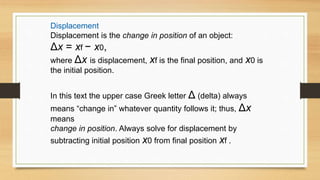
Displacement
Displacement is the change in position of an object:
Δx = xf − x0,
where Δx is displacement, xf is the final position, and x0 is
the initial position.
In this text the upper case Greek letter Δ (delta) always
means “change in” whatever quantity follows it; thus, Δx
means
change in position. Always solve for displacement by
subtracting initial position x0 from final position xf .
Note that displacement has a direction as well as a
magnitude. The professor’s displacement is 2.0 m to
the right, and the airline
passenger’s displacement is 4.0 m toward the rear.
In one-dimensional motion, direction can be
specified with a plus or minus
sign. When you begin a problem, you
should select which direction is positive
(usually that will be to the right or up, but
you are
free to select positive as being any
direction).
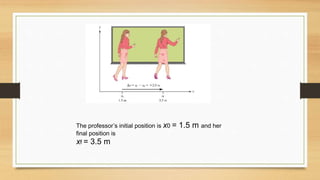
The professor’s initial position is x0 = 1.5 m and her
final position is
xf = 3.5 m
Thus her displacement is
Δx = xf −x0 = 3.5 m − 1.5 m = + 2.0
m
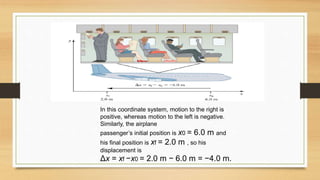
In this coordinate system, motion to the right is
positive, whereas motion to the left is negative.
Similarly, the airplane
passenger’s initial position is x0 = 6.0 m and
his final position is xf = 2.0 m , so his
displacement is
Δx = xf −x0 = 2.0 m − 6.0 m = −4.0 m.
His displacement is negative because his motion
is toward the rear of the plane, or in the negative
x direction in our coordinate
system

Displacement

  • 1.
  • 2.
    If an objectmoves relative to a reference frame (for example, if a professor moves to the right relative to a white board or a passenger moves toward the rear of an airplane), then the object’s position changes. This change in position is known as displacement. The word “displacement” implies that an object has moved, or has been displaced.
  • 3.
    Displacement Displacement is thechange in position of an object: Δx = xf − x0, where Δx is displacement, xf is the final position, and x0 is the initial position. In this text the upper case Greek letter Δ (delta) always means “change in” whatever quantity follows it; thus, Δx means change in position. Always solve for displacement by subtracting initial position x0 from final position xf .
  • 6.
    Note that displacementhas a direction as well as a magnitude. The professor’s displacement is 2.0 m to the right, and the airline passenger’s displacement is 4.0 m toward the rear.
  • 7.
    In one-dimensional motion,direction can be specified with a plus or minus sign. When you begin a problem, you should select which direction is positive (usually that will be to the right or up, but you are free to select positive as being any direction).
  • 8.
    The professor’s initialposition is x0 = 1.5 m and her final position is xf = 3.5 m
  • 9.
    Thus her displacementis Δx = xf −x0 = 3.5 m − 1.5 m = + 2.0 m
  • 10.
    In this coordinatesystem, motion to the right is positive, whereas motion to the left is negative. Similarly, the airplane passenger’s initial position is x0 = 6.0 m and his final position is xf = 2.0 m , so his displacement is Δx = xf −x0 = 2.0 m − 6.0 m = −4.0 m.
  • 11.
    His displacement isnegative because his motion is toward the rear of the plane, or in the negative x direction in our coordinate system