Factors Affecting
       Resistance
Reported By: Ralph Lery Guerrero
             Kevin Roxas
             Marco Lauro Delos Santos
Resistance


• Is defined as an obstacle to
  the flow of electric current.
• Is the opposition offered by
  any object to the passage of
  an electric current through
  it.
Length

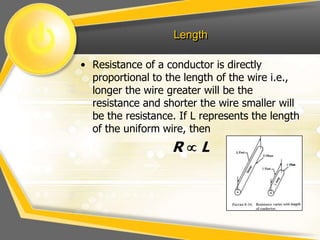
• Resistance of a conductor is directly
  proportional to the length of the wire i.e.,
  longer the wire greater will be the
  resistance and shorter the wire smaller will
  be the resistance. If L represents the length
  of the uniform wire, then
                   RL
Length


                    R1/R2=l1/l2
Where
        R1= resistance of the first conductor(in ohms)
        R2= resistance of the second conductor(in
ohms)
        l1=length of the first conductor (in cm)
        l2=length of the second conductor (in cm)
Length

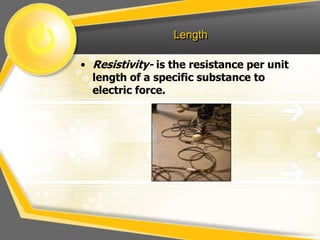
• Resistivity- is the resistance per unit
  length of a specific substance to
  electric force.
Length

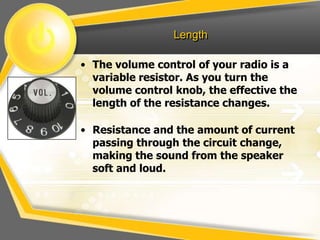
• The volume control of your radio is a
  variable resistor. As you turn the
  volume control knob, the effective the
  length of the resistance changes.

• Resistance and the amount of current
  passing through the circuit change,
  making the sound from the speaker
  soft and loud.
Diameter (Cross-sectional area)

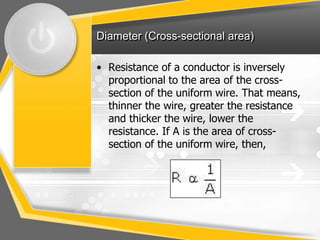
• Resistance of a conductor is inversely
  proportional to the area of the cross-
  section of the uniform wire. That means,
  thinner the wire, greater the resistance
  and thicker the wire, lower the
  resistance. If A is the area of cross-
  section of the uniform wire, then,
Diameter (Cross-sectional area)


   If the cross-sectional area is
   doubled, twice as many electrons
   became available to flow so that
   the current is doubled.
Diameter (Cross-sectional area)

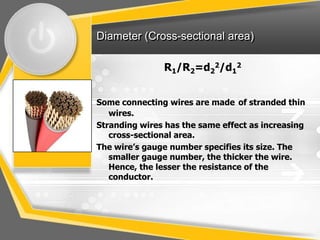
               R1/R2=d22/d12


Some connecting wires are made of stranded thin
   wires.
Stranding wires has the same effect as increasing
   cross-sectional area.
The wire’s gauge number specifies its size. The
   smaller gauge number, the thicker the wire.
   Hence, the lesser the resistance of the
   conductor.
Diameter (Cross-sectional area)

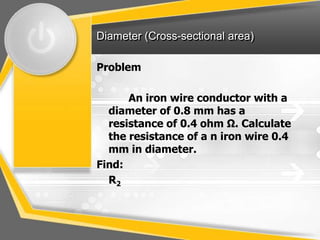
Problem

      An iron wire conductor with a
  diameter of 0.8 mm has a
  resistance of 0.4 ohm Ω. Calculate
  the resistance of a n iron wire 0.4
  mm in diameter.
Find:
  R2
Diameter (Cross-sectional area)

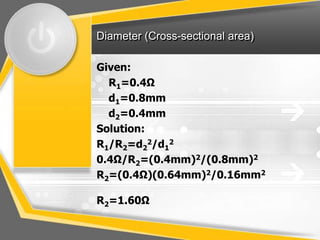
Given:
  R1=0.4Ω
  d1=0.8mm
  d2=0.4mm
Solution:
R1/R2=d22/d12
0.4Ω/R2=(0.4mm)2/(0.8mm)2
R2=(0.4Ω)(0.64mm)2/0.16mm2

R2=1.60Ω
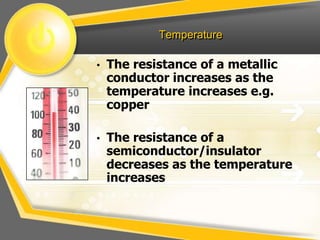
Temperature

•   The resistance of a metallic
    conductor increases as the
    temperature increases e.g.
    copper

•   The resistance of a
    semiconductor/insulator
    decreases as the temperature
    increases
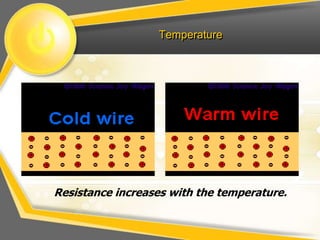
Temperature


Resistance increases with the temperature.
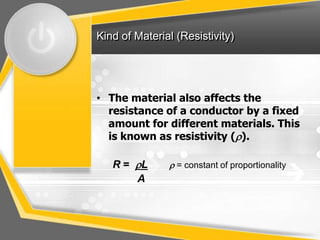
Kind of Material (Resistivity)


• The material also affects the
  resistance of a conductor by a fixed
  amount for different materials. This
  is known as resistivity ().

   R = L       = constant of proportionality
       A
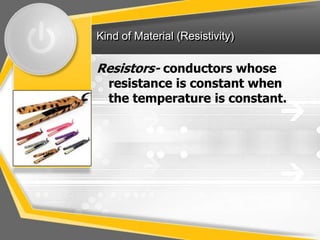
Kind of Material (Resistivity)

Resistors- conductors whose
  resistance is constant when
  the temperature is constant.
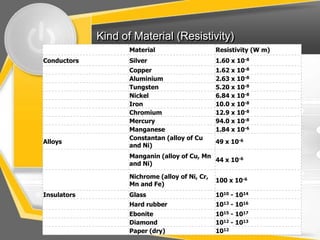
Kind of Material (Resistivity)
                    Material                     Resistivity (W m)
Conductors          Silver                       1.60 x 10⁻⁸
                    Copper                       1.62 x 10⁻⁸
                    Aluminium                    2.63 x 10⁻⁸
                    Tungsten                     5.20 x 10⁻⁸
                    Nickel                       6.84 x 10⁻⁸
                    Iron                         10.0 x 10⁻⁸
                    Chromium                     12.9 x 10⁻⁸
                    Mercury                      94.0 x 10⁻⁸
                    Manganese                    1.84 x 10⁻⁶
                    Constantan (alloy of Cu
Alloys                                           49 x 10-6
                    and Ni)
                    Manganin (alloy of Cu, Mn
                                              44 x 10-6
                    and Ni)

                    Nichrome (alloy of Ni, Cr,
                                                 100 x 10-6
                    Mn and Fe)
Insulators          Glass                        1010 - 1014
                    Hard rubber                  1013 - 1016
                    Ebonite                      1015 - 1017
                    Diamond                      1012 - 1013
                    Paper (dry)                  1012
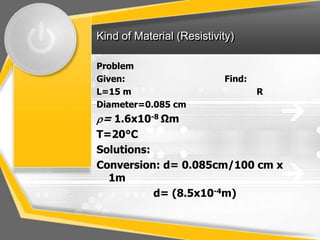
Kind of Material (Resistivity)

Problem
Given:                     Find:
L=15 m                             R
Diameter=0.085 cm
= 1.6x10⁻⁸ Ωm
T=20°C
Solutions:
Conversion: d= 0.085cm/100 cm x
  1m
           d= (8.5x10⁻⁴m)
Kind of Material (Resistivity)

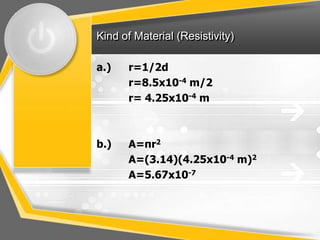
a.)   r=1/2d
      r=8.5x10⁻⁴ m/2
      r= 4.25x10⁻⁴ m


b.)   A=πr2
      A=(3.14)(4.25x10⁻⁴ m)2
      A=5.67x10⁻⁷
Kind of Material (Resistivity)


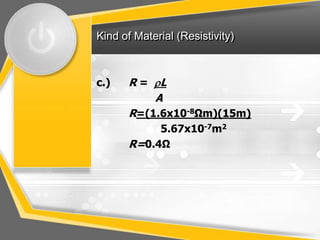
c.)   R = L
          A
      R=(1.6x10⁻⁸Ωm)(15m)
           5.67x10⁻⁷m2
      R=0.4Ω
Signing Off …    By: RLUG

THANK YOU! =))

Factors affecting resistance

  • 1.
    Factors Affecting Resistance Reported By: Ralph Lery Guerrero Kevin Roxas Marco Lauro Delos Santos
  • 2.
    Resistance • Is definedas an obstacle to the flow of electric current. • Is the opposition offered by any object to the passage of an electric current through it.
  • 3.
    Length • Resistance ofa conductor is directly proportional to the length of the wire i.e., longer the wire greater will be the resistance and shorter the wire smaller will be the resistance. If L represents the length of the uniform wire, then RL
  • 4.
    Length R1/R2=l1/l2 Where R1= resistance of the first conductor(in ohms) R2= resistance of the second conductor(in ohms) l1=length of the first conductor (in cm) l2=length of the second conductor (in cm)
  • 5.
    Length • Resistivity- isthe resistance per unit length of a specific substance to electric force.
  • 6.
    Length • The volumecontrol of your radio is a variable resistor. As you turn the volume control knob, the effective the length of the resistance changes. • Resistance and the amount of current passing through the circuit change, making the sound from the speaker soft and loud.
  • 7.
    Diameter (Cross-sectional area) •Resistance of a conductor is inversely proportional to the area of the cross- section of the uniform wire. That means, thinner the wire, greater the resistance and thicker the wire, lower the resistance. If A is the area of cross- section of the uniform wire, then,
  • 8.
    Diameter (Cross-sectional area) If the cross-sectional area is doubled, twice as many electrons became available to flow so that the current is doubled.
  • 9.
    Diameter (Cross-sectional area) R1/R2=d22/d12 Some connecting wires are made of stranded thin wires. Stranding wires has the same effect as increasing cross-sectional area. The wire’s gauge number specifies its size. The smaller gauge number, the thicker the wire. Hence, the lesser the resistance of the conductor.
  • 10.
    Diameter (Cross-sectional area) Problem An iron wire conductor with a diameter of 0.8 mm has a resistance of 0.4 ohm Ω. Calculate the resistance of a n iron wire 0.4 mm in diameter. Find: R2
  • 11.
    Diameter (Cross-sectional area) Given: R1=0.4Ω d1=0.8mm d2=0.4mm Solution: R1/R2=d22/d12 0.4Ω/R2=(0.4mm)2/(0.8mm)2 R2=(0.4Ω)(0.64mm)2/0.16mm2 R2=1.60Ω
  • 12.
    Temperature • The resistance of a metallic conductor increases as the temperature increases e.g. copper • The resistance of a semiconductor/insulator decreases as the temperature increases
  • 13.
  • 14.
    Kind of Material(Resistivity) • The material also affects the resistance of a conductor by a fixed amount for different materials. This is known as resistivity (). R = L  = constant of proportionality A
  • 15.
    Kind of Material(Resistivity) Resistors- conductors whose resistance is constant when the temperature is constant.
  • 16.
    Kind of Material(Resistivity) Material Resistivity (W m) Conductors Silver 1.60 x 10⁻⁸ Copper 1.62 x 10⁻⁸ Aluminium 2.63 x 10⁻⁸ Tungsten 5.20 x 10⁻⁸ Nickel 6.84 x 10⁻⁸ Iron 10.0 x 10⁻⁸ Chromium 12.9 x 10⁻⁸ Mercury 94.0 x 10⁻⁸ Manganese 1.84 x 10⁻⁶ Constantan (alloy of Cu Alloys 49 x 10-6 and Ni) Manganin (alloy of Cu, Mn 44 x 10-6 and Ni) Nichrome (alloy of Ni, Cr, 100 x 10-6 Mn and Fe) Insulators Glass 1010 - 1014 Hard rubber 1013 - 1016 Ebonite 1015 - 1017 Diamond 1012 - 1013 Paper (dry) 1012
  • 17.
    Kind of Material(Resistivity) Problem Given: Find: L=15 m R Diameter=0.085 cm = 1.6x10⁻⁸ Ωm T=20°C Solutions: Conversion: d= 0.085cm/100 cm x 1m d= (8.5x10⁻⁴m)
  • 18.
    Kind of Material(Resistivity) a.) r=1/2d r=8.5x10⁻⁴ m/2 r= 4.25x10⁻⁴ m b.) A=πr2 A=(3.14)(4.25x10⁻⁴ m)2 A=5.67x10⁻⁷
  • 19.
    Kind of Material(Resistivity) c.) R = L A R=(1.6x10⁻⁸Ωm)(15m) 5.67x10⁻⁷m2 R=0.4Ω
  • 20.
    Signing Off … By: RLUG THANK YOU! =))