wave optics _
COHERENT & INCOHERENT ADDITION OF WAVES .
~ Humera Fatima
II A -57
o COHERENT &
INCOHERENT WAVES
▹ Coherent waves
have the same
frequency and
constant phase
difference .
▹ Ex: sound waves ,
light waves ,
electromagnetic
waves etc.
▹ These waves have
random frequencies
and phase
differences .
▹ Ex: Tungsten
filament ,
fluorescent bulbs etc
.
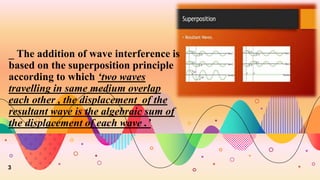
_ The addition of wave interference is
based on the superposition principle
according to which ‘two waves
travelling in same medium overlap
each other , the displacement of the
resultant wave is the algebraic sum of
the displacement of each wave .’
3
 Consider two needles S1 and S2
moving periodically up and down in
an identical fashion of water. They
produce two water waves , and at a
particular point , the phase difference
between the displacements produced by
each of the waves does not change with
time , when this happens the two
sources are said to be coherent . Shows
the position of crests & troughs at a
given instant of time .
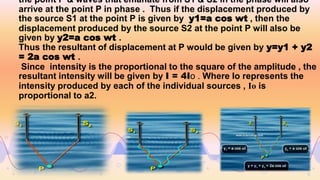
the point P & waves that emanate from S1 & S2 in the phase will also
arrive at the point P in phase . Thus if the displacement produced by
the source S1 at the point P is given by y1=a cos wt , then the
displacement produced by the source S2 at the point P will also be
given by y2=a cos wt .
Thus the resultant of displacement at P would be given by y=y1 + y2
= 2a cos wt .
Since intensity is the proportional to the square of the amplitude , the
resultant intensity will be given by I = 4Io . Where Io represents the
intensity produced by each of the individual sources , Io is
proportional to a2.
5
 The two sources are said to be
interfere constructively and we have
what we refer to as constructive
interference .
6
“
▹ We next consider a point Q for which S2Q – S1Q =2λ
▹ The waves emanating from S1 will arrive exactly two
cycles earlier than the waves from S2 & will again be in
phase. Thus if the displacement produced by S1 is given
by y1= a cost wt then the displacement produced by
S2 will be given by y2= a cos wt-4π = a cos wt .
Where we have used the fact that a path difference of
2lambda will corresponds to a phase difference of 4π .
▹ The two displacements are again in phase and the
intensity will be 4Io giving rise to constructive
interference.
7
.
In the above analysis we have assumed that the distances S1Q &
S2Q are much greater than D ( which represents the distance
between S1 & S2) .
So that although S1Q & S2Q are not equal , the amplitudes of the
displacement produced by each wave are very nearly the same .
.
8

wave optics-1.pptx

  • 1.
    wave optics _ COHERENT& INCOHERENT ADDITION OF WAVES . ~ Humera Fatima II A -57
  • 2.
    o COHERENT & INCOHERENTWAVES ▹ Coherent waves have the same frequency and constant phase difference . ▹ Ex: sound waves , light waves , electromagnetic waves etc. ▹ These waves have random frequencies and phase differences . ▹ Ex: Tungsten filament , fluorescent bulbs etc .
  • 3.
    _ The additionof wave interference is based on the superposition principle according to which ‘two waves travelling in same medium overlap each other , the displacement of the resultant wave is the algebraic sum of the displacement of each wave .’ 3
  • 4.
     Consider twoneedles S1 and S2 moving periodically up and down in an identical fashion of water. They produce two water waves , and at a particular point , the phase difference between the displacements produced by each of the waves does not change with time , when this happens the two sources are said to be coherent . Shows the position of crests & troughs at a given instant of time .
  • 5.
    the point P& waves that emanate from S1 & S2 in the phase will also arrive at the point P in phase . Thus if the displacement produced by the source S1 at the point P is given by y1=a cos wt , then the displacement produced by the source S2 at the point P will also be given by y2=a cos wt . Thus the resultant of displacement at P would be given by y=y1 + y2 = 2a cos wt . Since intensity is the proportional to the square of the amplitude , the resultant intensity will be given by I = 4Io . Where Io represents the intensity produced by each of the individual sources , Io is proportional to a2. 5
  • 6.
     The twosources are said to be interfere constructively and we have what we refer to as constructive interference . 6
  • 7.
    “ ▹ We nextconsider a point Q for which S2Q – S1Q =2λ ▹ The waves emanating from S1 will arrive exactly two cycles earlier than the waves from S2 & will again be in phase. Thus if the displacement produced by S1 is given by y1= a cost wt then the displacement produced by S2 will be given by y2= a cos wt-4π = a cos wt . Where we have used the fact that a path difference of 2lambda will corresponds to a phase difference of 4π . ▹ The two displacements are again in phase and the intensity will be 4Io giving rise to constructive interference. 7
  • 8.
    . In the aboveanalysis we have assumed that the distances S1Q & S2Q are much greater than D ( which represents the distance between S1 & S2) . So that although S1Q & S2Q are not equal , the amplitudes of the displacement produced by each wave are very nearly the same . . 8