Application of principle of
superposition of wave in the
formation of stationary wave
Presented by : [SECTION M2] Yukesh Gautam
Sirson Sharma
Ujjwal Shah
Shreeyansh Poudel
Sarthak Rijal
ACKNOWLEDGEMENT :
Never let small minds convince you that your dreams are too big!!
Hello and good morning to you all from my side. I Yukesh Gautam on the behalf of my
team members would like to express the deep sense of gratitude to our Uniglobe college
and respected teacher Mr. Saroj Baral who gave the
golden opportunity to do this project. I really acknowledge your support ,effort and timely
guidance which actually helped us in better understanding of the subject matter.
Also,
I could not forget my team members who have been so instrumental in the preparation of the project.
It was totally impossible to finalize the project without you!! Really kind effort and encouragement.
TABLE OF CONTENT
 Introduction
 Types of superposition waves
 Stationary waves
 Nodes and antinodes
 Characteristics
 Conclusion
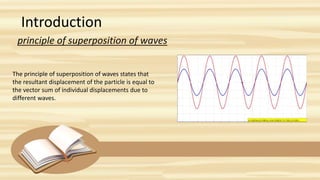
The principle of superposition of waves states that
the resultant displacement of the particle is equal to
the vector sum of individual displacements due to
different waves.
Introduction
principle of superposition of waves
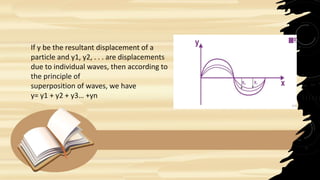
If y be the resultant displacement of a
particle and y1, y2, . . . are displacements
due to individual waves, then according to
the principle of
superposition of waves, we have
y= y1 + y2 + y3… +yn
Superposition of wave
Interference
There are two types of interference of a wave.
i. Constructive interference
ii. Destructive interference
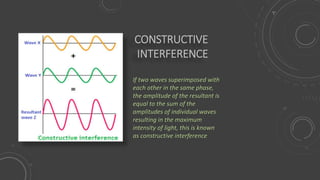
CONSTRUCTIVE
INTERFERENCE
If two waves superimposed with
each other in the same phase,
the amplitude of the resultant is
equal to the sum of the
amplitudes of individual waves
resulting in the maximum
intensity of light, this is known
as constructive interference
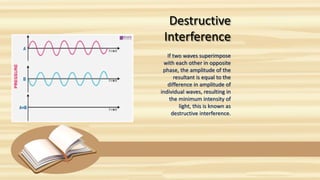
Destructive
Interference
If two waves superimpose
with each other in opposite
phase, the amplitude of the
resultant is equal to the
difference in amplitude of
individual waves, resulting in
the minimum intensity of
light, this is known as
destructive interference.
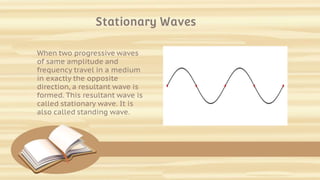
Let y1 and y2 be the displacements of
two progressive waves of same
amplitude a and wave length
travelling in opposite direction
simultaneously with the same velocity v.
The equations of these waves may be
expressed as follows,
y1 = a sin (ωt – kx) . . . (1)
y2 = a sin (ωt + kx) . . . (2)
Thus, the resultant displacement of the
particle of medium due to both the
waves will be determined
from the principle of superposition,
= y1 + y2
= a sin (ωt – kx) + a sin (ωt + kx)
= a [sin (ωt – kx) + a sin (ωt + kx)] Applying formula sinC+sinD
y = 2a cos kx. sinωt
y = A sinωt . . . (3)
Equation (3) represents a simple harmonic wave whose amplitude is A = 2a
cos kx. It is evident that, for different values of x, the amplitude will have
different values. Obviously, the frequency of stationary wave is equal to the
interfering waves i.e. there is no change in frequency.
Nodes and Antinodes
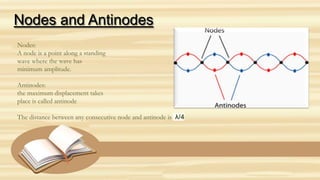
Nodes:
A node is a point along a standing
wave where the wave has
minimum amplitude.
Antinodes:
the maximum displacement takes
place is called antinode
The distance between any consecutive node and antinode is λ/4
1) One easy to understand example is two people shaking either end of a jump rope.
If they shake in sync, the rope will form a regular pattern with nodes and antinodes
and appear to be stationary, hence the name standing wave.
2) When we press a guitar string against the fret, we are fixing one of the ends, thus
causing a reflection phenomenon: when a wave formed in the string reaches the fret,
it is reflected and travels backwards.
CONCLUSION :
Overall, this project is the
source of knowledge of
Superposition of wave
and its types.
Again I will like to thanks
our respected teacher Mr
Saroj Baral for gaving us
golden opportunity to
participate in this project.
physics presentation (yukesh).pptx

physics presentation (yukesh).pptx

  • 1.
    Application of principleof superposition of wave in the formation of stationary wave
  • 2.
    Presented by :[SECTION M2] Yukesh Gautam Sirson Sharma Ujjwal Shah Shreeyansh Poudel Sarthak Rijal
  • 3.
    ACKNOWLEDGEMENT : Never letsmall minds convince you that your dreams are too big!! Hello and good morning to you all from my side. I Yukesh Gautam on the behalf of my team members would like to express the deep sense of gratitude to our Uniglobe college and respected teacher Mr. Saroj Baral who gave the golden opportunity to do this project. I really acknowledge your support ,effort and timely guidance which actually helped us in better understanding of the subject matter. Also, I could not forget my team members who have been so instrumental in the preparation of the project. It was totally impossible to finalize the project without you!! Really kind effort and encouragement.
  • 4.
    TABLE OF CONTENT Introduction  Types of superposition waves  Stationary waves  Nodes and antinodes  Characteristics  Conclusion
  • 5.
    The principle ofsuperposition of waves states that the resultant displacement of the particle is equal to the vector sum of individual displacements due to different waves. Introduction principle of superposition of waves
  • 6.
    If y bethe resultant displacement of a particle and y1, y2, . . . are displacements due to individual waves, then according to the principle of superposition of waves, we have y= y1 + y2 + y3… +yn
  • 7.
    Superposition of wave Interference Thereare two types of interference of a wave. i. Constructive interference ii. Destructive interference
  • 8.
    CONSTRUCTIVE INTERFERENCE If two wavessuperimposed with each other in the same phase, the amplitude of the resultant is equal to the sum of the amplitudes of individual waves resulting in the maximum intensity of light, this is known as constructive interference
  • 9.
    Destructive Interference If two wavessuperimpose with each other in opposite phase, the amplitude of the resultant is equal to the difference in amplitude of individual waves, resulting in the minimum intensity of light, this is known as destructive interference.
  • 11.
    Let y1 andy2 be the displacements of two progressive waves of same amplitude a and wave length travelling in opposite direction simultaneously with the same velocity v. The equations of these waves may be expressed as follows, y1 = a sin (ωt – kx) . . . (1) y2 = a sin (ωt + kx) . . . (2) Thus, the resultant displacement of the particle of medium due to both the waves will be determined
  • 12.
    from the principleof superposition, = y1 + y2 = a sin (ωt – kx) + a sin (ωt + kx) = a [sin (ωt – kx) + a sin (ωt + kx)] Applying formula sinC+sinD y = 2a cos kx. sinωt y = A sinωt . . . (3) Equation (3) represents a simple harmonic wave whose amplitude is A = 2a cos kx. It is evident that, for different values of x, the amplitude will have different values. Obviously, the frequency of stationary wave is equal to the interfering waves i.e. there is no change in frequency.
  • 13.
    Nodes and Antinodes Nodes: Anode is a point along a standing wave where the wave has minimum amplitude. Antinodes: the maximum displacement takes place is called antinode The distance between any consecutive node and antinode is λ/4
  • 14.
    1) One easyto understand example is two people shaking either end of a jump rope. If they shake in sync, the rope will form a regular pattern with nodes and antinodes and appear to be stationary, hence the name standing wave. 2) When we press a guitar string against the fret, we are fixing one of the ends, thus causing a reflection phenomenon: when a wave formed in the string reaches the fret, it is reflected and travels backwards.
  • 15.
    CONCLUSION : Overall, thisproject is the source of knowledge of Superposition of wave and its types. Again I will like to thanks our respected teacher Mr Saroj Baral for gaving us golden opportunity to participate in this project.