BANKING OF ROADS.
• Made by –
• Hrishank Chhatbar (103038)
• Ayush Bulchandani (103018)
• Sahil Chawla (103036)
• Dhruv Chechani (103037)
• Ishan Daga (103047)
CIRCULAR MOTION
• When a car is moving along a curved road, it is performing
circular motion. For circular motion it is not necessary
that the car should complete a full circle; an arc of a circle
is also treated as a circular path.
• We know that centripetal force (CPF) is necessary for
circular motion. If CPF is not present, the car cannot
travel along a circular path and will instead travel along a
tangential path.
• The centripetal force for circular motion of the car can be
provided in two ways:
1. Frictional force between the tyres of the car and
the road.
2. Banking of Roads
WHAT IS BANKING OF ROAD?
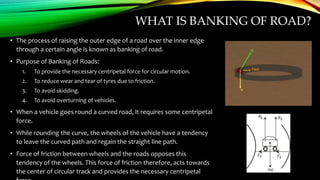
• The process of raising the outer edge of a road over the inner edge
through a certain angle is known as banking of road.
• Purpose of Banking of Roads:
1. To provide the necessary centripetal force for circular motion.
2. To reduce wear and tear of tyres due to friction.
3. To avoid skidding.
4. To avoid overturning of vehicles.
• When a vehicle goes round a curved road, it requires some centripetal
force.
• While rounding the curve, the wheels of the vehicle have a tendency
to leave the curved path and regain the straight line path.
• Force of friction between wheels and the roads opposes this
tendency of the wheels. This force of friction therefore, acts towards
the center of circular track and provides the necessary centripetal
DEFINITION AND DERIVATION
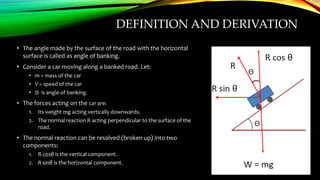
• The angle made by the surface of the road with the horizontal
surface is called as angle of banking.
• Consider a car moving along a banked road. Let:
• m = mass of the car
• V = speed of the car
• Θ is angle of banking.
• The forces acting on the car are:
1. Its weight mg acting vertically downwards.
2. The normal reaction R acting perpendicular to the surface of the
road.
• The normal reaction can be resolved (broken up) into two
components:
1. R cosθ is the vertical component.
2. R sinθ is the horizontal component.
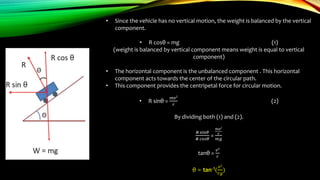
• Since the vehicle has no vertical motion, the weight is balanced by the vertical
component.
• R cosθ = mg (1)
(weight is balanced by vertical component means weight is equal to vertical
component)
• The horizontal component is the unbalanced component . This horizontal
component acts towards the center of the circular path.
• This component provides the centripetal force for circular motion.
• R sinθ =
𝑚𝑣2
𝑟
(2)
By dividing both (1) and (2).
𝑅 sin𝜃
𝑅 𝑐𝑜𝑠𝜃
=
𝑚𝑣
2
𝑟
𝑚𝑔
tanθ =
𝑣2
𝑟
θ = tan-1(
𝑣2
𝑟𝑔
)
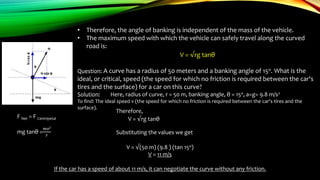
• Therefore, the angle of banking is independent of the mass of the vehicle.
• The maximum speed with which the vehicle can safely travel along the curved
road is:
V = √rg tanθ
Question: A curve has a radius of 50 meters and a banking angle of 15o. What is the
ideal, or critical, speed (the speed for which no friction is required between the car's
tires and the surface) for a car on this curve?
Solution: Here, radius of curve, r = 50 m, banking angle, θ = 15o, a=g= 9.8 m/s2
To find: The ideal speed v (the speed for which no friction is required between the car's tires and the
surface).
F Net = F Centripetal
mg tanθ =
𝑚𝑣2
𝑟
Therefore,
V = √rg tanθ
Substituting the values we get
V = √(50 m) (9.8 ) (tan 15o)
V = 11 m/s
If the car has a speed of about 11 m/s, it can negotiate the curve without any friction.
MAX SPEED OF A VEHICLE ON A
BANKED ROAD WITH FRICTION
• Consider a vehicle moving along a curved banked road. Let
• m = mass of vehicle
• r = radius of curvature of road
• θ = angle of banking
• F = frictional force between tyres and road.
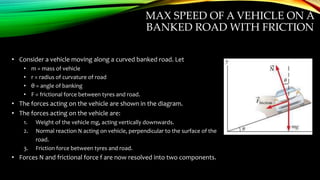
• The forces acting on the vehicle are shown in the diagram.
• The forces acting on the vehicle are:
1. Weight of the vehicle mg, acting vertically downwards.
2. Normal reaction N acting on vehicle, perpendicular to the surface of the
road.
3. Friction force between tyres and road.
• Forces N and frictional force f are now resolved into two components.
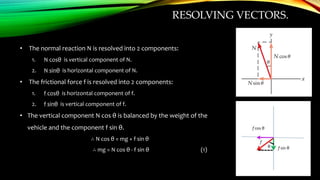
• The normal reaction N is resolved into 2 components:
1. N cosθ is vertical component of N.
2. N sinθ is horizontal component of N.
• The frictional force f is resolved into 2 components:
1. f cosθ is horizontal component of f.
2. f sinθ is vertical component of f.
• The vertical component N cos θ is balanced by the weight of the
vehicle and the component f sin θ.
∴ N cos θ = mg + f sin θ
∴ mg = N cos θ - f sin θ (1)
RESOLVING VECTORS.
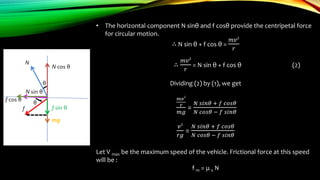
• The horizontal component N sinθ and f cosθ provide the centripetal force
for circular motion.
∴ N sin θ + f cos θ =
𝑚𝑣2
𝑟
∴
𝑚𝑣2
𝑟
= N sin θ + f cos θ (2)
Dividing (2) by (1), we get
𝑚𝑣2
𝑟
𝑚𝑔
=
𝑁 𝑠𝑖𝑛𝜃 + 𝑓 𝑐𝑜𝑠𝜃
𝑁 𝑐𝑜𝑠𝜃 − 𝑓 𝑠𝑖𝑛𝜃
𝑣2
𝑟𝑔
=
𝑁 𝑠𝑖𝑛𝜃 + 𝑓 𝑐𝑜𝑠𝜃
𝑁 𝑐𝑜𝑠𝜃 − 𝑓 𝑠𝑖𝑛𝜃
Let V max be the maximum speed of the vehicle. Frictional force at this speed
will be :
f m = μ s N
𝑣 𝑚𝑎𝑥
2
𝑟𝑔
=
𝑁 𝑠𝑖𝑛𝜃 + 𝑓 𝑚
𝑐𝑜𝑠𝜃
𝑁 𝑐𝑜𝑠𝜃 − 𝑓 𝑚
𝑠𝑖𝑛𝜃
But
f m = μ s N
∴
𝑣 𝑚𝑎𝑥
2
𝑟𝑔
=
𝑁 𝑠𝑖𝑛𝜃 + μs N 𝑐𝑜𝑠𝜃
𝑁 𝑐𝑜𝑠𝜃 − μs N 𝑠𝑖𝑛𝜃
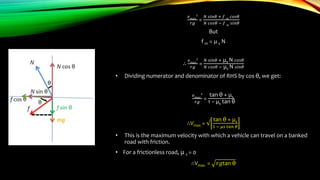
• Dividing numerator and denominator of RHS by cos θ, we get:
𝑣 𝑚𝑎𝑥
2
𝑟𝑔
=
tan θ + μs
1 − μs tan θ
∴Vmax = √
tan θ + μs
1 − 𝜇𝑠 𝑡𝑎𝑛 𝜃
• This is the maximum velocity with which a vehicle can travel on a banked
road with friction.
• For a frictionless road, μ s = 0
∴Vmax = 𝑟𝑔tan θ
THANK YOU