THE SHOULDER
Anatomy
Separations
Fractured Clavicle
Dislocations
Supraspinatus
Tendonitis
THE SHOULDER
Scapulothoracic
Acromioclavicular
Sternoclavicular
Glenohumeral
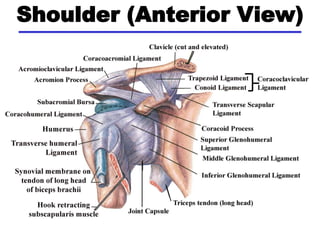
Shoulder (Anterior View)
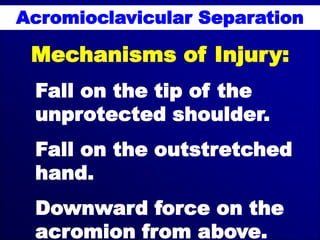
Acromioclavicular Separation
Mechanisms of Injury:
Fall on the tip of the
unprotected shoulder.
Fall on the outstretched
hand.
Downward force on the
acromion from above.
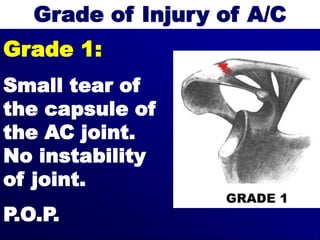
Grade of Injury of A/C
Grade 1:
Small tear of
the capsule of
the AC joint.
No instability
of joint.
P.O.P.
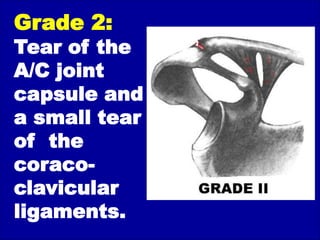
Grade 2:
Tear of the
A/C joint
capsule and
a small tear
of the
coraco-
clavicular
ligaments.
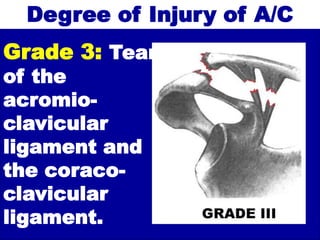
Degree of Injury of A/C
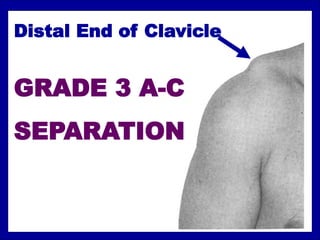
Grade 3: Tear
of the
acromio-
clavicular
ligament and
the coraco-
clavicular
ligament.
Distal End of Clavicle
GRADE 3 A-C
SEPARATION
INSTABILITY OF A-C Jt.
Grade 1: No instability of
acromio-clavicular joint.
Grade 2: Slight instability of
A-C joint. ‘Springy’
clavicle.
Grade 3: Total separation of
A-C joint. The clavicle
goes superiorly.
ACTIVE MOVEMENTS
TO ASSESS A-C Jt.
Abduction
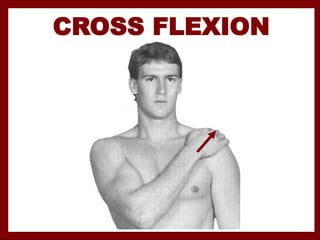
Cross Flexion
CROSS FLEXION
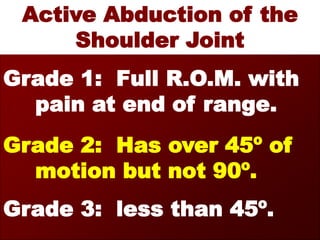
Active Abduction of the
Shoulder Joint
Grade 1: Full R.O.M. with
pain at end of range.
Grade 2: Has over 45º of
motion but not 90º.
Grade 3: less than 45º.
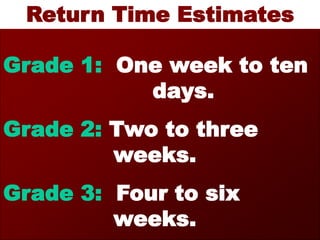
Return Time Estimates
Grade 1: One week to ten
days.
Grade 2: Two to three
weeks.
Grade 3: Four to six
weeks.
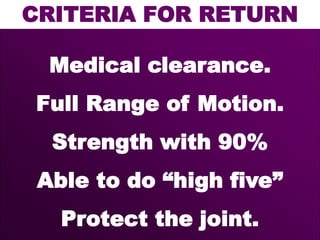
CRITERIA FOR RETURN
Medical clearance.
Full Range of Motion.
Strength with 90%
Able to do “high five”
Protect the joint.
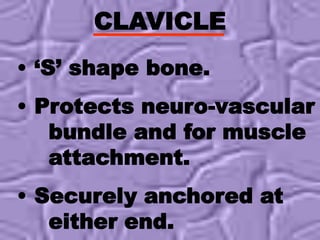
CLAVICLE
• ‘S’ shape bone.
• Protects neuro-vascular
bundle and for muscle
attachment.
• Securely anchored at
either end.
CLAVICLE FRACTURE
Any force that brings the
shoulder to the midline of
the body.
Direct impact to clavicle
from superior or anterior
direction.
Clavicle Fracture: Signs &
Symptoms
Pain and loss of function of
shoulder.
Spasm of trapezius and SCM
(sternocliedomastoid) m.
Arm held to body, shoulder
elevated.
Clavicle Fracture: Signs &
Symptoms
May be palpable deformity
when palpating the clavicle.
In a pre-pubescent person,
they may get a ‘greenstick’
fracture.
MEDICAL REFERRAL!
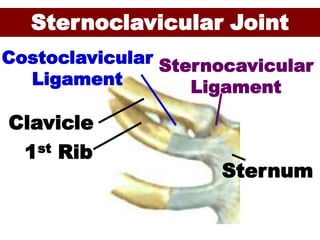
Clavicle
1st Rib
Sternum
Sternocavicular
Ligament
Costoclavicular
Ligament
Sternoclavicular Joint
STERNOCLAVICULAR
JOINT SEPARATION
Very stable joint. Major ligaments
are the sternoclavicular and costo-
clavicular ligaments.
Mechanism of Injury is the
same as for the A.C. joint.
Pain. Loss of motion. The
unaffected side looks higher.
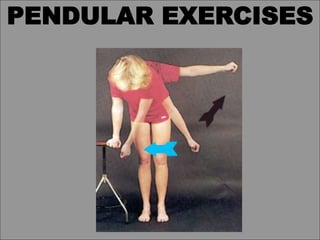
PENDULAR EXERCISES
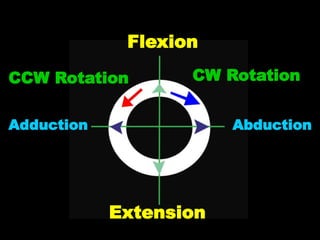
Flexion
Adduction Abduction
Extension
CW Rotation
CCW Rotation
ANATOMICAL
PREDISPOSITION TO
DISLOCATION
• Glenoid Defects
• Labral Defects
• Neuromuscular
Disorders
LUX = DISLOCATE
SUBLUX = PARTIAL
DISLOCATION
TERMINOLOGY
TRAUMATIC
Single force applies
excessive overload to the
soft tissues of the joint and
often damages the Glenoid
Labrum (Bankart Lesion)
and the joint capsule.
ATRAUMATIC
Athlete who has multiple
joint laxities, who had
frequent episodes of sub-
luxations before and a
relatively minor one
results in dislocation.
(Congenital hypermobility
and/or muscle weakness)
ACQUIRED
Sports such as swimming,
gymnastics and baseball
where repetitive micro-
trauma, poor stretching and
motion lead to capsular
stretching. Eventual
feeling of instability.
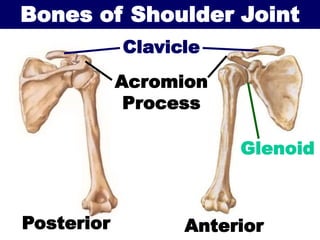
Bones of Shoulder Joint
Acromion
Process
Clavicle
Posterior Anterior
Glenoid
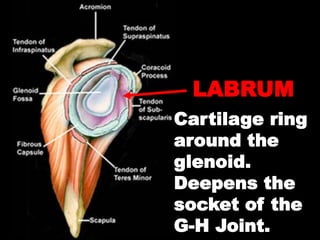
LABRUM
Cartilage ring
around the
glenoid.
Deepens the
socket of the
G-H Joint.
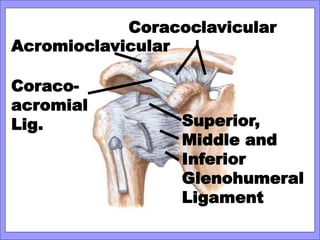
Superior,
Middle and
Inferior
Glenohumeral
Ligament
Coracoclavicular
Acromioclavicular
Coraco-
acromial
Lig.
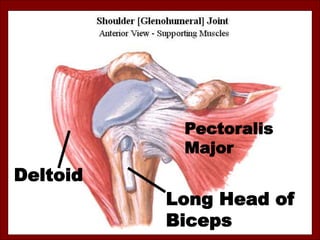
Pectoralis
Major
Long Head of
Biceps
Deltoid
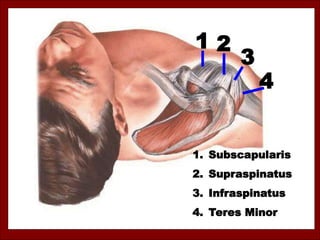
1 2
3
4
1. Subscapularis
2. Supraspinatus
3. Infraspinatus
4. Teres Minor
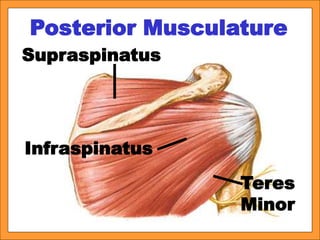
Supraspinatus
Infraspinatus
Teres
Minor
Posterior Musculature
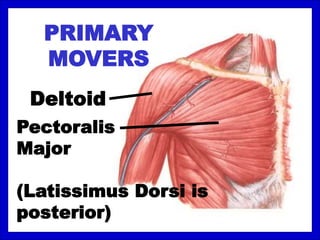
PRIMARY
MOVERS
Deltoid
Pectoralis
Major
(Latissimus Dorsi is
posterior)
TYPES OF DISLOCATIONS
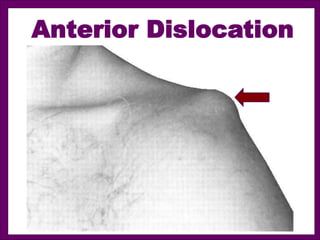
Anterior (85%)
Inferior (5%)
Posterior (10%)
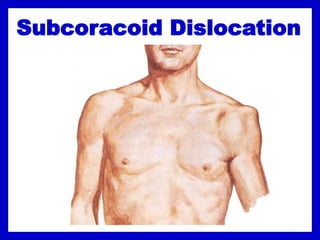
Subcoracoid
Dislocation
ANTERIOR DISLOCATION
Arm in abduction and
external rotation. Force
is taken on the hand or
arm which increases the
external rotation of the
arm causing the head of
the humerus to dislocate.
INFERIOR DISLOCATION
Arm is in excessive
abduction and a force
is taken on the hand
pushing the head of
the humerus inferiorly
out of the glenoid.
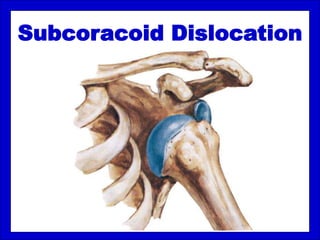
Subcoracoid Dislocation
Anterior Dislocation
Subcoracoid Dislocation
The elbow is held away
from the side and the
hand can not turn onto
the stomach.
POSTERIOR DISLOCATION
The arm is in flexion
and adduction. Force is
taken on the hand,
causing the head of the
humerus to be push out
the glenoid posteriorly.
POSTERIOR DISLOCATION
The coracoid process
may be prominent. The
elbow will be at the side
and the hand on the
stomach. Attempting to
turn the arm out causes
shoulder pain.
For any dislocated
shoulder, do not try to
reduce the joint. Do not
pull on the arm.
Try to immobilize as best
you can (difficult).
Medical referral!
Recurrent dislocations
have nothing to do with
the treatment after the
first dislocation.
Recurrent dislocations are
dependent upon the
damage that happens
during the first dislocation.
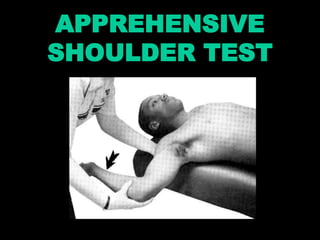
APPREHENSIVE
SHOULDER TEST
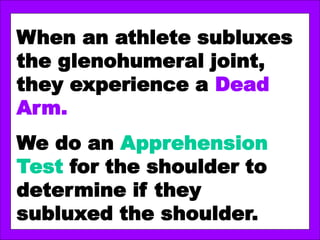
When an athlete subluxes
the glenohumeral joint,
they experience a Dead
Arm.
We do an Apprehension
Test for the shoulder to
determine if they
subluxed the shoulder.
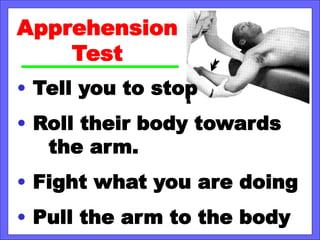
Apprehension
Test
• Tell you to stop
• Roll their body towards
the arm.
• Fight what you are doing
• Pull the arm to the body
OVERUSE INJURIES OF
THE SHOULDER
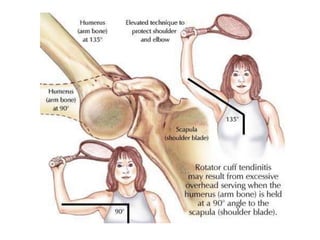
SUPRASPINATUS
IMPINGEMENT
OF THE
SHOULDER
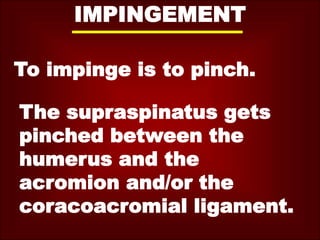
IMPINGEMENT
To impinge is to pinch.
The supraspinatus gets
pinched between the
humerus and the
acromion and/or the
coracoacromial ligament.
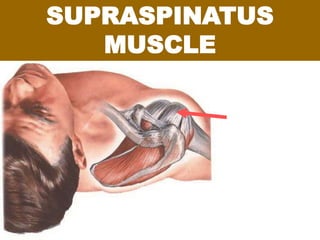
SUPRASPINATUS
MUSCLE
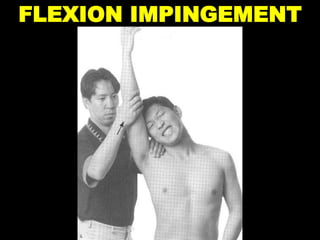
FLEXION IMPINGEMENT
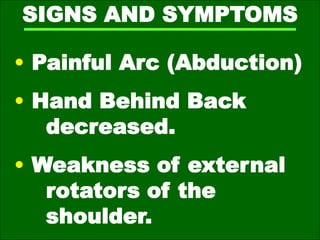
SIGNS AND SYMPTOMS
• Painful Arc (Abduction)
• Hand Behind Back
decreased.
• Weakness of external
rotators of the
shoulder.
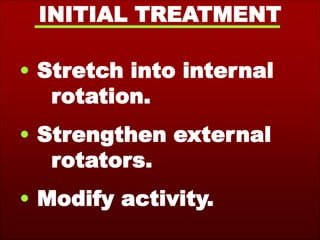
INITIAL TREATMENT
• Stretch into internal
rotation.
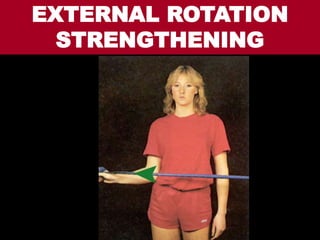
• Strengthen external
rotators.
• Modify activity.
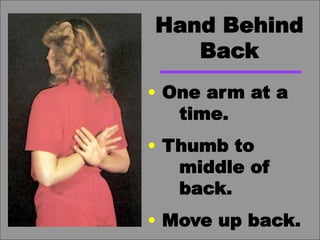
Hand Behind
Back
• One arm at a
time.
• Thumb to
middle of
back.
• Move up back.
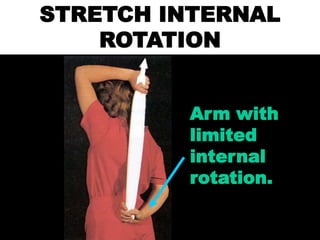
STRETCH INTERNAL
ROTATION
Arm with
limited
internal
rotation.
EXTERNAL ROTATION
STRENGTHENING
MEDICAL REFERRAL
PHYSIOTHERAPY

Shoulder.ppt