DERMATOMES AND
MYOTOMES
-Dr. Monica Dhanani
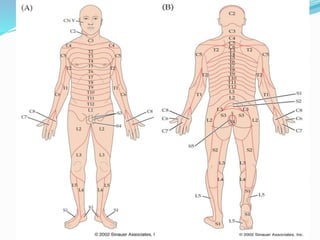
Dermatomes:- the sensory distribution of each nerve
root is called the dermatomes.
The area of the skin supplied by a single nerve root
 There are 31 segments of spinal cord each with a pair of
ventral and dorsal that innervate motor and sensory
function resp.
 The anterior and posterior nerve roots combine on each
side to form the spinal nerve as they exit the vertebral canal
through IV foramina
 The 31 spines segment on each side give rise to 31 spinal
nerves which are composed of 8C, 12T, 5L ,5S and 1C spinal
nerve
 Dermatomes exist for each of the spinal nerve except C1
 Sensory information form a specific dermatomes is
transmitted by the sensory nerve fibers to the spinal nerve
of a specific segment of spinal cord
 Dermatomes along the arms and legs differs from the
pattern of the trunk dermatomes because they run
longitudinally along the limbs
Clinical Significance
 dermatomes are useful to help localize neurological
levels particularly in radiculopathy.
 Effacement or encroachment of a spinal nerve may or
may not exhibited symptoms in dermatomic area
covered by the compressed nerve root in addition to
weakness or dtr loss
 Viruses that infect spinal nerves such as herpes zoster
reveal their origin by showing up as a pain full
dermatomic area
 C1- vertex of skull
 C2-forehead occiput
 C3-neck,temporal area
 C4-shoulder area,clavicles,upper scap
 C5-deltoid, ant arm till base of thumb
 C6-ant arm,rad side of hand to thumb n index finger
 C7-Lat arm n forearm to index,long and ring fingers
 C8-medial arm and forearm to long,ring and little fingers
 T1-medial side of forearm to base of little finger
 T2-medial side of upp arm to med elbow,pectoral and
midscapular area
 T3 to T12- T3 to T6 upper thorax
 T5-T7 coastal margin
 T8-T12 abdomen and lumbar region
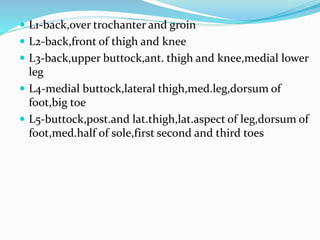
 L1-back,over trochanter and groin
 L2-back,front of thigh and knee
 L3-back,upper buttock,ant. thigh and knee,medial lower
leg
 L4-medial buttock,lateral thigh,med.leg,dorsum of
foot,big toe
 L5-buttock,post.and lat.thigh,lat.aspect of leg,dorsum of
foot,med.half of sole,first second and third toes
 S1-buttock,thigh,and leg post.
 S2-same as s1
 S3-groin,med.thigh to knee
 S4-perineum,genitals,lower sacrum
Myotomes:- are defined as groups of
muscles supplied by a single nerve root.
Clinical Significance
 Info. about the level in the spine where a lesion may be
present.
 Muscle weakness
 IV disc herniation
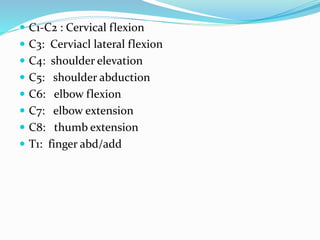
 C1-C2 : Cervical flexion
 C3: Cerviacl lateral flexion
 C4: shoulder elevation
 C5: shoulder abduction
 C6: elbow flexion
 C7: elbow extension
 C8: thumb extension
 T1: finger abd/add
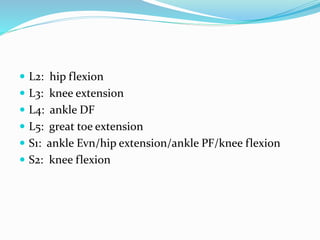
 L2: hip flexion
 L3: knee extension
 L4: ankle DF
 L5: great toe extension
 S1: ankle Evn/hip extension/ankle PF/knee flexion
 S2: knee flexion
THANK YOU

DERMATOMES AND MYOTOMES

  • 1.
  • 2.
    Dermatomes:- the sensorydistribution of each nerve root is called the dermatomes. The area of the skin supplied by a single nerve root
  • 3.
     There are31 segments of spinal cord each with a pair of ventral and dorsal that innervate motor and sensory function resp.  The anterior and posterior nerve roots combine on each side to form the spinal nerve as they exit the vertebral canal through IV foramina  The 31 spines segment on each side give rise to 31 spinal nerves which are composed of 8C, 12T, 5L ,5S and 1C spinal nerve  Dermatomes exist for each of the spinal nerve except C1  Sensory information form a specific dermatomes is transmitted by the sensory nerve fibers to the spinal nerve of a specific segment of spinal cord  Dermatomes along the arms and legs differs from the pattern of the trunk dermatomes because they run longitudinally along the limbs
  • 4.
    Clinical Significance  dermatomesare useful to help localize neurological levels particularly in radiculopathy.  Effacement or encroachment of a spinal nerve may or may not exhibited symptoms in dermatomic area covered by the compressed nerve root in addition to weakness or dtr loss  Viruses that infect spinal nerves such as herpes zoster reveal their origin by showing up as a pain full dermatomic area
  • 5.
     C1- vertexof skull  C2-forehead occiput  C3-neck,temporal area  C4-shoulder area,clavicles,upper scap  C5-deltoid, ant arm till base of thumb  C6-ant arm,rad side of hand to thumb n index finger  C7-Lat arm n forearm to index,long and ring fingers  C8-medial arm and forearm to long,ring and little fingers  T1-medial side of forearm to base of little finger  T2-medial side of upp arm to med elbow,pectoral and midscapular area  T3 to T12- T3 to T6 upper thorax  T5-T7 coastal margin  T8-T12 abdomen and lumbar region
  • 7.
     L1-back,over trochanterand groin  L2-back,front of thigh and knee  L3-back,upper buttock,ant. thigh and knee,medial lower leg  L4-medial buttock,lateral thigh,med.leg,dorsum of foot,big toe  L5-buttock,post.and lat.thigh,lat.aspect of leg,dorsum of foot,med.half of sole,first second and third toes
  • 8.
     S1-buttock,thigh,and legpost.  S2-same as s1  S3-groin,med.thigh to knee  S4-perineum,genitals,lower sacrum
  • 9.
    Myotomes:- are definedas groups of muscles supplied by a single nerve root.
  • 10.
    Clinical Significance  Info.about the level in the spine where a lesion may be present.  Muscle weakness  IV disc herniation
  • 11.
     C1-C2 :Cervical flexion  C3: Cerviacl lateral flexion  C4: shoulder elevation  C5: shoulder abduction  C6: elbow flexion  C7: elbow extension  C8: thumb extension  T1: finger abd/add
  • 12.
     L2: hipflexion  L3: knee extension  L4: ankle DF  L5: great toe extension  S1: ankle Evn/hip extension/ankle PF/knee flexion  S2: knee flexion
  • 13.