ABNORMAL GAIT PATTERNS
GAIT & GAIT CYCLE
• Human gait refers to locomotion achieved
through the movement of human limbs.
• Gait is a series of rhythmical & alternating
movements of trunk & limbs which result in
forward progression of center of gravity & the
body.
• Gait is a sequence of foot movements by which a
person moves forward.
• The gait cycle is a repetitive pattern involving
steps and strides.
GAIT CYCLE
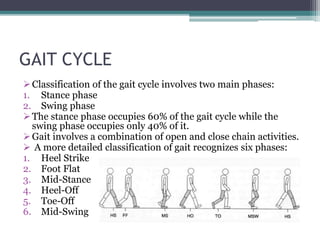
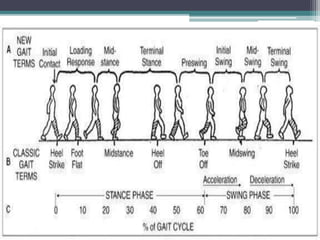
Classification of the gait cycle involves two main phases:
1. Stance phase
2. Swing phase
The stance phase occupies 60% of the gait cycle while the
swing phase occupies only 40% of it.
Gait involves a combination of open and close chain activities.
 A more detailed classification of gait recognizes six phases:
1. Heel Strike
2. Foot Flat
3. Mid-Stance
4. Heel-Off
5. Toe-Off
6. Mid-Swing
GAIT CYCLE
An alternative classification of gait involves the
following eight phases:
1. Initial Contact
2. Loading Response
3. Midstance
4. Terminal Stance
5. Pre swing
6. Initial Swing
7. Mid Swing
8. Late Swing
Abnormal Gait Syndromes
In general gait deviations fall under four
headings:
▫ Pain
▫ Joint muscle range of motion(ROM) limitation
▫ Muscular weakness/paralysis
▫ Neurological involvement(UMN,LMN)
▫ Leg length discrepancies
Abnormal Gait
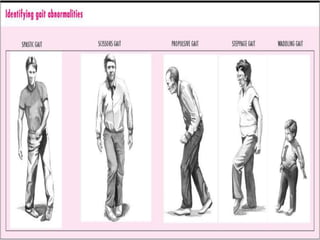
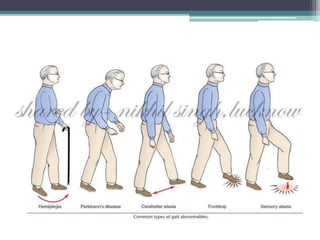
Hemiplegic gait
Scissors gait/ Diplegic gait
Myopathic gait
Steppage gait
Parkinson gait &Propulsive gait
Sensory gait
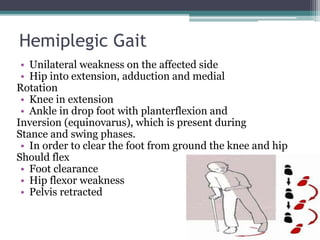
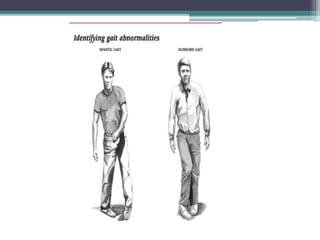
Hemiplegic Gait
• Unilateral weakness on the affected side
• Hip into extension, adduction and medial
Rotation
• Knee in extension
• Ankle in drop foot with planterflexion and
Inversion (equinovarus), which is present during
Stance and swing phases.
• In order to clear the foot from ground the knee and hip
Should flex
• Foot clearance
• Hip flexor weakness
• Pelvis retracted
Hemiplegic Gait
• Weakness in distal muscles(foot drop) and
extensor hypertonia in lower limb.
• Most commonly seen in stroke. with mild
hemepresis, loss of normal arm swing.
• Slight circumduction may be the only
abnormalities
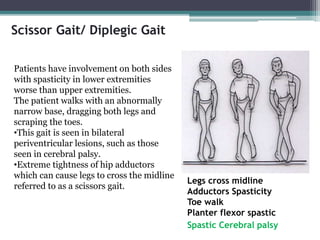
Legs cross midline
Adductors Spasticity
Toe walk
Planter flexor spastic
Spastic Cerebral palsy
Scissor Gait/ Diplegic Gait
Patients have involvement on both sides
with spasticity in lower extremities
worse than upper extremities.
The patient walks with an abnormally
narrow base, dragging both legs and
scraping the toes.
•This gait is seen in bilateral
periventricular lesions, such as those
seen in cerebral palsy.
•Extreme tightness of hip adductors
which can cause legs to cross the midline
referred to as a scissors gait.
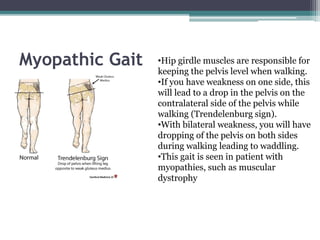
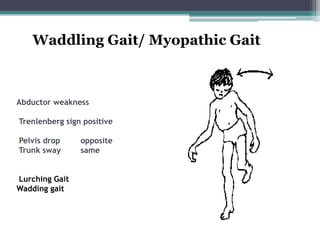
Myopathic Gait •Hip girdle muscles are responsible for
keeping the pelvis level when walking.
•If you have weakness on one side, this
will lead to a drop in the pelvis on the
contralateral side of the pelvis while
walking (Trendelenburg sign).
•With bilateral weakness, you will have
dropping of the pelvis on both sides
during walking leading to waddling.
•This gait is seen in patient with
myopathies, such as muscular
dystrophy
Waddling Gait/ Myopathic Gait
Abductor weakness
Trenlenberg sign positive
Pelvis drop opposite
Trunk sway same
Lurching Gait
Wadding gait
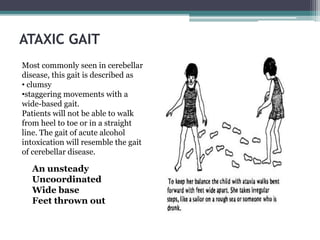
An unsteady
Uncoordinated
Wide base
Feet thrown out
ATAXIC GAIT
Most commonly seen in cerebellar
disease, this gait is described as
• clumsy
•staggering movements with a
wide-based gait.
Patients will not be able to walk
from heel to toe or in a straight
line. The gait of acute alcohol
intoxication will resemble the gait
of cerebellar disease.
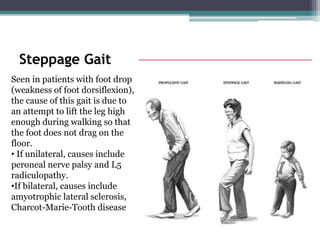
Steppage Gait
Seen in patients with foot drop
(weakness of foot dorsiflexion),
the cause of this gait is due to
an attempt to lift the leg high
enough during walking so that
the foot does not drag on the
floor.
• If unilateral, causes include
peroneal nerve palsy and L5
radiculopathy.
•If bilateral, causes include
amyotrophic lateral sclerosis,
Charcot-Marie-Tooth disease
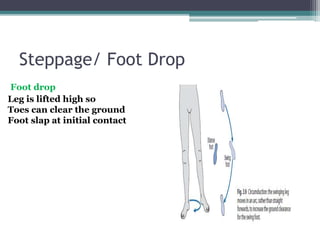
Steppage/ Foot Drop
Foot drop
Leg is lifted high so
Toes can clear the ground
Foot slap at initial contact
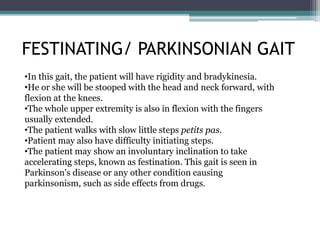
FESTINATING/ PARKINSONIAN GAIT
•In this gait, the patient will have rigidity and bradykinesia.
•He or she will be stooped with the head and neck forward, with
flexion at the knees.
•The whole upper extremity is also in flexion with the fingers
usually extended.
•The patient walks with slow little steps petits pas.
•Patient may also have difficulty initiating steps.
•The patient may show an involuntary inclination to take
accelerating steps, known as festination. This gait is seen in
Parkinson's disease or any other condition causing
parkinsonism, such as side effects from drugs.
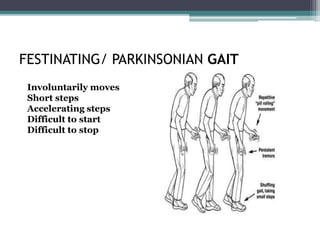
Involuntarily moves
Short steps
Accelerating steps
Difficult to start
Difficult to stop
FESTINATING/ PARKINSONIAN GAIT
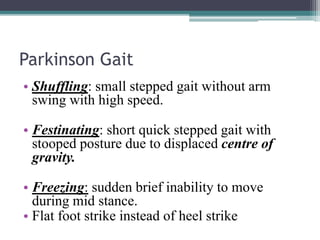
Parkinson Gait
• Shuffling: small stepped gait without arm
swing with high speed.
• Festinating: short quick stepped gait with
stooped posture due to displaced centre of
gravity.
• Freezing: sudden brief inability to move
during mid stance.
• Flat foot strike instead of heel strike
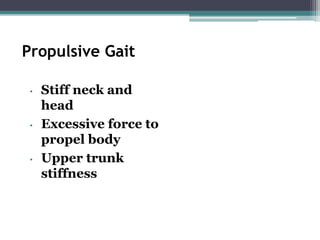
Propulsive Gait
• Stiff neck and
head
• Excessive force to
propel body
• Upper trunk
stiffness
Proprioceptive Loss: Sensory Ataxia
As our feet touch the ground, we receive propioreceptive information to tell us
their location. The sensory ataxic gait occurs when there is loss of this
propioreceptive input.
This gait is also sometimes referred to as a stomping gait since patients
may lift their legs very high to hit the
• Wide, irregular, uneven steps
• Unsteady, wide based gait
• Throw feet forward and out and bring them down first
on heels and then toes (double tapping sound)
• Watch ground
• Positive Romberg (cannot stand with feet together and
eyes closed)
• Friedrich ataxia
Gait abnormalities presentation

Gait abnormalities presentation

  • 1.
  • 2.
    GAIT & GAITCYCLE • Human gait refers to locomotion achieved through the movement of human limbs. • Gait is a series of rhythmical & alternating movements of trunk & limbs which result in forward progression of center of gravity & the body. • Gait is a sequence of foot movements by which a person moves forward. • The gait cycle is a repetitive pattern involving steps and strides.
  • 3.
    GAIT CYCLE Classification ofthe gait cycle involves two main phases: 1. Stance phase 2. Swing phase The stance phase occupies 60% of the gait cycle while the swing phase occupies only 40% of it. Gait involves a combination of open and close chain activities.  A more detailed classification of gait recognizes six phases: 1. Heel Strike 2. Foot Flat 3. Mid-Stance 4. Heel-Off 5. Toe-Off 6. Mid-Swing
  • 4.
    GAIT CYCLE An alternativeclassification of gait involves the following eight phases: 1. Initial Contact 2. Loading Response 3. Midstance 4. Terminal Stance 5. Pre swing 6. Initial Swing 7. Mid Swing 8. Late Swing
  • 6.
    Abnormal Gait Syndromes Ingeneral gait deviations fall under four headings: ▫ Pain ▫ Joint muscle range of motion(ROM) limitation ▫ Muscular weakness/paralysis ▫ Neurological involvement(UMN,LMN) ▫ Leg length discrepancies
  • 7.
    Abnormal Gait Hemiplegic gait Scissorsgait/ Diplegic gait Myopathic gait Steppage gait Parkinson gait &Propulsive gait Sensory gait
  • 8.
    Hemiplegic Gait • Unilateralweakness on the affected side • Hip into extension, adduction and medial Rotation • Knee in extension • Ankle in drop foot with planterflexion and Inversion (equinovarus), which is present during Stance and swing phases. • In order to clear the foot from ground the knee and hip Should flex • Foot clearance • Hip flexor weakness • Pelvis retracted
  • 9.
    Hemiplegic Gait • Weaknessin distal muscles(foot drop) and extensor hypertonia in lower limb. • Most commonly seen in stroke. with mild hemepresis, loss of normal arm swing. • Slight circumduction may be the only abnormalities
  • 11.
    Legs cross midline AdductorsSpasticity Toe walk Planter flexor spastic Spastic Cerebral palsy Scissor Gait/ Diplegic Gait Patients have involvement on both sides with spasticity in lower extremities worse than upper extremities. The patient walks with an abnormally narrow base, dragging both legs and scraping the toes. •This gait is seen in bilateral periventricular lesions, such as those seen in cerebral palsy. •Extreme tightness of hip adductors which can cause legs to cross the midline referred to as a scissors gait.
  • 12.
    Myopathic Gait •Hipgirdle muscles are responsible for keeping the pelvis level when walking. •If you have weakness on one side, this will lead to a drop in the pelvis on the contralateral side of the pelvis while walking (Trendelenburg sign). •With bilateral weakness, you will have dropping of the pelvis on both sides during walking leading to waddling. •This gait is seen in patient with myopathies, such as muscular dystrophy
  • 13.
    Waddling Gait/ MyopathicGait Abductor weakness Trenlenberg sign positive Pelvis drop opposite Trunk sway same Lurching Gait Wadding gait
  • 14.
    An unsteady Uncoordinated Wide base Feetthrown out ATAXIC GAIT Most commonly seen in cerebellar disease, this gait is described as • clumsy •staggering movements with a wide-based gait. Patients will not be able to walk from heel to toe or in a straight line. The gait of acute alcohol intoxication will resemble the gait of cerebellar disease.
  • 15.
    Steppage Gait Seen inpatients with foot drop (weakness of foot dorsiflexion), the cause of this gait is due to an attempt to lift the leg high enough during walking so that the foot does not drag on the floor. • If unilateral, causes include peroneal nerve palsy and L5 radiculopathy. •If bilateral, causes include amyotrophic lateral sclerosis, Charcot-Marie-Tooth disease
  • 16.
    Steppage/ Foot Drop Footdrop Leg is lifted high so Toes can clear the ground Foot slap at initial contact
  • 17.
    FESTINATING/ PARKINSONIAN GAIT •Inthis gait, the patient will have rigidity and bradykinesia. •He or she will be stooped with the head and neck forward, with flexion at the knees. •The whole upper extremity is also in flexion with the fingers usually extended. •The patient walks with slow little steps petits pas. •Patient may also have difficulty initiating steps. •The patient may show an involuntary inclination to take accelerating steps, known as festination. This gait is seen in Parkinson's disease or any other condition causing parkinsonism, such as side effects from drugs.
  • 18.
    Involuntarily moves Short steps Acceleratingsteps Difficult to start Difficult to stop FESTINATING/ PARKINSONIAN GAIT
  • 19.
    Parkinson Gait • Shuffling:small stepped gait without arm swing with high speed. • Festinating: short quick stepped gait with stooped posture due to displaced centre of gravity. • Freezing: sudden brief inability to move during mid stance. • Flat foot strike instead of heel strike
  • 20.
    Propulsive Gait • Stiffneck and head • Excessive force to propel body • Upper trunk stiffness
  • 21.
    Proprioceptive Loss: SensoryAtaxia As our feet touch the ground, we receive propioreceptive information to tell us their location. The sensory ataxic gait occurs when there is loss of this propioreceptive input. This gait is also sometimes referred to as a stomping gait since patients may lift their legs very high to hit the • Wide, irregular, uneven steps • Unsteady, wide based gait • Throw feet forward and out and bring them down first on heels and then toes (double tapping sound) • Watch ground • Positive Romberg (cannot stand with feet together and eyes closed) • Friedrich ataxia