SUPERCRITICAL BOILER
1
By
Ashvani Shukla
C&I
BGR ENERGY
2
INTRODUCTION TO SUPERCRITICAL
TECHNOLOGY
What is Supercritical Pressure ?
Critical point in water vapour cycle is a
thermodynamic state where there is no clear
distinction between liquid and gaseous state
of water.
Water reaches to this state at a critical
pressure above 22.1 MPa and 374 o
C.
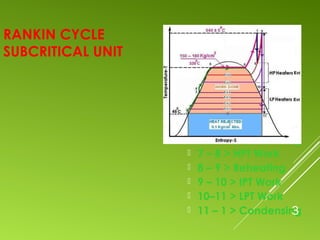
RANKIN CYCLE
SUBCRITICAL UNIT
 1 - 2 > CEP work
 2 - 3 > LP Heating
 3 - 4 > BFP work
 4 - 5 > HP Heating
 5 – 6 > Eco, WW
 6 – 7 > Superheating
 7 – 8 > HPT Work
 8 – 9 > Reheating
 9 – 10 > IPT Work
 10–11 > LPT Work
 11 – 1 > Condensing3
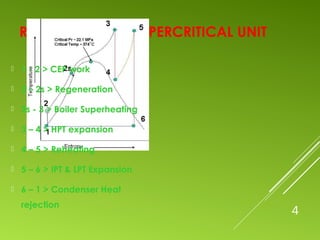
RANKINE CYCLE SUPERCRITICAL UNIT
 1 - 2 > CEP work
 2 – 2s > Regeneration
 2s - 3 > Boiler Superheating
 3 – 4 > HPT expansion
 4 – 5 > Reheating
 5 – 6 > IPT & LPT Expansion
 6 – 1 > Condenser Heat
rejection
4
5
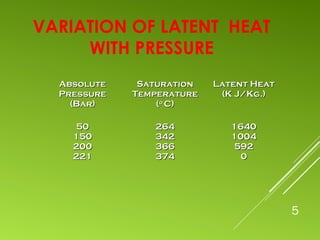
AbsoluteAbsolute
PressurePressure
(Bar)(Bar)
SaturationSaturation
TemperatureTemperature
((oo
C)C)
Latent HeatLatent Heat
(K J/Kg.)(K J/Kg.)
5050
150150
200200
221221
264264
342342
366366
374374
16401640
10041004
592592
00
VARIATION OF LATENT HEAT
WITH PRESSURE
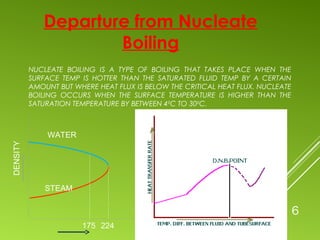
NUCLEATE BOILING IS A TYPE OF BOILING THAT TAKES PLACE WHEN THE
SURFACE TEMP IS HOTTER THAN THE SATURATED FLUID TEMP BY A CERTAIN
AMOUNT BUT WHERE HEAT FLUX IS BELOW THE CRITICAL HEAT FLUX. NUCLEATE
BOILING OCCURS WHEN THE SURFACE TEMPERATURE IS HIGHER THAN THE
SATURATION TEMPERATURE BY BETWEEN 40
C TO 300
C.
6
Departure from Nucleate
Boiling
DENSITY
WATER
STEAM
175 224
7
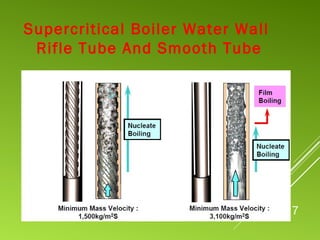
Supercritical Boiler Water Wall
Rifle Tube And Smooth Tube
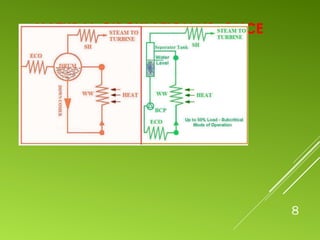
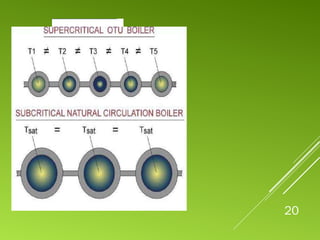
NATURAL CIRCULATION VS. ONCE
THROUGH SYSTEM
8
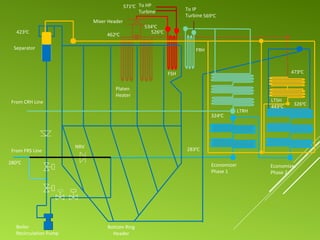
From CRH Line
From FRS Line
Boiler
Recirculation Pump
Economizer
Phase 1
Economizer
Phase 2
LTRH
LTSH
4430
C
FRH
Platen
Heater
Mixer Header
FSH
To HP
Turbine To IP
Turbine
Separator
Bottom Ring
Header
2830
C
3260
C
4230
C
4730
C
4620
C
5340
C
5260
C
5710
C
5690
C
3240
C
2800
C
NRV
10
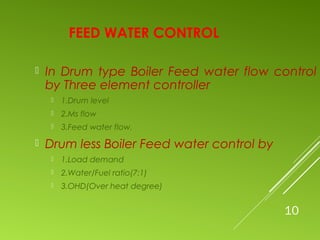
FEED WATER CONTROL
 In Drum type Boiler Feed water flow control
by Three element controller
 1.Drum level
 2.Ms flow
 3.Feed water flow.
 Drum less Boiler Feed water control by
 1.Load demand
 2.Water/Fuel ratio(7:1)
 3.OHD(Over heat degree)
11
DIFFERENCE OF SUBCRITICAL(500MW)
AND SUPERCRITICAL(660MW)
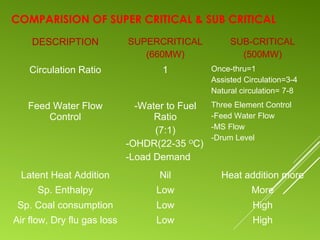
COMPARISION OF SUPER CRITICAL & SUB CRITICAL
DESCRIPTION SUPERCRITICAL
(660MW)
SUB-CRITICAL
(500MW)
Circulation Ratio 1 Once-thru=1
Assisted Circulation=3-4
Natural circulation= 7-8
Feed Water Flow
Control
-Water to Fuel
Ratio
(7:1)
-OHDR(22-35 O
C)
-Load Demand
Three Element Control
-Feed Water Flow
-MS Flow
-Drum Level
Latent Heat Addition Nil Heat addition more
Sp. Enthalpy Low More
Sp. Coal consumption Low High
Air flow, Dry flu gas loss Low High
CONTINUE..
13
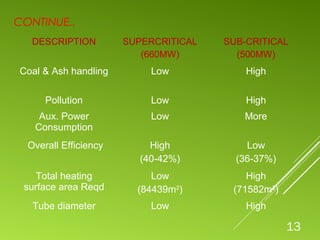
DESCRIPTION SUPERCRITICAL
(660MW)
SUB-CRITICAL
(500MW)
Coal & Ash handling Low High
Pollution Low High
Aux. Power
Consumption
Low More
Overall Efficiency High
(40-42%)
Low
(36-37%)
Total heating
surface area Reqd
Low
(84439m2
)
High
(71582m2
)
Tube diameter Low High
CONTINUE..
DESCRIPTION SUPERCRITICAL
(660MW)
SUB-CRITICAL
(500MW)
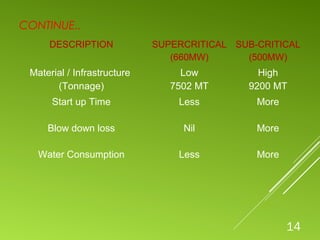
Material / Infrastructure
(Tonnage)
Low
7502 MT
High
9200 MT
Start up Time Less More
Blow down loss Nil More
Water Consumption Less More
14
15
Water Wall Design
WATER WALL ARRANGEMENT
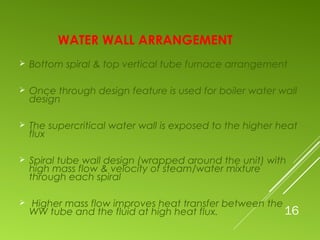
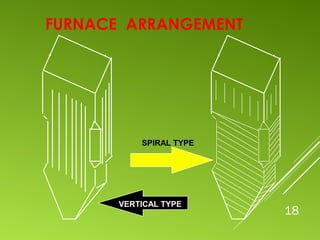
 Bottom spiral & top vertical tube furnace arrangement
 Once through design feature is used for boiler water wall
design
 The supercritical water wall is exposed to the higher heat
flux
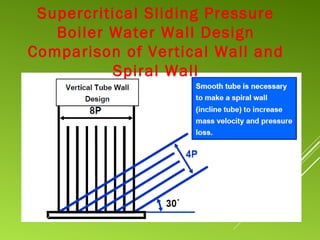
 Spiral tube wall design (wrapped around the unit) with
high mass flow & velocity of steam/water mixture
through each spiral
 Higher mass flow improves heat transfer between the
WW tube and the fluid at high heat flux. 16
17
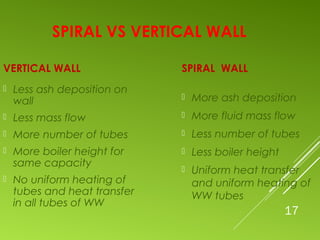
SPIRAL VS VERTICAL WALL
VERTICAL WALL
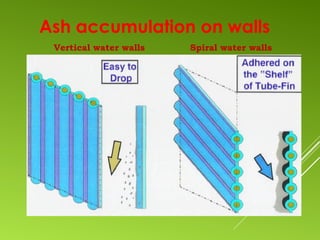
 Less ash deposition on
wall
 Less mass flow
 More number of tubes
 More boiler height for
same capacity
 No uniform heating of
tubes and heat transfer
in all tubes of WW
SPIRAL WALL
 More ash deposition
 More fluid mass flow
 Less number of tubes
 Less boiler height
 Uniform heat transfer
and uniform heating of
WW tubes
18
FURNACE ARRANGEMENT
VERTICAL TYPE
SPIRAL TYPE
19
Supercritical Sliding Pressure
Boiler Water Wall Design
Comparison of Vertical Wall and
Spiral Wall
20
21
Ash accumulation on walls
Vertical water walls Spiral water walls
22
Super Critical Boiler
Materials
23
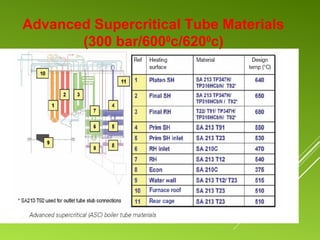
Advanced Supercritical Tube Materials
(300 bar/6000
c/6200
c)
24
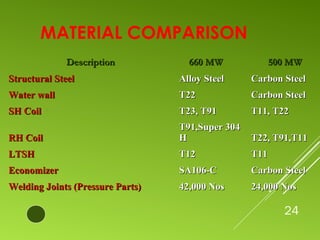
MATERIAL COMPARISON
DescriptionDescription 660 MW660 MW 500 MW500 MW
Structural SteelStructural Steel Alloy SteelAlloy Steel Carbon SteelCarbon Steel
Water wallWater wall T22T22 Carbon SteelCarbon Steel
SH CoilSH Coil T23, T91T23, T91 T11, T22T11, T22
RH CoilRH Coil
T91,Super 304T91,Super 304
HH T22, T91,T11T22, T91,T11
LTSHLTSH T12T12 T11T11
EconomizerEconomizer SA106-CSA106-C Carbon SteelCarbon Steel
Welding Joints (Pressure Parts)Welding Joints (Pressure Parts) 42,000 Nos42,000 Nos 24,000 Nos24,000 Nos
25
Steam Water Cycle
Chemistry Controls
26
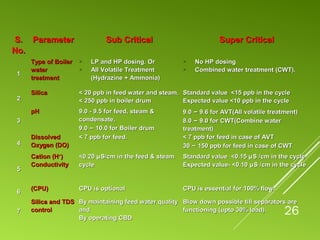
S.S.
No.No.
ParameterParameter Sub CriticalSub Critical Super CriticalSuper Critical
11
Type of BoilerType of Boiler
waterwater
treatmenttreatment
 LP and HP dosing. OrLP and HP dosing. Or
 All Volatile TreatmentAll Volatile Treatment
(Hydrazine + Ammonia)(Hydrazine + Ammonia)
 No HP dosingNo HP dosing
 Combined water treatment (CWT).Combined water treatment (CWT).
22
SilicaSilica < 20 ppb in feed water and steam,< 20 ppb in feed water and steam,
< 250 ppb in boiler drum< 250 ppb in boiler drum
Standard value <15 ppb in the cycleStandard value <15 ppb in the cycle
Expected value <10 ppb in the cycleExpected value <10 ppb in the cycle
33
pHpH 9.0 - 9.5 for feed, steam &9.0 - 9.5 for feed, steam &
condensate,condensate,
9.09.0 –– 10.0 for Boiler drum10.0 for Boiler drum
9.09.0 –– 9.6 for AVT(All volatile treatment)9.6 for AVT(All volatile treatment)
8.08.0 –– 9.0 for CWT(Combine water9.0 for CWT(Combine water
treatment)treatment)
44
DissolvedDissolved
Oxygen (DO)Oxygen (DO)
< 7 ppb for feed.< 7 ppb for feed. < 7 ppb for feed in case of AVT< 7 ppb for feed in case of AVT
3030 –– 150 ppb for feed in case of CWT150 ppb for feed in case of CWT
55
Cation (HCation (H++
))
ConductivityConductivity
<0.20<0.20 µµS/cm in the feed & steamS/cm in the feed & steam
cyclecycle
Standard value <0.15Standard value <0.15 µµS /cm in the cycleS /cm in the cycle
Expected value- <0.10Expected value- <0.10 µµS /cm in the cycleS /cm in the cycle
66 (CPU)(CPU) CPU is optionalCPU is optional CPU is essential for 100% flow.CPU is essential for 100% flow.
77
Silica and TDSSilica and TDS
controlcontrol
By maintaining feed water qualityBy maintaining feed water quality
andand
By operating CBDBy operating CBD
Blow down possible till separators areBlow down possible till separators are
functioning (upto 30% load).functioning (upto 30% load).
27
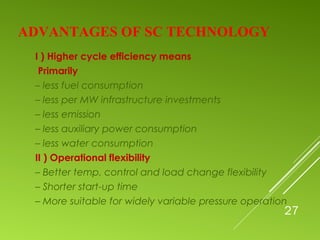
ADVANTAGES OF SC TECHNOLOGY
I ) Higher cycle efficiency means
Primarily
– less fuel consumption
– less per MW infrastructure investments
– less emission
– less auxiliary power consumption
– less water consumption
II ) Operational flexibility
– Better temp. control and load change flexibility
– Shorter start-up time
– More suitable for widely variable pressure operation
28
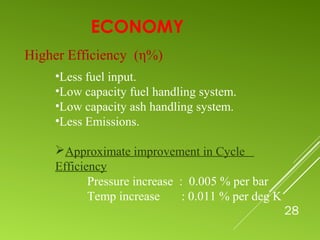
ECONOMY
Higher Efficiency (η%)
•Less fuel input.
•Low capacity fuel handling system.
•Low capacity ash handling system.
•Less Emissions.
Approximate improvement in Cycle
Efficiency
Pressure increase : 0.005 % per bar
Temp increase : 0.011 % per deg K
29
INCREASE OF CYCLE EFFICIENCY DUE TO
STEAM PARAMETERS
300
241
175 538 / 538
538 / 566
566 / 566
580 / 600
600 / 620
6,77
5,79
3,74
5,74
4,81
2,76
4,26
3,44
1,47
3,37
2,64
0,75
2,42
1,78
0
0
1
2
3
4
5
6
7
8
9
10
HP / RH outlet temperature [deg. C]Pressure [bar]
Increase of efficiency [%]
30
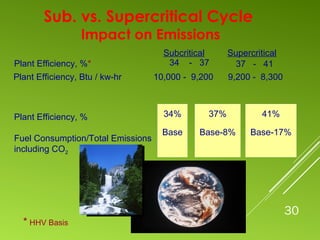
Sub. vs. Supercritical Cycle
Impact on Emissions
Plant Efficiency, %*
Plant Efficiency, %
Fuel Consumption/Total Emissions
including CO2
Subcritical Supercritical
34 - 37 37 - 41
Plant Efficiency, Btu / kw-hr 10,000 - 9,200 9,200 - 8,300
34%
Base
37%
Base-8%
41%
Base-17%
* HHV Basis
31
CHALLENGES OF SUPERCRITICAL
TECHNOLOGY
 Water chemistry is more stringent in super critical once through
boiler.
 Metallurgical Challenges
 More complex in erection due to spiral water wall.
 More feed pump power is required due to more friction losses
in spiral water wall.
 Maintenance of tube leakage is difficult due to complex
design of water wall.
 Ash sticking tendency is more in spiral water wall in
comparison of vertical wall.
THANK YOU

Super critical boiler

  • 1.
  • 2.
    2 INTRODUCTION TO SUPERCRITICAL TECHNOLOGY Whatis Supercritical Pressure ? Critical point in water vapour cycle is a thermodynamic state where there is no clear distinction between liquid and gaseous state of water. Water reaches to this state at a critical pressure above 22.1 MPa and 374 o C.
  • 3.
    RANKIN CYCLE SUBCRITICAL UNIT 1 - 2 > CEP work  2 - 3 > LP Heating  3 - 4 > BFP work  4 - 5 > HP Heating  5 – 6 > Eco, WW  6 – 7 > Superheating  7 – 8 > HPT Work  8 – 9 > Reheating  9 – 10 > IPT Work  10–11 > LPT Work  11 – 1 > Condensing3
  • 4.
    RANKINE CYCLE SUPERCRITICALUNIT  1 - 2 > CEP work  2 – 2s > Regeneration  2s - 3 > Boiler Superheating  3 – 4 > HPT expansion  4 – 5 > Reheating  5 – 6 > IPT & LPT Expansion  6 – 1 > Condenser Heat rejection 4
  • 5.
    5 AbsoluteAbsolute PressurePressure (Bar)(Bar) SaturationSaturation TemperatureTemperature ((oo C)C) Latent HeatLatent Heat (KJ/Kg.)(K J/Kg.) 5050 150150 200200 221221 264264 342342 366366 374374 16401640 10041004 592592 00 VARIATION OF LATENT HEAT WITH PRESSURE
  • 6.
    NUCLEATE BOILING ISA TYPE OF BOILING THAT TAKES PLACE WHEN THE SURFACE TEMP IS HOTTER THAN THE SATURATED FLUID TEMP BY A CERTAIN AMOUNT BUT WHERE HEAT FLUX IS BELOW THE CRITICAL HEAT FLUX. NUCLEATE BOILING OCCURS WHEN THE SURFACE TEMPERATURE IS HIGHER THAN THE SATURATION TEMPERATURE BY BETWEEN 40 C TO 300 C. 6 Departure from Nucleate Boiling DENSITY WATER STEAM 175 224
  • 7.
    7 Supercritical Boiler WaterWall Rifle Tube And Smooth Tube
  • 8.
    NATURAL CIRCULATION VS.ONCE THROUGH SYSTEM 8
  • 9.
    From CRH Line FromFRS Line Boiler Recirculation Pump Economizer Phase 1 Economizer Phase 2 LTRH LTSH 4430 C FRH Platen Heater Mixer Header FSH To HP Turbine To IP Turbine Separator Bottom Ring Header 2830 C 3260 C 4230 C 4730 C 4620 C 5340 C 5260 C 5710 C 5690 C 3240 C 2800 C NRV
  • 10.
    10 FEED WATER CONTROL In Drum type Boiler Feed water flow control by Three element controller  1.Drum level  2.Ms flow  3.Feed water flow.  Drum less Boiler Feed water control by  1.Load demand  2.Water/Fuel ratio(7:1)  3.OHD(Over heat degree)
  • 11.
  • 12.
    COMPARISION OF SUPERCRITICAL & SUB CRITICAL DESCRIPTION SUPERCRITICAL (660MW) SUB-CRITICAL (500MW) Circulation Ratio 1 Once-thru=1 Assisted Circulation=3-4 Natural circulation= 7-8 Feed Water Flow Control -Water to Fuel Ratio (7:1) -OHDR(22-35 O C) -Load Demand Three Element Control -Feed Water Flow -MS Flow -Drum Level Latent Heat Addition Nil Heat addition more Sp. Enthalpy Low More Sp. Coal consumption Low High Air flow, Dry flu gas loss Low High
  • 13.
    CONTINUE.. 13 DESCRIPTION SUPERCRITICAL (660MW) SUB-CRITICAL (500MW) Coal &Ash handling Low High Pollution Low High Aux. Power Consumption Low More Overall Efficiency High (40-42%) Low (36-37%) Total heating surface area Reqd Low (84439m2 ) High (71582m2 ) Tube diameter Low High
  • 14.
    CONTINUE.. DESCRIPTION SUPERCRITICAL (660MW) SUB-CRITICAL (500MW) Material /Infrastructure (Tonnage) Low 7502 MT High 9200 MT Start up Time Less More Blow down loss Nil More Water Consumption Less More 14
  • 15.
  • 16.
    WATER WALL ARRANGEMENT Bottom spiral & top vertical tube furnace arrangement  Once through design feature is used for boiler water wall design  The supercritical water wall is exposed to the higher heat flux  Spiral tube wall design (wrapped around the unit) with high mass flow & velocity of steam/water mixture through each spiral  Higher mass flow improves heat transfer between the WW tube and the fluid at high heat flux. 16
  • 17.
    17 SPIRAL VS VERTICALWALL VERTICAL WALL  Less ash deposition on wall  Less mass flow  More number of tubes  More boiler height for same capacity  No uniform heating of tubes and heat transfer in all tubes of WW SPIRAL WALL  More ash deposition  More fluid mass flow  Less number of tubes  Less boiler height  Uniform heat transfer and uniform heating of WW tubes
  • 18.
  • 19.
    19 Supercritical Sliding Pressure BoilerWater Wall Design Comparison of Vertical Wall and Spiral Wall
  • 20.
  • 21.
    21 Ash accumulation onwalls Vertical water walls Spiral water walls
  • 22.
  • 23.
    23 Advanced Supercritical TubeMaterials (300 bar/6000 c/6200 c)
  • 24.
    24 MATERIAL COMPARISON DescriptionDescription 660MW660 MW 500 MW500 MW Structural SteelStructural Steel Alloy SteelAlloy Steel Carbon SteelCarbon Steel Water wallWater wall T22T22 Carbon SteelCarbon Steel SH CoilSH Coil T23, T91T23, T91 T11, T22T11, T22 RH CoilRH Coil T91,Super 304T91,Super 304 HH T22, T91,T11T22, T91,T11 LTSHLTSH T12T12 T11T11 EconomizerEconomizer SA106-CSA106-C Carbon SteelCarbon Steel Welding Joints (Pressure Parts)Welding Joints (Pressure Parts) 42,000 Nos42,000 Nos 24,000 Nos24,000 Nos
  • 25.
  • 26.
    26 S.S. No.No. ParameterParameter Sub CriticalSubCritical Super CriticalSuper Critical 11 Type of BoilerType of Boiler waterwater treatmenttreatment  LP and HP dosing. OrLP and HP dosing. Or  All Volatile TreatmentAll Volatile Treatment (Hydrazine + Ammonia)(Hydrazine + Ammonia)  No HP dosingNo HP dosing  Combined water treatment (CWT).Combined water treatment (CWT). 22 SilicaSilica < 20 ppb in feed water and steam,< 20 ppb in feed water and steam, < 250 ppb in boiler drum< 250 ppb in boiler drum Standard value <15 ppb in the cycleStandard value <15 ppb in the cycle Expected value <10 ppb in the cycleExpected value <10 ppb in the cycle 33 pHpH 9.0 - 9.5 for feed, steam &9.0 - 9.5 for feed, steam & condensate,condensate, 9.09.0 –– 10.0 for Boiler drum10.0 for Boiler drum 9.09.0 –– 9.6 for AVT(All volatile treatment)9.6 for AVT(All volatile treatment) 8.08.0 –– 9.0 for CWT(Combine water9.0 for CWT(Combine water treatment)treatment) 44 DissolvedDissolved Oxygen (DO)Oxygen (DO) < 7 ppb for feed.< 7 ppb for feed. < 7 ppb for feed in case of AVT< 7 ppb for feed in case of AVT 3030 –– 150 ppb for feed in case of CWT150 ppb for feed in case of CWT 55 Cation (HCation (H++ )) ConductivityConductivity <0.20<0.20 µµS/cm in the feed & steamS/cm in the feed & steam cyclecycle Standard value <0.15Standard value <0.15 µµS /cm in the cycleS /cm in the cycle Expected value- <0.10Expected value- <0.10 µµS /cm in the cycleS /cm in the cycle 66 (CPU)(CPU) CPU is optionalCPU is optional CPU is essential for 100% flow.CPU is essential for 100% flow. 77 Silica and TDSSilica and TDS controlcontrol By maintaining feed water qualityBy maintaining feed water quality andand By operating CBDBy operating CBD Blow down possible till separators areBlow down possible till separators are functioning (upto 30% load).functioning (upto 30% load).
  • 27.
    27 ADVANTAGES OF SCTECHNOLOGY I ) Higher cycle efficiency means Primarily – less fuel consumption – less per MW infrastructure investments – less emission – less auxiliary power consumption – less water consumption II ) Operational flexibility – Better temp. control and load change flexibility – Shorter start-up time – More suitable for widely variable pressure operation
  • 28.
    28 ECONOMY Higher Efficiency (η%) •Lessfuel input. •Low capacity fuel handling system. •Low capacity ash handling system. •Less Emissions. Approximate improvement in Cycle Efficiency Pressure increase : 0.005 % per bar Temp increase : 0.011 % per deg K
  • 29.
    29 INCREASE OF CYCLEEFFICIENCY DUE TO STEAM PARAMETERS 300 241 175 538 / 538 538 / 566 566 / 566 580 / 600 600 / 620 6,77 5,79 3,74 5,74 4,81 2,76 4,26 3,44 1,47 3,37 2,64 0,75 2,42 1,78 0 0 1 2 3 4 5 6 7 8 9 10 HP / RH outlet temperature [deg. C]Pressure [bar] Increase of efficiency [%]
  • 30.
    30 Sub. vs. SupercriticalCycle Impact on Emissions Plant Efficiency, %* Plant Efficiency, % Fuel Consumption/Total Emissions including CO2 Subcritical Supercritical 34 - 37 37 - 41 Plant Efficiency, Btu / kw-hr 10,000 - 9,200 9,200 - 8,300 34% Base 37% Base-8% 41% Base-17% * HHV Basis
  • 31.
    31 CHALLENGES OF SUPERCRITICAL TECHNOLOGY Water chemistry is more stringent in super critical once through boiler.  Metallurgical Challenges  More complex in erection due to spiral water wall.  More feed pump power is required due to more friction losses in spiral water wall.  Maintenance of tube leakage is difficult due to complex design of water wall.  Ash sticking tendency is more in spiral water wall in comparison of vertical wall.
  • 32.