DR. VIBHA KHANNA
Asso. Prof. (Botany)
SPC GOVERNMENT COLLEGE
AJMER (Rajasthan)
PLANT BIOCHEMISTRY
• BLOCK 2. : Sulphur metabolism
– PRESENTATION 1:
• Sulphur an essential macronutrient
WHY IS SULFUR IMPORTANT?
• Sulphur is among the most versatile elements in living
organism
• The versatility of sulphur derives in part from the
property that it shares with nitrogen – ‘multiple stable
oxidation states’
• It represents the ninth and least abundant essential
macronutrient in plants, preceded by carbon, oxygen,
hydrogen, nitrogen, potassium, calcium, magnesium,
and phosphorus.
• Sulphur plays critical roles in the catalytic or
electrochemical functions of the biomolecules in cells.
WHY IS SULFUR IMPORTANT?
BECAUSE SULFUR NOT ONLY SERVES AS A
STRUCTURAL COMPONENT BUT ALSO PLAYS
CHARACTERISTIC FUNCTIONS IN CELLS
• Sulphur is found in
– amino acids (Cys and Met),
– oligopeptides (glutathione [GSH] and phytochelatins),
– vitamins and cofactors (biotin, thiamine, CoA, andS-
adenosyl-Met), and
– a variety of secondary products (glucosinolates in
Cruciferae and allyl Cys sulfoxides in Allium).
IMPORTANCE OF SULPHUR
• The thiol (sulfhydryl) group of Cys in proteins maintains
protein structure by forming disulfide bonds between two
Cys residues via oxidation.
• The thiol of Cysteine (Cys) and glutathione (GSH) is often
involved in the redox cycle by two thiol 4 disulfide
conversions.
• This interchange is adaptable for redox control and
mitigation against oxidative stress in nearly all aerobic
organisms including plants
• The nucleophilicity of the thiol group, and in particular
GSH, plays a role in detoxification of xenobiotics by direct
conjugation with sulfhydryl group mediated by GSH S-
transferase.
IMPORTANCE OF SULPHUR
• Phytochelatins, a polymerized version of GSH, are
involved in detoxification of heavy metals by
serving as chelating ligands through thiol groups.
• Sulphur-containing secondary products often have
a characteristic smell and are regarded not only as
defense compounds against herbivores and
pathogenic organisms but also as signaling
molecules for fundamental cellular functions
• The catalytic sites for several enzymes and co-
enzymes, such as urease and co-enzyme-A ,
contain sulfur.
• Sulphur participates in electron transport through
iron-sulphur clusters.
GLUTATHIONE IS IMPORTANT IN STRESS
MITIGATION
• Because of its nucleophilic properties, glutathione serves as the first
line of defense against the products of oxygen metabolism, reactive
oxygen species, and other electrophilic compounds such as toxins
(herbicides), xenobiotics, and heavy metals.
• When plants encounter reactive oxygen species, glutathione is a
direct source of electrons for stress mitigation by the enzyme
glutathione peroxidase or an indirect means to maintain a reduced
pool of ascorbate, another antioxidant.
• Glutathione reacts directly with toxins in a reaction mediated by
glutathione S-transferase. In this way the toxins are inactivated and
tagged for transport into the vacuole and for degradation.
• In some plants heavy-metal detoxification is mediated by
glutathione derivatives called phytochelatins, which have the
general structure (γ-glutamylcysteine)nGly (n = 2–11), and by Cys-
rich proteins called metallothioneins. In both molecules thiol groups
serve as the metal ion ligand.
SULFUR NUTRITION IMPACTS AGRICULTURE, FOOD
QUALITY, AND NUTRA- AND PHARMACEUTICALS
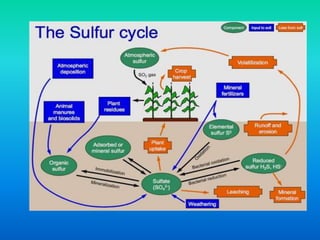
• Sulphur assimilation in plants plays a key role in
the sulfur cycle in nature. The inorganic sulfur in
the environment, sulfate ion in soil and sulfur
dioxide gas in the air, is fixed into Cys by the
sulfur assimilation pathway in plants.
• Thereafter, Cys is converted to Met. Animals,
however, do not have the assimilatory
mechanisms for inorganic sulfur; they require
Met as an essential amino acid for their source of
sulfur nutrient.
Therapeutic Properties of S-compounds
• Antiseptic, ‘alliin’ in garlic {Alliin (S-allylcysteine sulfoxide) is the
most abundant organosulfur compound in the whole garlic bulbs
When fresh garlic is chopped or crushed, the enzyme alliinase
converts alliin into allicin which is antioxidant and anti-
inflammatory}
• Anticarcinogenic ‘sulphoraphane’ in broccoli {Sulforaphane (SFN),
an isothiocyanate, has the ability to modulate multiple cellular
targets involved in cancer development simultaneously, including:
(i) DNA protection by modulating carcinogen-metabolizing enzymes
and blocking the action of mutagens; (ii) inhibition of cell
proliferation and induction of apoptosis, thereby retarding or
eliminating clonal expansion of initiated, transformed, and/or
neoplastic cells; (iii) inhibition of neoangiogenesis, progression of
benign tumors to malignant tumors, and metastasis formation. SFN
is therefore able to prevent, delay, or reverse preneoplastic lesions,
as well as to act on cancer cells as a therapeutic agent.
Sulphur Cycle in Nature
• Sulphur is available to plants primarily in the
form of anionic sulphate (SO4
2−) present in
soil.
• It is actively transported into roots and then
distributed, mostly unmetabolized,
throughout the plant.
• SO4
2− is a major anionic component of
vacuolar sap; therefore, it does not necessarily
enter the assimilation stream.
Sulphur Cycle in Nature
• Sulphur assimilation in plants plays a key role in
the sulfur cycle in nature.
• The inorganic sulfur in the environment, sulfate
ion in soil and sulfur dioxide gas in the air, is fixed
into Cys by the sulfur assimilation pathway in
plants.
• Thereafter, Cys is converted to Met.
• Animals, however, do not have the assimilatory
mechanisms for inorganic sulfur; they require
Met as an essential amino acid for their source
of sulfur nutrient.
Sulphur deficiency in Plants
• Sulphur is not as mobile in plant tissue as
nitrogen. The result is that a deficiency affects
a plant in a different way. Both cause leaves to
turn yellow. The difference is that a nitrogen
deficiency first affects the older leaves and a
sulfur deficiency the younger leaves.
• A deficiency of sulfur is unusual but possible in
an acid soil with low organic content

Sulphur: the macronutrient

  • 1.
    DR. VIBHA KHANNA Asso.Prof. (Botany) SPC GOVERNMENT COLLEGE AJMER (Rajasthan)
  • 2.
    PLANT BIOCHEMISTRY • BLOCK2. : Sulphur metabolism – PRESENTATION 1: • Sulphur an essential macronutrient
  • 3.
    WHY IS SULFURIMPORTANT? • Sulphur is among the most versatile elements in living organism • The versatility of sulphur derives in part from the property that it shares with nitrogen – ‘multiple stable oxidation states’ • It represents the ninth and least abundant essential macronutrient in plants, preceded by carbon, oxygen, hydrogen, nitrogen, potassium, calcium, magnesium, and phosphorus. • Sulphur plays critical roles in the catalytic or electrochemical functions of the biomolecules in cells.
  • 4.
    WHY IS SULFURIMPORTANT? BECAUSE SULFUR NOT ONLY SERVES AS A STRUCTURAL COMPONENT BUT ALSO PLAYS CHARACTERISTIC FUNCTIONS IN CELLS • Sulphur is found in – amino acids (Cys and Met), – oligopeptides (glutathione [GSH] and phytochelatins), – vitamins and cofactors (biotin, thiamine, CoA, andS- adenosyl-Met), and – a variety of secondary products (glucosinolates in Cruciferae and allyl Cys sulfoxides in Allium).
  • 5.
    IMPORTANCE OF SULPHUR •The thiol (sulfhydryl) group of Cys in proteins maintains protein structure by forming disulfide bonds between two Cys residues via oxidation. • The thiol of Cysteine (Cys) and glutathione (GSH) is often involved in the redox cycle by two thiol 4 disulfide conversions. • This interchange is adaptable for redox control and mitigation against oxidative stress in nearly all aerobic organisms including plants • The nucleophilicity of the thiol group, and in particular GSH, plays a role in detoxification of xenobiotics by direct conjugation with sulfhydryl group mediated by GSH S- transferase.
  • 6.
    IMPORTANCE OF SULPHUR •Phytochelatins, a polymerized version of GSH, are involved in detoxification of heavy metals by serving as chelating ligands through thiol groups. • Sulphur-containing secondary products often have a characteristic smell and are regarded not only as defense compounds against herbivores and pathogenic organisms but also as signaling molecules for fundamental cellular functions • The catalytic sites for several enzymes and co- enzymes, such as urease and co-enzyme-A , contain sulfur. • Sulphur participates in electron transport through iron-sulphur clusters.
  • 7.
    GLUTATHIONE IS IMPORTANTIN STRESS MITIGATION • Because of its nucleophilic properties, glutathione serves as the first line of defense against the products of oxygen metabolism, reactive oxygen species, and other electrophilic compounds such as toxins (herbicides), xenobiotics, and heavy metals. • When plants encounter reactive oxygen species, glutathione is a direct source of electrons for stress mitigation by the enzyme glutathione peroxidase or an indirect means to maintain a reduced pool of ascorbate, another antioxidant. • Glutathione reacts directly with toxins in a reaction mediated by glutathione S-transferase. In this way the toxins are inactivated and tagged for transport into the vacuole and for degradation. • In some plants heavy-metal detoxification is mediated by glutathione derivatives called phytochelatins, which have the general structure (γ-glutamylcysteine)nGly (n = 2–11), and by Cys- rich proteins called metallothioneins. In both molecules thiol groups serve as the metal ion ligand.
  • 8.
    SULFUR NUTRITION IMPACTSAGRICULTURE, FOOD QUALITY, AND NUTRA- AND PHARMACEUTICALS • Sulphur assimilation in plants plays a key role in the sulfur cycle in nature. The inorganic sulfur in the environment, sulfate ion in soil and sulfur dioxide gas in the air, is fixed into Cys by the sulfur assimilation pathway in plants. • Thereafter, Cys is converted to Met. Animals, however, do not have the assimilatory mechanisms for inorganic sulfur; they require Met as an essential amino acid for their source of sulfur nutrient.
  • 9.
    Therapeutic Properties ofS-compounds • Antiseptic, ‘alliin’ in garlic {Alliin (S-allylcysteine sulfoxide) is the most abundant organosulfur compound in the whole garlic bulbs When fresh garlic is chopped or crushed, the enzyme alliinase converts alliin into allicin which is antioxidant and anti- inflammatory} • Anticarcinogenic ‘sulphoraphane’ in broccoli {Sulforaphane (SFN), an isothiocyanate, has the ability to modulate multiple cellular targets involved in cancer development simultaneously, including: (i) DNA protection by modulating carcinogen-metabolizing enzymes and blocking the action of mutagens; (ii) inhibition of cell proliferation and induction of apoptosis, thereby retarding or eliminating clonal expansion of initiated, transformed, and/or neoplastic cells; (iii) inhibition of neoangiogenesis, progression of benign tumors to malignant tumors, and metastasis formation. SFN is therefore able to prevent, delay, or reverse preneoplastic lesions, as well as to act on cancer cells as a therapeutic agent.
  • 11.
    Sulphur Cycle inNature • Sulphur is available to plants primarily in the form of anionic sulphate (SO4 2−) present in soil. • It is actively transported into roots and then distributed, mostly unmetabolized, throughout the plant. • SO4 2− is a major anionic component of vacuolar sap; therefore, it does not necessarily enter the assimilation stream.
  • 12.
    Sulphur Cycle inNature • Sulphur assimilation in plants plays a key role in the sulfur cycle in nature. • The inorganic sulfur in the environment, sulfate ion in soil and sulfur dioxide gas in the air, is fixed into Cys by the sulfur assimilation pathway in plants. • Thereafter, Cys is converted to Met. • Animals, however, do not have the assimilatory mechanisms for inorganic sulfur; they require Met as an essential amino acid for their source of sulfur nutrient.
  • 13.
    Sulphur deficiency inPlants • Sulphur is not as mobile in plant tissue as nitrogen. The result is that a deficiency affects a plant in a different way. Both cause leaves to turn yellow. The difference is that a nitrogen deficiency first affects the older leaves and a sulfur deficiency the younger leaves. • A deficiency of sulfur is unusual but possible in an acid soil with low organic content