Nitrogen Fixation
Presented by:
Neha kausar Nasim sheikh
RTMNU
NITROGEN:
• Nitrogen = essential constituent of all
biomolecules.
• Plants: from soil in form of nitrates or
ammonium ion.
• Atmosphere = 78% of molecular nitrogen but
plants unable to convert this molecular nitrogen
nitrogen into a useful form.
• Enzyme Nitrogenase= prokaryots
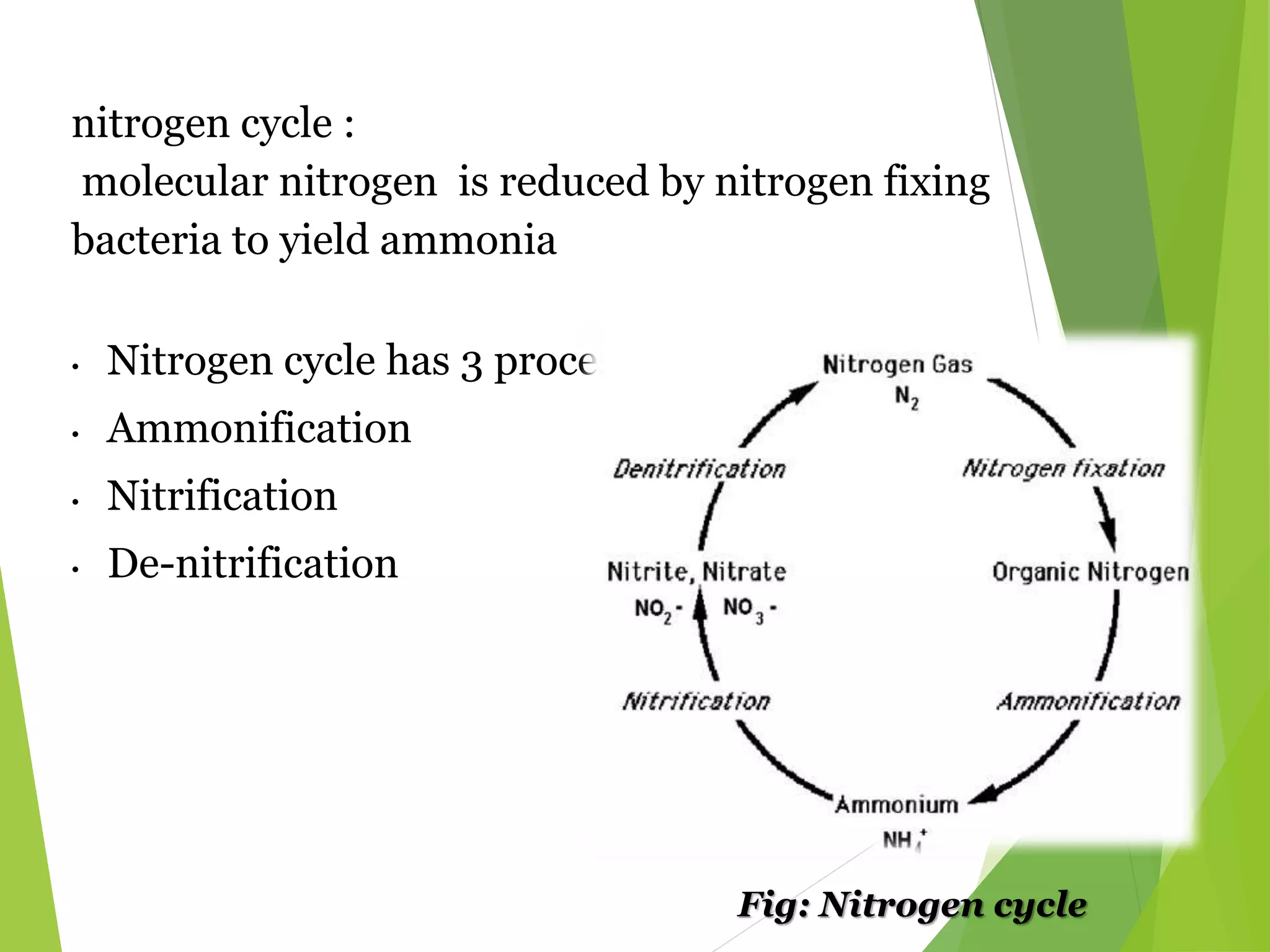
nitrogen cycle :
molecular nitrogen is reduced by nitrogen fixing
bacteria to yield ammonia
• Nitrogen cycle has 3 process
• Ammonification
• Nitrification
• De-nitrification
Fig: Nitrogen cycle
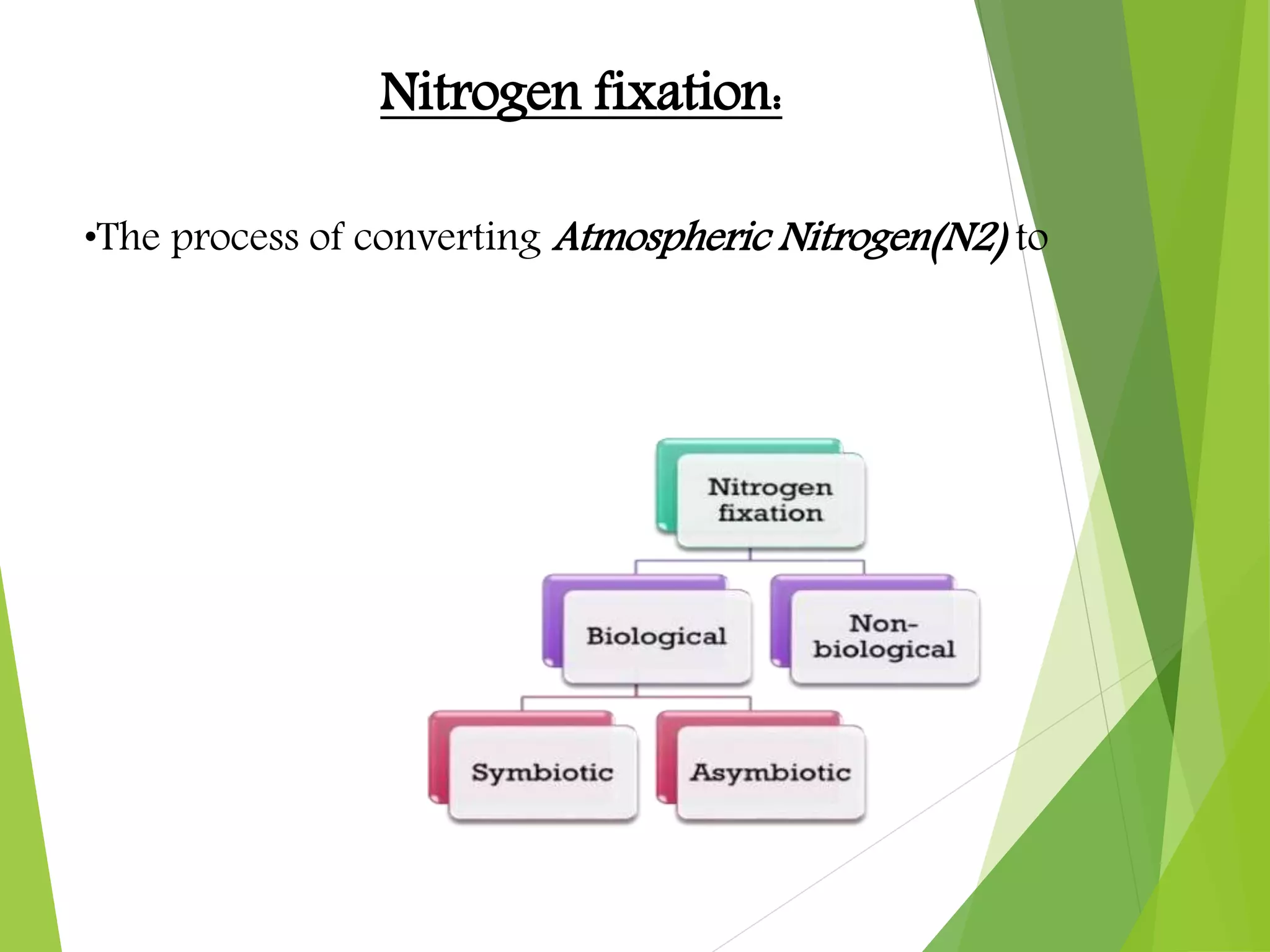
Nitrogen fixation:
•The process of converting Atmospheric Nitrogen(N2) to
Non – biological nitrogen fixation:
•These acids readily release the hydrogen, forming nitrate and nitrite ions.
•The nitrate can be readily utilized by plants and microorganisms.
Nitric oxide
Nitrous Oxide
Biological nitrogen fixation
•prokaryote domain because of the presence nitrogenase enzyme
•prokaryotes which fix nitrogen – nitrogen fixers
•It includes both free living and symbiotic associations with plants
•Diazatrophs – certain strains of bacteria of genus rhizobium that
shows symbiotic association with legumes via root nodules
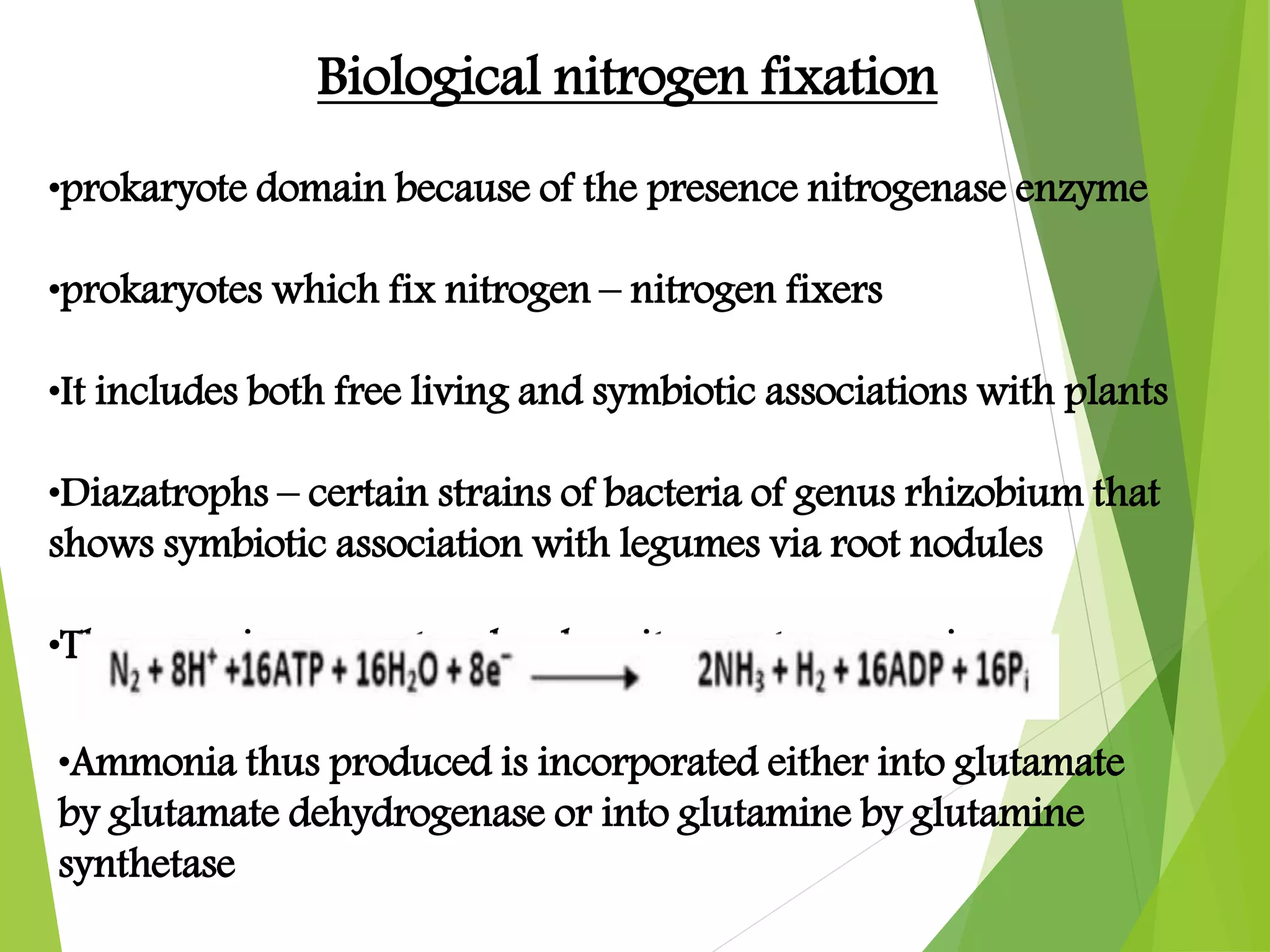
•These species convert molecular nitrogen to ammonia
•Ammonia thus produced is incorporated either into glutamate
by glutamate dehydrogenase or into glutamine by glutamine
synthetase
Symbiotic nitrogen fixation
• Symbiotic nitrogen fixation occurs in plants that
plants that harbor nitrogen fixing bacteria
within their tissues
• example = symbiotic association between roots
between roots of legumes and bacteria of the
genus Rhizobium
• This association results form the root nodules in
nodules in legumes
• Root nodules – it is a enlarged multicellular
multicellular structures on roots
• Legume – rhizobium association will fix 25 – 60
fix 25 – 60 kg of molecular nitrogen annually
Asymbiotic nitrogen fixation:
• The free living nitrogen fixing organisms are called
are asymbiotic – organisms.
• It includes Aerobic bacteria, anaerobic bacteria and
blue green algae
• Bacteria: types -
• Free living anaerobic : Clostridium
• Free living aerobic : Azotobacter
• Free living photosynthetic : Rhodopseudomonas
• Free living Fungi : Yeast
• Blue green algae: Nostoc, Anabaena
Asymbiotic
Relationship
Bacteria
fixes 30% of N2
Symbiotic
Relationship
Bacteria
Fixes 70% of N2
Biological Fixation by
Diazotrophs
• There are TWO types of Nitrogen
Fixing Bacteria
Formation of Root Nodules
• Root nodules formed due to infection of Rhizobium called Crown Gall
• Roots of the legumes secrete some growth factors helps in fast multiplication
of bacteria
(E.g.) Pisum sativum secretes homo serine also carbohydrate containing
protein Lectins over their surface.
• This helps in recognition and attachment of rhizobial cells.
• Rhizobial cells have carbohydrate receptor on their surface.
• Lectins interact with the carbohydrate receptor of rhizobial cells
Occur between root hairs and young root hair
• Bacteria enter the roots through soft infected root hairs
Tips are deformed and curved.
Basic requirements of nitrogen fixation:
• Nitrogenase enzyme complex
• Protective mechanism against Oxygen – leghaemoglobin
• Electron donor (Pyruvate) via Ferrodoxin
• Constant supply of ATP
• Coenzymes and cofactors like CoA, inorganic phosphate and
Mg+2
• Cobalt and Molybdenum
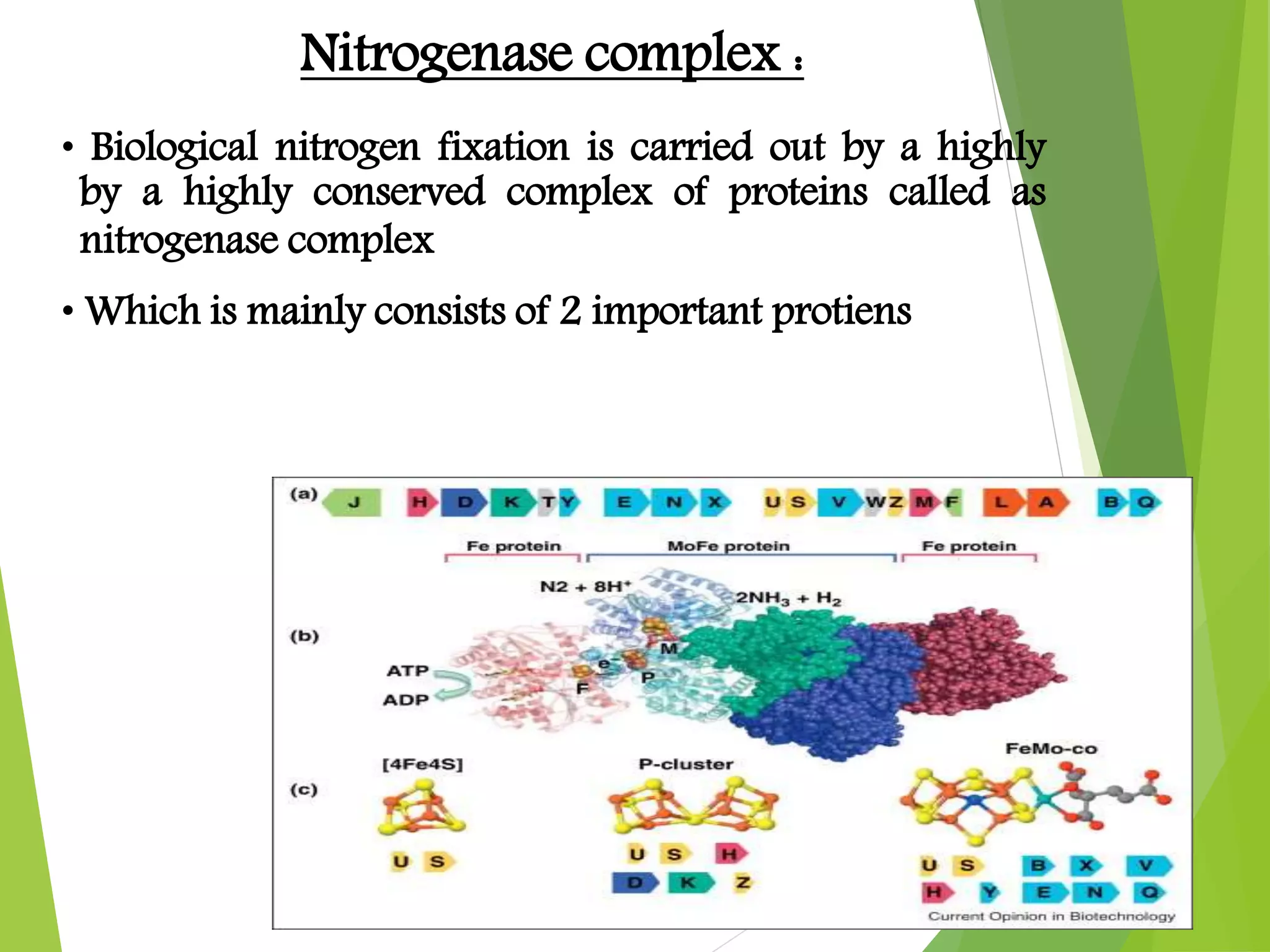
Nitrogenase complex :
• Biological nitrogen fixation is carried out by a highly
by a highly conserved complex of proteins called as
nitrogenase complex
• Which is mainly consists of 2 important protiens
• Dinitrogenase reductase – is a dimer of 2
identical subunits
• It contains a single 4Fe – 4S redox center
bound between the subunits
• This can be oxidized and reduced by 1 electron
• Also it has 2 binding sites for ATP or ADP
• Dinitrogenase – is a tetramer with 2 copies of 2
different subunits (𝜶𝟐 − 𝜷𝟐 heterodimer)
• Contains both iron and molybdenum
• Its redox centres has 2 MO, 32 Fe and 30 S per
tetramer
• And it has 2 binding site for reductase
• About half of the iron and sulphur is present as
2 bridged pairs of 4Fe – 4S centres called as P
• P cluster – consists 2[ 4Fe – 4S] clusters linked
through additional sulphide ion
Action of nitrogenase enzyme :
• For reducing nitrogen into ammonia nitrogenase
requires 8 electrons
• At first dinitrogense is reduced by transferring of
electrons to dintrogenase reductase
• Dinitrogenase has a 2 binding sites for reductase
• The 8 electrons are transferred from reductase to
dinitrigenase one at a time :
•Reduced reductase binds to dinitrogenase
and transfers single electron , oxidized
form dissociates in a repeating cycle.
•Each cycle requires the hydrolysis of ATP
molecule by dinitrogenase reductase
•Immediate source of electrons to reduce
reductase is reduced ferredoxin
•Ultimate source of electrons to reduce
ferredoxin is pyruvate
References
• Lehninger principles of Biochemistry – Nelson, Cox
• Nitrogen fixation – Wikipedia
•
THANKING YOU!

Nitrogen fixation in plants

  • 1.
    Nitrogen Fixation Presented by: Nehakausar Nasim sheikh RTMNU
  • 2.
    NITROGEN: • Nitrogen =essential constituent of all biomolecules. • Plants: from soil in form of nitrates or ammonium ion. • Atmosphere = 78% of molecular nitrogen but plants unable to convert this molecular nitrogen nitrogen into a useful form. • Enzyme Nitrogenase= prokaryots
  • 3.
    nitrogen cycle : molecularnitrogen is reduced by nitrogen fixing bacteria to yield ammonia • Nitrogen cycle has 3 process • Ammonification • Nitrification • De-nitrification Fig: Nitrogen cycle
  • 4.
    Nitrogen fixation: •The processof converting Atmospheric Nitrogen(N2) to
  • 5.
    Non – biologicalnitrogen fixation: •These acids readily release the hydrogen, forming nitrate and nitrite ions. •The nitrate can be readily utilized by plants and microorganisms. Nitric oxide Nitrous Oxide
  • 6.
    Biological nitrogen fixation •prokaryotedomain because of the presence nitrogenase enzyme •prokaryotes which fix nitrogen – nitrogen fixers •It includes both free living and symbiotic associations with plants •Diazatrophs – certain strains of bacteria of genus rhizobium that shows symbiotic association with legumes via root nodules •These species convert molecular nitrogen to ammonia •Ammonia thus produced is incorporated either into glutamate by glutamate dehydrogenase or into glutamine by glutamine synthetase
  • 7.
    Symbiotic nitrogen fixation •Symbiotic nitrogen fixation occurs in plants that plants that harbor nitrogen fixing bacteria within their tissues • example = symbiotic association between roots between roots of legumes and bacteria of the genus Rhizobium • This association results form the root nodules in nodules in legumes • Root nodules – it is a enlarged multicellular multicellular structures on roots • Legume – rhizobium association will fix 25 – 60 fix 25 – 60 kg of molecular nitrogen annually
  • 8.
    Asymbiotic nitrogen fixation: •The free living nitrogen fixing organisms are called are asymbiotic – organisms. • It includes Aerobic bacteria, anaerobic bacteria and blue green algae • Bacteria: types - • Free living anaerobic : Clostridium • Free living aerobic : Azotobacter • Free living photosynthetic : Rhodopseudomonas • Free living Fungi : Yeast • Blue green algae: Nostoc, Anabaena
  • 9.
    Asymbiotic Relationship Bacteria fixes 30% ofN2 Symbiotic Relationship Bacteria Fixes 70% of N2 Biological Fixation by Diazotrophs • There are TWO types of Nitrogen Fixing Bacteria
  • 10.
    Formation of RootNodules • Root nodules formed due to infection of Rhizobium called Crown Gall • Roots of the legumes secrete some growth factors helps in fast multiplication of bacteria (E.g.) Pisum sativum secretes homo serine also carbohydrate containing protein Lectins over their surface. • This helps in recognition and attachment of rhizobial cells. • Rhizobial cells have carbohydrate receptor on their surface. • Lectins interact with the carbohydrate receptor of rhizobial cells Occur between root hairs and young root hair • Bacteria enter the roots through soft infected root hairs Tips are deformed and curved.
  • 13.
    Basic requirements ofnitrogen fixation: • Nitrogenase enzyme complex • Protective mechanism against Oxygen – leghaemoglobin • Electron donor (Pyruvate) via Ferrodoxin • Constant supply of ATP • Coenzymes and cofactors like CoA, inorganic phosphate and Mg+2 • Cobalt and Molybdenum
  • 14.
    Nitrogenase complex : •Biological nitrogen fixation is carried out by a highly by a highly conserved complex of proteins called as nitrogenase complex • Which is mainly consists of 2 important protiens
  • 15.
    • Dinitrogenase reductase– is a dimer of 2 identical subunits • It contains a single 4Fe – 4S redox center bound between the subunits • This can be oxidized and reduced by 1 electron • Also it has 2 binding sites for ATP or ADP • Dinitrogenase – is a tetramer with 2 copies of 2 different subunits (𝜶𝟐 − 𝜷𝟐 heterodimer) • Contains both iron and molybdenum • Its redox centres has 2 MO, 32 Fe and 30 S per tetramer • And it has 2 binding site for reductase • About half of the iron and sulphur is present as 2 bridged pairs of 4Fe – 4S centres called as P • P cluster – consists 2[ 4Fe – 4S] clusters linked through additional sulphide ion
  • 16.
    Action of nitrogenaseenzyme : • For reducing nitrogen into ammonia nitrogenase requires 8 electrons • At first dinitrogense is reduced by transferring of electrons to dintrogenase reductase • Dinitrogenase has a 2 binding sites for reductase • The 8 electrons are transferred from reductase to dinitrigenase one at a time :
  • 17.
    •Reduced reductase bindsto dinitrogenase and transfers single electron , oxidized form dissociates in a repeating cycle. •Each cycle requires the hydrolysis of ATP molecule by dinitrogenase reductase •Immediate source of electrons to reduce reductase is reduced ferredoxin •Ultimate source of electrons to reduce ferredoxin is pyruvate
  • 18.
    References • Lehninger principlesof Biochemistry – Nelson, Cox • Nitrogen fixation – Wikipedia • THANKING YOU!