KASTURIKA SEN BEURA
Asstt. Professor-cum-Junior Scientist
UG Class Lecture
on
Sulphur Cycle
(for ASC-121)
DEPARTMENT OF SOIL SCIENCE AND AGRICULTURAL CHEMISTRY
BIHAR AGRICULTURAL UNIVERSITY, SABOUR,
BHAGALPUR- 813210
Importance of Sulphur
 Sulphur like N, is an essential element for all living systems
because of it’s
 inert nature, is not utilized by plants. To be used first S has to to
be oxidized or reduced.
 Only 1 to 3% of the soil total S is in the plant-available form
(SO42-).
 The bulk of soil S (200 to 1100 kg/ha) is in soil organic matter.
Mineralization of organic S compounds is an important source of
S for growing plants
 In soil, it occurs both organic (S containing amino acids, vitamins
) as well as inorganic forms (Sulphur, sulphates etc., )
What is Sulphur Cycle ?
Sulfur cycle, circulation of suphur in various forms through nature.
Sulphur occurs in all living matter as a component of
certain aminoaciods.
It is abundant in the soil in protiens and, through a series of
microbial transformations, ends up as sulphates usable by plants.
Process of sulphur cycle
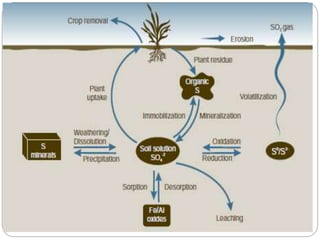
 The sulphur is released by the weathering of rocks.
 Sulphur comes in contact with air and is converted into sulphates.
 Sulphates are taken up by plants and microbes and are converted
into organic forms.
 The organic form of sulphur is then consumed by the animals
through their food and thus sulphur moves in the food chain.
 When the animals die some of the sulphur is released by
decomposition while some enter the tissues of microbes.
 There are several natural sources such as volcanic eruptions,
evaporation of water, and breakdown of organic matter in swamps,
that release sulphur directly into the atmosphere. This sulphur falls
on earth with rainfall.
Cyclic transformation of S
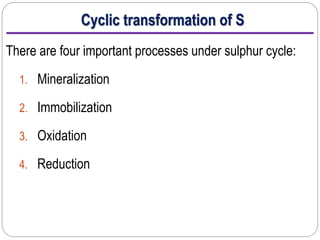
There are four important processes under sulphur cycle:
1. Mineralization
2. Immobilization
3. Oxidation
4. Reduction
What are the steps of Sulphur cycle?
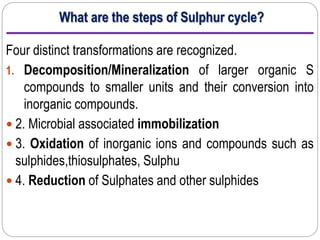
Four distinct transformations are recognized.
1. Decomposition/Mineralization of larger organic S
compounds to smaller units and their conversion into
inorganic compounds.
 2. Microbial associated immobilization
 3. Oxidation of inorganic ions and compounds such as
sulphides,thiosulphates, Sulphu
 4. Reduction of Sulphates and other sulphides
 The weathering of S-containing minerals such as gypsum
(CaSO4) can be a source of crop available S particularly in dry
regions where the amount of precipitation is too low to leach it
from the soil profile.
 Other primary and secondary minerals will release elemental S
(S0/S2-), which is converted to SO42- when exposed to moisture,
oxygen and microbial processes.
LeachCrop available S (sulphate -sulphur) can become
temporarily lost from soil solution through precipitation with
magnesium or calcium (typical for Alberta) or adsorption to
aluminum or iron oxides on clay particles.
Sulphate-sulphur is soluble and mobile in soils and will move with
groundwater.
ing losses of S are possible, especially in coarse textured soils,
but with average rainfall this type of loss will be low.
Volatile S losses can sometimes occur, but for most agricultural
soils these losses are thought to be insignificant.
Mineralization
 Conversion of organic bound S into inorganic state, mediated
through Microorganisms.
 The released S in either absorbed by plants or escaped into
atmosphere in the form of oxides.
Oxidation
 Occurs both in aerobic and anaerobic condition
 • Bacteria
 • Nonfilamentous forms- Thiobacillus
 • Filamentous forms – Beggiatoa,Thiothrix and Thioloca
 • Fungi and actinomycets
 • Aspergillus, Penecillium and Microsporium
 Produces Sulphuric acid ,lower down the soil pH – Hence used in
controlling
 plant disease
 Apple and Potato scab –Streptomyces scabis ,Sweet potato rot – S.
Ipomea
 S+ Thiobacillus application is used for the control
 Remediation of alkali soil
 Increases the solubilization of other nutrients (P,K,Ca,Mn,Al and Mg )
 Preparation of biosuper- Rock phosphate + T.thiooxidans and S---
Australia
 Lipman’s process- Compost preparation
 Soil + manure + elemental S + rock phosphate
Sulphate reduction
 Reduces inorganic sulphate into Hydrogen sulphide –reduces the
availability of S for plant nutrition.
 Sulphates are reduced to hydrogen sulphide by Desulfovibrio
desulfuricans. This occurs in two steps:
 Firstly, the sulphates are converted to sulphites utilizing ATP.
 Secondly, the reduction of sulphite to hydrogen sulphide.
THANK YOU

-Sulphur cycle.ppt

  • 1.
    KASTURIKA SEN BEURA Asstt.Professor-cum-Junior Scientist UG Class Lecture on Sulphur Cycle (for ASC-121) DEPARTMENT OF SOIL SCIENCE AND AGRICULTURAL CHEMISTRY BIHAR AGRICULTURAL UNIVERSITY, SABOUR, BHAGALPUR- 813210
  • 2.
    Importance of Sulphur Sulphur like N, is an essential element for all living systems because of it’s  inert nature, is not utilized by plants. To be used first S has to to be oxidized or reduced.  Only 1 to 3% of the soil total S is in the plant-available form (SO42-).  The bulk of soil S (200 to 1100 kg/ha) is in soil organic matter. Mineralization of organic S compounds is an important source of S for growing plants  In soil, it occurs both organic (S containing amino acids, vitamins ) as well as inorganic forms (Sulphur, sulphates etc., )
  • 3.
    What is SulphurCycle ? Sulfur cycle, circulation of suphur in various forms through nature. Sulphur occurs in all living matter as a component of certain aminoaciods. It is abundant in the soil in protiens and, through a series of microbial transformations, ends up as sulphates usable by plants.
  • 4.
    Process of sulphurcycle  The sulphur is released by the weathering of rocks.  Sulphur comes in contact with air and is converted into sulphates.  Sulphates are taken up by plants and microbes and are converted into organic forms.  The organic form of sulphur is then consumed by the animals through their food and thus sulphur moves in the food chain.  When the animals die some of the sulphur is released by decomposition while some enter the tissues of microbes.  There are several natural sources such as volcanic eruptions, evaporation of water, and breakdown of organic matter in swamps, that release sulphur directly into the atmosphere. This sulphur falls on earth with rainfall.
  • 6.
    Cyclic transformation ofS There are four important processes under sulphur cycle: 1. Mineralization 2. Immobilization 3. Oxidation 4. Reduction
  • 7.
    What are thesteps of Sulphur cycle? Four distinct transformations are recognized. 1. Decomposition/Mineralization of larger organic S compounds to smaller units and their conversion into inorganic compounds.  2. Microbial associated immobilization  3. Oxidation of inorganic ions and compounds such as sulphides,thiosulphates, Sulphu  4. Reduction of Sulphates and other sulphides
  • 8.
     The weatheringof S-containing minerals such as gypsum (CaSO4) can be a source of crop available S particularly in dry regions where the amount of precipitation is too low to leach it from the soil profile.  Other primary and secondary minerals will release elemental S (S0/S2-), which is converted to SO42- when exposed to moisture, oxygen and microbial processes.
  • 9.
    LeachCrop available S(sulphate -sulphur) can become temporarily lost from soil solution through precipitation with magnesium or calcium (typical for Alberta) or adsorption to aluminum or iron oxides on clay particles. Sulphate-sulphur is soluble and mobile in soils and will move with groundwater. ing losses of S are possible, especially in coarse textured soils, but with average rainfall this type of loss will be low. Volatile S losses can sometimes occur, but for most agricultural soils these losses are thought to be insignificant.
  • 10.
    Mineralization  Conversion oforganic bound S into inorganic state, mediated through Microorganisms.  The released S in either absorbed by plants or escaped into atmosphere in the form of oxides. Oxidation  Occurs both in aerobic and anaerobic condition  • Bacteria  • Nonfilamentous forms- Thiobacillus  • Filamentous forms – Beggiatoa,Thiothrix and Thioloca  • Fungi and actinomycets  • Aspergillus, Penecillium and Microsporium
  • 11.
     Produces Sulphuricacid ,lower down the soil pH – Hence used in controlling  plant disease  Apple and Potato scab –Streptomyces scabis ,Sweet potato rot – S. Ipomea  S+ Thiobacillus application is used for the control  Remediation of alkali soil  Increases the solubilization of other nutrients (P,K,Ca,Mn,Al and Mg )  Preparation of biosuper- Rock phosphate + T.thiooxidans and S--- Australia  Lipman’s process- Compost preparation  Soil + manure + elemental S + rock phosphate
  • 12.
    Sulphate reduction  Reducesinorganic sulphate into Hydrogen sulphide –reduces the availability of S for plant nutrition.  Sulphates are reduced to hydrogen sulphide by Desulfovibrio desulfuricans. This occurs in two steps:  Firstly, the sulphates are converted to sulphites utilizing ATP.  Secondly, the reduction of sulphite to hydrogen sulphide.
  • 13.