Sulphur cycle
Presented by
Surajit Basak
Roll. PGBOT17020
Plant physiology and biochemistry
Department of Botany, BU
What is sulphur
 It is a chemical element naturally occurring in nature
 It is 10th most abundant in earth crust and pure form of it is crystalline solid
 Sulphur is widely present in biochemical cycle.
 Important in the functioning of proteins and enzymes in plants and animals
 It is present in proteins, amino acids, vitamins, and enzymes, necessary for plants
and animals.
 It is widely used in the fertilizer and in industry apart from Biochemical cycle
Why Sulphur is important
 Sulfur is not only important to humans, but also to plants and bacterias.
 Methionine, cysteine, homocysteine, and taurine are the 4 common sulfur-
containing amino acids which are essential in the organism structure.
 Sulphur is a component of penicillin-class antibiotics.
 Before the age of antibiotics in the 1940s, sulfur-containing drugs-sulfa drugs-
were commonly used to treat infectious diseases.
 Sulfur dioxide kills molds and bacteria as preservative.
What is Sulphur cycle
 Sulphur cycle is the cyclic process where the one form of sulphur is being
interchanged in biological cycle
 Sulphur cycle shows the essential role of sulphur in the biological system
 Sulphur cycle shows how sulphur is being transform and transported from
organism to organism finally to atmosphere or in earth crust.
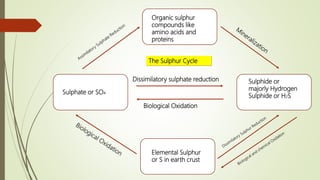
Organic sulphur
compounds like
amino acids and
proteins
Elemental Sulphur
or S in earth crust
Sulphate or SO4
Sulphide or
majorly Hydrogen
Sulphide or H2S
Biological Oxidation
Dissimilatory sulphate reduction
The Sulphur Cycle
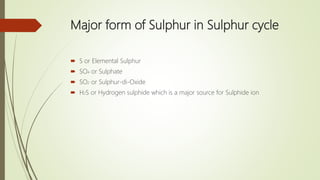
Major form of Sulphur in Sulphur cycle
 S or Elemental Sulphur
 SO4 or Sulphate
 SO2 or Sulphur-di-Oxide
 H2S or Hydrogen sulphide which is a major source for Sulphide ion
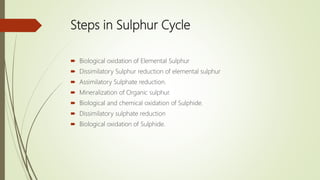
Steps in Sulphur Cycle
 Biological oxidation of Elemental Sulphur
 Dissimilatory Sulphur reduction of elemental sulphur
 Assimilatory Sulphate reduction.
 Mineralization of Organic sulphur.
 Biological and chemical oxidation of Sulphide.
 Dissimilatory sulphate reduction
 Biological oxidation of Sulphide.
Biological Oxidation of elemental Sulphur
 Here elemental sulphur is oxidised into SO4 or the sulphate.
 It generates energy by electron flow cycle
 Mainly done by the Sulphur bacteria
 The oxidation of sulphur to sulphate is also done by nature spontaneously via
different means like burning of sulphur, reaction with other compounds and
Oxygen.
Dissimilatory Sulphur Reduction
 Here Elemental sulphur is reduce to the S2- ion.
 This forms the Hydrogen Sulphide a toxic gas for oxygen dependent organisms
 These are majorly performed by anaerobic Sulphur bacteria mainly the pink
sulphur bacteria.
 This produces electron for the bacteria to carry out the ET chain completion.
 As it is a dissimilatory process it produces enough energy along with loss of
energy
Assimilatory sulphate reduction
 It is an assimilatory process that requiring energy for the reaction.
 The reaction is endothermic and requires reductase enzyme.
 This process is mainly applied by the plants after absorbing sulphate from soil to
convert it to Sulphur containing amino acid.
 This is the gateway for the Sulphur to enter inside food chain and from one
organism to another.
 As it is a reduction process the in which oxygen is removed from sulphate.
Mineralization of Organic sulphur
 Mineralization of Sulphur is the step where the Sulphur gets back to the soil after
the plat has been dead.
 After the organism is dead the Sulphur containing amino acids are broken down
by the decomposer and is mixed in soil as sulphide (S2-).
 A portion of it escapes into the atmosphere in the form of Hydrogen sulphide
(H2S) via the decomposition of Sulphated amino acid.
 This process is interfered by pollution mainly the Sulphur oxide pollutions
Biological and chemical oxidation of Sulphide
 In this process the Sulphide is again converted back to the elemental Sulphur form.
 This oxidation process is carried out both by the microbes or decomposer and the
environmental factor.
 The place where this process happens in quiet well then the place become Sulphur
rich and deposition of the Sulphur can be seen.
 In this step the Oxido-reductase enzyme plays the main and vital role in the
conversion of S2- to S
Dissimilatory sulphate reduction
 Dissimilatory Sulphate reduction is one of the chief physiological function of
Sulphur bacteria that uses Sulphur as electron carrier rather than oxygen.
 This process liberates energy that is utilized by the Sulphur dependent microbes
mainly green Sulphur bacteria.
 This process is a reduction process where hydrogen is accepted or the electron is
accepted by the molecule.
 This process is one of the chief process by the Sulphur bacteria that forms
Hydrogen sulphide in Sulphur rich area.
Biological oxidation of Sulphide
 Here the sulphide ion is oxidized to Sulphate form.
 Sulphide form is insoluble form for most of the organism that requiring Sulphur
so to make it soluble the sulphide is oxidized to Sulphate for better absorption.
 This process is majorly done by the soil microbes.
 This process Can be endothermic if it is by biological but if it is by natural means
it is exothermic in nature.
 Here also the Oxido-Reductase plays vital role.
Essentiality of Sulphur cycle
 Sulphur cycle is important for the organisms in their many physiological function.
 Some essential amino acid contains Sulphur as essential atom.
 Sulphur is although harmful for many organism in its pure elemental form but
due to Sulphur cycle the modification of the elemental Sulphur to its compound
makes it less toxic to that organism.
 Plants uses Sulphur compounds as repellent such as in onion(Contains Cycalliin
with MeCSO) that decompose when plant or the plant part is affected. The
Sulphur containing compounds are used as antifungal shield for the plant
Affect of Sulphur in nature
 Volcanoes release large amounts of sulfur dioxide gas (SO2) into the atmosphere.
 SO2 gas can react chemically with oxygen, dust particles and water to form
volcanic smog.
 SO2 combines with water in clouds which creates acid rain (H2SO4)
References
 https://www.sciencedirect.com/topics/earth-and-planetary-sciences/sulfur-cycle
 http://www.biologydiscussion.com/soil-microbiology/the-sulphur-cycle-with-
diagram-soil-microbiology/55524
 http://www.yourarticlelibrary.com/notes/short-notes-on-carbon-cycle-nitrogen-
cycle-and-sulphur-cycle-2158-words/9928
 https://www.researchgate.net/figure/The-biological-sulphur-cycle-Janssen-et-al-
1999_fig1_264037481
 https://www.slideshare.net/hanaraihanah/sulfur-cycle-presentation
 https://www.slideshare.net/danboanddomo/sulfur-cycle-17392888
Thank you

sulfurcycle-190707073010 (1).pdf

  • 1.
    Sulphur cycle Presented by SurajitBasak Roll. PGBOT17020 Plant physiology and biochemistry Department of Botany, BU
  • 2.
    What is sulphur It is a chemical element naturally occurring in nature  It is 10th most abundant in earth crust and pure form of it is crystalline solid  Sulphur is widely present in biochemical cycle.  Important in the functioning of proteins and enzymes in plants and animals  It is present in proteins, amino acids, vitamins, and enzymes, necessary for plants and animals.  It is widely used in the fertilizer and in industry apart from Biochemical cycle
  • 3.
    Why Sulphur isimportant  Sulfur is not only important to humans, but also to plants and bacterias.  Methionine, cysteine, homocysteine, and taurine are the 4 common sulfur- containing amino acids which are essential in the organism structure.  Sulphur is a component of penicillin-class antibiotics.  Before the age of antibiotics in the 1940s, sulfur-containing drugs-sulfa drugs- were commonly used to treat infectious diseases.  Sulfur dioxide kills molds and bacteria as preservative.
  • 4.
    What is Sulphurcycle  Sulphur cycle is the cyclic process where the one form of sulphur is being interchanged in biological cycle  Sulphur cycle shows the essential role of sulphur in the biological system  Sulphur cycle shows how sulphur is being transform and transported from organism to organism finally to atmosphere or in earth crust.
  • 5.
    Organic sulphur compounds like aminoacids and proteins Elemental Sulphur or S in earth crust Sulphate or SO4 Sulphide or majorly Hydrogen Sulphide or H2S Biological Oxidation Dissimilatory sulphate reduction The Sulphur Cycle
  • 6.
    Major form ofSulphur in Sulphur cycle  S or Elemental Sulphur  SO4 or Sulphate  SO2 or Sulphur-di-Oxide  H2S or Hydrogen sulphide which is a major source for Sulphide ion
  • 7.
    Steps in SulphurCycle  Biological oxidation of Elemental Sulphur  Dissimilatory Sulphur reduction of elemental sulphur  Assimilatory Sulphate reduction.  Mineralization of Organic sulphur.  Biological and chemical oxidation of Sulphide.  Dissimilatory sulphate reduction  Biological oxidation of Sulphide.
  • 8.
    Biological Oxidation ofelemental Sulphur  Here elemental sulphur is oxidised into SO4 or the sulphate.  It generates energy by electron flow cycle  Mainly done by the Sulphur bacteria  The oxidation of sulphur to sulphate is also done by nature spontaneously via different means like burning of sulphur, reaction with other compounds and Oxygen.
  • 9.
    Dissimilatory Sulphur Reduction Here Elemental sulphur is reduce to the S2- ion.  This forms the Hydrogen Sulphide a toxic gas for oxygen dependent organisms  These are majorly performed by anaerobic Sulphur bacteria mainly the pink sulphur bacteria.  This produces electron for the bacteria to carry out the ET chain completion.  As it is a dissimilatory process it produces enough energy along with loss of energy
  • 10.
    Assimilatory sulphate reduction It is an assimilatory process that requiring energy for the reaction.  The reaction is endothermic and requires reductase enzyme.  This process is mainly applied by the plants after absorbing sulphate from soil to convert it to Sulphur containing amino acid.  This is the gateway for the Sulphur to enter inside food chain and from one organism to another.  As it is a reduction process the in which oxygen is removed from sulphate.
  • 11.
    Mineralization of Organicsulphur  Mineralization of Sulphur is the step where the Sulphur gets back to the soil after the plat has been dead.  After the organism is dead the Sulphur containing amino acids are broken down by the decomposer and is mixed in soil as sulphide (S2-).  A portion of it escapes into the atmosphere in the form of Hydrogen sulphide (H2S) via the decomposition of Sulphated amino acid.  This process is interfered by pollution mainly the Sulphur oxide pollutions
  • 12.
    Biological and chemicaloxidation of Sulphide  In this process the Sulphide is again converted back to the elemental Sulphur form.  This oxidation process is carried out both by the microbes or decomposer and the environmental factor.  The place where this process happens in quiet well then the place become Sulphur rich and deposition of the Sulphur can be seen.  In this step the Oxido-reductase enzyme plays the main and vital role in the conversion of S2- to S
  • 13.
    Dissimilatory sulphate reduction Dissimilatory Sulphate reduction is one of the chief physiological function of Sulphur bacteria that uses Sulphur as electron carrier rather than oxygen.  This process liberates energy that is utilized by the Sulphur dependent microbes mainly green Sulphur bacteria.  This process is a reduction process where hydrogen is accepted or the electron is accepted by the molecule.  This process is one of the chief process by the Sulphur bacteria that forms Hydrogen sulphide in Sulphur rich area.
  • 14.
    Biological oxidation ofSulphide  Here the sulphide ion is oxidized to Sulphate form.  Sulphide form is insoluble form for most of the organism that requiring Sulphur so to make it soluble the sulphide is oxidized to Sulphate for better absorption.  This process is majorly done by the soil microbes.  This process Can be endothermic if it is by biological but if it is by natural means it is exothermic in nature.  Here also the Oxido-Reductase plays vital role.
  • 15.
    Essentiality of Sulphurcycle  Sulphur cycle is important for the organisms in their many physiological function.  Some essential amino acid contains Sulphur as essential atom.  Sulphur is although harmful for many organism in its pure elemental form but due to Sulphur cycle the modification of the elemental Sulphur to its compound makes it less toxic to that organism.  Plants uses Sulphur compounds as repellent such as in onion(Contains Cycalliin with MeCSO) that decompose when plant or the plant part is affected. The Sulphur containing compounds are used as antifungal shield for the plant
  • 16.
    Affect of Sulphurin nature  Volcanoes release large amounts of sulfur dioxide gas (SO2) into the atmosphere.  SO2 gas can react chemically with oxygen, dust particles and water to form volcanic smog.  SO2 combines with water in clouds which creates acid rain (H2SO4)
  • 17.
    References  https://www.sciencedirect.com/topics/earth-and-planetary-sciences/sulfur-cycle  http://www.biologydiscussion.com/soil-microbiology/the-sulphur-cycle-with- diagram-soil-microbiology/55524 http://www.yourarticlelibrary.com/notes/short-notes-on-carbon-cycle-nitrogen- cycle-and-sulphur-cycle-2158-words/9928  https://www.researchgate.net/figure/The-biological-sulphur-cycle-Janssen-et-al- 1999_fig1_264037481  https://www.slideshare.net/hanaraihanah/sulfur-cycle-presentation  https://www.slideshare.net/danboanddomo/sulfur-cycle-17392888
  • 18.