Gujarat technological university
Birla vishwakarma mahavidhyalaya
Guided by:
PROF. R.S.BAROT
RATHOD ANKIT (140070125026)
SHAH RUSHI (140070125027)
SHAH VRAJ (140070125028)
SHIYAL VIKRAM (140070125029)
SUBJECT: METAL JOINING PROCESSES
(2162107)
Prepared by :
TOPIC: SUBMERGED ARC WELDING (SAW)
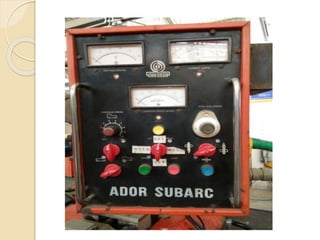
Submerged Arc Welding
 Submerged arc welding (SAW) is a method in
which the heat required to fuse the metal is
generated by an arc formed by an electric
current passing between the electrode and the
work piece.
 There is no visible arc and no sparks, spatter or
fume. Arc and molten pool remains completely
hidden.
 This arc submerged under the loose granular
flux.
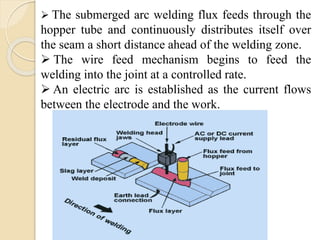
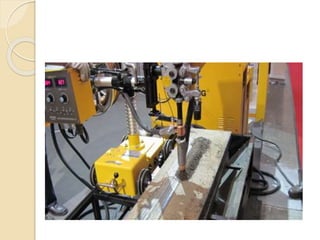
 The submerged arc welding flux feeds through the
hopper tube and continuously distributes itself over
the seam a short distance ahead of the welding zone.
 The wire feed mechanism begins to feed the
welding into the joint at a controlled rate.
 An electric arc is established as the current flows
between the electrode and the work.
Arc initiation
 After arranging the polarity ,arc struck
either by touching electrode of w/p or
by placing steel ball wool
 No withdrawn facilities available for
arc initiation , ball of thin wire is placed
at working of electrode
 So technique adopted for arc initiation
is called ball wool wire method.
 For arc initiation, electrode touches the
ball of thin wire of steel which has very
small gauge.
 The ball is kept on contact with w/p, the
wire ball wool virtually fuse and
vaporised by providing electrical supply.
 Initially flux works as insulated but it
melt as due to arc heat & become
conductivity & began to start arc.
 Further causing melting and ionization
of electrode wire.
Why touch & draw is not used
?
 In SAW process the wire is fed
automatically by motor only in forward
direction only.
 For touch & draw method anyone
have to add more facilities on m/c for
draw , moment will have to be control
by motor which makes automation
difficult.
Advantages
 High quality
 Little risk of undercut and porosity
 No spatter
 High current upto 4000A is used
 High deposition rate upto 20kg/h because arc is
completely confine by granular flux.
 High thermal efficiency
 weld upto 75mm thick plates
 High welding speeds are possible upto 5m/s
 No edge preparation required
 Neat appearance
Limitations
Precise joint preparation required
No observation of arc and process during
welding is possible
Limited to flat position .
It can not be used for plates less than 5mm
thickness
Flux is subjected to contamination and
absorption of moisture.
Flux consumption is high
Irregular wire feed.
Applications
 Fabrication of Boiler Pressure Vessel.
 Railroad tank cars.
 Structural shapes and cylinders.
 Circular welds and Longitudinal pipe welding.
 Beam Production.
 Ship Building.
 Circumferential welding in wind tower
fabrication.
submerged arc welding presentation gtu

submerged arc welding presentation gtu

  • 1.
    Gujarat technological university Birlavishwakarma mahavidhyalaya Guided by: PROF. R.S.BAROT RATHOD ANKIT (140070125026) SHAH RUSHI (140070125027) SHAH VRAJ (140070125028) SHIYAL VIKRAM (140070125029) SUBJECT: METAL JOINING PROCESSES (2162107) Prepared by : TOPIC: SUBMERGED ARC WELDING (SAW)
  • 2.
    Submerged Arc Welding Submerged arc welding (SAW) is a method in which the heat required to fuse the metal is generated by an arc formed by an electric current passing between the electrode and the work piece.  There is no visible arc and no sparks, spatter or fume. Arc and molten pool remains completely hidden.  This arc submerged under the loose granular flux.
  • 3.
     The submergedarc welding flux feeds through the hopper tube and continuously distributes itself over the seam a short distance ahead of the welding zone.  The wire feed mechanism begins to feed the welding into the joint at a controlled rate.  An electric arc is established as the current flows between the electrode and the work.
  • 7.
    Arc initiation  Afterarranging the polarity ,arc struck either by touching electrode of w/p or by placing steel ball wool  No withdrawn facilities available for arc initiation , ball of thin wire is placed at working of electrode  So technique adopted for arc initiation is called ball wool wire method.
  • 8.
     For arcinitiation, electrode touches the ball of thin wire of steel which has very small gauge.  The ball is kept on contact with w/p, the wire ball wool virtually fuse and vaporised by providing electrical supply.  Initially flux works as insulated but it melt as due to arc heat & become conductivity & began to start arc.  Further causing melting and ionization of electrode wire.
  • 9.
    Why touch &draw is not used ?  In SAW process the wire is fed automatically by motor only in forward direction only.  For touch & draw method anyone have to add more facilities on m/c for draw , moment will have to be control by motor which makes automation difficult.
  • 11.
    Advantages  High quality Little risk of undercut and porosity  No spatter  High current upto 4000A is used  High deposition rate upto 20kg/h because arc is completely confine by granular flux.  High thermal efficiency  weld upto 75mm thick plates  High welding speeds are possible upto 5m/s  No edge preparation required  Neat appearance
  • 12.
    Limitations Precise joint preparationrequired No observation of arc and process during welding is possible Limited to flat position . It can not be used for plates less than 5mm thickness Flux is subjected to contamination and absorption of moisture. Flux consumption is high Irregular wire feed.
  • 13.
    Applications  Fabrication ofBoiler Pressure Vessel.  Railroad tank cars.  Structural shapes and cylinders.  Circular welds and Longitudinal pipe welding.  Beam Production.  Ship Building.  Circumferential welding in wind tower fabrication.