Shri S’ad Vidhya Mandal Institute Of
Technology
Presented by
Singh Lav 150450119159
Singh Pranjul 150450119160
Sojitra Samarth 150450119161
Presentation on Submerged arc welding
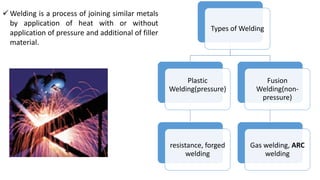
Types of Welding
Plastic
Welding(pressure)
resistance, forged
welding
Fusion
Welding(non-
pressure)
Gas welding, ARC
welding
 Welding is a process of joining similar metals
by application of heat with or without
application of pressure and additional of filler
material.
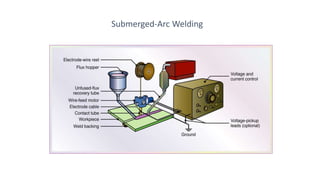
Submerged-Arc Welding
 The fluxed used in the process include lime, silica, manganese oxide, calcium fluoride and
other compounds free from gas producing substances. They available in many different
grades.
 The filler wire used may be bare or slightly copper coated. The welding action is initiated
by one of the many methods available depending upon the equipment used.
 In some cases the welding is started by striking an arc in the conventional way by letting the
electrode touch the workpiece under the flux layer and slightly withdrawing it. In others,
the welding action can be initiated by introducing a piece of high resistance conducting
material like steel wool or carbon between the electrode and the workpiece.
 Once the welding action has been initiated the intense heat produced by the flow of current
in the high resistance path melts a part of the flux around the electrode forming a
conducting pool.
 The end of the electrode dipping in the fluid flux and the base metal melt under the liquid
flux pool.
 The molten filler displaces the liquid flux and fuses with the molten base metal forming the
weld.
 The molten flux coating over the molten metal pool forms a blanket that eliminates
spatter losses and protects the welded joint from oxidation.
 As welding proceeds, the molten weld metal and the liquid flux cool and solidify under a
layer of unused flux.
 The molten flux on solidification forms a brittle slag layer which can be easily removed.
Unused granular flux material can be reclaimed and reused.
 The molten flux layer above the weld provides conditions most suitable for the use of
large currents which make possible rapid generation of intense heat.
 The molten flux and the granulated flux covering provide excellent insulation
concentrating the heat generated in a small region making possible thorough fusion of the
base metal and the flux metal.
 The concentrated heat permits high welding speeds and deep penetration. The flux can
also be used as a carrier of alloying elements to be introduced into the weld metal.
 The intense heat and deep penetration permit use of narrow grooves in the base metal for
edge preparation requiring smaller quantities of filler metal.
 Thin plates can be easily welded in one pass without any edge preparation while only a
slight bevelling is necessary in most other cases.
 The quality of welds produced in submerged arc welding is very high with good
toughness, ductility and uniformity of properties.
 Submerged arc welding is most suitable for welding in the downhand or flat position
although welds can be made on a straight slope.
 The high speed of welding with the associated large quantities of flux filler metal
melted require the weld to be in a near horizontal position to avoid the flowing out of
the liquid weld metal and the flux.
 Materials successfully welded by the process include low carbon steel, medium carbon
steel, heat resistant steel, corrosion resistant steel. high strength steels and non
ferrule metals like monel metal, nickel and others.
 Submerged arc welding can also be easily adaptable to semi-or fully mechanized
operation.
Basic equipments and its function.
• Wire feeder:- It is used to drive the electrode to the work through
the contact tube of a welding gun welding head.
• Welding power source : To supply electric current to electrode.
• An arrangement for holding the flux and feeding of the arc.
To get optimum results they are depends on certain parameters;
• Welding current
• Arc voltage
• Arc travel speed
• Electrode size
• Heat Input rate
Advantages
• High deposition rates
• No arc flash or glare
• Minimal smoke and fumes
• Flux and wire added separately - extra dimension
of control
• Easily automated
• Joints can be prepared with narrow grooves
• Can be used to weld carbon steels, low alloy steels,
stainless steels, chromium-molybdenum steels,
nickel base alloys
Limitations
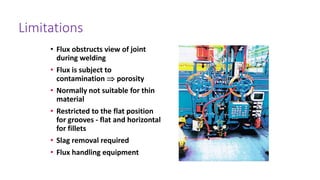
• Flux obstructs view of joint
during welding
• Flux is subject to
contamination porosity
• Normally not suitable for thin
material
• Restricted to the flat position
for grooves - flat and horizontal
for fillets
• Slag removal required
• Flux handling equipment
Application
• Automotive, Aviation, Ship Building and Nuclear power industry.
• Fabrication of Pipes, Pressure Vessels Boilers, Rail road, Railways
coaches. In heavy fabrication industry.
• Rebuilding of worm out parts.
THANK YOU

Submerged arc welding

  • 1.
    Shri S’ad VidhyaMandal Institute Of Technology Presented by Singh Lav 150450119159 Singh Pranjul 150450119160 Sojitra Samarth 150450119161 Presentation on Submerged arc welding
  • 2.
    Types of Welding Plastic Welding(pressure) resistance,forged welding Fusion Welding(non- pressure) Gas welding, ARC welding  Welding is a process of joining similar metals by application of heat with or without application of pressure and additional of filler material.
  • 3.
  • 4.
     The fluxedused in the process include lime, silica, manganese oxide, calcium fluoride and other compounds free from gas producing substances. They available in many different grades.  The filler wire used may be bare or slightly copper coated. The welding action is initiated by one of the many methods available depending upon the equipment used.  In some cases the welding is started by striking an arc in the conventional way by letting the electrode touch the workpiece under the flux layer and slightly withdrawing it. In others, the welding action can be initiated by introducing a piece of high resistance conducting material like steel wool or carbon between the electrode and the workpiece.  Once the welding action has been initiated the intense heat produced by the flow of current in the high resistance path melts a part of the flux around the electrode forming a conducting pool.  The end of the electrode dipping in the fluid flux and the base metal melt under the liquid flux pool.  The molten filler displaces the liquid flux and fuses with the molten base metal forming the weld.
  • 5.
     The moltenflux coating over the molten metal pool forms a blanket that eliminates spatter losses and protects the welded joint from oxidation.  As welding proceeds, the molten weld metal and the liquid flux cool and solidify under a layer of unused flux.  The molten flux on solidification forms a brittle slag layer which can be easily removed. Unused granular flux material can be reclaimed and reused.  The molten flux layer above the weld provides conditions most suitable for the use of large currents which make possible rapid generation of intense heat.  The molten flux and the granulated flux covering provide excellent insulation concentrating the heat generated in a small region making possible thorough fusion of the base metal and the flux metal.  The concentrated heat permits high welding speeds and deep penetration. The flux can also be used as a carrier of alloying elements to be introduced into the weld metal.  The intense heat and deep penetration permit use of narrow grooves in the base metal for edge preparation requiring smaller quantities of filler metal.
  • 6.
     Thin platescan be easily welded in one pass without any edge preparation while only a slight bevelling is necessary in most other cases.  The quality of welds produced in submerged arc welding is very high with good toughness, ductility and uniformity of properties.  Submerged arc welding is most suitable for welding in the downhand or flat position although welds can be made on a straight slope.  The high speed of welding with the associated large quantities of flux filler metal melted require the weld to be in a near horizontal position to avoid the flowing out of the liquid weld metal and the flux.  Materials successfully welded by the process include low carbon steel, medium carbon steel, heat resistant steel, corrosion resistant steel. high strength steels and non ferrule metals like monel metal, nickel and others.  Submerged arc welding can also be easily adaptable to semi-or fully mechanized operation.
  • 7.
    Basic equipments andits function. • Wire feeder:- It is used to drive the electrode to the work through the contact tube of a welding gun welding head. • Welding power source : To supply electric current to electrode. • An arrangement for holding the flux and feeding of the arc.
  • 8.
    To get optimumresults they are depends on certain parameters; • Welding current • Arc voltage • Arc travel speed • Electrode size • Heat Input rate
  • 9.
    Advantages • High depositionrates • No arc flash or glare • Minimal smoke and fumes • Flux and wire added separately - extra dimension of control • Easily automated • Joints can be prepared with narrow grooves • Can be used to weld carbon steels, low alloy steels, stainless steels, chromium-molybdenum steels, nickel base alloys
  • 10.
    Limitations • Flux obstructsview of joint during welding • Flux is subject to contamination porosity • Normally not suitable for thin material • Restricted to the flat position for grooves - flat and horizontal for fillets • Slag removal required • Flux handling equipment
  • 11.
    Application • Automotive, Aviation,Ship Building and Nuclear power industry. • Fabrication of Pipes, Pressure Vessels Boilers, Rail road, Railways coaches. In heavy fabrication industry. • Rebuilding of worm out parts.
  • 12.

Editor's Notes

  • #10  Since the arc is completely submerged in the flux, there is no arc radiation. Screens or light filtering lenses are not needed. Additionally, the smoke and fumes are trapped within the flux and thus minimizing smoke and fumes . Since the process is simple to mechanize and easily automated, it is extremely consistent once a procedure is qualified. And it can be used on a wide variety of materials.
  • #11  Because of the high current levels common to this process, it is normally not suited for thinner materials. Due to the presence of a granulated flux, submerged arc welding is limited to the flat and horizontal positions. As with SMAW and FCAW, SAW produces a slag which must be completely removed after each pass. Finally, additional flux handling equipment is required.