joining together (metal parts) by heating the
surfaces to the point of melting with a blowpipe,
electric arc, or other means, and uniting them by
pressing, hammering, etc.
1 . PLASTIC WELDING OR
PRESSURE WELDING
 Example : Resistance
welding
2. FUSION WELDING OR NON-
PRESSURE WELDING
 Example : a .Arc welding
b . Gas welding
 Arc welding is a type of welding that uses a welding power supply to create an electric
arc between an electrode and the base material to melt the metals at the welding point.
Today it remains an important process for the fabrication of steel structures and vehicles.
 SHIELDED METAL
ARC WELDING
MACHINES (SMAW) :-
Shielded metal arc
welding (SMAW), also
known as manual metal
arc welding (MMA or
MMAW), flux shielded
arc welding or
informally as
stick welding, is a
manual
arc welding process
that uses a consumable
electrode covered with
a flux to lay the weld.
 Submerged Arc
Welding (SAW) :-
Submerged arc
welding (SAW) is a
common arc welding
process. The first patent
on the submerged-arc
welding (SAW) process
was taken out in 1935
and covered an electric
arc beneath a bed of
granulated flux.
 ADVANTAGES
1. Relative simplicity and
portability of equipment
.
2.Low cost .
3.Adaptable to confined
spaces and remote locations.
4. Suitable for out-of-position
welding
 DISADVANTAGES
1.Not as productive as
continuous wire
processes.
2. Likely to be more
costly to deposit a
given quantity of
metal.
3. Relatively high metal
wastage (electrode
stubs)
 ADVANTAGES
1 .Welding is carried out without
sparks, smoke, flash or spatter.
2.Weld metal deposit possesses
uniformity, good ductility,
corrosion resistance and good
impact strength.
3.Very neat appearance and
smooth weld shapes can be got.
 DISADVANTAGES
1.The flux needs replacing of
the same on the joint which is
not always possible.
2.The progress is limited to
welding in flat position and on
the metal more than 4.8
mm thick. In small thicknesses
burn through is likely to occur.
3. Flux is subjected to
contamination that may cause
weld porosity.
 Limited to ferrous (steel or stainless steels)
and some nickel-based alloys.
 Normally limited to long straight seams or
rotated pipes or vessels.
 Requires inter-pass and post weld slag
removal.
Gas metal arc welding (GMAW),
sometimes referred to by its
subtypes metal inert
gas (MIG) welding or metal active
gas (MAG)welding, is a welding process
in which an electric arc forms between a
consumable wire electrode and the work
piece metal(s), which heats the work
piece metal(s), causing them to melt and
join.
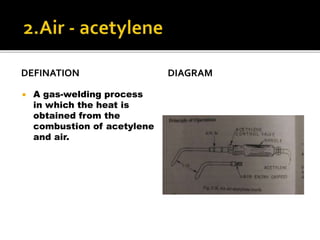
 1. Oxy - acetylene
 2. Air - acetylene
 3.Oxy - hydrogen
 PURPOSES
 Oxyacetylene gas welding is
commonly used to permanently join
mild steel.A mixture of oxygen and
acetylene, burns as an intense /
focused flame, at approximately
3,500 degrees centigrade.When the
flame comes in contact with steel, it
melts the surface forming a molten
pool, allowing welding to take
place. Oxyacetylene can also be
used for brazing, bronze welding,
forging / shaping metal and cutting.
 This type of welding is suitable for
the prefabrication of steel sheet,
tubes and plates.
 CHART DIAGRAM  H-BEAM WELDING
DEFINATION
 A gas-welding process
in which the heat is
obtained from the
combustion of acetylene
and air.
DIAGRAM
 Ox hydrogen is a mixture of hydrogen (H2) and oxygen (O2) gases.This gaseous mixture is
used for torches to process refractory materials and was the first[1] gaseous mixture used
for welding. Theoretically, a ratio of 2:1 hydrogen: oxygen is enough to achieve maximum
efficiency; in practice a ratio 4:1 or 5:1 is needed to avoid an oxidizing flame.[2]
 Portability – moving the welding equipment
may not be that tough, but you also have to
handle the high pressure cylinders that contain
the shielding gas. Proper care must be taken.
 Sensitive to wind – the shielding gas used for
mig welding can easily be blown away when
welding outdoors. Even inside, a fan or a wind
draft of as low as 5mph can be enough to cause
porosity.
 Lack of fusion – due to the ability to weld at low
currents this process has the potential for lack of
fusision when running in short circuit mode.
ADVANTAGES
 Low Hydrogen weld
deposit with all electrodes
 High production factor
since no slag is required to
be removed and uses a
continuous electrode.
 With the parameters
properly set for the
application, anyone can
weld after a very short
amount of practice.
DISADVANTAGES
 Requires aWire Feeder
which is difficult to move
and can sometimes be a
maintenance/repair
burden.
 Needs Shielding Gas so
welding in windy
conditions can be difficult.
 Is not suitable for windy
conditions.
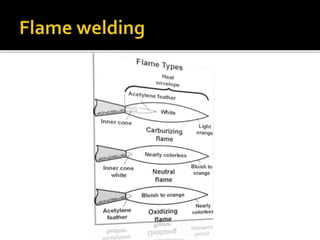
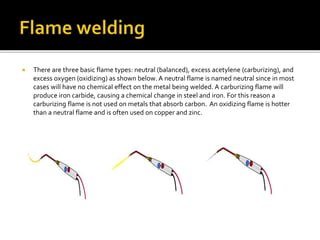
 There are three basic flame types: neutral (balanced), excess acetylene (carburizing), and
excess oxygen (oxidizing) as shown below. A neutral flame is named neutral since in most
cases will have no chemical effect on the metal being welded. A carburizing flame will
produce iron carbide, causing a chemical change in steel and iron. For this reason a
carburizing flame is not used on metals that absorb carbon. An oxidizing flame is hotter
than a neutral flame and is often used on copper and zinc.
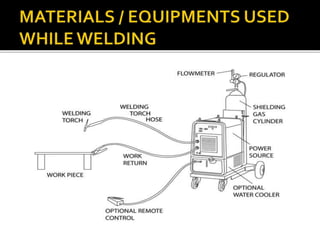
 Welding machine (A.C or D.C)
 Two cables for job and another for electrode
 Electrode holder
 Gloves
 Wire brush
 Chipping hammer
 Goggles
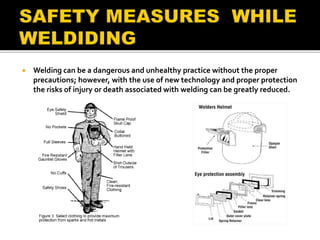
 Welding can be a dangerous and unhealthy practice without the proper
precautions; however, with the use of new technology and proper protection
the risks of injury or death associated with welding can be greatly reduced.
Welding presentation

Welding presentation

  • 1.
    joining together (metalparts) by heating the surfaces to the point of melting with a blowpipe, electric arc, or other means, and uniting them by pressing, hammering, etc.
  • 2.
    1 . PLASTICWELDING OR PRESSURE WELDING  Example : Resistance welding 2. FUSION WELDING OR NON- PRESSURE WELDING  Example : a .Arc welding b . Gas welding
  • 3.
     Arc weldingis a type of welding that uses a welding power supply to create an electric arc between an electrode and the base material to melt the metals at the welding point. Today it remains an important process for the fabrication of steel structures and vehicles.
  • 4.
     SHIELDED METAL ARCWELDING MACHINES (SMAW) :- Shielded metal arc welding (SMAW), also known as manual metal arc welding (MMA or MMAW), flux shielded arc welding or informally as stick welding, is a manual arc welding process that uses a consumable electrode covered with a flux to lay the weld.  Submerged Arc Welding (SAW) :- Submerged arc welding (SAW) is a common arc welding process. The first patent on the submerged-arc welding (SAW) process was taken out in 1935 and covered an electric arc beneath a bed of granulated flux.
  • 5.
     ADVANTAGES 1. Relativesimplicity and portability of equipment . 2.Low cost . 3.Adaptable to confined spaces and remote locations. 4. Suitable for out-of-position welding  DISADVANTAGES 1.Not as productive as continuous wire processes. 2. Likely to be more costly to deposit a given quantity of metal. 3. Relatively high metal wastage (electrode stubs)
  • 6.
     ADVANTAGES 1 .Weldingis carried out without sparks, smoke, flash or spatter. 2.Weld metal deposit possesses uniformity, good ductility, corrosion resistance and good impact strength. 3.Very neat appearance and smooth weld shapes can be got.  DISADVANTAGES 1.The flux needs replacing of the same on the joint which is not always possible. 2.The progress is limited to welding in flat position and on the metal more than 4.8 mm thick. In small thicknesses burn through is likely to occur. 3. Flux is subjected to contamination that may cause weld porosity.
  • 7.
     Limited toferrous (steel or stainless steels) and some nickel-based alloys.  Normally limited to long straight seams or rotated pipes or vessels.  Requires inter-pass and post weld slag removal.
  • 8.
    Gas metal arcwelding (GMAW), sometimes referred to by its subtypes metal inert gas (MIG) welding or metal active gas (MAG)welding, is a welding process in which an electric arc forms between a consumable wire electrode and the work piece metal(s), which heats the work piece metal(s), causing them to melt and join.
  • 9.
     1. Oxy- acetylene  2. Air - acetylene  3.Oxy - hydrogen
  • 10.
     PURPOSES  Oxyacetylenegas welding is commonly used to permanently join mild steel.A mixture of oxygen and acetylene, burns as an intense / focused flame, at approximately 3,500 degrees centigrade.When the flame comes in contact with steel, it melts the surface forming a molten pool, allowing welding to take place. Oxyacetylene can also be used for brazing, bronze welding, forging / shaping metal and cutting.  This type of welding is suitable for the prefabrication of steel sheet, tubes and plates.
  • 11.
     CHART DIAGRAM H-BEAM WELDING
  • 12.
    DEFINATION  A gas-weldingprocess in which the heat is obtained from the combustion of acetylene and air. DIAGRAM
  • 13.
     Ox hydrogenis a mixture of hydrogen (H2) and oxygen (O2) gases.This gaseous mixture is used for torches to process refractory materials and was the first[1] gaseous mixture used for welding. Theoretically, a ratio of 2:1 hydrogen: oxygen is enough to achieve maximum efficiency; in practice a ratio 4:1 or 5:1 is needed to avoid an oxidizing flame.[2]
  • 14.
     Portability –moving the welding equipment may not be that tough, but you also have to handle the high pressure cylinders that contain the shielding gas. Proper care must be taken.  Sensitive to wind – the shielding gas used for mig welding can easily be blown away when welding outdoors. Even inside, a fan or a wind draft of as low as 5mph can be enough to cause porosity.  Lack of fusion – due to the ability to weld at low currents this process has the potential for lack of fusision when running in short circuit mode.
  • 15.
    ADVANTAGES  Low Hydrogenweld deposit with all electrodes  High production factor since no slag is required to be removed and uses a continuous electrode.  With the parameters properly set for the application, anyone can weld after a very short amount of practice. DISADVANTAGES  Requires aWire Feeder which is difficult to move and can sometimes be a maintenance/repair burden.  Needs Shielding Gas so welding in windy conditions can be difficult.  Is not suitable for windy conditions.
  • 17.
     There arethree basic flame types: neutral (balanced), excess acetylene (carburizing), and excess oxygen (oxidizing) as shown below. A neutral flame is named neutral since in most cases will have no chemical effect on the metal being welded. A carburizing flame will produce iron carbide, causing a chemical change in steel and iron. For this reason a carburizing flame is not used on metals that absorb carbon. An oxidizing flame is hotter than a neutral flame and is often used on copper and zinc.
  • 18.
     Welding machine(A.C or D.C)  Two cables for job and another for electrode  Electrode holder  Gloves  Wire brush  Chipping hammer  Goggles
  • 20.
     Welding canbe a dangerous and unhealthy practice without the proper precautions; however, with the use of new technology and proper protection the risks of injury or death associated with welding can be greatly reduced.