Welding Processes - Chapter 31
1
WELDING PROCESSES
1. Arc Welding
2. Resistance Welding
3. Oxyfuel Gas Welding
4. Other Fusion Welding Processes
5. Solid State Welding
6. Weld Quality
7. Weldability
8. Design Considerations in Welding
2
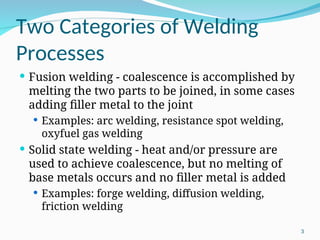
Two Categories of Welding
Processes
 Fusion welding - coalescence is accomplished by
melting the two parts to be joined, in some cases
adding filler metal to the joint
 Examples: arc welding, resistance spot welding,
oxyfuel gas welding
 Solid state welding - heat and/or pressure are
used to achieve coalescence, but no melting of
base metals occurs and no filler metal is added
 Examples: forge welding, diffusion welding,
friction welding
3
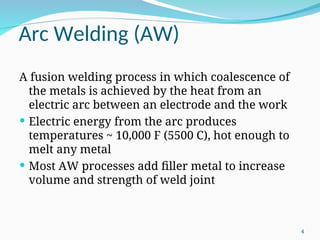
Arc Welding (AW)
A fusion welding process in which coalescence of
the metals is achieved by the heat from an
electric arc between an electrode and the work
 Electric energy from the arc produces
temperatures ~ 10,000 F (5500 C), hot enough to
melt any metal
 Most AW processes add filler metal to increase
volume and strength of weld joint
4
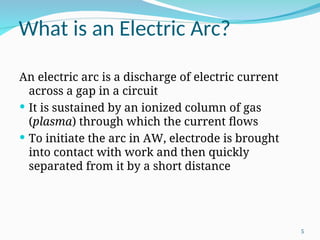
What is an Electric Arc?
An electric arc is a discharge of electric current
across a gap in a circuit
 It is sustained by an ionized column of gas
(plasma) through which the current flows
 To initiate the arc in AW, electrode is brought
into contact with work and then quickly
separated from it by a short distance
5
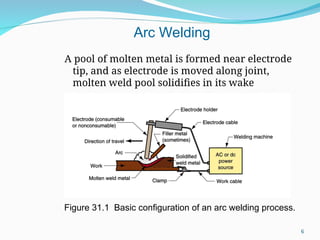
A pool of molten metal is formed near electrode
tip, and as electrode is moved along joint,
molten weld pool solidifies in its wake
Figure 31.1 Basic configuration of an arc welding process.
Arc Welding
6
Manual Arc Welding and Arc
Time  Problems with manual welding:
 Weld joint quality
 Productivity
 Arc Time = (time arc is on) divided by
(hours worked)
 Also called “arc-on time”
 Manual welding arc time = 20%
 Machine welding arc time ~ 50%
7
Two Basic Types of AW
Electrodes
 Consumable – consumed during welding process
 Source of filler metal in arc welding
 Nonconsumable – not consumed during welding
process
 Filler metal must be added separately
8
Consumable Electrodes
 Forms of consumable electrodes
 Welding rods (a.k.a. sticks) are 9 to 18 inches and
3/8 inch or less in diameter and must be changed
frequently
 Weld wire can be continuously fed from spools
with long lengths of wire, avoiding frequent
interruptions
 In both rod and wire forms, electrode is
consumed by arc and added to weld joint as filler
metal
9
Nonconsumable Electrodes
 Made of tungsten which resists melting
 Gradually depleted during welding (vaporization
is principal mechanism)
 Any filler metal must be supplied by a separate
wire fed into weld pool
10
Arc Shielding
 At high temperatures in AW, metals are
chemically reactive to oxygen, nitrogen, and
hydrogen in air
 Mechanical properties of joint can be seriously
degraded by these reactions
 To protect operation, arc must be shielded from
surrounding air in AW processes
 Arc shielding is accomplished by:
 Shielding gases, e.g., argon, helium, CO2
 Flux
11
Flux
A substance that prevents formation of oxides and
other contaminants in welding, or dissolves them
and facilitates removal
 Provides protective atmosphere for welding
 Stabilizes arc
 Reduces spattering
12
Various Flux Application
Methods
 Pouring granular flux onto welding operation
 Stick electrode coated with flux material that
melts during welding to cover operation
 Tubular electrodes in which flux is contained in
the core and released as electrode is consumed
13
Power Source in Arc Welding
 Direct current (DC) vs. Alternating current (AC)
 AC machines less expensive to purchase and
operate, but generally restricted to ferrous metals
 DC equipment can be used on all metals and is
generally noted for better arc control
14
Consumable Electrode AW
Processes
 Shielded Metal Arc Welding
 Gas Metal Arc Welding
 Flux‑Cored Arc Welding
 Electrogas Welding
 Submerged Arc Welding
15
Shielded Metal Arc Welding
(SMAW)
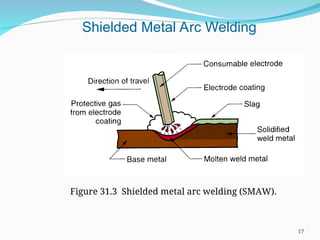
Uses a consumable electrode consisting of a filler
metal rod coated with chemicals that provide
flux and shielding
 Sometimes called "stick welding"
 Power supply, connecting cables, and electrode
holder available for a few thousand dollars
16
Figure 31.3 Shielded metal arc welding (SMAW).
Shielded Metal Arc Welding
17
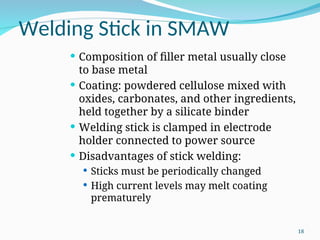
Welding Stick in SMAW
 Composition of filler metal usually close
to base metal
 Coating: powdered cellulose mixed with
oxides, carbonates, and other ingredients,
held together by a silicate binder
 Welding stick is clamped in electrode
holder connected to power source
 Disadvantages of stick welding:
 Sticks must be periodically changed
 High current levels may melt coating
prematurely
18
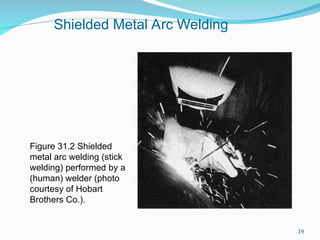
Figure 31.2 Shielded
metal arc welding (stick
welding) performed by a
(human) welder (photo
courtesy of Hobart
Brothers Co.).
Shielded Metal Arc Welding
19
SMAW Applications
 Used for steels, stainless steels,
cast irons, and certain nonferrous
alloys
 Not used or rarely used for
aluminum and its alloys, copper
alloys, and titanium
20
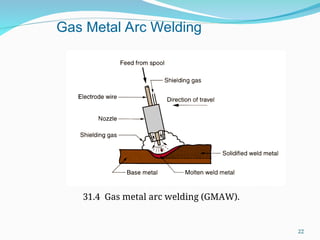
Gas Metal Arc Welding (GMAW)
Uses a consumable bare metal wire as
electrode and shielding accomplished by
flooding arc with a gas
 Wire is fed continuously and automatically
from a spool through the welding gun
 Shielding gases include inert gases such as
argon and helium for aluminum welding,
and active gases such as CO2 for steel
welding
 Bare electrode wire plus shielding gases
eliminate slag on weld bead - no need for
manual grinding and cleaning of slag
21
31.4 Gas metal arc welding (GMAW).
Gas Metal Arc Welding
22
GMAW Advantages over
SMAW
 Better arc time because of continuous wire
electrode
 Sticks must be periodically changed in SMAW
 Better use of electrode filler metal than SMAW
 End of stick cannot be used in SMAW
 Higher deposition rates
 Eliminates problem of slag removal
 Can be readily automated
23
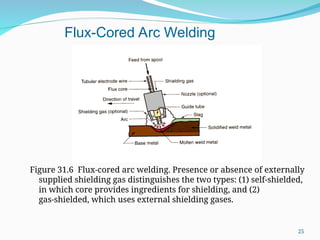
Flux Cored Arc Welding (FCAW)
‑
Adaptation of shielded metal arc welding, to
overcome limitations of stick electrodes
 Electrode is a continuous consumable tubing (in
coils) containing flux and other ingredients (e.g.,
alloying elements) in its core
 Two versions:
 Self‑shielded FCAW - core includes compounds
that produce shielding gases
 Gas‑shielded FCAW - uses externally applied
shielding gases
24
Figure 31.6 Flux‑cored arc welding. Presence or absence of externally
supplied shielding gas distinguishes the two types: (1) self‑shielded,
in which core provides ingredients for shielding, and (2)
gas‑shielded, which uses external shielding gases.
Flux-Cored Arc Welding
25
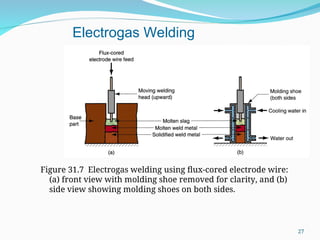
Electrogas Welding (EGW)
Uses a continuous consumable electrode, either
flux‑cored wire or bare wire with externally
supplied shielding gases, and molding shoes to
contain molten metal
 When flux‑cored electrode wire is used and no
external gases are supplied, then special case of
self‑shielded FCAW
 When a bare electrode wire used with shielding
gases from external source, then special case of
GMAW
26
Figure 31.7 Electrogas welding using flux‑cored electrode wire:
(a) front view with molding shoe removed for clarity, and (b)
side view showing molding shoes on both sides.
Electrogas Welding
27
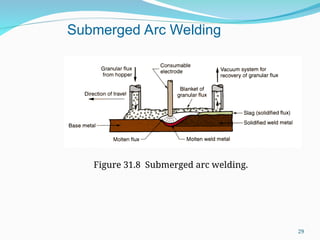
Submerged Arc Welding (SAW)
Uses a continuous, consumable bare
wire electrode, with arc shielding
provided by a cover of granular flux
 Electrode wire is fed automatically
from a coil
 Flux introduced into joint slightly
ahead of arc by gravity from a hopper
 Completely submerges operation,
preventing sparks, spatter, and
radiation
28
Figure 31.8 Submerged arc welding.
Submerged Arc Welding
29
SAW Applications and Products
 Steel fabrication of structural shapes (e.g.,
I‑beams)
 Seams for large diameter pipes, tanks, and
pressure vessels
 Welded components for heavy machinery
 Most steels (except hi C steel)
 Not good for nonferrous metals
30
Nonconsumable Electrode
Processes
 Gas Tungsten Arc Welding
 Plasma Arc Welding
 Carbon Arc Welding
 Stud Welding
31
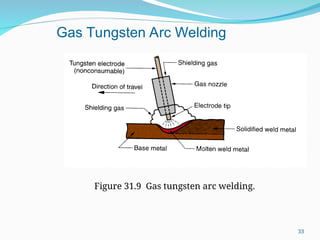
Gas Tungsten Arc Welding (GTAW)
Uses a nonconsumable tungsten electrode
and an inert gas for arc shielding
 Melting point of tungsten = 3410C
(6170F)
 A.k.a. Tungsten Inert Gas (TIG) welding
 In Europe, called "WIG welding"
 Used with or without a filler metal
 When filler metal used, it is added to
weld pool from separate rod or wire
 Applications: aluminum and stainless
steel most common
32
Figure 31.9 Gas tungsten arc welding.
Gas Tungsten Arc Welding
33
Advantages / Disadvantages of
GTAW
Advantages:
 High quality welds for suitable applications
 No spatter because no filler metal through arc
 Little or no post-weld cleaning because no flux
Disadvantages:
 Generally slower and more costly than consumable
electrode AW processes
34
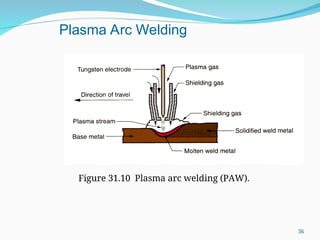
Plasma Arc Welding (PAW)
Special form of GTAW in which a constricted
plasma arc is directed at weld area
 Tungsten electrode is contained in a nozzle that
focuses a high velocity stream of inert gas
(argon) into arc region to form a high velocity,
intensely hot plasma arc stream
 Temperatures in PAW reach 28,000C (50,000F),
due to constriction of arc, producing a plasma jet
of small diameter and very high energy density
35
Figure 31.10 Plasma arc welding (PAW).
Plasma Arc Welding
36
Advantages / Disadvantages of
PAW
Advantages:
 Good arc stability
 Better penetration control than other AW
 High travel speeds
 Excellent weld quality
 Can be used to weld almost any metals
Disadvantages:
 High equipment cost
 Larger torch size than other AW
 Tends to restrict access in some joints
37
Resistance Welding (RW)
A group of fusion welding processes that use a
combination of heat and pressure to accomplish
coalescence
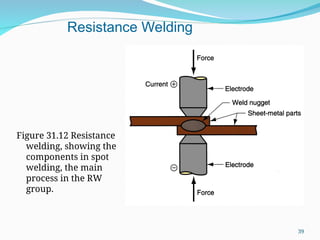
 Heat generated by electrical resistance to current
flow at junction to be welded
 Principal RW process is resistance spot welding
(RSW)
38
Figure 31.12 Resistance
welding, showing the
components in spot
welding, the main
process in the RW
group.
Resistance Welding
39
Components in Resistance Spot
Welding
 Parts to be welded (usually sheet metal)
 Two opposing electrodes
 Means of applying pressure to squeeze parts
between electrodes
 Power supply from which a controlled current
can be applied for a specified time duration
40
Advantages / Drawbacks of RW
Advantages:
 No filler metal required
 High production rates possible
 Lends itself to mechanization and automation
 Lower operator skill level than for arc welding
 Good repeatability and reliability
Disadvantages:
 High initial equipment cost
 Limited to lap joints for most RW processes
41
Resistance Spot Welding (RSW)
Resistance welding process in which fusion of
faying surfaces of a lap joint is achieved at
one location by opposing electrodes
 Used to join sheet metal parts using a series
of spot welds
 Widely used in mass production of
automobiles, appliances, metal furniture,
and other products made of sheet metal
 Typical car body has ~ 10,000 spot welds
 Annual production of automobiles in the
world is measured in tens of millions of units
42
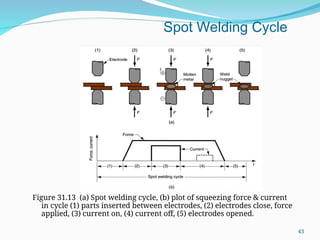
Figure 31.13 (a) Spot welding cycle, (b) plot of squeezing force & current
in cycle (1) parts inserted between electrodes, (2) electrodes close, force
applied, (3) current on, (4) current off, (5) electrodes opened.
Spot Welding Cycle
43
Resistance Seam Welding
(RSEW)
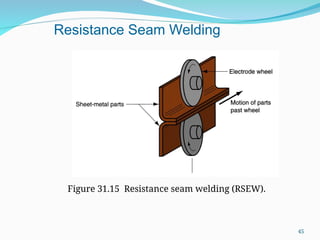
Uses rotating wheel electrodes to
produce a series of overlapping spot
welds along lap joint
 Can produce air‑tight joints
 Applications:
 Gasoline tanks
 Automobile mufflers
 Various other sheet metal containers
44
Figure 31.15 Resistance seam welding (RSEW).
Resistance Seam Welding
45
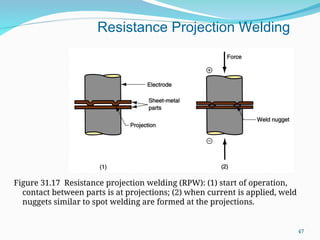
Resistance Projection Welding
(RPW)
A resistance welding process in which coalescence
occurs at one or more small contact points on
parts
 Contact points determined by design of parts to
be joined
 May consist of projections, embossments, or
localized intersections of parts
46
Figure 31.17 Resistance projection welding (RPW): (1) start of operation,
contact between parts is at projections; (2) when current is applied, weld
nuggets similar to spot welding are formed at the projections.
Resistance Projection Welding
47
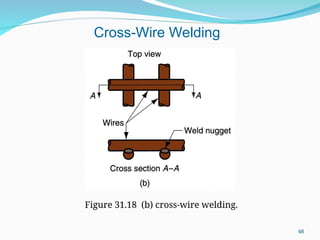
Figure 31.18 (b) cross‑wire welding.
Cross-Wire Welding
48
Oxyfuel Gas Welding (OFW)
Group of fusion welding operations that burn
various fuels mixed with oxygen
 OFW employs several types of gases, which is the
primary distinction among the members of this
group
 Oxyfuel gas is also used in flame cutting torches
to cut and separate metal plates and other parts
 Most important OFW process is oxyacetylene
welding
49
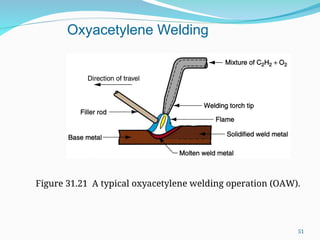
Oxyacetylene Welding (OAW)
Fusion welding performed by a high temperature
flame from combustion of acetylene and oxygen
 Flame is directed by a welding torch
 Filler metal is sometimes added
 Composition must be similar to base metal
 Filler rod often coated with flux to clean surfaces
and prevent oxidation
50
Figure 31.21 A typical oxyacetylene welding operation (OAW).
Oxyacetylene Welding
51
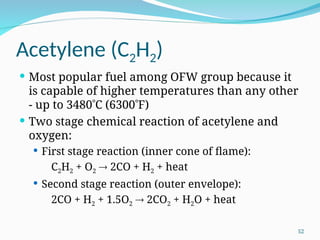
Acetylene (C2H2)
 Most popular fuel among OFW group because it
is capable of higher temperatures than any other
‑ up to 3480C (6300F)
 Two stage chemical reaction of acetylene and
oxygen:
 First stage reaction (inner cone of flame):
C2H2 + O2  2CO + H2 + heat
 Second stage reaction (outer envelope):
2CO + H2 + 1.5O2  2CO2 + H2O + heat
52
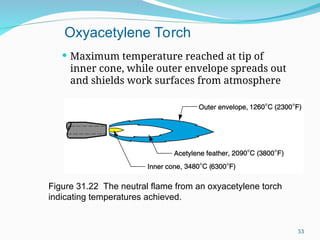
 Maximum temperature reached at tip of
inner cone, while outer envelope spreads out
and shields work surfaces from atmosphere
Figure 31.22 The neutral flame from an oxyacetylene torch
indicating temperatures achieved.
Oxyacetylene Torch
53
Safety Issue in OAW
 Together, acetylene and oxygen are highly
flammable
 C2H2 is colorless and odorless
 It is therefore processed to have characteristic
garlic odor
54
OAW Safety Issue
 C2H2 is physically unstable at pressures
much above 15 lb/in2
(about 1 atm)
 Storage cylinders are packed with porous
filler material (such as asbestos) saturated
with acetone (CH3COCH3)
 Acetone dissolves about 25 times its own
volume of acetylene
 Different screw threads are standard on the
C2H2 and O2 cylinders and hoses to avoid
accidental connection of wrong gases
55
Alternative Gases for OFW
 Methylacetylene‑Propadiene (MAPP)
 Hydrogen
 Propylene
 Propane
 Natural Gas
56
Other Fusion Welding
Processes
FW processes that cannot be classified as arc,
resistance, or oxyfuel welding
 Use unique technologies to develop heat for
melting
 Applications are typically unique
 Processes include:
 Electron beam welding
 Laser beam welding
 Electroslag welding
 Thermit welding
57
Electron Beam Welding (EBW)
Fusion welding process in which heat for welding
is provided by a highly‑focused, high‑intensity
stream of electrons striking work surface
 Electron beam gun operates at:
 High voltage (e.g., 10 to 150 kV typical) to
accelerate electrons
 Beam currents are low (measured in milliamps)
 Power in EBW not exceptional, but power
density is
58
EBW Vacuum Chamber
When first developed, EBW had to be carried out
in vacuum chamber to minimize disruption of
electron beam by air molecules
 Serious inconvenience in production
 Pumpdown time can take as long as an hour
59
Three Vacuum Levels in EBW
 High-vacuum welding – welding done in
same vacuum chamber as beam generation
 Highest quality weld
 Medium-vacuum welding – welding done in
separate chamber with partial vacuum
 Vacuum pump-down time reduced
 Non-vacuum welding – welding done at or
near atmospheric pressure, with work
positioned close to electron beam generator
 Vacuum divider required to separate work
from beam generator
60
EBW Advantages / Disadvantages
Advantages:
 High‑quality welds, deep and narrow profiles
 Limited heat affected zone, low thermal
distortion
 High welding speeds
 No flux or shielding gases needed
Disadvantages:
 High equipment cost
 Precise joint preparation & alignment
required
 Vacuum chamber required
 Safety concern: EBW generates x‑rays
61
Laser Beam Welding (LBW)
Fusion welding process in which coalescence is
achieved by energy of a highly concentrated,
coherent light beam focused on joint
 Laser = "light amplification by stimulated
emission of radiation"
 LBW normally performed with shielding gases to
prevent oxidation
 Filler metal not usually added
 High power density in small area, so LBW often
used for small parts
62
Comparison: LBW vs. EBW
 No vacuum chamber required for LBW
 No x‑rays emitted in LBW
 Laser beams can be focused and directed by
optical lenses and mirrors
 LBW not capable of the deep welds and high
depth‑to‑width ratios of EBW
 Maximum LBW depth = ~ 19 mm (3/4 in), whereas
EBW depths = 50 mm (2 in)
63
Thermit Welding (TW)
FW process in which heat for coalescence is
produced by superheated molten metal from the
chemical reaction of thermite
 Thermite = mixture of Al and Fe3O4 fine powders
that produce an exothermic reaction when
ignited
 Also used for incendiary bombs
 Filler metal obtained from liquid metal
 Process used for joining, but has more in common
with casting than welding
64
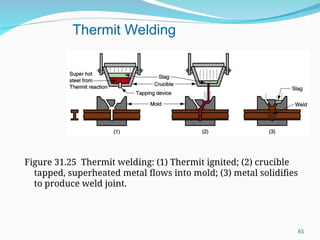
Figure 31.25 Thermit welding: (1) Thermit ignited; (2) crucible
tapped, superheated metal flows into mold; (3) metal solidifies
to produce weld joint.
Thermit Welding
65
TW Applications
 Joining of railroad rails
 Repair of cracks in large steel castings and
forgings
 Weld surface is often smooth enough that no
finishing is required
66
Solid State Welding (SSW)
 Coalescence of part surfaces is achieved by:
 Pressure alone, or
 Heat and pressure
 If both heat and pressure are used, heat is not
enough to melt work surfaces
 For some SSW processes, time is also a factor
 No filler metal is added
 Each SSW process has its own way of creating a
bond at the faying surfaces
67
Success Factors in SSW
 Essential factors for a successful solid state weld
are that the two faying surfaces must be:
 Very clean
 In very close physical contact with each other to
permit atomic bonding
68
SSW Advantages over FW
Processes
 If no melting, then no heat affected zone, so
metal around joint retains original properties
 Many SSW processes produce welded joints that
bond the entire contact interface between two
parts rather than at distinct spots or seams
 Some SSW processes can be used to bond
dissimilar metals, without concerns about
relative melting points, thermal expansions, and
other problems that arise in FW
69
Solid State Welding Processes
 Forge welding
 Cold welding
 Roll welding
 Hot pressure welding
 Diffusion welding
 Explosion welding
 Friction welding
 Ultrasonic welding
70
Forge Welding
Welding process in which components to be joined
are heated to hot working temperature range
and then forged together by hammering or
similar means
 Historic significance in development of
manufacturing technology
 Process dates from about 1000 B.C., when
blacksmiths learned to weld two pieces of metal
 Of minor commercial importance today except
for its variants
71
Cold Welding (CW)
SSW process done by applying high pressure between
clean contacting surfaces at room temperature
 Cleaning usually done by degreasing and wire
brushing immediately before joining
 No heat is applied, but deformation raises work
temperature
 At least one of the metals, preferably both, must be
very ductile
 Soft aluminum and copper suited to CW
 Applications: making electrical connections
72
Roll Welding (ROW)
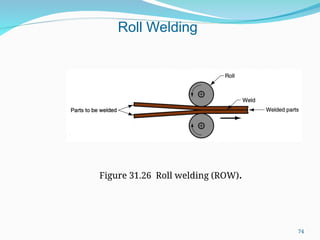
SSW process in which pressure sufficient to cause
coalescence is applied by means of rolls, either
with or without external heat
 Variation of either forge welding or cold welding,
depending on whether heating of workparts is
done prior to process
 If no external heat, called cold roll welding
 If heat is supplied, hot roll welding
73
Figure 31.26 Roll welding (ROW).
Roll Welding
74
Roll Welding Applications
 Cladding stainless steel to mild or low alloy steel
for corrosion resistance
 Bimetallic strips for measuring temperature
 "Sandwich" coins for U.S mint
75
Diffusion Welding (DFW)
SSW process uses heat and pressure, usually in a
controlled atmosphere, with sufficient time for
diffusion and coalescence to occur
 Temperatures  0.5 Tm
 Plastic deformation at surfaces is minimal
 Primary coalescence mechanism is solid state
diffusion
 Limitation: time required for diffusion can range
from seconds to hours
76
DFW Applications
 Joining of high‑strength and refractory metals in
aerospace and nuclear industries
 Can be used to join either similar and dissimilar
metals
 For joining dissimilar metals, a filler layer of
different metal is often sandwiched between
base metals to promote diffusion
77
Explosion Welding (EXW)
SSW process in which rapid coalescence of two
metallic surfaces is caused by the energy of a
detonated explosive
 No filler metal used
 No external heat applied
 No diffusion occurs - time is too short
 Bonding is metallurgical, combined with
mechanical interlocking that results from a
rippled or wavy interface between the metals
78
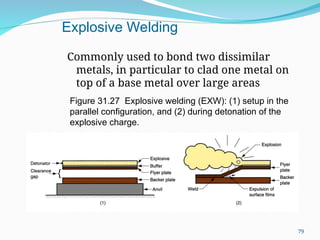
Commonly used to bond two dissimilar
metals, in particular to clad one metal on
top of a base metal over large areas
Figure 31.27 Explosive welding (EXW): (1) setup in the
parallel configuration, and (2) during detonation of the
explosive charge.
Explosive Welding
79
Friction Welding (FRW)
SSW process in which coalescence is achieved by
frictional heat combined with pressure
 When properly carried out, no melting occurs at
faying surfaces
 No filler metal, flux, or shielding gases normally
used
 Process yields a narrow HAZ
 Can be used to join dissimilar metals
 Widely used commercial process, amenable to
automation and mass production
80
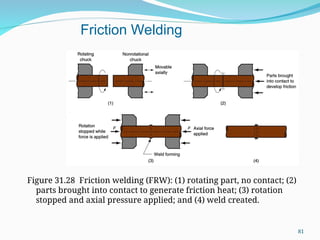
Figure 31.28 Friction welding (FRW): (1) rotating part, no contact; (2)
parts brought into contact to generate friction heat; (3) rotation
stopped and axial pressure applied; and (4) weld created.
Friction Welding
81
Two Types of Friction Welding
1. Continuous‑drive friction welding
 One part is driven at constant rpm
against stationary part to cause
friction heat at interface
 At proper temperature, rotation is
stopped and parts are forced together
2. Inertia friction welding
 Rotating part is connected to flywheel,
which is brought up to required speed
 Flywheel is disengaged from drive,
and parts are forced together
82
Applications / Limitations of
FRW
Applications:
 Shafts and tubular parts
 Industries: automotive, aircraft, farm equipment,
petroleum and natural gas
Limitations:
 At least one of the parts must be rotational
 Flash must usually be removed
 Upsetting reduces the part lengths (which must
be taken into consideration in product design)
83
Ultrasonic Welding (USW)
Two components are held together, oscillatory shear
stresses of ultrasonic frequency are applied to
interface to cause coalescence
 Oscillatory motion breaks down any surface films to
allow intimate contact and strong metallurgical
bonding between surfaces
 Although heating of surfaces occurs, temperatures are
well below Tm
 No filler metals, fluxes, or shielding gases
 Generally limited to lap joints on soft materials such as
aluminum and copper
84
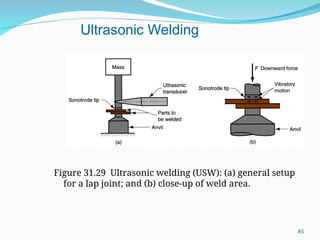
Figure 31.29 Ultrasonic welding (USW): (a) general setup
for a lap joint; and (b) close‑up of weld area.
Ultrasonic Welding
85
USW Applications
 Wire terminations and splicing in
electrical and electronics industry
 Eliminates need for soldering
 Assembly of aluminum sheet metal
panels
 Welding of tubes to sheets in solar
panels
 Assembly of small parts in automotive
industry
86
Weld Quality
Concerned with obtaining an acceptable
weld joint that is strong and absent of
defects, and the methods of inspecting
and testing the joint to assure its
quality
 Topics:
 Residual stresses and distortion
 Welding defects
 Inspection and testing methods
87
Residual Stresses and
Distortion
 Rapid heating and cooling in localized regions
during FW result in thermal expansion and
contraction that cause residual stresses
 These stresses, in turn, cause distortion and
warpage
 Situation in welding is complicated because:
 Heating is very localized
 Melting of base metals in these regions
 Location of heating and melting is in motion (at
least in AW)
88
Techniques to Minimize
Warpage
 Welding fixtures to physically restrain parts
 Heat sinks to rapidly remove heat
 Tack welding at multiple points along joint to
create a rigid structure prior to seam welding
 Selection of welding conditions (speed, amount
of filler metal used, etc.) to reduce warpage
 Preheating base parts
 Stress relief heat treatment of welded assembly
 Proper design of weldment
89
Welding Defects
 Cracks
 Cavities
 Solid inclusions
 Imperfect shape or unacceptable contour
 Incomplete fusion
 Miscellaneous defects
90
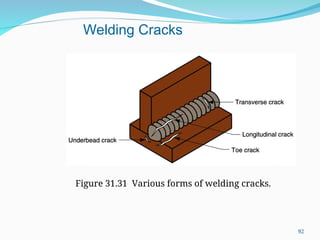
Welding Cracks
Fracture‑type interruptions either in weld or in
base metal adjacent to weld
 Serious defect because it is a discontinuity in the
metal that significantly reduces strength
 Caused by embrittlement or low ductility of weld
and/or base metal combined with high restraint
during contraction
 In general, this defect must be repaired
91
Figure 31.31 Various forms of welding cracks.
Welding Cracks
92
Cavities
Two defect types, similar to defects found in
castings:
1. Porosity - small voids in weld metal formed by
gases entrapped during solidification
 Caused by inclusion of atmospheric gases, sulfur
in weld metal, or surface contaminants
2. Shrinkage voids - cavities formed by shrinkage
during solidification
93
Solid Inclusions
 Solid inclusions - nonmetallic material entrapped
in weld metal
 Most common form is slag inclusions generated
during AW processes that use flux
 Instead of floating to top of weld pool, globules of
slag become encased during solidification
 Metallic oxides that form during welding of
certain metals such as aluminum, which
normally has a surface coating of Al2O3
94
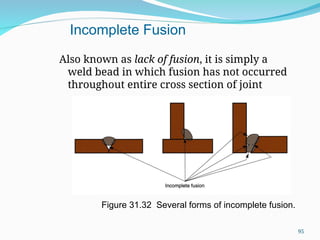
Also known as lack of fusion, it is simply a
weld bead in which fusion has not occurred
throughout entire cross section of joint
Figure 31.32 Several forms of incomplete fusion.
Incomplete Fusion
95
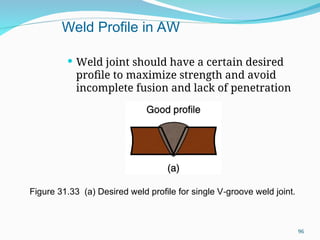
 Weld joint should have a certain desired
profile to maximize strength and avoid
incomplete fusion and lack of penetration
Figure 31.33 (a) Desired weld profile for single V groove weld joint.
‑
Weld Profile in AW
96
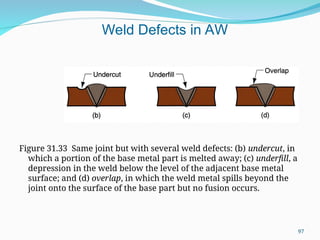
Figure 31.33 Same joint but with several weld defects: (b) undercut, in
which a portion of the base metal part is melted away; (c) underfill, a
depression in the weld below the level of the adjacent base metal
surface; and (d) overlap, in which the weld metal spills beyond the
joint onto the surface of the base part but no fusion occurs.
Weld Defects in AW
97
Inspection and Testing
Methods
 Visual inspection
 Nondestructive evaluation
 Destructive testing
98
Visual Inspection
 Most widely used welding inspection
method
 Human inspector visually examines for:
 Conformance to dimensions
 Warpage
 Cracks, cavities, incomplete fusion, and
other surface defects
 Limitations:
 Only surface defects are detectable
 Welding inspector must also determine
if additional tests are warranted
99
Nondestructive Evaluation (NDE)
Tests  Ultrasonic testing - high frequency sound
waves directed through specimen - cracks,
inclusions are detected by loss in sound
transmission
 Radiographic testing - x‑rays or gamma
radiation provide photograph of internal
flaws
 Dye‑penetrant and fluorescent‑penetrant
tests - methods for detecting small cracks
and cavities that are open at surface
 Magnetic particle testing – iron filings
sprinkled on surface reveal subsurface
defects by distorting magnetic field in part
100
Destructive Testing
Tests in which weld is destroyed either during
testing or to prepare test specimen
 Mechanical tests - purpose is similar to
conventional testing methods such as tensile
tests, shear tests, etc
 Metallurgical tests - preparation of metallurgical
specimens (e.g., photomicrographs) of weldment
to examine metallic structure, defects, extent and
condition of heat affected zone, and similar
phenomena
101
Weldability
Capacity of a metal or combination of metals to be
welded into a suitably designed structure, and
for the resulting weld joint(s) to possess the
required metallurgical properties to perform
satisfactorily in intended service
 Good weldability characterized by:
 Ease with which welding process is accomplished
 Absence of weld defects
 Acceptable strength, ductility, and toughness in
welded joint
102
Weldability Factors – Welding
Process
 Some metals or metal combinations can be
readily welded by one process but are difficult to
weld by others
 Example: stainless steel readily welded by most
AW and RW processes, but difficult to weld by
OFW
103
Weldability Factors – Base
Metal Some metals melt too easily; e.g.,
aluminum
 Metals with high thermal conductivity
transfer heat away from weld, which
causes problems; e.g., copper
 High thermal expansion and contraction
in metal causes distortion problems
 Dissimilar metals pose problems in
welding when their physical and/or
mechanical properties are substantially
different
104
Other Factors Affecting Weldability
 Filler metal
 Must be compatible with base metal(s)
 In general, elements mixed in liquid
state that form a solid solution upon
solidification will not cause a problem
 Surface conditions
 Moisture can result in porosity in fusion
zone
 Oxides and other films on metal surfaces
can prevent adequate contact and fusion
105
Design Considerations in
Welding
 Design for welding ‑ product should be designed
from the start as a welded assembly, and not as a
casting or forging or other formed shape
 Minimum parts ‑ welded assemblies should
consist of fewest number of parts possible
 Example: usually more cost efficient to perform
simple bending operations on a part than to weld
an assembly from flat plates and sheets
106
Arc Welding Design Guidelines
 Good fit‑up of parts - to maintain
dimensional control and minimize
distortion
 Machining is sometimes required to
achieve satisfactory fit‑up
 Assembly must allow access for welding
gun to reach welding area
 Design of assembly should allow flat
welding to be performed as much as
possible, since this is fastest and most
convenient welding position
107
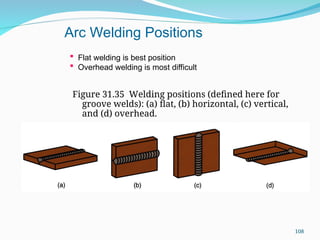
Figure 31.35 Welding positions (defined here for
groove welds): (a) flat, (b) horizontal, (c) vertical,
and (d) overhead.
 Flat welding is best position
 Overhead welding is most difficult
Arc Welding Positions
108
Design Guidelines - RSW
 Low‑carbon sheet steel up to 0.125 (3.2 mm) is
ideal metal for RSW 109
 How additional strength and stiffness can be
obtained in large flat sheet metal components
 Spot welding reinforcing parts into them
 Forming flanges and embossments
 Spot welded assembly must provide access for
electrodes to reach welding area
 Sufficient overlap of sheet metal parts required
for electrode tip to make proper contact
109
393237222-Welding-Processes-Chapter-31.ppt

  • 1.
    Welding Processes -Chapter 31 1
  • 2.
    WELDING PROCESSES 1. ArcWelding 2. Resistance Welding 3. Oxyfuel Gas Welding 4. Other Fusion Welding Processes 5. Solid State Welding 6. Weld Quality 7. Weldability 8. Design Considerations in Welding 2
  • 3.
    Two Categories ofWelding Processes  Fusion welding - coalescence is accomplished by melting the two parts to be joined, in some cases adding filler metal to the joint  Examples: arc welding, resistance spot welding, oxyfuel gas welding  Solid state welding - heat and/or pressure are used to achieve coalescence, but no melting of base metals occurs and no filler metal is added  Examples: forge welding, diffusion welding, friction welding 3
  • 4.
    Arc Welding (AW) Afusion welding process in which coalescence of the metals is achieved by the heat from an electric arc between an electrode and the work  Electric energy from the arc produces temperatures ~ 10,000 F (5500 C), hot enough to melt any metal  Most AW processes add filler metal to increase volume and strength of weld joint 4
  • 5.
    What is anElectric Arc? An electric arc is a discharge of electric current across a gap in a circuit  It is sustained by an ionized column of gas (plasma) through which the current flows  To initiate the arc in AW, electrode is brought into contact with work and then quickly separated from it by a short distance 5
  • 6.
    A pool ofmolten metal is formed near electrode tip, and as electrode is moved along joint, molten weld pool solidifies in its wake Figure 31.1 Basic configuration of an arc welding process. Arc Welding 6
  • 7.
    Manual Arc Weldingand Arc Time  Problems with manual welding:  Weld joint quality  Productivity  Arc Time = (time arc is on) divided by (hours worked)  Also called “arc-on time”  Manual welding arc time = 20%  Machine welding arc time ~ 50% 7
  • 8.
    Two Basic Typesof AW Electrodes  Consumable – consumed during welding process  Source of filler metal in arc welding  Nonconsumable – not consumed during welding process  Filler metal must be added separately 8
  • 9.
    Consumable Electrodes  Formsof consumable electrodes  Welding rods (a.k.a. sticks) are 9 to 18 inches and 3/8 inch or less in diameter and must be changed frequently  Weld wire can be continuously fed from spools with long lengths of wire, avoiding frequent interruptions  In both rod and wire forms, electrode is consumed by arc and added to weld joint as filler metal 9
  • 10.
    Nonconsumable Electrodes  Madeof tungsten which resists melting  Gradually depleted during welding (vaporization is principal mechanism)  Any filler metal must be supplied by a separate wire fed into weld pool 10
  • 11.
    Arc Shielding  Athigh temperatures in AW, metals are chemically reactive to oxygen, nitrogen, and hydrogen in air  Mechanical properties of joint can be seriously degraded by these reactions  To protect operation, arc must be shielded from surrounding air in AW processes  Arc shielding is accomplished by:  Shielding gases, e.g., argon, helium, CO2  Flux 11
  • 12.
    Flux A substance thatprevents formation of oxides and other contaminants in welding, or dissolves them and facilitates removal  Provides protective atmosphere for welding  Stabilizes arc  Reduces spattering 12
  • 13.
    Various Flux Application Methods Pouring granular flux onto welding operation  Stick electrode coated with flux material that melts during welding to cover operation  Tubular electrodes in which flux is contained in the core and released as electrode is consumed 13
  • 14.
    Power Source inArc Welding  Direct current (DC) vs. Alternating current (AC)  AC machines less expensive to purchase and operate, but generally restricted to ferrous metals  DC equipment can be used on all metals and is generally noted for better arc control 14
  • 15.
    Consumable Electrode AW Processes Shielded Metal Arc Welding  Gas Metal Arc Welding  Flux‑Cored Arc Welding  Electrogas Welding  Submerged Arc Welding 15
  • 16.
    Shielded Metal ArcWelding (SMAW) Uses a consumable electrode consisting of a filler metal rod coated with chemicals that provide flux and shielding  Sometimes called "stick welding"  Power supply, connecting cables, and electrode holder available for a few thousand dollars 16
  • 17.
    Figure 31.3 Shieldedmetal arc welding (SMAW). Shielded Metal Arc Welding 17
  • 18.
    Welding Stick inSMAW  Composition of filler metal usually close to base metal  Coating: powdered cellulose mixed with oxides, carbonates, and other ingredients, held together by a silicate binder  Welding stick is clamped in electrode holder connected to power source  Disadvantages of stick welding:  Sticks must be periodically changed  High current levels may melt coating prematurely 18
  • 19.
    Figure 31.2 Shielded metalarc welding (stick welding) performed by a (human) welder (photo courtesy of Hobart Brothers Co.). Shielded Metal Arc Welding 19
  • 20.
    SMAW Applications  Usedfor steels, stainless steels, cast irons, and certain nonferrous alloys  Not used or rarely used for aluminum and its alloys, copper alloys, and titanium 20
  • 21.
    Gas Metal ArcWelding (GMAW) Uses a consumable bare metal wire as electrode and shielding accomplished by flooding arc with a gas  Wire is fed continuously and automatically from a spool through the welding gun  Shielding gases include inert gases such as argon and helium for aluminum welding, and active gases such as CO2 for steel welding  Bare electrode wire plus shielding gases eliminate slag on weld bead - no need for manual grinding and cleaning of slag 21
  • 22.
    31.4 Gas metalarc welding (GMAW). Gas Metal Arc Welding 22
  • 23.
    GMAW Advantages over SMAW Better arc time because of continuous wire electrode  Sticks must be periodically changed in SMAW  Better use of electrode filler metal than SMAW  End of stick cannot be used in SMAW  Higher deposition rates  Eliminates problem of slag removal  Can be readily automated 23
  • 24.
    Flux Cored ArcWelding (FCAW) ‑ Adaptation of shielded metal arc welding, to overcome limitations of stick electrodes  Electrode is a continuous consumable tubing (in coils) containing flux and other ingredients (e.g., alloying elements) in its core  Two versions:  Self‑shielded FCAW - core includes compounds that produce shielding gases  Gas‑shielded FCAW - uses externally applied shielding gases 24
  • 25.
    Figure 31.6 Flux‑coredarc welding. Presence or absence of externally supplied shielding gas distinguishes the two types: (1) self‑shielded, in which core provides ingredients for shielding, and (2) gas‑shielded, which uses external shielding gases. Flux-Cored Arc Welding 25
  • 26.
    Electrogas Welding (EGW) Usesa continuous consumable electrode, either flux‑cored wire or bare wire with externally supplied shielding gases, and molding shoes to contain molten metal  When flux‑cored electrode wire is used and no external gases are supplied, then special case of self‑shielded FCAW  When a bare electrode wire used with shielding gases from external source, then special case of GMAW 26
  • 27.
    Figure 31.7 Electrogaswelding using flux‑cored electrode wire: (a) front view with molding shoe removed for clarity, and (b) side view showing molding shoes on both sides. Electrogas Welding 27
  • 28.
    Submerged Arc Welding(SAW) Uses a continuous, consumable bare wire electrode, with arc shielding provided by a cover of granular flux  Electrode wire is fed automatically from a coil  Flux introduced into joint slightly ahead of arc by gravity from a hopper  Completely submerges operation, preventing sparks, spatter, and radiation 28
  • 29.
    Figure 31.8 Submergedarc welding. Submerged Arc Welding 29
  • 30.
    SAW Applications andProducts  Steel fabrication of structural shapes (e.g., I‑beams)  Seams for large diameter pipes, tanks, and pressure vessels  Welded components for heavy machinery  Most steels (except hi C steel)  Not good for nonferrous metals 30
  • 31.
    Nonconsumable Electrode Processes  GasTungsten Arc Welding  Plasma Arc Welding  Carbon Arc Welding  Stud Welding 31
  • 32.
    Gas Tungsten ArcWelding (GTAW) Uses a nonconsumable tungsten electrode and an inert gas for arc shielding  Melting point of tungsten = 3410C (6170F)  A.k.a. Tungsten Inert Gas (TIG) welding  In Europe, called "WIG welding"  Used with or without a filler metal  When filler metal used, it is added to weld pool from separate rod or wire  Applications: aluminum and stainless steel most common 32
  • 33.
    Figure 31.9 Gastungsten arc welding. Gas Tungsten Arc Welding 33
  • 34.
    Advantages / Disadvantagesof GTAW Advantages:  High quality welds for suitable applications  No spatter because no filler metal through arc  Little or no post-weld cleaning because no flux Disadvantages:  Generally slower and more costly than consumable electrode AW processes 34
  • 35.
    Plasma Arc Welding(PAW) Special form of GTAW in which a constricted plasma arc is directed at weld area  Tungsten electrode is contained in a nozzle that focuses a high velocity stream of inert gas (argon) into arc region to form a high velocity, intensely hot plasma arc stream  Temperatures in PAW reach 28,000C (50,000F), due to constriction of arc, producing a plasma jet of small diameter and very high energy density 35
  • 36.
    Figure 31.10 Plasmaarc welding (PAW). Plasma Arc Welding 36
  • 37.
    Advantages / Disadvantagesof PAW Advantages:  Good arc stability  Better penetration control than other AW  High travel speeds  Excellent weld quality  Can be used to weld almost any metals Disadvantages:  High equipment cost  Larger torch size than other AW  Tends to restrict access in some joints 37
  • 38.
    Resistance Welding (RW) Agroup of fusion welding processes that use a combination of heat and pressure to accomplish coalescence  Heat generated by electrical resistance to current flow at junction to be welded  Principal RW process is resistance spot welding (RSW) 38
  • 39.
    Figure 31.12 Resistance welding,showing the components in spot welding, the main process in the RW group. Resistance Welding 39
  • 40.
    Components in ResistanceSpot Welding  Parts to be welded (usually sheet metal)  Two opposing electrodes  Means of applying pressure to squeeze parts between electrodes  Power supply from which a controlled current can be applied for a specified time duration 40
  • 41.
    Advantages / Drawbacksof RW Advantages:  No filler metal required  High production rates possible  Lends itself to mechanization and automation  Lower operator skill level than for arc welding  Good repeatability and reliability Disadvantages:  High initial equipment cost  Limited to lap joints for most RW processes 41
  • 42.
    Resistance Spot Welding(RSW) Resistance welding process in which fusion of faying surfaces of a lap joint is achieved at one location by opposing electrodes  Used to join sheet metal parts using a series of spot welds  Widely used in mass production of automobiles, appliances, metal furniture, and other products made of sheet metal  Typical car body has ~ 10,000 spot welds  Annual production of automobiles in the world is measured in tens of millions of units 42
  • 43.
    Figure 31.13 (a)Spot welding cycle, (b) plot of squeezing force & current in cycle (1) parts inserted between electrodes, (2) electrodes close, force applied, (3) current on, (4) current off, (5) electrodes opened. Spot Welding Cycle 43
  • 44.
    Resistance Seam Welding (RSEW) Usesrotating wheel electrodes to produce a series of overlapping spot welds along lap joint  Can produce air‑tight joints  Applications:  Gasoline tanks  Automobile mufflers  Various other sheet metal containers 44
  • 45.
    Figure 31.15 Resistanceseam welding (RSEW). Resistance Seam Welding 45
  • 46.
    Resistance Projection Welding (RPW) Aresistance welding process in which coalescence occurs at one or more small contact points on parts  Contact points determined by design of parts to be joined  May consist of projections, embossments, or localized intersections of parts 46
  • 47.
    Figure 31.17 Resistanceprojection welding (RPW): (1) start of operation, contact between parts is at projections; (2) when current is applied, weld nuggets similar to spot welding are formed at the projections. Resistance Projection Welding 47
  • 48.
    Figure 31.18 (b)cross‑wire welding. Cross-Wire Welding 48
  • 49.
    Oxyfuel Gas Welding(OFW) Group of fusion welding operations that burn various fuels mixed with oxygen  OFW employs several types of gases, which is the primary distinction among the members of this group  Oxyfuel gas is also used in flame cutting torches to cut and separate metal plates and other parts  Most important OFW process is oxyacetylene welding 49
  • 50.
    Oxyacetylene Welding (OAW) Fusionwelding performed by a high temperature flame from combustion of acetylene and oxygen  Flame is directed by a welding torch  Filler metal is sometimes added  Composition must be similar to base metal  Filler rod often coated with flux to clean surfaces and prevent oxidation 50
  • 51.
    Figure 31.21 Atypical oxyacetylene welding operation (OAW). Oxyacetylene Welding 51
  • 52.
    Acetylene (C2H2)  Mostpopular fuel among OFW group because it is capable of higher temperatures than any other ‑ up to 3480C (6300F)  Two stage chemical reaction of acetylene and oxygen:  First stage reaction (inner cone of flame): C2H2 + O2  2CO + H2 + heat  Second stage reaction (outer envelope): 2CO + H2 + 1.5O2  2CO2 + H2O + heat 52
  • 53.
     Maximum temperaturereached at tip of inner cone, while outer envelope spreads out and shields work surfaces from atmosphere Figure 31.22 The neutral flame from an oxyacetylene torch indicating temperatures achieved. Oxyacetylene Torch 53
  • 54.
    Safety Issue inOAW  Together, acetylene and oxygen are highly flammable  C2H2 is colorless and odorless  It is therefore processed to have characteristic garlic odor 54
  • 55.
    OAW Safety Issue C2H2 is physically unstable at pressures much above 15 lb/in2 (about 1 atm)  Storage cylinders are packed with porous filler material (such as asbestos) saturated with acetone (CH3COCH3)  Acetone dissolves about 25 times its own volume of acetylene  Different screw threads are standard on the C2H2 and O2 cylinders and hoses to avoid accidental connection of wrong gases 55
  • 56.
    Alternative Gases forOFW  Methylacetylene‑Propadiene (MAPP)  Hydrogen  Propylene  Propane  Natural Gas 56
  • 57.
    Other Fusion Welding Processes FWprocesses that cannot be classified as arc, resistance, or oxyfuel welding  Use unique technologies to develop heat for melting  Applications are typically unique  Processes include:  Electron beam welding  Laser beam welding  Electroslag welding  Thermit welding 57
  • 58.
    Electron Beam Welding(EBW) Fusion welding process in which heat for welding is provided by a highly‑focused, high‑intensity stream of electrons striking work surface  Electron beam gun operates at:  High voltage (e.g., 10 to 150 kV typical) to accelerate electrons  Beam currents are low (measured in milliamps)  Power in EBW not exceptional, but power density is 58
  • 59.
    EBW Vacuum Chamber Whenfirst developed, EBW had to be carried out in vacuum chamber to minimize disruption of electron beam by air molecules  Serious inconvenience in production  Pumpdown time can take as long as an hour 59
  • 60.
    Three Vacuum Levelsin EBW  High-vacuum welding – welding done in same vacuum chamber as beam generation  Highest quality weld  Medium-vacuum welding – welding done in separate chamber with partial vacuum  Vacuum pump-down time reduced  Non-vacuum welding – welding done at or near atmospheric pressure, with work positioned close to electron beam generator  Vacuum divider required to separate work from beam generator 60
  • 61.
    EBW Advantages /Disadvantages Advantages:  High‑quality welds, deep and narrow profiles  Limited heat affected zone, low thermal distortion  High welding speeds  No flux or shielding gases needed Disadvantages:  High equipment cost  Precise joint preparation & alignment required  Vacuum chamber required  Safety concern: EBW generates x‑rays 61
  • 62.
    Laser Beam Welding(LBW) Fusion welding process in which coalescence is achieved by energy of a highly concentrated, coherent light beam focused on joint  Laser = "light amplification by stimulated emission of radiation"  LBW normally performed with shielding gases to prevent oxidation  Filler metal not usually added  High power density in small area, so LBW often used for small parts 62
  • 63.
    Comparison: LBW vs.EBW  No vacuum chamber required for LBW  No x‑rays emitted in LBW  Laser beams can be focused and directed by optical lenses and mirrors  LBW not capable of the deep welds and high depth‑to‑width ratios of EBW  Maximum LBW depth = ~ 19 mm (3/4 in), whereas EBW depths = 50 mm (2 in) 63
  • 64.
    Thermit Welding (TW) FWprocess in which heat for coalescence is produced by superheated molten metal from the chemical reaction of thermite  Thermite = mixture of Al and Fe3O4 fine powders that produce an exothermic reaction when ignited  Also used for incendiary bombs  Filler metal obtained from liquid metal  Process used for joining, but has more in common with casting than welding 64
  • 65.
    Figure 31.25 Thermitwelding: (1) Thermit ignited; (2) crucible tapped, superheated metal flows into mold; (3) metal solidifies to produce weld joint. Thermit Welding 65
  • 66.
    TW Applications  Joiningof railroad rails  Repair of cracks in large steel castings and forgings  Weld surface is often smooth enough that no finishing is required 66
  • 67.
    Solid State Welding(SSW)  Coalescence of part surfaces is achieved by:  Pressure alone, or  Heat and pressure  If both heat and pressure are used, heat is not enough to melt work surfaces  For some SSW processes, time is also a factor  No filler metal is added  Each SSW process has its own way of creating a bond at the faying surfaces 67
  • 68.
    Success Factors inSSW  Essential factors for a successful solid state weld are that the two faying surfaces must be:  Very clean  In very close physical contact with each other to permit atomic bonding 68
  • 69.
    SSW Advantages overFW Processes  If no melting, then no heat affected zone, so metal around joint retains original properties  Many SSW processes produce welded joints that bond the entire contact interface between two parts rather than at distinct spots or seams  Some SSW processes can be used to bond dissimilar metals, without concerns about relative melting points, thermal expansions, and other problems that arise in FW 69
  • 70.
    Solid State WeldingProcesses  Forge welding  Cold welding  Roll welding  Hot pressure welding  Diffusion welding  Explosion welding  Friction welding  Ultrasonic welding 70
  • 71.
    Forge Welding Welding processin which components to be joined are heated to hot working temperature range and then forged together by hammering or similar means  Historic significance in development of manufacturing technology  Process dates from about 1000 B.C., when blacksmiths learned to weld two pieces of metal  Of minor commercial importance today except for its variants 71
  • 72.
    Cold Welding (CW) SSWprocess done by applying high pressure between clean contacting surfaces at room temperature  Cleaning usually done by degreasing and wire brushing immediately before joining  No heat is applied, but deformation raises work temperature  At least one of the metals, preferably both, must be very ductile  Soft aluminum and copper suited to CW  Applications: making electrical connections 72
  • 73.
    Roll Welding (ROW) SSWprocess in which pressure sufficient to cause coalescence is applied by means of rolls, either with or without external heat  Variation of either forge welding or cold welding, depending on whether heating of workparts is done prior to process  If no external heat, called cold roll welding  If heat is supplied, hot roll welding 73
  • 74.
    Figure 31.26 Rollwelding (ROW). Roll Welding 74
  • 75.
    Roll Welding Applications Cladding stainless steel to mild or low alloy steel for corrosion resistance  Bimetallic strips for measuring temperature  "Sandwich" coins for U.S mint 75
  • 76.
    Diffusion Welding (DFW) SSWprocess uses heat and pressure, usually in a controlled atmosphere, with sufficient time for diffusion and coalescence to occur  Temperatures  0.5 Tm  Plastic deformation at surfaces is minimal  Primary coalescence mechanism is solid state diffusion  Limitation: time required for diffusion can range from seconds to hours 76
  • 77.
    DFW Applications  Joiningof high‑strength and refractory metals in aerospace and nuclear industries  Can be used to join either similar and dissimilar metals  For joining dissimilar metals, a filler layer of different metal is often sandwiched between base metals to promote diffusion 77
  • 78.
    Explosion Welding (EXW) SSWprocess in which rapid coalescence of two metallic surfaces is caused by the energy of a detonated explosive  No filler metal used  No external heat applied  No diffusion occurs - time is too short  Bonding is metallurgical, combined with mechanical interlocking that results from a rippled or wavy interface between the metals 78
  • 79.
    Commonly used tobond two dissimilar metals, in particular to clad one metal on top of a base metal over large areas Figure 31.27 Explosive welding (EXW): (1) setup in the parallel configuration, and (2) during detonation of the explosive charge. Explosive Welding 79
  • 80.
    Friction Welding (FRW) SSWprocess in which coalescence is achieved by frictional heat combined with pressure  When properly carried out, no melting occurs at faying surfaces  No filler metal, flux, or shielding gases normally used  Process yields a narrow HAZ  Can be used to join dissimilar metals  Widely used commercial process, amenable to automation and mass production 80
  • 81.
    Figure 31.28 Frictionwelding (FRW): (1) rotating part, no contact; (2) parts brought into contact to generate friction heat; (3) rotation stopped and axial pressure applied; and (4) weld created. Friction Welding 81
  • 82.
    Two Types ofFriction Welding 1. Continuous‑drive friction welding  One part is driven at constant rpm against stationary part to cause friction heat at interface  At proper temperature, rotation is stopped and parts are forced together 2. Inertia friction welding  Rotating part is connected to flywheel, which is brought up to required speed  Flywheel is disengaged from drive, and parts are forced together 82
  • 83.
    Applications / Limitationsof FRW Applications:  Shafts and tubular parts  Industries: automotive, aircraft, farm equipment, petroleum and natural gas Limitations:  At least one of the parts must be rotational  Flash must usually be removed  Upsetting reduces the part lengths (which must be taken into consideration in product design) 83
  • 84.
    Ultrasonic Welding (USW) Twocomponents are held together, oscillatory shear stresses of ultrasonic frequency are applied to interface to cause coalescence  Oscillatory motion breaks down any surface films to allow intimate contact and strong metallurgical bonding between surfaces  Although heating of surfaces occurs, temperatures are well below Tm  No filler metals, fluxes, or shielding gases  Generally limited to lap joints on soft materials such as aluminum and copper 84
  • 85.
    Figure 31.29 Ultrasonicwelding (USW): (a) general setup for a lap joint; and (b) close‑up of weld area. Ultrasonic Welding 85
  • 86.
    USW Applications  Wireterminations and splicing in electrical and electronics industry  Eliminates need for soldering  Assembly of aluminum sheet metal panels  Welding of tubes to sheets in solar panels  Assembly of small parts in automotive industry 86
  • 87.
    Weld Quality Concerned withobtaining an acceptable weld joint that is strong and absent of defects, and the methods of inspecting and testing the joint to assure its quality  Topics:  Residual stresses and distortion  Welding defects  Inspection and testing methods 87
  • 88.
    Residual Stresses and Distortion Rapid heating and cooling in localized regions during FW result in thermal expansion and contraction that cause residual stresses  These stresses, in turn, cause distortion and warpage  Situation in welding is complicated because:  Heating is very localized  Melting of base metals in these regions  Location of heating and melting is in motion (at least in AW) 88
  • 89.
    Techniques to Minimize Warpage Welding fixtures to physically restrain parts  Heat sinks to rapidly remove heat  Tack welding at multiple points along joint to create a rigid structure prior to seam welding  Selection of welding conditions (speed, amount of filler metal used, etc.) to reduce warpage  Preheating base parts  Stress relief heat treatment of welded assembly  Proper design of weldment 89
  • 90.
    Welding Defects  Cracks Cavities  Solid inclusions  Imperfect shape or unacceptable contour  Incomplete fusion  Miscellaneous defects 90
  • 91.
    Welding Cracks Fracture‑type interruptionseither in weld or in base metal adjacent to weld  Serious defect because it is a discontinuity in the metal that significantly reduces strength  Caused by embrittlement or low ductility of weld and/or base metal combined with high restraint during contraction  In general, this defect must be repaired 91
  • 92.
    Figure 31.31 Variousforms of welding cracks. Welding Cracks 92
  • 93.
    Cavities Two defect types,similar to defects found in castings: 1. Porosity - small voids in weld metal formed by gases entrapped during solidification  Caused by inclusion of atmospheric gases, sulfur in weld metal, or surface contaminants 2. Shrinkage voids - cavities formed by shrinkage during solidification 93
  • 94.
    Solid Inclusions  Solidinclusions - nonmetallic material entrapped in weld metal  Most common form is slag inclusions generated during AW processes that use flux  Instead of floating to top of weld pool, globules of slag become encased during solidification  Metallic oxides that form during welding of certain metals such as aluminum, which normally has a surface coating of Al2O3 94
  • 95.
    Also known aslack of fusion, it is simply a weld bead in which fusion has not occurred throughout entire cross section of joint Figure 31.32 Several forms of incomplete fusion. Incomplete Fusion 95
  • 96.
     Weld jointshould have a certain desired profile to maximize strength and avoid incomplete fusion and lack of penetration Figure 31.33 (a) Desired weld profile for single V groove weld joint. ‑ Weld Profile in AW 96
  • 97.
    Figure 31.33 Samejoint but with several weld defects: (b) undercut, in which a portion of the base metal part is melted away; (c) underfill, a depression in the weld below the level of the adjacent base metal surface; and (d) overlap, in which the weld metal spills beyond the joint onto the surface of the base part but no fusion occurs. Weld Defects in AW 97
  • 98.
    Inspection and Testing Methods Visual inspection  Nondestructive evaluation  Destructive testing 98
  • 99.
    Visual Inspection  Mostwidely used welding inspection method  Human inspector visually examines for:  Conformance to dimensions  Warpage  Cracks, cavities, incomplete fusion, and other surface defects  Limitations:  Only surface defects are detectable  Welding inspector must also determine if additional tests are warranted 99
  • 100.
    Nondestructive Evaluation (NDE) Tests Ultrasonic testing - high frequency sound waves directed through specimen - cracks, inclusions are detected by loss in sound transmission  Radiographic testing - x‑rays or gamma radiation provide photograph of internal flaws  Dye‑penetrant and fluorescent‑penetrant tests - methods for detecting small cracks and cavities that are open at surface  Magnetic particle testing – iron filings sprinkled on surface reveal subsurface defects by distorting magnetic field in part 100
  • 101.
    Destructive Testing Tests inwhich weld is destroyed either during testing or to prepare test specimen  Mechanical tests - purpose is similar to conventional testing methods such as tensile tests, shear tests, etc  Metallurgical tests - preparation of metallurgical specimens (e.g., photomicrographs) of weldment to examine metallic structure, defects, extent and condition of heat affected zone, and similar phenomena 101
  • 102.
    Weldability Capacity of ametal or combination of metals to be welded into a suitably designed structure, and for the resulting weld joint(s) to possess the required metallurgical properties to perform satisfactorily in intended service  Good weldability characterized by:  Ease with which welding process is accomplished  Absence of weld defects  Acceptable strength, ductility, and toughness in welded joint 102
  • 103.
    Weldability Factors –Welding Process  Some metals or metal combinations can be readily welded by one process but are difficult to weld by others  Example: stainless steel readily welded by most AW and RW processes, but difficult to weld by OFW 103
  • 104.
    Weldability Factors –Base Metal Some metals melt too easily; e.g., aluminum  Metals with high thermal conductivity transfer heat away from weld, which causes problems; e.g., copper  High thermal expansion and contraction in metal causes distortion problems  Dissimilar metals pose problems in welding when their physical and/or mechanical properties are substantially different 104
  • 105.
    Other Factors AffectingWeldability  Filler metal  Must be compatible with base metal(s)  In general, elements mixed in liquid state that form a solid solution upon solidification will not cause a problem  Surface conditions  Moisture can result in porosity in fusion zone  Oxides and other films on metal surfaces can prevent adequate contact and fusion 105
  • 106.
    Design Considerations in Welding Design for welding ‑ product should be designed from the start as a welded assembly, and not as a casting or forging or other formed shape  Minimum parts ‑ welded assemblies should consist of fewest number of parts possible  Example: usually more cost efficient to perform simple bending operations on a part than to weld an assembly from flat plates and sheets 106
  • 107.
    Arc Welding DesignGuidelines  Good fit‑up of parts - to maintain dimensional control and minimize distortion  Machining is sometimes required to achieve satisfactory fit‑up  Assembly must allow access for welding gun to reach welding area  Design of assembly should allow flat welding to be performed as much as possible, since this is fastest and most convenient welding position 107
  • 108.
    Figure 31.35 Weldingpositions (defined here for groove welds): (a) flat, (b) horizontal, (c) vertical, and (d) overhead.  Flat welding is best position  Overhead welding is most difficult Arc Welding Positions 108
  • 109.
    Design Guidelines -RSW  Low‑carbon sheet steel up to 0.125 (3.2 mm) is ideal metal for RSW 109  How additional strength and stiffness can be obtained in large flat sheet metal components  Spot welding reinforcing parts into them  Forming flanges and embossments  Spot welded assembly must provide access for electrodes to reach welding area  Sufficient overlap of sheet metal parts required for electrode tip to make proper contact 109