Sublevel open stopping 
Virendra suryawanshi 
10108EN066
Sublevel open stopping 
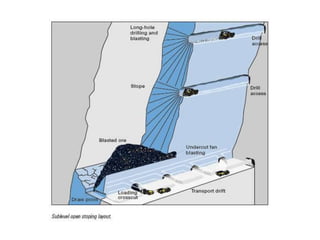
sublevel stoping is a vertical mining method in which a 
large open stope is create within the vein. This open stope 
is not meant to be occupied by the miners therefore ,all 
work of drilling and must be performed from sublevel 
within the ore block. 
Three different variations of sublevel stoping are practiced 
1. Blast hole method . 
2. Open ending method. 
3. Vertical Crater Retreat (VCR) method.
Development 
1.Stope sequence 
2.Drilling 
3.Blasting
Fan Drill Pattern from multiple drift levels 
Parallel Drill Pattern in a Sublevel 
Stope
Labelled Stope Layout with Ring 
Drilling
Equipment 
Sublevel open stopping is a highly mechanized mining method utilizing a wide 
range of equipment for drilling and mucking. Typically production drilling is 
carried out by high-efficiency column and arm long hole drills or DTH drill rigs. 
These systems use electric drive instead of hydraulic and have high pressure 
pneumatic DTH hammers or rotary percussion drilling systems. It is with 
recent advantages in drilling technology that these systems have 
revolutionized sublevel stopping operations. 
Mucking may be done with load haul dump equipment or LHD’s. They either 
take the ore from the draw point entrances and travel to an ore skip location 
for shaft transportation of ore to surface, or they transport and load the ore 
onto haul trucks which then transport the ore to surface via ramp access. 
Slusher and scraper systems have also been used in combination with mine 
car transport as well. In this scenario, the ore is scraped into designated ore 
passes where it falls into waiting mine cars. These cars then either transport 
the ore to waiting haul trucks or to skip locations as described previously.
Support 
1.Pillars 
A wide array of pillars are used in a typical sublevel stopping 
operation. Rib pillars are installed as a support divider between 
horizontally adjacent stopes. During production, as vertical slices 
are blasted away, some slices are left behind as support pillars in 
order to help control subsidence within the stope. Sill and crown 
pillars are also a key support development in sublevel stoping. 
They are used between vertically adjacent stopes (sill pillar) or 
between a stope and surface operations (crown pillar). These 
pillars provide roof and floor support as well as aid in the 
prevention of cave-ins, rock bursting, and surface subsidence
Backfill 
In sublevel stoping a backfill program is usually established in 
large openings created during production. Backfill allows for the 
recovery of support pillars, permitting up to 90% ore recovery. 
Apart from this, backfill provides additional ground support, 
reduces dilution and helps with the redistribution of stresses 
around openings, which reduces rock bursting events. 
Ground Support 
Due to the strong nature of the rock required for use of this 
method, ground support is usually minimal. However ground 
conditioning is still needed in some areas and is done using different 
types of bolts including cable/rock bolts and grouted rebar. In Canada, 
any opening in which workers will be present needs to have a minimum 
bolt pattern before the workers are allowed to work freely.
Applicability condition 
1.Ore strength: moderate to strong, may be less competent than 
for stope and pillar mining. 
2.Rock strength: Fairly strong to strong. 
3.Deposit dip: Fairly steep (>45 degree , preferably 60 to 90 
degree ). 
4.Deposite size: Moderate to thick width (20 to 100 ft or 6 to 
30m), fairly large extent. 
5.Deposite shape: Tabular or lenticular, regular dip and 
boundaries helpful.
Advantage 
1.Moderate to high productivity. 
2.Moderate to high production rate. 
3.Low breakage cost; fairly low handling cost. 
4.Fair recovery (about 75%). 
5.Modest dilution (about 20%)
Disadvantage 
1.Fairly complicated and expensive 
development. 
2.Inflexible in mining plan. 
3.Long hole drilling requires precision 
(<2%deviation). 
4.Large blasts can cause significant vibration , 
air blast , and structural damage
Thank you

Sublevel open stopping assignment

  • 1.
    Sublevel open stopping Virendra suryawanshi 10108EN066
  • 2.
    Sublevel open stopping sublevel stoping is a vertical mining method in which a large open stope is create within the vein. This open stope is not meant to be occupied by the miners therefore ,all work of drilling and must be performed from sublevel within the ore block. Three different variations of sublevel stoping are practiced 1. Blast hole method . 2. Open ending method. 3. Vertical Crater Retreat (VCR) method.
  • 4.
    Development 1.Stope sequence 2.Drilling 3.Blasting
  • 5.
    Fan Drill Patternfrom multiple drift levels Parallel Drill Pattern in a Sublevel Stope
  • 6.
    Labelled Stope Layoutwith Ring Drilling
  • 7.
    Equipment Sublevel openstopping is a highly mechanized mining method utilizing a wide range of equipment for drilling and mucking. Typically production drilling is carried out by high-efficiency column and arm long hole drills or DTH drill rigs. These systems use electric drive instead of hydraulic and have high pressure pneumatic DTH hammers or rotary percussion drilling systems. It is with recent advantages in drilling technology that these systems have revolutionized sublevel stopping operations. Mucking may be done with load haul dump equipment or LHD’s. They either take the ore from the draw point entrances and travel to an ore skip location for shaft transportation of ore to surface, or they transport and load the ore onto haul trucks which then transport the ore to surface via ramp access. Slusher and scraper systems have also been used in combination with mine car transport as well. In this scenario, the ore is scraped into designated ore passes where it falls into waiting mine cars. These cars then either transport the ore to waiting haul trucks or to skip locations as described previously.
  • 8.
    Support 1.Pillars Awide array of pillars are used in a typical sublevel stopping operation. Rib pillars are installed as a support divider between horizontally adjacent stopes. During production, as vertical slices are blasted away, some slices are left behind as support pillars in order to help control subsidence within the stope. Sill and crown pillars are also a key support development in sublevel stoping. They are used between vertically adjacent stopes (sill pillar) or between a stope and surface operations (crown pillar). These pillars provide roof and floor support as well as aid in the prevention of cave-ins, rock bursting, and surface subsidence
  • 9.
    Backfill In sublevelstoping a backfill program is usually established in large openings created during production. Backfill allows for the recovery of support pillars, permitting up to 90% ore recovery. Apart from this, backfill provides additional ground support, reduces dilution and helps with the redistribution of stresses around openings, which reduces rock bursting events. Ground Support Due to the strong nature of the rock required for use of this method, ground support is usually minimal. However ground conditioning is still needed in some areas and is done using different types of bolts including cable/rock bolts and grouted rebar. In Canada, any opening in which workers will be present needs to have a minimum bolt pattern before the workers are allowed to work freely.
  • 10.
    Applicability condition 1.Orestrength: moderate to strong, may be less competent than for stope and pillar mining. 2.Rock strength: Fairly strong to strong. 3.Deposit dip: Fairly steep (>45 degree , preferably 60 to 90 degree ). 4.Deposite size: Moderate to thick width (20 to 100 ft or 6 to 30m), fairly large extent. 5.Deposite shape: Tabular or lenticular, regular dip and boundaries helpful.
  • 11.
    Advantage 1.Moderate tohigh productivity. 2.Moderate to high production rate. 3.Low breakage cost; fairly low handling cost. 4.Fair recovery (about 75%). 5.Modest dilution (about 20%)
  • 12.
    Disadvantage 1.Fairly complicatedand expensive development. 2.Inflexible in mining plan. 3.Long hole drilling requires precision (<2%deviation). 4.Large blasts can cause significant vibration , air blast , and structural damage
  • 13.