

Presented by-
Srimonta Roy-150821
WELCOME TO MY
PRESENTATION
 Introduction
 Nature and scope of mine.
 Classification.
 Description of mining methods.
 Selection of mining methods.
 Mine working and machinery.
 Mine development plans and design.
 Mine plants layout.
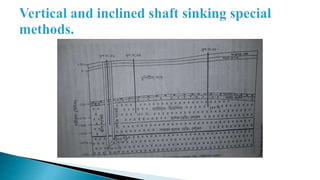
 Vertical and inclined shaft sinking by conventional and special
methods.
 Conclusion.
 References.
Underground mining is a technique used to access ores and
valuable minerals in the ground by digging into ground to
extract them.Minerals or ore deposits are exploited from
beneath the earth surface,which techniques are applied is
called underground mining system.Its applied below the depth
about more than 300m.
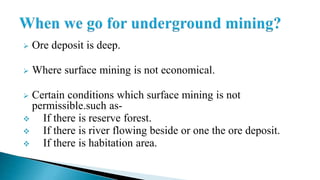
 Ore deposit is deep.
 Where surface mining is not economical.
 Certain conditions which surface mining is not
permissible.such as-
 If there is reserve forest.
 If there is river flowing beside or one the ore deposit.
 If there is habitation area.
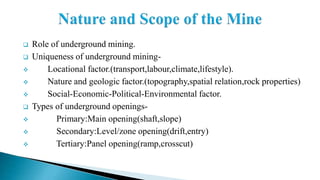
 Role of underground mining.
 Uniqueness of underground mining-
 Locational factor.(transport,labour,climate,lifestyle).
 Nature and geologic factor.(topography,spatial relation,rock properties)
 Social-Economic-Political-Environmental factor.
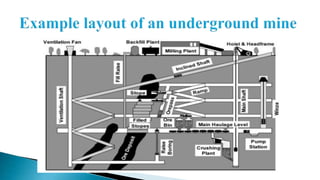
 Types of underground openings-
 Primary:Main opening(shaft,slope)
 Secondary:Level/zone opening(drift,entry)
 Tertiary:Panel opening(ramp,crosscut)
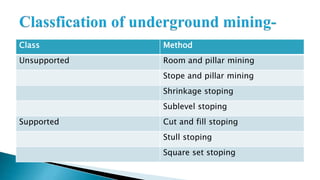
Class Method
Unsupported Room and pillar mining
Stope and pillar mining
Shrinkage stoping
Sublevel stoping
Supported Cut and fill stoping
Stull stoping
Square set stoping
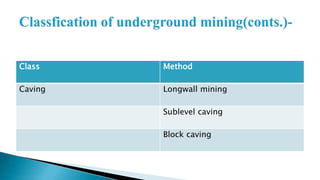
Class Method
Caving Longwall mining
Sublevel caving
Block caving
 Shaft:Primary vertical or near-vertical opening,connecting the
surface with underground workings;also vertical shaft.
 Slope:-Primary inclined opening,usually a shaft,connecting the
surface with underground workings;also vertical shaft.
 Drift:-Primary or secondary horizontal or near-horizontal
opening,oriented parallel to the strike of a pitching deposit.
 Entry:-secondary horizontal or near-horizontal opening,usually
driven in multiples.
 Room and pillar is a method employed in underground mining in which
rooms are cut into the coal bed and pillars of ore are left to provide support.
 This method is usually employed when ore is positioned in flat and narrow
deposits. The room and pillar method also helps control the flow of air
within the mine. Most underground coal mining is completed by this
method.
 It is a popular mining method for underground mining in tabular and
lenticular deposits.
 Room and pillar mining is usually used while extracting coal, iron, and
copper ores; it is best suited for deposits that are relatively flat. Rooms
generally are 2,067 feet (630 m) wide and pillars are up to 328 feet (100 m)
wide.
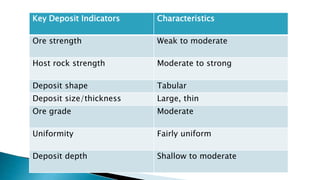
Key Deposit Indicators Characteristics
Ore strength Weak to moderate
Host rock strength Moderate to strong
Deposit shape Tabular
Deposit size/thickness Large, thin
Ore grade Moderate
Uniformity Fairly uniform
Deposit depth Shallow to moderate
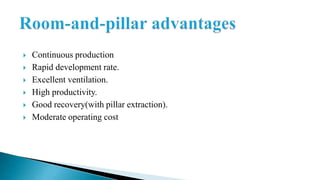
 Continuous production
 Rapid development rate.
 Excellent ventilation.
 High productivity.
 Good recovery(with pillar extraction).
 Moderate operating cost
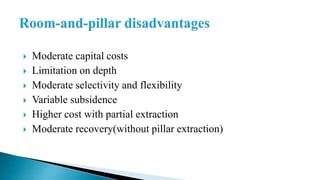
 Moderate capital costs
 Limitation on depth
 Moderate selectivity and flexibility
 Variable subsidence
 Higher cost with partial extraction
 Moderate recovery(without pillar extraction)
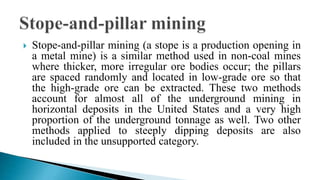
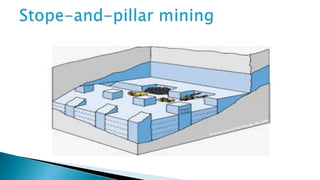
 Stope-and-pillar mining (a stope is a production opening in
a metal mine) is a similar method used in non-coal mines
where thicker, more irregular ore bodies occur; the pillars
are spaced randomly and located in low-grade ore so that
the high-grade ore can be extracted. These two methods
account for almost all of the underground mining in
horizontal deposits in the United States and a very high
proportion of the underground tonnage as well. Two other
methods applied to steeply dipping deposits are also
included in the unsupported category.
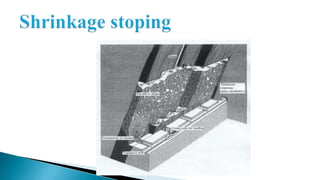
 Shrinkage stoping is the method characterized by the
mining advance being upward, with horizontal slices of
ore being blasted along the length of the stope.
 A portion of the broken ore is allowed to accumulate in
the stope to provide a working platform for the miners
and is thereafter withdrawn from the stope through
chutes Shrinkage stoping is more suitable than sublevel
stoping for stronger ore and weaker wall rock.
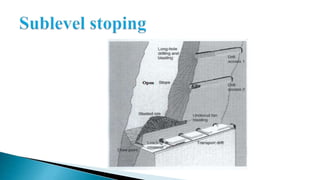
 Sublevel stoping differs from shrinkage stoping by
providing sublevels from which vertical slices are
blasted. In this manner, the stope is mined horizontally
from one end to the other.
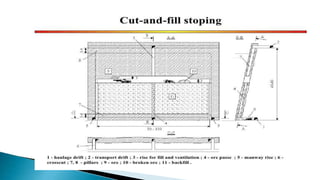
 Cut-and-fill is the most common of these methods and is
used primarily in steeply dipping metal deposits.
 The cut-and-fill method is practiced both in the overhand
(upward) and in the underhand (downward) directions. As
each horizontal slice is taken, the voids are filled with a
variety of fill types to support the walls. The fill can be rock
waste, tailings, cemented tailings, or other suitable
materials.
 Cut-and-fill mining is one of the more popular methods
used for vein deposits and has recently grown in use.
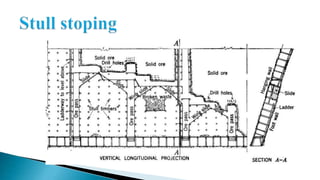
 Stull stoping is a supported mining method using
timber or rock bolts in tabular, pitching ore bodies.
 It is one of the methods that can be applied to ore
bodies that have dips between 10° and 45°.
 It often utilizes artificial pillars of waste to support the
roof.
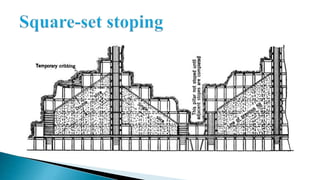
 Square-set stoping also involves backfilling mine
voids; however, it relies mainly on timber sets to
support the walls during mining.
 This mining method is rapidly disappearing in
North America because of the high cost of labor.
 However, it still finds occasional use in mining
high-grade ores or in countries where labor costs
are low.
 Hand tools:-A hand tool is any tool that is powered by hand
rather than a motor.
Example-Augur, Mine shovel, Moil, Hammer, Mine picks,
wedge etc.
 Power driven tools:-A power tool is a tool that is actuated by
an additional power source and mechanism other than the
solely manual labor used with hand tools.
Example-coal cutter machine, sharer machine, tunneling
machine, short wall cutter machine etc.
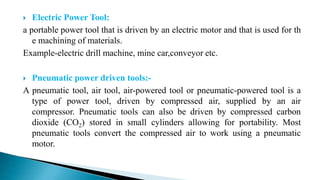
 Electric Power Tool:
a portable power tool that is driven by an electric motor and that is used for th
e machining of materials.
Example-electric drill machine, mine car,conveyor etc.
 Pneumatic power driven tools:-
A pneumatic tool, air tool, air-powered tool or pneumatic-powered tool is a
type of power tool, driven by compressed air, supplied by an air
compressor. Pneumatic tools can also be driven by compressed carbon
dioxide (CO2) stored in small cylinders allowing for portability. Most
pneumatic tools convert the compressed air to work using a pneumatic
motor.
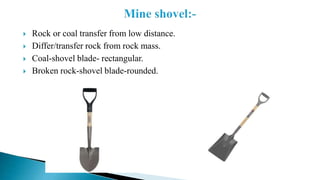
 Rock or coal transfer from low distance.
 Differ/transfer rock from rock mass.
 Coal-shovel blade- rectangular.
 Broken rock-shovel blade-rounded.
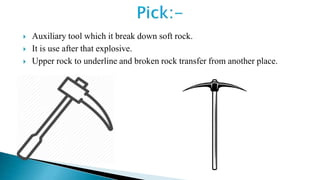
 Auxiliary tool which it break down soft rock.
 It is use after that explosive.
 Upper rock to underline and broken rock transfer from another place.
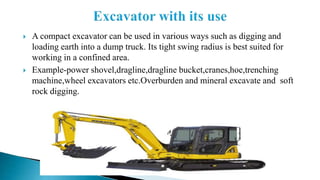
 A compact excavator can be used in various ways such as digging and
loading earth into a dump truck. Its tight swing radius is best suited for
working in a confined area.
 Example-power shovel,dragline,dragline bucket,cranes,hoe,trenching
machine,wheel excavators etc.Overburden and mineral excavate and soft
rock digging.
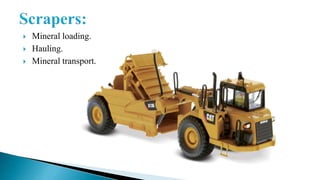
 Mineral loading.
 Hauling.
 Mineral transport.
 Timber
 Cements and limes
 Mortars
 Concrete
 Gunite
 Natural stone
 Brickstone
 Rainforced concrete
 Steel
 Spatial characteristics of the deposit.
 Geologic and hydrologic condition.
 Geotechnical properties.
 Economic consideration.
 Technologial factor.
 Environment concern.
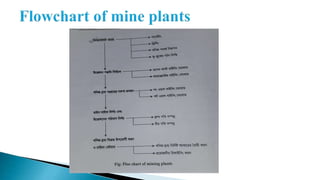
 Mine survey
 Feasibility study
 Mining method
 Drilling / shaft sinking
 Starting roadway
 Necessary equipment for broken rock
 Loading and transporting mineral to the surface.
 Necessity for shaft sinking:
 Extract of mineral.
 To transport of various machineries.
 Transport miners.
 Mine venntilation.
 The general design of the mine.
 The exact location.
 Shape and dimension of the shaft.
 Position of the permanent building
 List of equipments.
 Plan for the organization
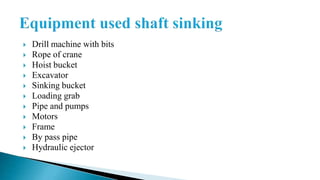
 Drill machine with bits
 Rope of crane
 Hoist bucket
 Excavator
 Sinking bucket
 Loading grab
 Pipe and pumps
 Motors
 Frame
 By pass pipe
 Hydraulic ejector
 Its depands on geologic structure and ground water condition.
 Strength of ground and water bearing condition of ground of
the depending shaft sinking for conventional method or special
method.
 The main work of sinking,loading the stone,supporting
the walls and equipping the shaft.
 Subsidiary work including hoisting,pumping
ventilation and lighting.
 Services such as power supply,water
supply,transport,stores,repairs,housing and social life.
 Here strong and relatively dry rock condition.
 When we are cutting the face of create water,its
remove or easily handled by bucket or pump.
 All of walls are temporary support.
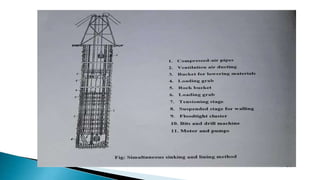
 Compressed air pipe
 Ventilation air ducting
 Bucket for lowering materials
 Loading grab
 Rock bucket
 Bits and drill machine
 Motor and pump.
 Mining is the extraction of valuable minerals or other geological
materials from the earth, usually from an orebody, lode, vein,
seam, reef or placer deposit. These deposits form a mineralized
package that is of economic interest to the miner.
 Ores recovered by mining include metals, coal, oil shale,
gemstones, limestone, chalk, dimension stone, rock salt, potash,
gravel, and clay. Mining is required to obtain any material that
cannot be grown through agricultural processes, or created
artificially in a laboratory or factory. Mining in a wider sense
 Hartman, H. L. (1992). SME Mining Engineering Handbook, Society for Mining, Metallurgy,
and Exploration Inc, p3.
 Hartman, H.L. and Matmansky, J.M. (2002). Introductory Mining Engineering. 2ndedn. John
Wiley & Sons, Inc. 584p.
 Hartman, H.L., 1987. Introductory mining engineering. A Wiley inter-science publication,
633p
 Puhakka, T. (1997). Underground Drilling and Loading Handbook. Finland: Tamrock Corp.
pp.98 –170.
 Skimmed Coal - new sink and float process removes slate and speeds production" Popular
Science, August 1938
 SME Mining Engineering Handbook, 2011, ed. Peter Darling.
Thank you.

Underground mining system

  • 1.
  • 2.
  • 3.
     Introduction  Natureand scope of mine.  Classification.  Description of mining methods.  Selection of mining methods.  Mine working and machinery.  Mine development plans and design.  Mine plants layout.  Vertical and inclined shaft sinking by conventional and special methods.  Conclusion.  References.
  • 4.
    Underground mining isa technique used to access ores and valuable minerals in the ground by digging into ground to extract them.Minerals or ore deposits are exploited from beneath the earth surface,which techniques are applied is called underground mining system.Its applied below the depth about more than 300m.
  • 5.
     Ore depositis deep.  Where surface mining is not economical.  Certain conditions which surface mining is not permissible.such as-  If there is reserve forest.  If there is river flowing beside or one the ore deposit.  If there is habitation area.
  • 6.
     Role ofunderground mining.  Uniqueness of underground mining-  Locational factor.(transport,labour,climate,lifestyle).  Nature and geologic factor.(topography,spatial relation,rock properties)  Social-Economic-Political-Environmental factor.  Types of underground openings-  Primary:Main opening(shaft,slope)  Secondary:Level/zone opening(drift,entry)  Tertiary:Panel opening(ramp,crosscut)
  • 7.
    Class Method Unsupported Roomand pillar mining Stope and pillar mining Shrinkage stoping Sublevel stoping Supported Cut and fill stoping Stull stoping Square set stoping
  • 8.
    Class Method Caving Longwallmining Sublevel caving Block caving
  • 9.
     Shaft:Primary verticalor near-vertical opening,connecting the surface with underground workings;also vertical shaft.  Slope:-Primary inclined opening,usually a shaft,connecting the surface with underground workings;also vertical shaft.  Drift:-Primary or secondary horizontal or near-horizontal opening,oriented parallel to the strike of a pitching deposit.  Entry:-secondary horizontal or near-horizontal opening,usually driven in multiples.
  • 11.
     Room andpillar is a method employed in underground mining in which rooms are cut into the coal bed and pillars of ore are left to provide support.  This method is usually employed when ore is positioned in flat and narrow deposits. The room and pillar method also helps control the flow of air within the mine. Most underground coal mining is completed by this method.  It is a popular mining method for underground mining in tabular and lenticular deposits.  Room and pillar mining is usually used while extracting coal, iron, and copper ores; it is best suited for deposits that are relatively flat. Rooms generally are 2,067 feet (630 m) wide and pillars are up to 328 feet (100 m) wide.
  • 13.
    Key Deposit IndicatorsCharacteristics Ore strength Weak to moderate Host rock strength Moderate to strong Deposit shape Tabular Deposit size/thickness Large, thin Ore grade Moderate Uniformity Fairly uniform Deposit depth Shallow to moderate
  • 14.
     Continuous production Rapid development rate.  Excellent ventilation.  High productivity.  Good recovery(with pillar extraction).  Moderate operating cost
  • 15.
     Moderate capitalcosts  Limitation on depth  Moderate selectivity and flexibility  Variable subsidence  Higher cost with partial extraction  Moderate recovery(without pillar extraction)
  • 16.
     Stope-and-pillar mining(a stope is a production opening in a metal mine) is a similar method used in non-coal mines where thicker, more irregular ore bodies occur; the pillars are spaced randomly and located in low-grade ore so that the high-grade ore can be extracted. These two methods account for almost all of the underground mining in horizontal deposits in the United States and a very high proportion of the underground tonnage as well. Two other methods applied to steeply dipping deposits are also included in the unsupported category.
  • 18.
     Shrinkage stopingis the method characterized by the mining advance being upward, with horizontal slices of ore being blasted along the length of the stope.  A portion of the broken ore is allowed to accumulate in the stope to provide a working platform for the miners and is thereafter withdrawn from the stope through chutes Shrinkage stoping is more suitable than sublevel stoping for stronger ore and weaker wall rock.
  • 20.
     Sublevel stopingdiffers from shrinkage stoping by providing sublevels from which vertical slices are blasted. In this manner, the stope is mined horizontally from one end to the other.
  • 22.
     Cut-and-fill isthe most common of these methods and is used primarily in steeply dipping metal deposits.  The cut-and-fill method is practiced both in the overhand (upward) and in the underhand (downward) directions. As each horizontal slice is taken, the voids are filled with a variety of fill types to support the walls. The fill can be rock waste, tailings, cemented tailings, or other suitable materials.  Cut-and-fill mining is one of the more popular methods used for vein deposits and has recently grown in use.
  • 24.
     Stull stopingis a supported mining method using timber or rock bolts in tabular, pitching ore bodies.  It is one of the methods that can be applied to ore bodies that have dips between 10° and 45°.  It often utilizes artificial pillars of waste to support the roof.
  • 26.
     Square-set stopingalso involves backfilling mine voids; however, it relies mainly on timber sets to support the walls during mining.  This mining method is rapidly disappearing in North America because of the high cost of labor.  However, it still finds occasional use in mining high-grade ores or in countries where labor costs are low.
  • 28.
     Hand tools:-Ahand tool is any tool that is powered by hand rather than a motor. Example-Augur, Mine shovel, Moil, Hammer, Mine picks, wedge etc.  Power driven tools:-A power tool is a tool that is actuated by an additional power source and mechanism other than the solely manual labor used with hand tools. Example-coal cutter machine, sharer machine, tunneling machine, short wall cutter machine etc.
  • 29.
     Electric PowerTool: a portable power tool that is driven by an electric motor and that is used for th e machining of materials. Example-electric drill machine, mine car,conveyor etc.  Pneumatic power driven tools:- A pneumatic tool, air tool, air-powered tool or pneumatic-powered tool is a type of power tool, driven by compressed air, supplied by an air compressor. Pneumatic tools can also be driven by compressed carbon dioxide (CO2) stored in small cylinders allowing for portability. Most pneumatic tools convert the compressed air to work using a pneumatic motor.
  • 30.
     Rock orcoal transfer from low distance.  Differ/transfer rock from rock mass.  Coal-shovel blade- rectangular.  Broken rock-shovel blade-rounded.
  • 31.
     Auxiliary toolwhich it break down soft rock.  It is use after that explosive.  Upper rock to underline and broken rock transfer from another place.
  • 32.
     A compactexcavator can be used in various ways such as digging and loading earth into a dump truck. Its tight swing radius is best suited for working in a confined area.  Example-power shovel,dragline,dragline bucket,cranes,hoe,trenching machine,wheel excavators etc.Overburden and mineral excavate and soft rock digging.
  • 33.
     Mineral loading. Hauling.  Mineral transport.
  • 34.
     Timber  Cementsand limes  Mortars  Concrete  Gunite  Natural stone  Brickstone  Rainforced concrete  Steel
  • 35.
     Spatial characteristicsof the deposit.  Geologic and hydrologic condition.  Geotechnical properties.  Economic consideration.  Technologial factor.  Environment concern.
  • 37.
     Mine survey Feasibility study  Mining method  Drilling / shaft sinking  Starting roadway  Necessary equipment for broken rock  Loading and transporting mineral to the surface.
  • 39.
     Necessity forshaft sinking:  Extract of mineral.  To transport of various machineries.  Transport miners.  Mine venntilation.
  • 40.
     The generaldesign of the mine.  The exact location.  Shape and dimension of the shaft.  Position of the permanent building  List of equipments.  Plan for the organization
  • 41.
     Drill machinewith bits  Rope of crane  Hoist bucket  Excavator  Sinking bucket  Loading grab  Pipe and pumps  Motors  Frame  By pass pipe  Hydraulic ejector
  • 42.
     Its depandson geologic structure and ground water condition.  Strength of ground and water bearing condition of ground of the depending shaft sinking for conventional method or special method.
  • 43.
     The mainwork of sinking,loading the stone,supporting the walls and equipping the shaft.  Subsidiary work including hoisting,pumping ventilation and lighting.  Services such as power supply,water supply,transport,stores,repairs,housing and social life.
  • 44.
     Here strongand relatively dry rock condition.  When we are cutting the face of create water,its remove or easily handled by bucket or pump.  All of walls are temporary support.
  • 45.
     Compressed airpipe  Ventilation air ducting  Bucket for lowering materials  Loading grab  Rock bucket  Bits and drill machine  Motor and pump.
  • 49.
     Mining isthe extraction of valuable minerals or other geological materials from the earth, usually from an orebody, lode, vein, seam, reef or placer deposit. These deposits form a mineralized package that is of economic interest to the miner.  Ores recovered by mining include metals, coal, oil shale, gemstones, limestone, chalk, dimension stone, rock salt, potash, gravel, and clay. Mining is required to obtain any material that cannot be grown through agricultural processes, or created artificially in a laboratory or factory. Mining in a wider sense
  • 50.
     Hartman, H.L. (1992). SME Mining Engineering Handbook, Society for Mining, Metallurgy, and Exploration Inc, p3.  Hartman, H.L. and Matmansky, J.M. (2002). Introductory Mining Engineering. 2ndedn. John Wiley & Sons, Inc. 584p.  Hartman, H.L., 1987. Introductory mining engineering. A Wiley inter-science publication, 633p  Puhakka, T. (1997). Underground Drilling and Loading Handbook. Finland: Tamrock Corp. pp.98 –170.  Skimmed Coal - new sink and float process removes slate and speeds production" Popular Science, August 1938  SME Mining Engineering Handbook, 2011, ed. Peter Darling.
  • 51.