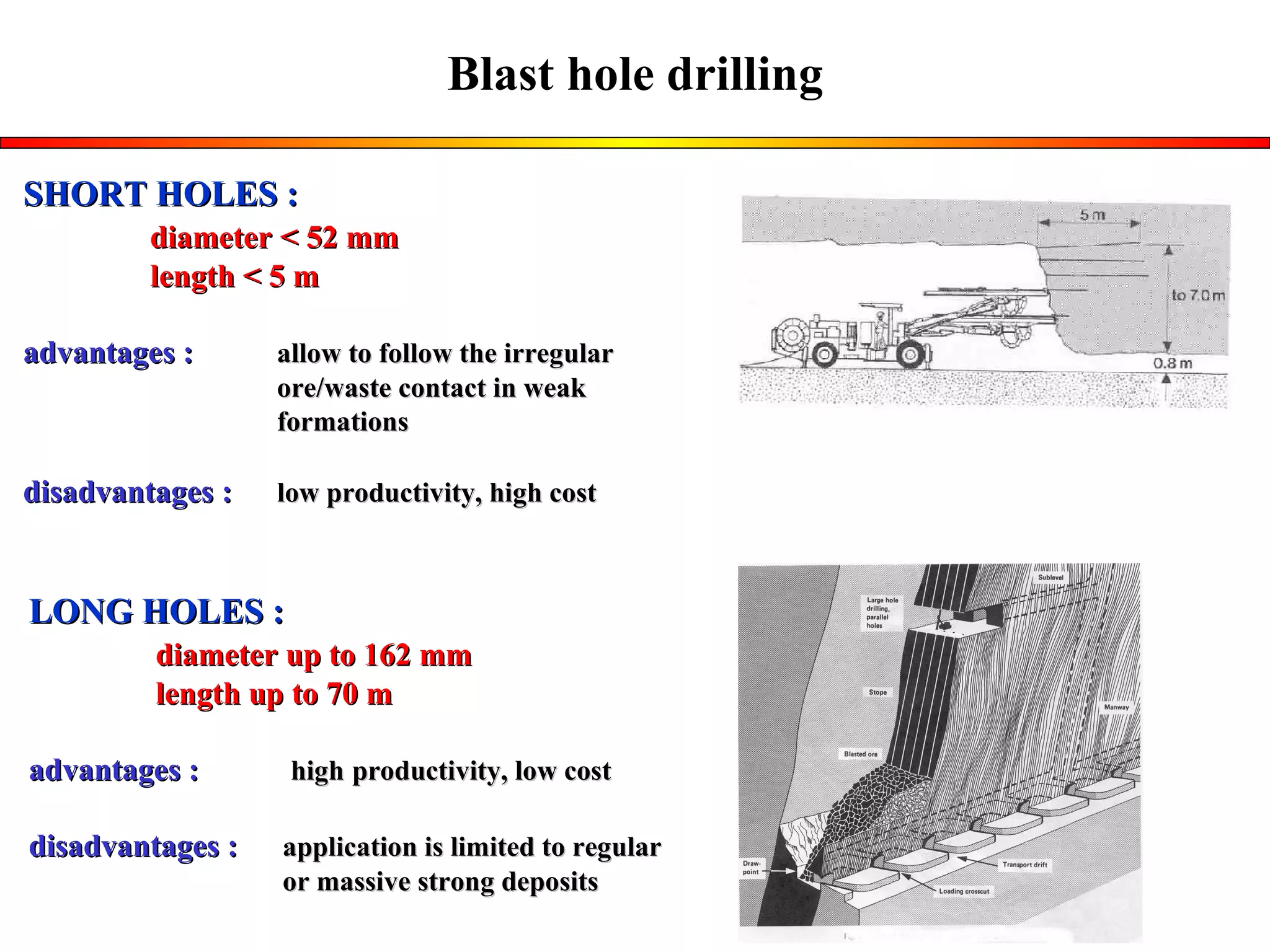
SHORT HOLES : diameter < 52 mm length < 5 m advantages : allow to follow the irregular ore/waste contact in weak formations disadvantages : low productivity, high cost Blast hole drilling LONG HOLES : diameter up to 162 mm length up to 70 m advantages :     high   productivity, low cost disadvantages : application is limited to regular  or massive strong deposits
Drilling patterns for narrow vein deposits Overhand or back stoping Breast stoping Frontal benching w h l l h w h w l Cut-and-fill and  Shrinkage Stoping Cut-and-fill and  Shrinkage Stoping Undercut-and-fill  Stoping Production  Jumbo Drifting  Jumbo Drifting  Jumbo Hand-held Stoper drill Hand-held Jack Leg drill Hand-held Jack Leg drill Hole depth, m 3 - 4 2 - 2.5
Drilling patterns for narrow vein deposits Schéma de foration de la face du chantier par tranches montantes remblayées  h w l
Drilling patterns for flat dipping deposits drifting downward benching downward benching with 4 free faces frontal benching with 4 free faces downward benching with 3 free faces frontal benching with 3 free faces
MANUAL DRILLING Short hole drilling JUMBOS Diameter : jusqu’à 82 mm Length :  15 m Downward drilling : 25 m/hour Upward drilling : 20 m/hour TOP HAMMER Diameter : 28-46  mm Length : 3 m Jack-hammer : 12.5 m/hour Stoper : 10 m/hour
Parallel drilling patterns for massive deposits vertical slabbing horizontal slabbing
Fan drilling patterns for massive deposits upward fan drilling downward fan drilling ring fan drilling
Beam pattern  patterns for massive deposits Crown pillar caving
Long hole drilling DOWN THE HOLE HAMMER DRILL RIG Diameter : up to 165 mm Length :  100 m Drilling speed : 15 (6-20) m/hour
Operating costs of drilling and blasting where : C hour   - hourly cost of the drilling equipment in $ per hour ; c bit,steel    - bit and steel wear cost per meter drilled in $ per meter , c bit,steel     1  $/m T round   - tonnage blasted per round in tonnes per round ; L round   - total holes length per round in m per round ; s drilling   - average drilling speed in m per hour : Jumbo frontal stoping, breasting : s drilling  = 25 m/hour Jumbo overhand stoping : s drilling  = 20 m/hour Jack leg : s drilling  = 12.5 m/hour Stoper : s drilling  = 10 m/hour
Cost estimation Capital cost Hourly operating cost Operator labor  Parts Maintenance labor Diesel fuel Electric power Lube oil Tires Compressed air
Cost estimation Hourly operating cost Capital cost and technical characteristics
Operating cost of drilling and blasting :  Tonnage blasted per round where : w   - stop width in m ; h   - stop height in m ; l   - stop length in m ;  average   - average rock masse density in tonne per m 3  .
Operating costs of drilling and blasting :  Total holes length per round where : l hole   - hole depth in meters ; N   - number of holes per round, holes ; q   - powder factor in kilograms of explosive per tonne of rock  broken ; Eh   - charge of explosive per hole in kilograms ; T round   - tonnage of rock blasted per round in tonnes.
Theoretical powder factor where : R c   - uniaxial compressive strength of the rock in MPa; C 1  and C 2   - empirical coefficients
Corrected powder factor where : q 0  - theoretical powder factor in kilograms of explosive per cubic meter  of rock broken ;  k 1  - is relative strength of explosive factor k 2  - is required fragmentation factor k 3  - is the hole diameter factor k 4  - free face condition factor is the factor taking in to account number  and conditions of free faces k 5  - drilling pattern factor taking into account increasing of the powder  factor when the drilling pattern is different from parallel
Relative strength of explosive factor - k 1 where : ABS ref  - absolute bulk strength of the reference explosive in J/cm 3  or in cal/cm 3 ABS   - absolute bulk strength of new explosive in J/cm 3  or in cal/cm 3 AWS ref  - absolute weight strength of the reference explosive in J/gramme or in  cal/gramme : explosive of reference is the Extra dynamite : AWS = 1030 cal/g AWS   - absolute weight strength of new used explosive in J/gramme k 1  = 1.13 for ANFO
Relative strength of explosive factor - k 1 Typical Properties of Extra Gelatine Typical Properties for Emulsion  and Emulsion/ANFO blends
Relative strength of explosive factor - k 1 Typical Properties of UNIGEL  Semi-Gelatin Nitroglycerine Dynamite Typical Properties of DYNO RU  Booster sensitive bulk emulsion
Required fragmentation factor - k 2 For short holes For long holes where : l f average distance between fractures in the rock masse b required average bloc size after blasting n 1  = 0.5 to 0.6
Hole diameter factor  - k 3 Jumbo  : d  = 38 mm Hend-held drill d  = 32 mm where : d  - new hole diameter in m d ref   - diameter of reference in m for short holes d ref  = 0.042 m for long holes d ref  = 0.105 m n2= 1  - in monolithic formation ; n2= 0.5 - in highly fractured formation
Free face condition factor  - k 4 k4 = 1.4 to 1.6 for a blast of short holes with a single free face perpendicular to holes axes k4 = 1.2 to 1.3 if blasting of long holes is done on the broken rock masse
Drilling pattern factor  - k 5 beam pattern :  k5 = 1.3 to 1.5 fan pattern : k5 = 1.1 to 1.2 parallel pattern (reference) : k5 = 1
Operating costs of drilling and blasting : u nit hole depth where : l hole   - hole depth in meters ; f pull    0.92  - pull factor taking in to account the subdrilling ; z   - stop size parallel to the hole, stop length for the breast or  frontal stoping and stop height for the overhand stoping ; l hole l h l hole
Operating costs of drilling and blasting :  Charge of explosive per hole where : Eh   - charge of explosive per hole in kilograms ; l hole   - hole depth in meters ; d hole   - hole diameter in meters ;    - of explosive loading density in kilograms per m 3,      = 800 for ANFO ; f burden  - burden factor, f burden    0.75 ; f p    - factor taking in to account charge diameter compared with hole  diameter, f p  = 1 for ANFO.
Cost of blasting where : p /   - corrected powder factor in kilograms of explosive per tonne of  rock broken ; c explosive   - cost of explosive in $ per kilogram ,  c explosive  = 0.6 $/kg for ANFO ; c cap,primer   - cost of caps and primers in $ per hole ,  c cap,primer     2.5 $/hole ; N   - number of holes per round .

Dril blustangnb

  • 1.
    SHORT HOLES :diameter < 52 mm length < 5 m advantages : allow to follow the irregular ore/waste contact in weak formations disadvantages : low productivity, high cost Blast hole drilling LONG HOLES : diameter up to 162 mm length up to 70 m advantages : high productivity, low cost disadvantages : application is limited to regular or massive strong deposits
  • 2.
    Drilling patterns fornarrow vein deposits Overhand or back stoping Breast stoping Frontal benching w h l l h w h w l Cut-and-fill and Shrinkage Stoping Cut-and-fill and Shrinkage Stoping Undercut-and-fill Stoping Production Jumbo Drifting Jumbo Drifting Jumbo Hand-held Stoper drill Hand-held Jack Leg drill Hand-held Jack Leg drill Hole depth, m 3 - 4 2 - 2.5
  • 3.
    Drilling patterns fornarrow vein deposits Schéma de foration de la face du chantier par tranches montantes remblayées h w l
  • 4.
    Drilling patterns forflat dipping deposits drifting downward benching downward benching with 4 free faces frontal benching with 4 free faces downward benching with 3 free faces frontal benching with 3 free faces
  • 5.
    MANUAL DRILLING Shorthole drilling JUMBOS Diameter : jusqu’à 82 mm Length : 15 m Downward drilling : 25 m/hour Upward drilling : 20 m/hour TOP HAMMER Diameter : 28-46 mm Length : 3 m Jack-hammer : 12.5 m/hour Stoper : 10 m/hour
  • 6.
    Parallel drilling patternsfor massive deposits vertical slabbing horizontal slabbing
  • 7.
    Fan drilling patternsfor massive deposits upward fan drilling downward fan drilling ring fan drilling
  • 8.
    Beam pattern patterns for massive deposits Crown pillar caving
  • 9.
    Long hole drillingDOWN THE HOLE HAMMER DRILL RIG Diameter : up to 165 mm Length : 100 m Drilling speed : 15 (6-20) m/hour
  • 10.
    Operating costs ofdrilling and blasting where : C hour - hourly cost of the drilling equipment in $ per hour ; c bit,steel - bit and steel wear cost per meter drilled in $ per meter , c bit,steel  1 $/m T round - tonnage blasted per round in tonnes per round ; L round - total holes length per round in m per round ; s drilling - average drilling speed in m per hour : Jumbo frontal stoping, breasting : s drilling = 25 m/hour Jumbo overhand stoping : s drilling = 20 m/hour Jack leg : s drilling = 12.5 m/hour Stoper : s drilling = 10 m/hour
  • 11.
    Cost estimation Capitalcost Hourly operating cost Operator labor Parts Maintenance labor Diesel fuel Electric power Lube oil Tires Compressed air
  • 12.
    Cost estimation Hourlyoperating cost Capital cost and technical characteristics
  • 13.
    Operating cost ofdrilling and blasting : Tonnage blasted per round where : w - stop width in m ; h - stop height in m ; l - stop length in m ;  average - average rock masse density in tonne per m 3 .
  • 14.
    Operating costs ofdrilling and blasting : Total holes length per round where : l hole - hole depth in meters ; N - number of holes per round, holes ; q - powder factor in kilograms of explosive per tonne of rock broken ; Eh - charge of explosive per hole in kilograms ; T round - tonnage of rock blasted per round in tonnes.
  • 15.
    Theoretical powder factorwhere : R c - uniaxial compressive strength of the rock in MPa; C 1 and C 2 - empirical coefficients
  • 16.
    Corrected powder factorwhere : q 0 - theoretical powder factor in kilograms of explosive per cubic meter of rock broken ; k 1 - is relative strength of explosive factor k 2 - is required fragmentation factor k 3 - is the hole diameter factor k 4 - free face condition factor is the factor taking in to account number and conditions of free faces k 5 - drilling pattern factor taking into account increasing of the powder factor when the drilling pattern is different from parallel
  • 17.
    Relative strength ofexplosive factor - k 1 where : ABS ref - absolute bulk strength of the reference explosive in J/cm 3 or in cal/cm 3 ABS - absolute bulk strength of new explosive in J/cm 3 or in cal/cm 3 AWS ref - absolute weight strength of the reference explosive in J/gramme or in cal/gramme : explosive of reference is the Extra dynamite : AWS = 1030 cal/g AWS - absolute weight strength of new used explosive in J/gramme k 1 = 1.13 for ANFO
  • 18.
    Relative strength ofexplosive factor - k 1 Typical Properties of Extra Gelatine Typical Properties for Emulsion and Emulsion/ANFO blends
  • 19.
    Relative strength ofexplosive factor - k 1 Typical Properties of UNIGEL Semi-Gelatin Nitroglycerine Dynamite Typical Properties of DYNO RU Booster sensitive bulk emulsion
  • 20.
    Required fragmentation factor- k 2 For short holes For long holes where : l f average distance between fractures in the rock masse b required average bloc size after blasting n 1 = 0.5 to 0.6
  • 21.
    Hole diameter factor - k 3 Jumbo : d = 38 mm Hend-held drill d = 32 mm where : d - new hole diameter in m d ref - diameter of reference in m for short holes d ref = 0.042 m for long holes d ref = 0.105 m n2= 1 - in monolithic formation ; n2= 0.5 - in highly fractured formation
  • 22.
    Free face conditionfactor - k 4 k4 = 1.4 to 1.6 for a blast of short holes with a single free face perpendicular to holes axes k4 = 1.2 to 1.3 if blasting of long holes is done on the broken rock masse
  • 23.
    Drilling pattern factor - k 5 beam pattern : k5 = 1.3 to 1.5 fan pattern : k5 = 1.1 to 1.2 parallel pattern (reference) : k5 = 1
  • 24.
    Operating costs ofdrilling and blasting : u nit hole depth where : l hole - hole depth in meters ; f pull  0.92 - pull factor taking in to account the subdrilling ; z - stop size parallel to the hole, stop length for the breast or frontal stoping and stop height for the overhand stoping ; l hole l h l hole
  • 25.
    Operating costs ofdrilling and blasting : Charge of explosive per hole where : Eh - charge of explosive per hole in kilograms ; l hole - hole depth in meters ; d hole - hole diameter in meters ;  - of explosive loading density in kilograms per m 3,  = 800 for ANFO ; f burden - burden factor, f burden  0.75 ; f p - factor taking in to account charge diameter compared with hole diameter, f p = 1 for ANFO.
  • 26.
    Cost of blastingwhere : p / - corrected powder factor in kilograms of explosive per tonne of rock broken ; c explosive - cost of explosive in $ per kilogram , c explosive = 0.6 $/kg for ANFO ; c cap,primer - cost of caps and primers in $ per hole , c cap,primer  2.5 $/hole ; N - number of holes per round .

Editor's Notes

  • #10 Marteau fond de trou : -http://www.infomine.com/equipment/sellers/dsupplies/drillerssupplies.html SECOROC down the hole hammer 3 ’ ’ to 8 ’ ’