CLASSIFICATION OF MINING SYSTEMS
Types of Mining Methods
Methods and procedures
DIFFERENT TYPE OF UNDERGROUND MINING METHODS
Supported
methods
Unsupported
methods
Caving
methods
1) Cut and fill
stoping
1) Room-and-pillar
mining
1) Longwall
mining
2) Stull stoping 2) Stope-and-pillar
mining
2) Sublevel
caving
3) Square set
stoping
3) Shrinkage stoping 3) Block Caving
4) Sublevel stoping
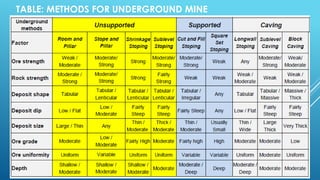
TABLE: METHODS FOR UNDERGROUND MINE
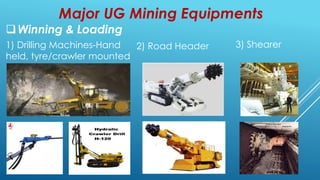
Major UG Mining Equipments
Winning & Loading
1) Drilling Machines-Hand
held, tyre/crawler mounted
2) Road Header 3) Shearer
4) Continuous Miner 5) Side Discharge
Loader (SDL)
6) Load Haul Dump (LHD)
o Shuttle car
o Roof Bolter
o Powered Support
Drilling machines, road header, shearer, continuous miner, side discharge loader, Load haul dump
Transportation
 Conveyors
 Haulages
 Winding systems
 Man Riding systems
 Shuttle cars/Ram Cars
 Locos
METHODS AND PROCEDURE
Cut and Fill Stoping: This method is used in vertical stopes and in
mining high-grade irregular ore bodies.
 The rock mass surrounding the ore deposit is usually week
 Unable to support loads over and extended stoping height
 Successive cutting of the ore into horizontal slices is carried out
starting from the bottom and progressing upwards towards the
surface
 The ore is extracted in horizontal slices and replaced with
backfill material
 The fill material varies, depending on the support required, and
the material available
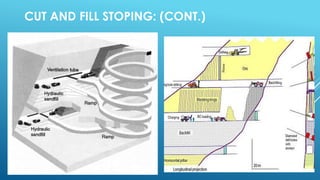
CUT AND FILL STOPING: (CONT.)
 It is one of the popular and expensive but selective
mining method, with low ore loss and dilution
 Is done only in high grade minerals/resources (why)
 Ore is drilled, blasted and removed from stope
 The ore is mined in slices
 Voids are backfilled with a variety of fill type to support
the walls ----rock waste, tailings, sand or other suitable
materials
 In cut and fill stoping, the orebody is retrieved in horizontal
slices beginning at the very bottom and advancing
upwards towards the surface.
 Ramps (inclined tunnels) are excavated to connect the
surface to the underground ore body.
 Drifts are excavated to come in contact with the ore slices.
The slices are drilled using a jumbo, blasted by charging the
drill holes with explosives, and ore is removed by using
dump trucks or Load Haul Dump (LHD) vehicles.
 The ore is dumped into an ore pass, an inclined tunnel
where ore is transported to a lower elevation in the mine.
MINING PROCEDURE OF CUT AND FILL STOPING
 The ore is picked up at the other end of the ore pass by a
LHD to be transported out of the mine through a ramp
(inclined tunnel).
 Once a slice is completely mined out, the empty space is
partially backfilled hydraulically.
 The backfill material used can be a mixture of sand and
rocks, waste rock with cement, or dewatered mill tailings
(rejected low grade ore from processing, usually fine and
sandy).
 The backfill underground serves to keep the mine walls
stable and also as the floor for mining the next slice.
 Mining continues upwards towards the surface until the
orebody is depleted.
It is practiced both direction-
 Overhand (Upward) cut and fill
 Is applied to ore lies underneath the working area
and the roof is backfill
 Involves a work area of cemented backfill while
mining ore from the roof
 Underhand (Downward) cut and fill
 Is applied to ore lies beneath the working area and
the roof is cemented backfill
 Ore overlies the working area and the machines
work on backfill
Advantages:
 Minimum developments before mining starts.
 Possibility of selective mining.
 Versatility under varying conditions.
 Openings are small therefore low dilution.
 Change to another method can be achieved readily.
 Investment in machinery is small.
 Large extent ground movements such as subsidence are kept
to minimum.
Disadvantages:
 Ore production is highly cyclical.
 The method is labour intensive and especially skilled labour
intensive.
 Use of mechanization is low therefore low productivity.
 Personnel work under freshly cut roof that can cause safety
problems.
 Degree of ground control is very high making the method
an expensive one.

Classification of Mining systems mne.pdf

  • 1.
    CLASSIFICATION OF MININGSYSTEMS Types of Mining Methods Methods and procedures
  • 2.
    DIFFERENT TYPE OFUNDERGROUND MINING METHODS Supported methods Unsupported methods Caving methods 1) Cut and fill stoping 1) Room-and-pillar mining 1) Longwall mining 2) Stull stoping 2) Stope-and-pillar mining 2) Sublevel caving 3) Square set stoping 3) Shrinkage stoping 3) Block Caving 4) Sublevel stoping
  • 3.
    TABLE: METHODS FORUNDERGROUND MINE
  • 4.
    Major UG MiningEquipments Winning & Loading 1) Drilling Machines-Hand held, tyre/crawler mounted 2) Road Header 3) Shearer
  • 5.
    4) Continuous Miner5) Side Discharge Loader (SDL) 6) Load Haul Dump (LHD) o Shuttle car o Roof Bolter o Powered Support Drilling machines, road header, shearer, continuous miner, side discharge loader, Load haul dump
  • 6.
    Transportation  Conveyors  Haulages Winding systems  Man Riding systems  Shuttle cars/Ram Cars  Locos
  • 7.
    METHODS AND PROCEDURE Cutand Fill Stoping: This method is used in vertical stopes and in mining high-grade irregular ore bodies.  The rock mass surrounding the ore deposit is usually week  Unable to support loads over and extended stoping height  Successive cutting of the ore into horizontal slices is carried out starting from the bottom and progressing upwards towards the surface  The ore is extracted in horizontal slices and replaced with backfill material  The fill material varies, depending on the support required, and the material available
  • 8.
    CUT AND FILLSTOPING: (CONT.)
  • 9.
    CUT AND FILLSTOPING: (CONT.)  It is one of the popular and expensive but selective mining method, with low ore loss and dilution  Is done only in high grade minerals/resources (why)  Ore is drilled, blasted and removed from stope  The ore is mined in slices  Voids are backfilled with a variety of fill type to support the walls ----rock waste, tailings, sand or other suitable materials
  • 10.
     In cutand fill stoping, the orebody is retrieved in horizontal slices beginning at the very bottom and advancing upwards towards the surface.  Ramps (inclined tunnels) are excavated to connect the surface to the underground ore body.  Drifts are excavated to come in contact with the ore slices. The slices are drilled using a jumbo, blasted by charging the drill holes with explosives, and ore is removed by using dump trucks or Load Haul Dump (LHD) vehicles.  The ore is dumped into an ore pass, an inclined tunnel where ore is transported to a lower elevation in the mine. MINING PROCEDURE OF CUT AND FILL STOPING
  • 11.
     The oreis picked up at the other end of the ore pass by a LHD to be transported out of the mine through a ramp (inclined tunnel).  Once a slice is completely mined out, the empty space is partially backfilled hydraulically.  The backfill material used can be a mixture of sand and rocks, waste rock with cement, or dewatered mill tailings (rejected low grade ore from processing, usually fine and sandy).  The backfill underground serves to keep the mine walls stable and also as the floor for mining the next slice.  Mining continues upwards towards the surface until the orebody is depleted.
  • 12.
    It is practicedboth direction-  Overhand (Upward) cut and fill  Is applied to ore lies underneath the working area and the roof is backfill  Involves a work area of cemented backfill while mining ore from the roof  Underhand (Downward) cut and fill  Is applied to ore lies beneath the working area and the roof is cemented backfill  Ore overlies the working area and the machines work on backfill
  • 13.
    Advantages:  Minimum developmentsbefore mining starts.  Possibility of selective mining.  Versatility under varying conditions.  Openings are small therefore low dilution.  Change to another method can be achieved readily.  Investment in machinery is small.  Large extent ground movements such as subsidence are kept to minimum.
  • 14.
    Disadvantages:  Ore productionis highly cyclical.  The method is labour intensive and especially skilled labour intensive.  Use of mechanization is low therefore low productivity.  Personnel work under freshly cut roof that can cause safety problems.  Degree of ground control is very high making the method an expensive one.