

SQUARE-SET STOPING
UNDERGROUND MINING | SUPPORTED METHOD
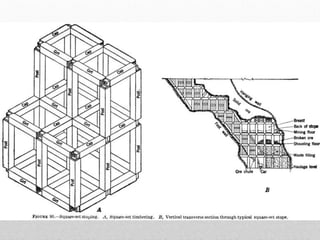
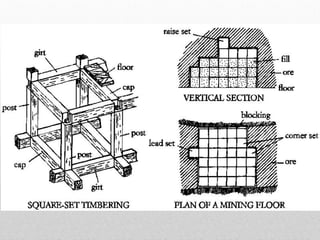
•A method relying on square-set timbering.
•High specialized method of stoping requiring expert input.
•In square set stoping, one small block of ore is removed and
replaced by a “set” or cubic frame of timber which is
immediately set into place.
•The timber sets is interlock and are filled with broken waste
rock or sand fill, for they are not strong enough to support the
stope walls.
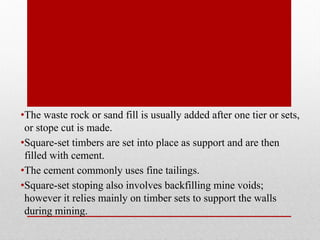
•The waste rock or sand fill is usually added after one tier or sets,
or stope cut is made.
•Square-set timbers are set into place as support and are then
filled with cement.
•The cement commonly uses fine tailings.
•Square-set stoping also involves backfilling mine voids;
however it relies mainly on timber sets to support the walls
during mining.
• In very valuable metallic deposits where exploitation
without loss is more important than the costs of obtaining it.
• When the mineral and box rock are not firm and systematic
fortification of the open space by exploitation is necessary.
• In regions with abundant forests and cheap labor.
• In high-grade mineralized bodies where losses due to
dilution of scour methods are unacceptable.
• In deposits with a minimum power of 3 to 3.5m.
• On incompetent land which is too narrow, too flat or too
irregular to be mined by "block caving".
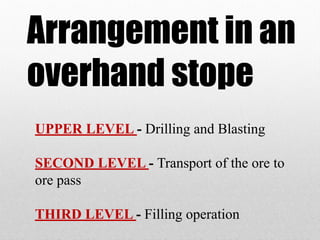
Arrangement in an
overhand stope
UPPER LEVEL - Drilling and Blasting
SECOND LEVEL - Transport of the ore to
ore pass
THIRD LEVEL - Filling operation
Cycle of operations
DRILLING: hand held percussion drills of the airleg
type; column-and-barmounted drifters
BLASTING: ANFO(ammonium nitrate and fuel oil),
slurries; charging by hand (cartridges) or machine
(bulk); firing by electric, detonating fuse, or
nonelectric methods
SECONDARY BLASTING: generally not required
LOADING: gravity flow to chutes(if possible); small
slusher or small loader
HAULAGE rail, LHD
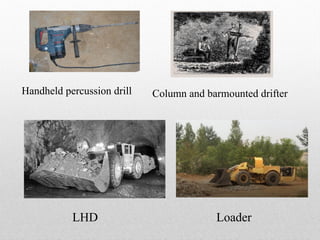
Handheld percussion drill Column and barmounted drifter
LHD Loader
conditions
ORE STRENGTH: weak to very weak
ROCK STRENGTH: weak to very weak
DEPOSIT SHAPE: any, regular to irregular
DEPOSIT DIP: any, preferably >45 °
DEPOSIT SIZE: any, generally small
ORE GRADE: high
ORE UNIFORMITY: variable
DEPTH: deep (up to 8500 ft. or 2.6 km)
advantages
•Flexible, versatile, adaptable to wide
variety of conditions
•Suitable for the worst ground
conditions when caving and
subsidence are not permitted
•Selective for irregular deposit and
variable ore occurrences; waste can
be sorted and left as fill
•Excellent recovery
disadvantages
•Very low productivity
•Very low production rate
•Highest mining cost
•Most labor intensive underground
mining method
•Very high timber cost
•Fire hazards are high
PART 2 DETELYADOSINTADO
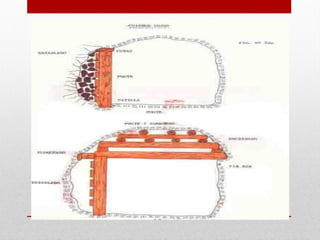
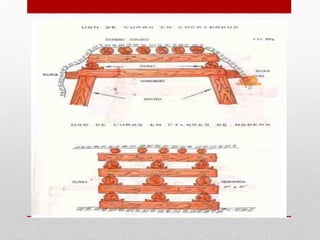
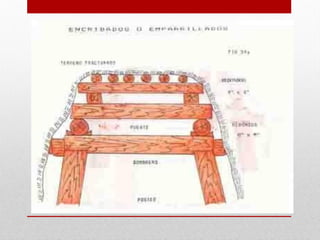
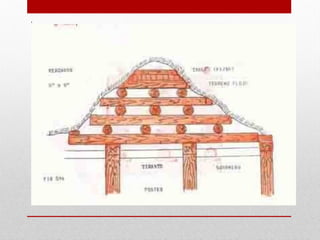
• MINING WITH SQUARE SET STOPING:
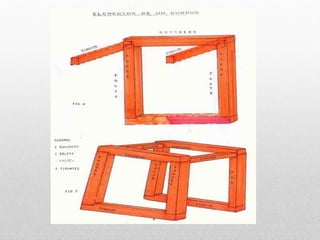
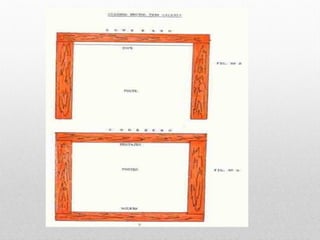
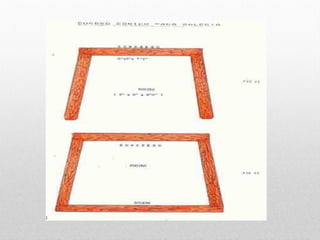
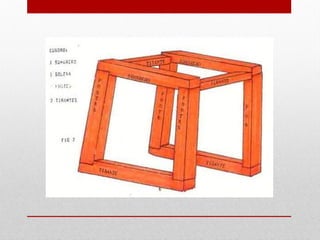
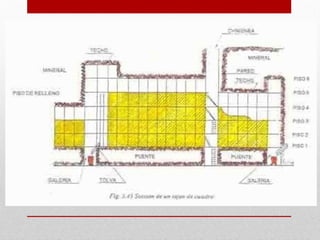
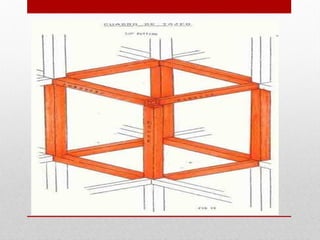
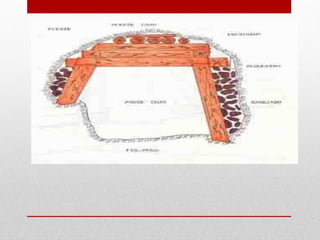
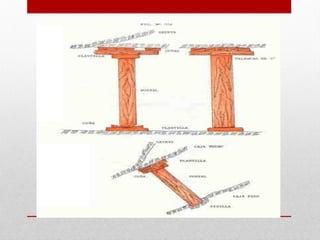
• A square set consists of two vertical woods and two
horizontal ones generally located at right angles.
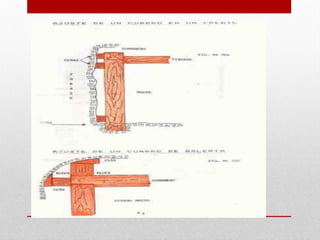
• The horizontal woods are usually called hats, the woods
verticals are called poles and the horizontal woods placed
perpendicular to the front are called advances, or at the ends
the timbers are notched to grab adjacent woods.
• The application of the method consists of shooting, extracting
and entangling small blocks of ore, before proceeding to the
next section.
• In general the application of the square set is declining due to
the high costs of labor and materials, also because more
effective methods have been developed to be used in less
competent areas.
• The method is based on a check system, the space between
the tables is filled in; you leave certain sections that serve as
access gallery and "ore pass ".
• Wood was the most important material for workers in the
operations of mining until the end of the Second World
War that it is used in mines on a small scale.
• Wood is a light weight material, easily transformable is
11 times lighter and 2 times more fragile than steel and
this makes it a material economical when using on mines
whose life span is short.
:
• ADVANTAGES OF THE METHOD
• Great recovery losses usually to 3 to 5%, dilution of the mineral is also
small. Different types of ore can be separated during exploitation.
• The bargain can be left on farms as a fill or support. Ga From the farm
areas can easily be traced galleries exploitation and conduct polling.
• Favorable ventilation conditions.
• Relatively high safety due to the fact that the farms are immediately.
DISADVANTAGES OF THE METHOD
• High extraction cost.
• Low productivity.
• High consumption of wood of 0.03-0.04m3 / tn mineral.
• Difficulty in transportation, motivated by the high consumption of
materials from Fortification and filling.
• Fire hazard
• Limited starting speed when exploiting powerful deposits.
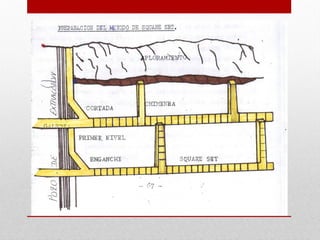
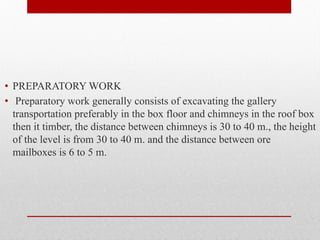
• PREPARATORY WORK
• Preparatory work generally consists of excavating the gallery
transportation preferably in the box floor and chimneys in the roof box
then it timber, the distance between chimneys is 30 to 40 m., the height
of the level is from 30 to 40 m. and the distance between ore
mailboxes is 6 to 5 m.
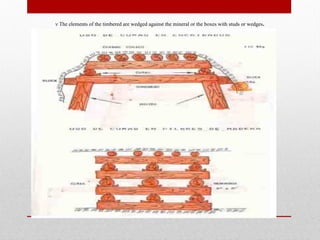
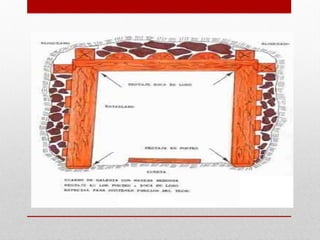
ν The elements of the timbered are wedged against the mineral or the boxes with studs or wedges.
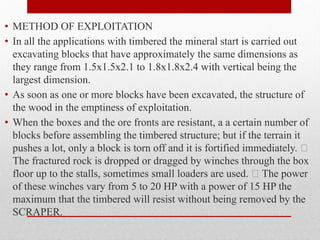
• METHOD OF EXPLOITATION
• In all the applications with timbered the mineral start is carried out
excavating blocks that have approximately the same dimensions as
they range from 1.5x1.5x2.1 to 1.8x1.8x2.4 with vertical being the
largest dimension.
• As soon as one or more blocks have been excavated, the structure of
the wood in the emptiness of exploitation.
• When the boxes and the ore fronts are resistant, a a certain number of
blocks before assembling the timbered structure; but if the terrain it
pushes a lot, only a block is torn off and it is fortified immediately. 
The fractured rock is dropped or dragged by winches through the box
floor up to the stalls, sometimes small loaders are used.  The power
of these winches vary from 5 to 20 HP with a power of 15 HP the
maximum that the timbered will resist without being removed by the
SCRAPER.
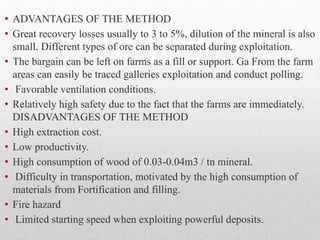
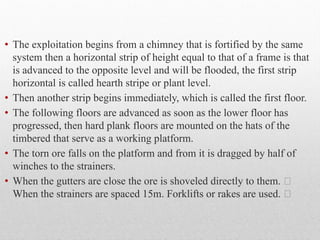
• The exploitation begins from a chimney that is fortified by the same
system then a horizontal strip of height equal to that of a frame is that
is advanced to the opposite level and will be flooded, the first strip
horizontal is called hearth stripe or plant level.
• Then another strip begins immediately, which is called the first floor.
• The following floors are advanced as soon as the lower floor has
progressed, then hard plank floors are mounted on the hats of the
timbered that serve as a working platform.
• The torn ore falls on the platform and from it is dragged by half of
winches to the strainers.
• When the gutters are close the ore is shoveled directly to them. 
When the strainers are spaced 15m. Forklifts or rakes are used. 
• To start the ore it is drilled upwards from the bottom of
the block or descending from the sides.
• Ventilation is done through the chimneys that connect to
the floors and which also serve to lower wood and
compressed air pipes and Water.
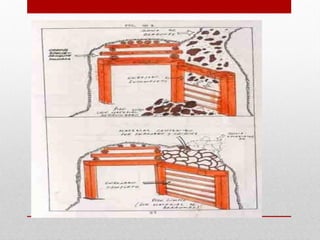
• The majority of methos by "SQUARE SET" require a
subsequent filling and that the paintings do not support
too much weight
• The type of filler used is hydraulic filling because it is
cheaper than the landfill fill.
'
PART 3 WHAT NOW? ?
H A R D R O C K M I N E R ’ S H A N D B O O K
© 2008 Stantec Consulting Ltd. 40
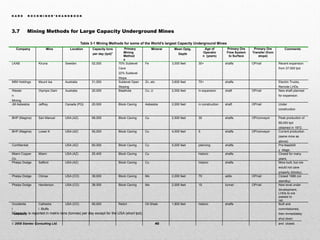
3.7 Mining Methods for Large Capacity Underground Mines
Table 3-1 Mining Methods for some of the World’s largest Capacity Underground Mines
Company Mine Location Capacity tons
per day (tpd)1
Primary
Mining
Method
s
Mineral Mean Optg.
Depth
Age of
Operatio
n (years)
Primary Ore
Flow System
to Surface
Primary Ore
Transfer (from
stope)
Comments
LKAB Kiruna Sweden 52,000 70% Sublevel
Cave
22% Sublevel
Stope
Fe 3,000 feet 30+ shafts OP/rail Recent expansion
from 37,000 tpd.
MIM Holdings Mount Isa Australia 31,000 Sublevel Open
Stoping
Zn, etc. 3,600 feet 70+ shafts Electric Trucks,
Remote LHDs.
Wester
n
Mining
Olympic Dam Australia 20,000 Blasthole Cu, U 2,000 feet in expansion shaft OP/rail New shaft planned
for expansion.
JM Asbestos Jeffrey Canada (PQ) 20,000 Block Caving Asbestos 2,000 feet in construction shaft OP/rail Under
construction
.
BHP (Magma) San Manuel USA (AZ) 68,000 Block Caving Cu 2,500 feet 30 shafts OP/conveyor Peak production of
68,000 tpd
obtained in 1972.
BHP (Magma) Lower K USA (AZ) 55,000 Block Caving Cu 4,000 feet 5 shafts OP/conveyor Current production
(same mine as
above)
Confidential USA (AZ) 60,000 Block Caving Cu 5,000 feet planning shafts Pre-feasibilit
y stage.
Miami Copper
Co.
Miami USA (AZ) 20,400 Block Caving Cu historic shafts Closed for many
years.
Phelps Dodge Safford USA (AZ) Block Caving Cu historic shafts Mine built, but ore
would not cave
properly (blocky).
Phelps Dodge Climax USA (CO) 36,000 Block Caving Mo 2,000 feet 70 adits OP/rail Closed 1986 (on
standby)
Phelps Dodge Henderson USA (CO) 38,000 Block Caving Mo 2,000 feet 10 tunnel OP/rail New level under
development,
LHDs to ore
passes to
rail.
Occidenta
l
Petroleum
Cathedra
l Bluffs
USA (CO) 60,000 Retort Oil Shale 1,800 feet historic shafts Built and
commissioned,
then immediately
shut down
and closed.
1
Capacity is reported in metric tons (tonnes) per day except for the USA (short tpd).
M I N E R A L
C H A P T E R 7 E
C O N O M I C S
41 © 2008 Stantec Consulting Ltd.
Table 3-1 Mining Methods for some of the World’s largest Capacity Underground Mines (continued)
Company Mine Location Capacity
(tpd) 1
Primary
Mining
Methods
Mineral Mean
Optg.
Depth
Age of
Operation
(years)
Primary
Ore
Flow
System
to
Surface
Primary
Ore
Transfer
(from
stope)
Comments
Copper
Range
White Pine USA (MI) 22,500 Room & Pillar Cu 3,000
feet
historic conveyor LHD/truck 10 miles of underground conveyors.
Anaconda Kelly USA (MO) 25,000 Block Caving Cu historic shafts Closed for many years.
Noranda Montanore USA (MO) 20,000 Room & Pillar Cu, Au 2,500
feet
on hold conveyor LHD/truck Development stopped (environmental
objections).
Molycorp Questa USA (NM) 16,300 Block Caving Mo 4,000
feet
12 conveyor LHD Being prepared for re-opening.
Andes M.C.
(Anaconda)
Portrerillos Chile Block Caving Cu historic adits OP/rail Grizzlies to ore passes - 45 tons per
manshift (1939).
Codelco El
Teniente
Chile 100,000 Block Caving Cu 2,000
feet
100 a adits OP/rail Everything used, including remote
controlled LHDs..
Codelco El
Salvador
Chile 34,500 Block Caving Cu 2,000
feet
30 a adits OP/rail LHD to ore passes to trains.
Codelco Andina/
Rio Blanco
Chile 15,000/
45,000
Block Caving Cu 2,000
feet
in expansion adits OP/rail Being developed to increase to ±45,000.
Mill is underground.
Codelco Chuqui
Norte
Chile 30,000 Block Caving Cu 2,500
feet
planning 242 million tons @ 0.7% Cu
(underground). (Planning stage.)
Freeport Ertsberg
East
Indonesia 17,000 Block Caving Cu 15 a ore
passes
LHD/truck Underground production varies (total
production is 115,000 tpd).
Philex
Minerals
Santo
Thomas
Philippines 28,000 Block Caving Cu 3,400
feet
20 a adits OP/rail Going concern.
Atlas Lutopal Philippines 35,000 Block Caving Cu 2,000
feet
historic adits OP/rail Mined out.
Atlas Carman Philippines 40,000 Block Caving Cu planning adits OP/rail Planning stage.
Lepanto Far
Southeast
Philippines 17,000 Blasthole Au 5,000
feet
on hold shafts LHD/truck Feasibility stage.
RTZ Palabora South
Africa
60,000 Block Caving Cu 4,000
feet
in
construction
shafts LHD/truck Under construction – now considering
80,000 tpd.
1
Capacity is reported in metric tons (tonnes) per day except for the USA (short tpd).

Square set stoping

  • 1.
  • 3.
    •A method relyingon square-set timbering. •High specialized method of stoping requiring expert input. •In square set stoping, one small block of ore is removed and replaced by a “set” or cubic frame of timber which is immediately set into place. •The timber sets is interlock and are filled with broken waste rock or sand fill, for they are not strong enough to support the stope walls.
  • 5.
    •The waste rockor sand fill is usually added after one tier or sets, or stope cut is made. •Square-set timbers are set into place as support and are then filled with cement. •The cement commonly uses fine tailings. •Square-set stoping also involves backfilling mine voids; however it relies mainly on timber sets to support the walls during mining.
  • 6.
    • In veryvaluable metallic deposits where exploitation without loss is more important than the costs of obtaining it. • When the mineral and box rock are not firm and systematic fortification of the open space by exploitation is necessary. • In regions with abundant forests and cheap labor. • In high-grade mineralized bodies where losses due to dilution of scour methods are unacceptable. • In deposits with a minimum power of 3 to 3.5m. • On incompetent land which is too narrow, too flat or too irregular to be mined by "block caving".
  • 7.
    Arrangement in an overhandstope UPPER LEVEL - Drilling and Blasting SECOND LEVEL - Transport of the ore to ore pass THIRD LEVEL - Filling operation
  • 8.
    Cycle of operations DRILLING:hand held percussion drills of the airleg type; column-and-barmounted drifters BLASTING: ANFO(ammonium nitrate and fuel oil), slurries; charging by hand (cartridges) or machine (bulk); firing by electric, detonating fuse, or nonelectric methods SECONDARY BLASTING: generally not required LOADING: gravity flow to chutes(if possible); small slusher or small loader HAULAGE rail, LHD
  • 9.
    Handheld percussion drillColumn and barmounted drifter LHD Loader
  • 10.
    conditions ORE STRENGTH: weakto very weak ROCK STRENGTH: weak to very weak DEPOSIT SHAPE: any, regular to irregular DEPOSIT DIP: any, preferably >45 ° DEPOSIT SIZE: any, generally small ORE GRADE: high ORE UNIFORMITY: variable DEPTH: deep (up to 8500 ft. or 2.6 km)
  • 11.
    advantages •Flexible, versatile, adaptableto wide variety of conditions •Suitable for the worst ground conditions when caving and subsidence are not permitted •Selective for irregular deposit and variable ore occurrences; waste can be sorted and left as fill •Excellent recovery
  • 12.
    disadvantages •Very low productivity •Verylow production rate •Highest mining cost •Most labor intensive underground mining method •Very high timber cost •Fire hazards are high
  • 13.
  • 14.
    • MINING WITHSQUARE SET STOPING: • A square set consists of two vertical woods and two horizontal ones generally located at right angles. • The horizontal woods are usually called hats, the woods verticals are called poles and the horizontal woods placed perpendicular to the front are called advances, or at the ends the timbers are notched to grab adjacent woods. • The application of the method consists of shooting, extracting and entangling small blocks of ore, before proceeding to the next section. • In general the application of the square set is declining due to the high costs of labor and materials, also because more effective methods have been developed to be used in less competent areas. • The method is based on a check system, the space between the tables is filled in; you leave certain sections that serve as access gallery and "ore pass ".
  • 17.
    • Wood wasthe most important material for workers in the operations of mining until the end of the Second World War that it is used in mines on a small scale. • Wood is a light weight material, easily transformable is 11 times lighter and 2 times more fragile than steel and this makes it a material economical when using on mines whose life span is short.
  • 18.
  • 21.
    • ADVANTAGES OFTHE METHOD • Great recovery losses usually to 3 to 5%, dilution of the mineral is also small. Different types of ore can be separated during exploitation. • The bargain can be left on farms as a fill or support. Ga From the farm areas can easily be traced galleries exploitation and conduct polling. • Favorable ventilation conditions. • Relatively high safety due to the fact that the farms are immediately. DISADVANTAGES OF THE METHOD • High extraction cost. • Low productivity. • High consumption of wood of 0.03-0.04m3 / tn mineral. • Difficulty in transportation, motivated by the high consumption of materials from Fortification and filling. • Fire hazard • Limited starting speed when exploiting powerful deposits.
  • 24.
    • PREPARATORY WORK •Preparatory work generally consists of excavating the gallery transportation preferably in the box floor and chimneys in the roof box then it timber, the distance between chimneys is 30 to 40 m., the height of the level is from 30 to 40 m. and the distance between ore mailboxes is 6 to 5 m.
  • 25.
    ν The elementsof the timbered are wedged against the mineral or the boxes with studs or wedges.
  • 29.
    • METHOD OFEXPLOITATION • In all the applications with timbered the mineral start is carried out excavating blocks that have approximately the same dimensions as they range from 1.5x1.5x2.1 to 1.8x1.8x2.4 with vertical being the largest dimension. • As soon as one or more blocks have been excavated, the structure of the wood in the emptiness of exploitation. • When the boxes and the ore fronts are resistant, a a certain number of blocks before assembling the timbered structure; but if the terrain it pushes a lot, only a block is torn off and it is fortified immediately.  The fractured rock is dropped or dragged by winches through the box floor up to the stalls, sometimes small loaders are used.  The power of these winches vary from 5 to 20 HP with a power of 15 HP the maximum that the timbered will resist without being removed by the SCRAPER.
  • 30.
    • The exploitationbegins from a chimney that is fortified by the same system then a horizontal strip of height equal to that of a frame is that is advanced to the opposite level and will be flooded, the first strip horizontal is called hearth stripe or plant level. • Then another strip begins immediately, which is called the first floor. • The following floors are advanced as soon as the lower floor has progressed, then hard plank floors are mounted on the hats of the timbered that serve as a working platform. • The torn ore falls on the platform and from it is dragged by half of winches to the strainers. • When the gutters are close the ore is shoveled directly to them.  When the strainers are spaced 15m. Forklifts or rakes are used. 
  • 31.
    • To startthe ore it is drilled upwards from the bottom of the block or descending from the sides. • Ventilation is done through the chimneys that connect to the floors and which also serve to lower wood and compressed air pipes and Water. • The majority of methos by "SQUARE SET" require a subsequent filling and that the paintings do not support too much weight • The type of filler used is hydraulic filling because it is cheaper than the landfill fill.
  • 38.
  • 39.
  • 40.
    H A RD R O C K M I N E R ’ S H A N D B O O K © 2008 Stantec Consulting Ltd. 40 3.7 Mining Methods for Large Capacity Underground Mines Table 3-1 Mining Methods for some of the World’s largest Capacity Underground Mines Company Mine Location Capacity tons per day (tpd)1 Primary Mining Method s Mineral Mean Optg. Depth Age of Operatio n (years) Primary Ore Flow System to Surface Primary Ore Transfer (from stope) Comments LKAB Kiruna Sweden 52,000 70% Sublevel Cave 22% Sublevel Stope Fe 3,000 feet 30+ shafts OP/rail Recent expansion from 37,000 tpd. MIM Holdings Mount Isa Australia 31,000 Sublevel Open Stoping Zn, etc. 3,600 feet 70+ shafts Electric Trucks, Remote LHDs. Wester n Mining Olympic Dam Australia 20,000 Blasthole Cu, U 2,000 feet in expansion shaft OP/rail New shaft planned for expansion. JM Asbestos Jeffrey Canada (PQ) 20,000 Block Caving Asbestos 2,000 feet in construction shaft OP/rail Under construction . BHP (Magma) San Manuel USA (AZ) 68,000 Block Caving Cu 2,500 feet 30 shafts OP/conveyor Peak production of 68,000 tpd obtained in 1972. BHP (Magma) Lower K USA (AZ) 55,000 Block Caving Cu 4,000 feet 5 shafts OP/conveyor Current production (same mine as above) Confidential USA (AZ) 60,000 Block Caving Cu 5,000 feet planning shafts Pre-feasibilit y stage. Miami Copper Co. Miami USA (AZ) 20,400 Block Caving Cu historic shafts Closed for many years. Phelps Dodge Safford USA (AZ) Block Caving Cu historic shafts Mine built, but ore would not cave properly (blocky). Phelps Dodge Climax USA (CO) 36,000 Block Caving Mo 2,000 feet 70 adits OP/rail Closed 1986 (on standby) Phelps Dodge Henderson USA (CO) 38,000 Block Caving Mo 2,000 feet 10 tunnel OP/rail New level under development, LHDs to ore passes to rail. Occidenta l Petroleum Cathedra l Bluffs USA (CO) 60,000 Retort Oil Shale 1,800 feet historic shafts Built and commissioned, then immediately shut down and closed. 1 Capacity is reported in metric tons (tonnes) per day except for the USA (short tpd).
  • 41.
    M I NE R A L C H A P T E R 7 E C O N O M I C S 41 © 2008 Stantec Consulting Ltd. Table 3-1 Mining Methods for some of the World’s largest Capacity Underground Mines (continued) Company Mine Location Capacity (tpd) 1 Primary Mining Methods Mineral Mean Optg. Depth Age of Operation (years) Primary Ore Flow System to Surface Primary Ore Transfer (from stope) Comments Copper Range White Pine USA (MI) 22,500 Room & Pillar Cu 3,000 feet historic conveyor LHD/truck 10 miles of underground conveyors. Anaconda Kelly USA (MO) 25,000 Block Caving Cu historic shafts Closed for many years. Noranda Montanore USA (MO) 20,000 Room & Pillar Cu, Au 2,500 feet on hold conveyor LHD/truck Development stopped (environmental objections). Molycorp Questa USA (NM) 16,300 Block Caving Mo 4,000 feet 12 conveyor LHD Being prepared for re-opening. Andes M.C. (Anaconda) Portrerillos Chile Block Caving Cu historic adits OP/rail Grizzlies to ore passes - 45 tons per manshift (1939). Codelco El Teniente Chile 100,000 Block Caving Cu 2,000 feet 100 a adits OP/rail Everything used, including remote controlled LHDs.. Codelco El Salvador Chile 34,500 Block Caving Cu 2,000 feet 30 a adits OP/rail LHD to ore passes to trains. Codelco Andina/ Rio Blanco Chile 15,000/ 45,000 Block Caving Cu 2,000 feet in expansion adits OP/rail Being developed to increase to ±45,000. Mill is underground. Codelco Chuqui Norte Chile 30,000 Block Caving Cu 2,500 feet planning 242 million tons @ 0.7% Cu (underground). (Planning stage.) Freeport Ertsberg East Indonesia 17,000 Block Caving Cu 15 a ore passes LHD/truck Underground production varies (total production is 115,000 tpd). Philex Minerals Santo Thomas Philippines 28,000 Block Caving Cu 3,400 feet 20 a adits OP/rail Going concern. Atlas Lutopal Philippines 35,000 Block Caving Cu 2,000 feet historic adits OP/rail Mined out. Atlas Carman Philippines 40,000 Block Caving Cu planning adits OP/rail Planning stage. Lepanto Far Southeast Philippines 17,000 Blasthole Au 5,000 feet on hold shafts LHD/truck Feasibility stage. RTZ Palabora South Africa 60,000 Block Caving Cu 4,000 feet in construction shafts LHD/truck Under construction – now considering 80,000 tpd. 1 Capacity is reported in metric tons (tonnes) per day except for the USA (short tpd).