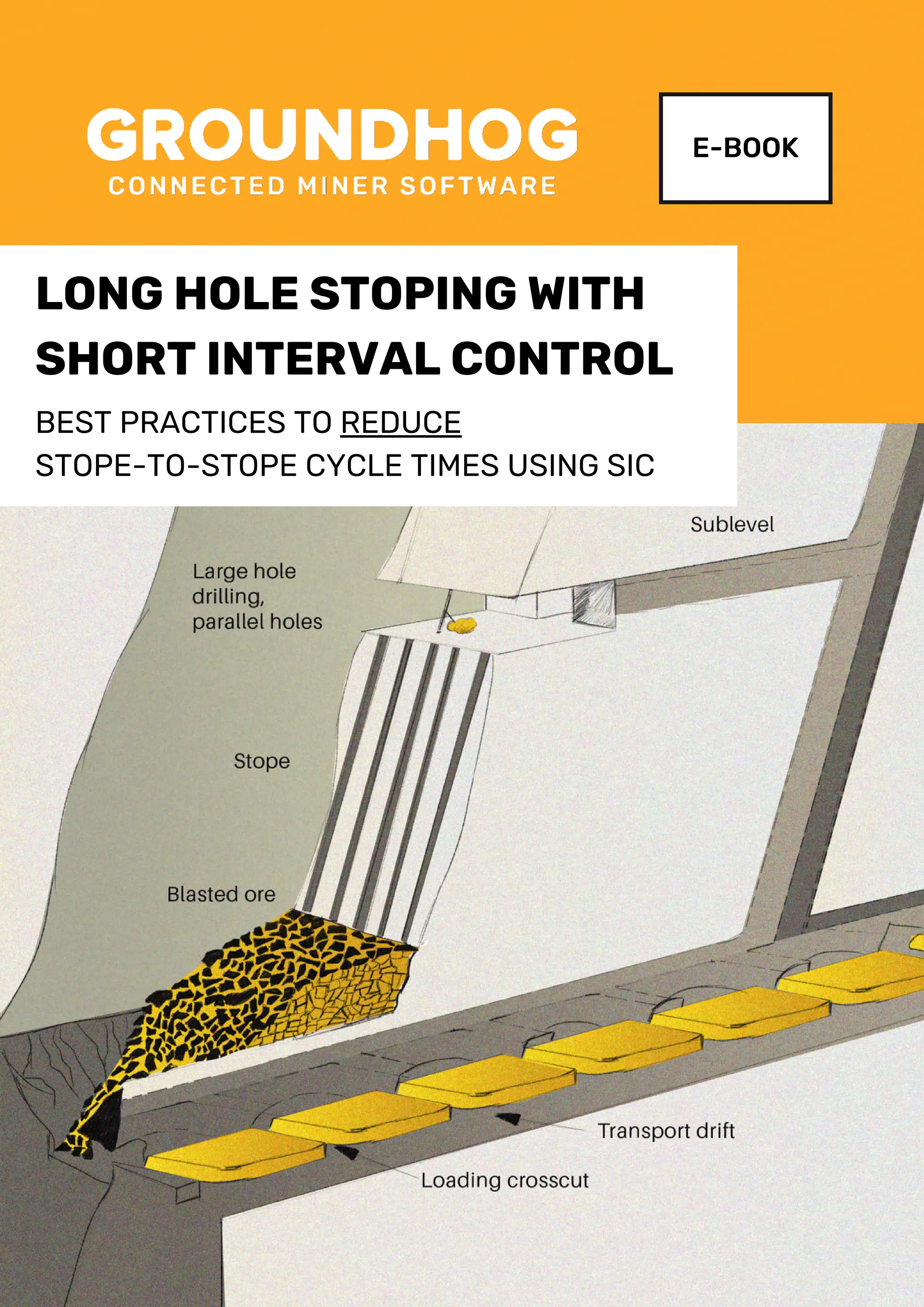
LONG HOLE STOPING WITH
SHORT INTERVAL CONTROL
BEST PRACTICES TO REDUCE
STOPE-TO-STOPE CYCLE TIMES USING SIC
E-BOOK
Contents
1
Executive Summary
The Long Hole Stoping Mining Method
Best practices to increase production
A case for Improving Operation Efficiency and Safety
Introduction to Short Interval Control
Introduction to FMS
Key performance indicators that can be assessed using GroundHog
Solutions
Our product capabilities
GroundHog Solution for Long Hole Stoping Design and
Development
Results
Conclusion
About us
References
1.
2.
3.
4.
5.
6.
7.
8.
9.
10.
11.
12.
13.
2
Mining companies seek to maximize returns to shareholders through
the efficient extraction of resources. In this price-takers market, cost
controls are the biggest driver of shareholder value. To that end,
miners can deploy many strategic and tactical levers at different
mining stages. Long hole open stoping is one such practice used in
large-scale underground mining for its proven feasibility and low
operational cost.
Long hole stoping is primarily used for large ore bodies with steep dip,
regular shapes, and defined ore bodies. There are different variations
of the method depending on the ore body. However, the method is
based on the principle of blasting out large stopes which are usually
backfilled to maximize the recovery of the ore body. The advantage of
this method is the continuous availability of ore as there is no
suspension of work for filling along with the low operational cost. To
choose the long hole stoping method, the resistance of the host rock is
required to be moderate to high.
Executive Summary
1.
2. Long Hole Stoping Method
Long-hole mining is a popular underground method in which we
employ long hole drilling to produce ore. It is a system of large-scale
drilling and blasting in which large amounts of ore are broken in single
blasts. Blasted slices of rock fall into an open void within the stope. The
rock is extracted, and the empty stope is backfilled (delayed
backfilling). The method is used for metalliferous mines to mine ore
where both the ore and wall rocks are relatively strong. The method
may be applied to a variety of vertical or steeply dipping orebody
shapes and sizes.
3
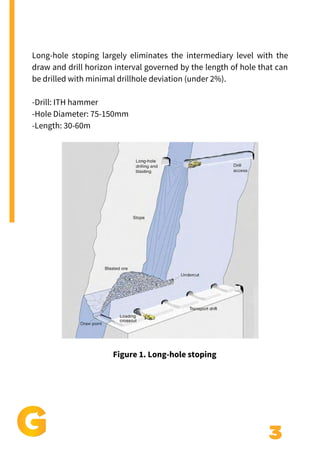
Long-hole stoping largely eliminates the intermediary level with the
draw and drill horizon interval governed by the length of hole that can
be drilled with minimal drillhole deviation (under 2%).
-Drill: ITH hammer
-Hole Diameter: 75-150mm
-Length: 30-60m
Figure 1. Long-hole stoping
4
Transverse
Longitudinal
Normally, the vertical dimension is the largest, as in Figure 1. This
mining method provides limited selectivity. The orebody should
preferably be regular, as changes in orebody geometry outlines are
difficult to compensate for. Production holes, commonly in the range
of 50mm to 110mm diameter, are drilled either in a fan-shaped pattern,
or in a pattern parallel to the stope dip. Drilling can be done in advance
of ore extraction. Stope dimensions are determined from local ground
conditions. Mined stope width varies with orebody thickness.
Stope blocks are accessed in two directions:
Transverse stoping is common to tabular ore zones of widths
exceeding 5 meters, where stope access is driven by normal ore zone
strike. Narrower width ore zones are mined longitudinally, with stope
access driven parallel to, and within, the ore zone strike.
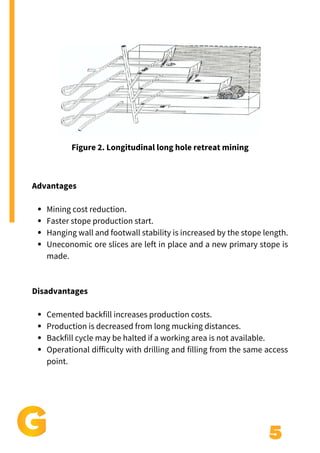
2.1. Longitudinal Long Hole Stoping is generally a pillarless mining
method, commonly developed in narrow, steeply dipping deposits. For
longitudinal retreat the long axis of the stope is along (or parallel) to
the strike of the orebody. The top sills are excavated to the full stope
strike width to permit drilling of parallel blastholes, typically at a
staggered pattern, as illustrated in Figure 2.
5
Figure 2. Longitudinal long hole retreat mining
Mining cost reduction.
Faster stope production start.
Hanging wall and footwall stability is increased by the stope length.
Uneconomic ore slices are left in place and a new primary stope is
made.
Cemented backfill increases production costs.
Production is decreased from long mucking distances.
Backfill cycle may be halted if a working area is not available.
Operational difficulty with drilling and filling from the same access
point.
Advantages
Disadvantages
6
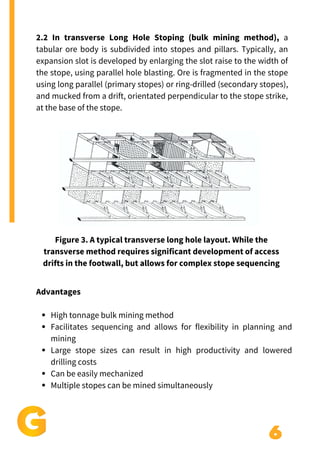
2.2 In transverse Long Hole Stoping (bulk mining method), a
tabular ore body is subdivided into stopes and pillars. Typically, an
expansion slot is developed by enlarging the slot raise to the width of
the stope, using parallel hole blasting. Ore is fragmented in the stope
using long parallel (primary stopes) or ring-drilled (secondary stopes),
and mucked from a drift, orientated perpendicular to the stope strike,
at the base of the stope.
Figure 3. A typical transverse long hole layout. While the
transverse method requires significant development of access
drifts in the footwall, but allows for complex stope sequencing
High tonnage bulk mining method
Facilitates sequencing and allows for flexibility in planning and
mining
Large stope sizes can result in high productivity and lowered
drilling costs
Can be easily mechanized
Multiple stopes can be mined simultaneously
Advantages
7
Repetitive techniques help to facilitate planning, training, mining,
and safety
Relatively high recovery
High development requirements result in high capital cost
Development primarily in waste
Poor selectivity
Poorly suited to single narrow vein structures
Moderate dilution, especially when using backfill
Considerable ventilation needs due to active equipment on top
and bottom sills
Disadvantages
3. Best practices to increase production
at mines using Long Hole Stoping
Adherence to Mine Planning - It is always a good practice to deploy
the mine plan with accuracy which leads to an improvement in grade
control due to better control of dilution. With accurate plan only the
part of the orebody is mined. This reduces ore transport costs and
improves cost efficiency per cycle.
Real-time visibility of operations – With the visibility of operations we
can track the availability and utilization status of equipment and can
optimize our production with available equipment.
Mechanization and Automation - In the case of tabular ore bodies we
can go with fully mechanized operation which increases the
production as well as safety.
8
Long hole drilling- Using ITH (In-the-hole hammer)
Powder loading- blasting
Support system- roof bolts (used in stope brow)
LHD- transport ore to crusher plant, mucking
Ventilation- for removing fumes
Primary crusher
Main Operations in Long Hole Stoping:
1.
2.
3.
4.
5.
6.
4. Operation and Safety Efficiency
improvement using GroundHog
Solution in Long Hole Stoping
GroundHog digital mining solution (SIC, FMS and Safety Management
System) helps to improve Operation Efficiency and Safety Performance
of the mine. Operation efficiency can be improved through data
capturing, real-time visibility of operation and timely correction of
deviation before it becomes a bottleneck. Similarly, pre-shift
examination of equipment and workplace, hazard identification, job
safety analysis, training management system and corrective actions
help to improve working environment and safety performance of a
mine.
A risk assessment can be carried out before the men and machine are
placed underground. Continuous monitoring of workplace safety is
recommended. Ground control is a critical issue while designing any
stoping method and subsequent systematic support must be
formulated for safe mining practices. Real-time visibility of all
operational activities and their sequence helps to take right decision
for corrective measures.
9
5.Introduction to SIC
Short Interval Control (SIC)
SIC is a framework of structured strategies to higher control shift
obligations by regularly reviewing overall performance inside a shift
and comparing wherein production stands relative to plan, which
allows supervisors to put into effect mid-course corrections which
could improve the general effectiveness and performance of
manufacturing at some point of a shift.
SIC is carried out as a sequence of quick and targeted reviews which
might be commonly executed every four hours via front-line groups.
During the evaluation, employees within the front-line groups perform
the challenge of reviewing losses and identifying actions to assist and
improve performance within the destiny.
Optimized for use in underground mine operations, GroundHog SIC
controls mining production, tracks, and schedules workforce, and
helps you get deep insights to drive higher operating efficiency.
a. Create shift plan - Easily create weekly, daily shift plans to meet
advance rates and tons.
b. Streamline allocation - Streamline equipment and miner allocation
to meet shift plans.
c. Greedy-auto assign – Shift manager can auto-assign to operators
and available equipment with just one press of a button.
Digital mining provides centralized single source of truth and
transparency in the system. Miningindustry must constantly be
adapting to new developments in mining methods andimproved
technologies.
10
6. Introduction to FMS
Fleet Management system (FMS)
The term fleet management refers to the overall process a business
uses for efficient fleet tasks & asset information, fuel management, cost
control, and compliance. It helps the OpsCenter continuously monitor
haulage, face utilization, equipment availability and utilization, and
fleet health. Also, it automatically tracks tonnage and material
movement. A fleet management system for underground mining
optimizes operations by controlling production, tracking, and
scheduling workforce, and presenting intelligent reports that improve
fleet productivity.
The ability to accurately monitor your fleet location, usage, and
behavior. The main objective of the fleet management system is used
to continuously monitor and optimize mines production. The FMS is
used in primary equipment like Loader, Hauler, Drill Jumbo, Bolters
etc. The system runs on algorithms and data is collected automatically
through a variety of sensors connected through mines network. In case
of equipment working at remote heading the system store the data and
transmit it to the GroundHog cloud hosting using peer-to-peer
networking.
d. Digital line ups - Digital line-ups on TVs and supervisor apps shorten
time to first-task-start.
e. Real-time monitoring - Monitor production in real time and mitigate
impacts.
11
7. Key performance indicators that can be
assessed using GroundHog Solutions
Safety targets
Mining layout
Drill rig
Production targets
Support requirements
Explosive’s requirement
Services requirement
Ore removal and cleaning requirement
Training requirement
8. Our product capabilities:
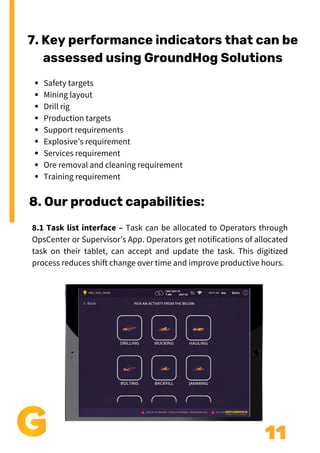
8.1 Task list interface – Task can be allocated to Operators through
OpsCenter or Supervisor’s App. Operators get notifications of allocated
task on their tablet, can accept and update the task. This digitized
process reduces shift change over time and improve productive hours.
12
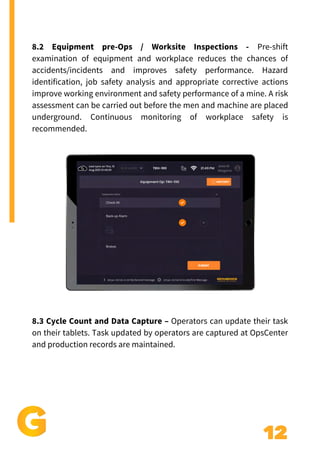
8.2 Equipment pre-Ops / Worksite Inspections - Pre-shift
examination of equipment and workplace reduces the chances of
accidents/incidents and improves safety performance. Hazard
identification, job safety analysis and appropriate corrective actions
improve working environment and safety performance of a mine. A risk
assessment can be carried out before the men and machine are placed
underground. Continuous monitoring of workplace safety is
recommended.
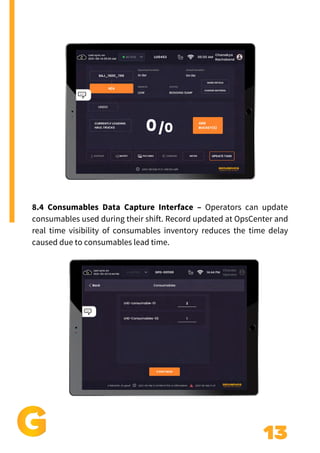
8.3 Cycle Count and Data Capture – Operators can update their task
on their tablets. Task updated by operators are captured at OpsCenter
and production records are maintained.
13
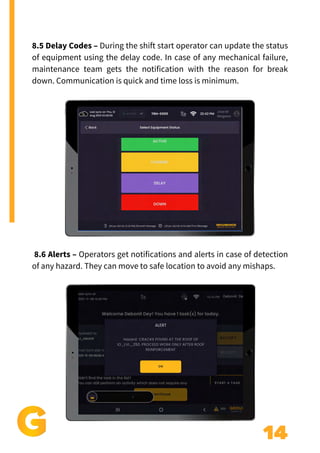
8.4 Consumables Data Capture Interface – Operators can update
consumables used during their shift. Record updated at OpsCenter and
real time visibility of consumables inventory reduces the time delay
caused due to consumables lead time.
14
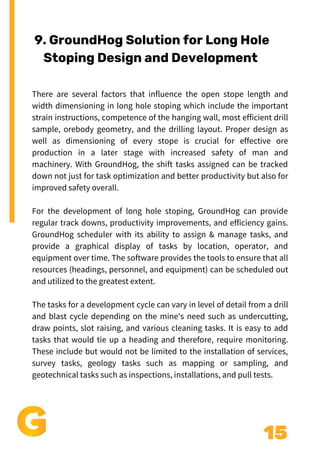
8.5 Delay Codes – During the shift start operator can update the status
of equipment using the delay code. In case of any mechanical failure,
maintenance team gets the notification with the reason for break
down. Communication is quick and time loss is minimum.
Add a little bit of body text
8.6 Alerts – Operators get notifications and alerts in case of detection
of any hazard. They can move to safe location to avoid any mishaps.
15
Add a little bit of body text
There are several factors that influence the open stope length and
width dimensioning in long hole stoping which include the important
strain instructions, competence of the hanging wall, most efficient drill
sample, orebody geometry, and the drilling layout. Proper design as
well as dimensioning of every stope is crucial for effective ore
production in a later stage with increased safety of man and
machinery. With GroundHog, the shift tasks assigned can be tracked
down not just for task optimization and better productivity but also for
improved safety overall.
For the development of long hole stoping, GroundHog can provide
regular track downs, productivity improvements, and efficiency gains.
GroundHog scheduler with its ability to assign & manage tasks, and
provide a graphical display of tasks by location, operator, and
equipment over time. The software provides the tools to ensure that all
resources (headings, personnel, and equipment) can be scheduled out
and utilized to the greatest extent.
The tasks for a development cycle can vary in level of detail from a drill
and blast cycle depending on the mine's need such as undercutting,
draw points, slot raising, and various cleaning tasks. It is easy to add
tasks that would tie up a heading and therefore, require monitoring.
These include but would not be limited to the installation of services,
survey tasks, geology tasks such as mapping or sampling, and
geotechnical tasks such as inspections, installations, and pull tests.
9. GroundHog Solution for Long Hole
Stoping Design and Development
16
Add a little bit of body text
The ability to plan and schedule all activities related to a particular
heading attempt to ensure:
1) full utilization of available resources, and
2) minimization of any unplanned activities or surprises.
After the shift schedule is finalized, it is dispatched automatically to all
personnel or equipment to which tasks have been assigned, providing
them with the location, start time, duration and units that define the
specific task. Upon accepting the task, they can record their progress
against the task at the intervals or units defined by the mine. This
progress is then available to the supervisor or the control room; so,
they can make any required adjustments throughout the shift. As a
result, the utilization of resources is maximized, and the shift’s
deliverables are met or exceeded. After the task is completed, the
operator formalizes the completion, records any required quantitative
measures (such as consumables), updates the status of the heading,
and proceeds to the next task on his list. The process is repeated.
9.1 Drilling and Blasting
The development phase requires a drill-blast-muck cycle to access the
stope which can be effectively scheduled using SIC FMS. The ease of
accessibility to the task and real-time monitoring of drilling operations
available based on the operator and machine input can be further
reported to the blasting team or blasters for accurate hole and rock
conditions. Also, it enables the supervisors and the senior hierarchy to
assess the task, men & machinery, and take prompt actions in case of
any downs and delays. Numbering each drill round and sample enables
tracking of accurate data on ore quality for every drill cut.
17
Add a little bit of body text
After the completion of drilling, the charging task can be scheduled and
blasted as per the blasting timing of the mine.
9.2 Time Model - Analysis
GroundHog provides a platform where you can track the status of the
equipment as well as the operator (personnel). Based on the mine’s
time, operator input can provide the equipment status, such as
equipment is down or in standby, as well as preconfigured breakdown
codes for easy communication of issues to the Maintenance
Department.
It allows you to maximize the use of the equipment and users by
providing visualizations in multiple formats of what each equipment
and operator is supposed to be doing going forward, it is effortless to
ensure that all operators and equipment are fully performed with
specific tasks during the shift.
9.3 Peer-to-Peer data transfer
This feature is very helpful to record or update the data during ongoing
operations in mine by transferring the live data using the Peer-to-Peer
network when devices come near to the next device (tablet).
Supervisors want it to make in-shift and submit-shift decisions, miners
want it to do their task properly and correctly and maintenance wants
it to monitor device fitness.
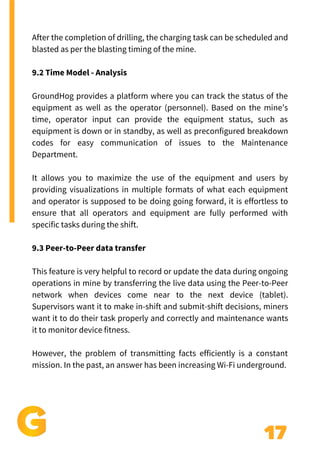
However, the problem of transmitting facts efficiently is a constant
mission. In the past, an answer has been increasing Wi-Fi underground.
18
The problem then lies within the large charges this generates.
GroundHog’s peer-to-peer network provides the answer. The data from
an equipment or operator’s app currently present in a no signal can be
transferred to the OpsCenter through the network of devices coming in
the vicinity of the equipment. The device(s) receive data from the
equipment and updates OpsCenter whenever it comes into the
working range of the Wi-fi access point installed at a common location.
This curbs the installation cost of Wi-fi infrastructure in mines and
enables undisturbed data transfer.
Peer-to-peer will play a foundational role in driving digitization across
the mining industry. Products such as GroundHog Peer-to-Peer that
integrate well with other mining software are in an excellent position to
help you digitize your mine and drive transformational results.
19
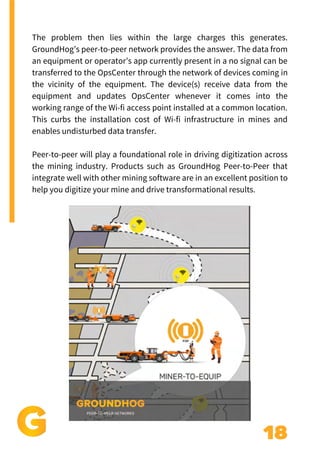
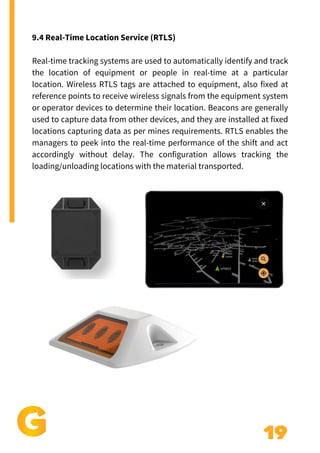
9.4 Real-Time Location Service (RTLS)
Real-time tracking systems are used to automatically identify and track
the location of equipment or people in real-time at a particular
location. Wireless RTLS tags are attached to equipment, also fixed at
reference points to receive wireless signals from the equipment system
or operator devices to determine their location. Beacons are generally
used to capture data from other devices, and they are installed at fixed
locations capturing data as per mines requirements. RTLS enables the
managers to peek into the real-time performance of the shift and act
accordingly without delay. The configuration allows tracking the
loading/unloading locations with the material transported.
20
Add a little bit of body text
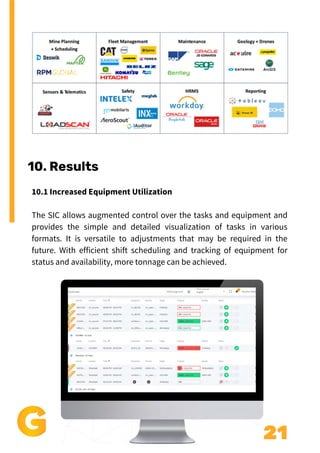
Integration with SAP for business
Integration with Deswik for Mine Planning & Scheduling
OSI PI for Equipment Health Monitoring
Location Tracking with Mobilaris, AeroScout, Meglab, etc.
9.5 AI-based Scheduling and Optimization
It is a hefty task to collate massive amounts of data and make accurate,
efficient decisions. Using SIC to create shift schedules, it will
recommend a skilled operator for the selected activity. AI is known for
its profound potential to optimize all kinds of activities. When AI
suggests an operator for a shift, it will not only show those operators
that are qualified for the shift but also suggest the names of another
operator which will improve the schedule of the plan as well.
GroundHog can also recognize if the equipment is being over or under-
utilized and raise an appropriate warning, or even more advanced,
propose a solution, e.g., an additional task. Empowering a digital mine
built with sensor network technologies to capitalize on IoT data for
real-time surveillance and operations management.
9.6 API - integration with 3rd Party Software
GroundHog can integrate with other mining software through API
integration, it has already integrated with such software for clients
which are currently under production. It does a regular R&D for various
other 3rd party software and data structures so that it can easily
integrate with it if a customer requires such an integration.
GroundHog supports the transfer of the information between systems
including Business & Integration, Operations & Productions.
GroundHog has divided this function into the following components:
21
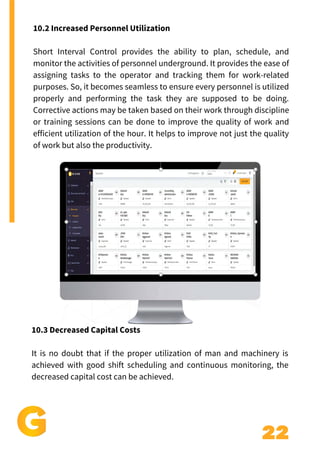
10.1 Increased Equipment Utilization
The SIC allows augmented control over the tasks and equipment and
provides the simple and detailed visualization of tasks in various
formats. It is versatile to adjustments that may be required in the
future. With efficient shift scheduling and tracking of equipment for
status and availability, more tonnage can be achieved.
10. Results
22
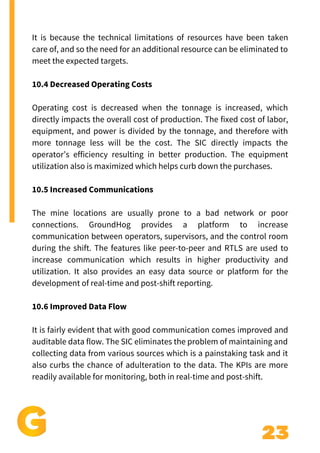
10.2 Increased Personnel Utilization
Short Interval Control provides the ability to plan, schedule, and
monitor the activities of personnel underground. It provides the ease of
assigning tasks to the operator and tracking them for work-related
purposes. So, it becomes seamless to ensure every personnel is utilized
properly and performing the task they are supposed to be doing.
Corrective actions may be taken based on their work through discipline
or training sessions can be done to improve the quality of work and
efficient utilization of the hour. It helps to improve not just the quality
of work but also the productivity.
10.3 Decreased Capital Costs
It is no doubt that if the proper utilization of man and machinery is
achieved with good shift scheduling and continuous monitoring, the
decreased capital cost can be achieved.
23
It is because the technical limitations of resources have been taken
care of, and so the need for an additional resource can be eliminated to
meet the expected targets.
10.4 Decreased Operating Costs
Operating cost is decreased when the tonnage is increased, which
directly impacts the overall cost of production. The fixed cost of labor,
equipment, and power is divided by the tonnage, and therefore with
more tonnage less will be the cost. The SIC directly impacts the
operator’s efficiency resulting in better production. The equipment
utilization also is maximized which helps curb down the purchases.
10.5 Increased Communications
The mine locations are usually prone to a bad network or poor
connections. GroundHog provides a platform to increase
communication between operators, supervisors, and the control room
during the shift. The features like peer-to-peer and RTLS are used to
increase communication which results in higher productivity and
utilization. It also provides an easy data source or platform for the
development of real-time and post-shift reporting.
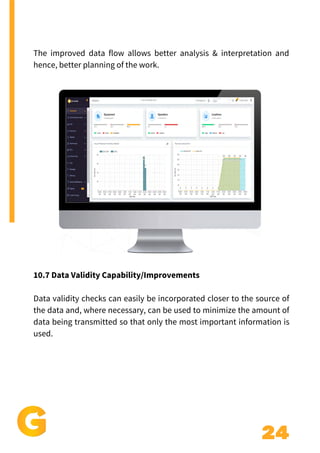
10.6 Improved Data Flow
It is fairly evident that with good communication comes improved and
auditable data flow. The SIC eliminates the problem of maintaining and
collecting data from various sources which is a painstaking task and it
also curbs the chance of adulteration to the data. The KPIs are more
readily available for monitoring, both in real-time and post-shift.
24
The improved data flow allows better analysis & interpretation and
hence, better planning of the work.
10.7 Data Validity Capability/Improvements
Data validity checks can easily be incorporated closer to the source of
the data and, where necessary, can be used to minimize the amount of
data being transmitted so that only the most important information is
used.
25
“Safety equipment” inventory and the guidelines in the OpsCenter
promotes coordination between the back filling and ore
transportation, if done through the same drift.
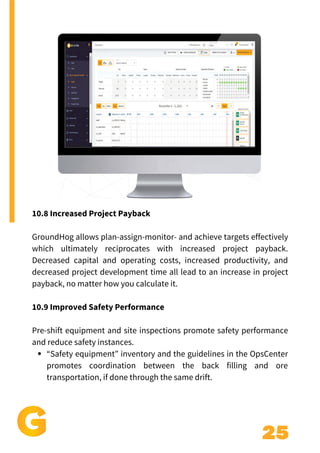
10.8 Increased Project Payback
GroundHog allows plan-assign-monitor- and achieve targets effectively
which ultimately reciprocates with increased project payback.
Decreased capital and operating costs, increased productivity, and
decreased project development time all lead to an increase in project
payback, no matter how you calculate it.
10.9 Improved Safety Performance
Pre-shift equipment and site inspections promote safety performance
and reduce safety instances.
26
11. Conclusion
Roof bolting profile in OpsCenter provides continuous support
monitoring (strata) using sensors and predicting roof sagging in the
primary developments.
There is no question about the capability of automation and
digitization. The Mining Industry has a great caliber that is no longer
unfathomable. Today the industry is thriving continuously into
profitability and productivity along with transforming the mines
congruously. With the assistance of SIC and FMS, set production goals
can be achieved with operational excellence resulting in better
tonnage and reduced cost of production. After all, sustainability is one
of the most discussed topics in today’s world.
12. About us
GroundHog is a fleet management and production control system
optimized for use in underground mines and designed to work out of
the box for all underground mine operations such as cut and fill, block
caving, Alimak, and pillar mining operations. Using leading technology
integrations, GroundHog helps accomplish better mining. It creates
intuitive, reliable, and scalable apps for some of the world’s largest
companies. Its products and solutions are focused on solving complex,
mission-critical problems and driving digital transformation across
mining, oil & gas, construction, and more. Based in Silicon Valley,
GroundHog counts global industry leaders such as Cargill, Barrick Gold,
Freeport McMoran, AECOM, and Atlas Copco are among its customers.
27
13. References
1. Longitudinal long-hole retreat
http://minewiki.engineering.queensu.ca/mediawiki/index.php/Longitu
dinal_longhole_retreat
2. Transverse long-hole stoping
https://minewiki.engineering.queensu.ca/mediawiki/index.php/Transv
erse_longhole_stoping
3. Design of stoping parameters and support system for long-hole
stoping method by numerical modeling
https://www.researchgate.net/publication/317615525_Design_of_stopi
ng_parameters_and_support_system_for_longhole_stoping_method_
by_numerical_modelling
4. A long hole stoping system for mining narrow platinum reefs
by P. van Dorssen, P. Valicek, M. Farren, G. Harrison,
W. Joubert, R.G.B. Pickering, and H.J. van Rensburg
5. Sublevel Stoping SME Mining Engineering Handbook
by Rimas T. Pakalnis and Paul B. Hughes
28
Authors
Ritika Suman
Product Marketing
Satish Penmetsa
CEO
Amitava Dutta
Director Product Operations
Chanakya Rachakonda
Product Manager
Authors
Ritika Suman, Product Marketing
Chanakya Rachakonda, Product Manager
Amitava Dutta, Director Product Operations
Satish Penmetsa, CEO
Contacts
Sales:
Amitava Dutta | adutta@groundhogapps.com
Satish Penmetsa | spenmetsa@groundhogapps.com

groundhog-solution-for-long-hol-stoping_updated.pdf

  • 1.
    LONG HOLE STOPINGWITH SHORT INTERVAL CONTROL BEST PRACTICES TO REDUCE STOPE-TO-STOPE CYCLE TIMES USING SIC E-BOOK
  • 2.
    Contents 1 Executive Summary The LongHole Stoping Mining Method Best practices to increase production A case for Improving Operation Efficiency and Safety Introduction to Short Interval Control Introduction to FMS Key performance indicators that can be assessed using GroundHog Solutions Our product capabilities GroundHog Solution for Long Hole Stoping Design and Development Results Conclusion About us References 1. 2. 3. 4. 5. 6. 7. 8. 9. 10. 11. 12. 13.
  • 3.
    2 Mining companies seekto maximize returns to shareholders through the efficient extraction of resources. In this price-takers market, cost controls are the biggest driver of shareholder value. To that end, miners can deploy many strategic and tactical levers at different mining stages. Long hole open stoping is one such practice used in large-scale underground mining for its proven feasibility and low operational cost. Long hole stoping is primarily used for large ore bodies with steep dip, regular shapes, and defined ore bodies. There are different variations of the method depending on the ore body. However, the method is based on the principle of blasting out large stopes which are usually backfilled to maximize the recovery of the ore body. The advantage of this method is the continuous availability of ore as there is no suspension of work for filling along with the low operational cost. To choose the long hole stoping method, the resistance of the host rock is required to be moderate to high. Executive Summary 1. 2. Long Hole Stoping Method Long-hole mining is a popular underground method in which we employ long hole drilling to produce ore. It is a system of large-scale drilling and blasting in which large amounts of ore are broken in single blasts. Blasted slices of rock fall into an open void within the stope. The rock is extracted, and the empty stope is backfilled (delayed backfilling). The method is used for metalliferous mines to mine ore where both the ore and wall rocks are relatively strong. The method may be applied to a variety of vertical or steeply dipping orebody shapes and sizes.
  • 4.
    3 Long-hole stoping largelyeliminates the intermediary level with the draw and drill horizon interval governed by the length of hole that can be drilled with minimal drillhole deviation (under 2%). -Drill: ITH hammer -Hole Diameter: 75-150mm -Length: 30-60m Figure 1. Long-hole stoping
  • 5.
    4 Transverse Longitudinal Normally, the verticaldimension is the largest, as in Figure 1. This mining method provides limited selectivity. The orebody should preferably be regular, as changes in orebody geometry outlines are difficult to compensate for. Production holes, commonly in the range of 50mm to 110mm diameter, are drilled either in a fan-shaped pattern, or in a pattern parallel to the stope dip. Drilling can be done in advance of ore extraction. Stope dimensions are determined from local ground conditions. Mined stope width varies with orebody thickness. Stope blocks are accessed in two directions: Transverse stoping is common to tabular ore zones of widths exceeding 5 meters, where stope access is driven by normal ore zone strike. Narrower width ore zones are mined longitudinally, with stope access driven parallel to, and within, the ore zone strike. 2.1. Longitudinal Long Hole Stoping is generally a pillarless mining method, commonly developed in narrow, steeply dipping deposits. For longitudinal retreat the long axis of the stope is along (or parallel) to the strike of the orebody. The top sills are excavated to the full stope strike width to permit drilling of parallel blastholes, typically at a staggered pattern, as illustrated in Figure 2.
  • 6.
    5 Figure 2. Longitudinallong hole retreat mining Mining cost reduction. Faster stope production start. Hanging wall and footwall stability is increased by the stope length. Uneconomic ore slices are left in place and a new primary stope is made. Cemented backfill increases production costs. Production is decreased from long mucking distances. Backfill cycle may be halted if a working area is not available. Operational difficulty with drilling and filling from the same access point. Advantages Disadvantages
  • 7.
    6 2.2 In transverseLong Hole Stoping (bulk mining method), a tabular ore body is subdivided into stopes and pillars. Typically, an expansion slot is developed by enlarging the slot raise to the width of the stope, using parallel hole blasting. Ore is fragmented in the stope using long parallel (primary stopes) or ring-drilled (secondary stopes), and mucked from a drift, orientated perpendicular to the stope strike, at the base of the stope. Figure 3. A typical transverse long hole layout. While the transverse method requires significant development of access drifts in the footwall, but allows for complex stope sequencing High tonnage bulk mining method Facilitates sequencing and allows for flexibility in planning and mining Large stope sizes can result in high productivity and lowered drilling costs Can be easily mechanized Multiple stopes can be mined simultaneously Advantages
  • 8.
    7 Repetitive techniques helpto facilitate planning, training, mining, and safety Relatively high recovery High development requirements result in high capital cost Development primarily in waste Poor selectivity Poorly suited to single narrow vein structures Moderate dilution, especially when using backfill Considerable ventilation needs due to active equipment on top and bottom sills Disadvantages 3. Best practices to increase production at mines using Long Hole Stoping Adherence to Mine Planning - It is always a good practice to deploy the mine plan with accuracy which leads to an improvement in grade control due to better control of dilution. With accurate plan only the part of the orebody is mined. This reduces ore transport costs and improves cost efficiency per cycle. Real-time visibility of operations – With the visibility of operations we can track the availability and utilization status of equipment and can optimize our production with available equipment. Mechanization and Automation - In the case of tabular ore bodies we can go with fully mechanized operation which increases the production as well as safety.
  • 9.
    8 Long hole drilling-Using ITH (In-the-hole hammer) Powder loading- blasting Support system- roof bolts (used in stope brow) LHD- transport ore to crusher plant, mucking Ventilation- for removing fumes Primary crusher Main Operations in Long Hole Stoping: 1. 2. 3. 4. 5. 6. 4. Operation and Safety Efficiency improvement using GroundHog Solution in Long Hole Stoping GroundHog digital mining solution (SIC, FMS and Safety Management System) helps to improve Operation Efficiency and Safety Performance of the mine. Operation efficiency can be improved through data capturing, real-time visibility of operation and timely correction of deviation before it becomes a bottleneck. Similarly, pre-shift examination of equipment and workplace, hazard identification, job safety analysis, training management system and corrective actions help to improve working environment and safety performance of a mine. A risk assessment can be carried out before the men and machine are placed underground. Continuous monitoring of workplace safety is recommended. Ground control is a critical issue while designing any stoping method and subsequent systematic support must be formulated for safe mining practices. Real-time visibility of all operational activities and their sequence helps to take right decision for corrective measures.
  • 10.
    9 5.Introduction to SIC ShortInterval Control (SIC) SIC is a framework of structured strategies to higher control shift obligations by regularly reviewing overall performance inside a shift and comparing wherein production stands relative to plan, which allows supervisors to put into effect mid-course corrections which could improve the general effectiveness and performance of manufacturing at some point of a shift. SIC is carried out as a sequence of quick and targeted reviews which might be commonly executed every four hours via front-line groups. During the evaluation, employees within the front-line groups perform the challenge of reviewing losses and identifying actions to assist and improve performance within the destiny. Optimized for use in underground mine operations, GroundHog SIC controls mining production, tracks, and schedules workforce, and helps you get deep insights to drive higher operating efficiency. a. Create shift plan - Easily create weekly, daily shift plans to meet advance rates and tons. b. Streamline allocation - Streamline equipment and miner allocation to meet shift plans. c. Greedy-auto assign – Shift manager can auto-assign to operators and available equipment with just one press of a button. Digital mining provides centralized single source of truth and transparency in the system. Miningindustry must constantly be adapting to new developments in mining methods andimproved technologies.
  • 11.
    10 6. Introduction toFMS Fleet Management system (FMS) The term fleet management refers to the overall process a business uses for efficient fleet tasks & asset information, fuel management, cost control, and compliance. It helps the OpsCenter continuously monitor haulage, face utilization, equipment availability and utilization, and fleet health. Also, it automatically tracks tonnage and material movement. A fleet management system for underground mining optimizes operations by controlling production, tracking, and scheduling workforce, and presenting intelligent reports that improve fleet productivity. The ability to accurately monitor your fleet location, usage, and behavior. The main objective of the fleet management system is used to continuously monitor and optimize mines production. The FMS is used in primary equipment like Loader, Hauler, Drill Jumbo, Bolters etc. The system runs on algorithms and data is collected automatically through a variety of sensors connected through mines network. In case of equipment working at remote heading the system store the data and transmit it to the GroundHog cloud hosting using peer-to-peer networking. d. Digital line ups - Digital line-ups on TVs and supervisor apps shorten time to first-task-start. e. Real-time monitoring - Monitor production in real time and mitigate impacts.
  • 12.
    11 7. Key performanceindicators that can be assessed using GroundHog Solutions Safety targets Mining layout Drill rig Production targets Support requirements Explosive’s requirement Services requirement Ore removal and cleaning requirement Training requirement 8. Our product capabilities: 8.1 Task list interface – Task can be allocated to Operators through OpsCenter or Supervisor’s App. Operators get notifications of allocated task on their tablet, can accept and update the task. This digitized process reduces shift change over time and improve productive hours.
  • 13.
    12 8.2 Equipment pre-Ops/ Worksite Inspections - Pre-shift examination of equipment and workplace reduces the chances of accidents/incidents and improves safety performance. Hazard identification, job safety analysis and appropriate corrective actions improve working environment and safety performance of a mine. A risk assessment can be carried out before the men and machine are placed underground. Continuous monitoring of workplace safety is recommended. 8.3 Cycle Count and Data Capture – Operators can update their task on their tablets. Task updated by operators are captured at OpsCenter and production records are maintained.
  • 14.
    13 8.4 Consumables DataCapture Interface – Operators can update consumables used during their shift. Record updated at OpsCenter and real time visibility of consumables inventory reduces the time delay caused due to consumables lead time.
  • 15.
    14 8.5 Delay Codes– During the shift start operator can update the status of equipment using the delay code. In case of any mechanical failure, maintenance team gets the notification with the reason for break down. Communication is quick and time loss is minimum. Add a little bit of body text 8.6 Alerts – Operators get notifications and alerts in case of detection of any hazard. They can move to safe location to avoid any mishaps.
  • 16.
    15 Add a littlebit of body text There are several factors that influence the open stope length and width dimensioning in long hole stoping which include the important strain instructions, competence of the hanging wall, most efficient drill sample, orebody geometry, and the drilling layout. Proper design as well as dimensioning of every stope is crucial for effective ore production in a later stage with increased safety of man and machinery. With GroundHog, the shift tasks assigned can be tracked down not just for task optimization and better productivity but also for improved safety overall. For the development of long hole stoping, GroundHog can provide regular track downs, productivity improvements, and efficiency gains. GroundHog scheduler with its ability to assign & manage tasks, and provide a graphical display of tasks by location, operator, and equipment over time. The software provides the tools to ensure that all resources (headings, personnel, and equipment) can be scheduled out and utilized to the greatest extent. The tasks for a development cycle can vary in level of detail from a drill and blast cycle depending on the mine's need such as undercutting, draw points, slot raising, and various cleaning tasks. It is easy to add tasks that would tie up a heading and therefore, require monitoring. These include but would not be limited to the installation of services, survey tasks, geology tasks such as mapping or sampling, and geotechnical tasks such as inspections, installations, and pull tests. 9. GroundHog Solution for Long Hole Stoping Design and Development
  • 17.
    16 Add a littlebit of body text The ability to plan and schedule all activities related to a particular heading attempt to ensure: 1) full utilization of available resources, and 2) minimization of any unplanned activities or surprises. After the shift schedule is finalized, it is dispatched automatically to all personnel or equipment to which tasks have been assigned, providing them with the location, start time, duration and units that define the specific task. Upon accepting the task, they can record their progress against the task at the intervals or units defined by the mine. This progress is then available to the supervisor or the control room; so, they can make any required adjustments throughout the shift. As a result, the utilization of resources is maximized, and the shift’s deliverables are met or exceeded. After the task is completed, the operator formalizes the completion, records any required quantitative measures (such as consumables), updates the status of the heading, and proceeds to the next task on his list. The process is repeated. 9.1 Drilling and Blasting The development phase requires a drill-blast-muck cycle to access the stope which can be effectively scheduled using SIC FMS. The ease of accessibility to the task and real-time monitoring of drilling operations available based on the operator and machine input can be further reported to the blasting team or blasters for accurate hole and rock conditions. Also, it enables the supervisors and the senior hierarchy to assess the task, men & machinery, and take prompt actions in case of any downs and delays. Numbering each drill round and sample enables tracking of accurate data on ore quality for every drill cut.
  • 18.
    17 Add a littlebit of body text After the completion of drilling, the charging task can be scheduled and blasted as per the blasting timing of the mine. 9.2 Time Model - Analysis GroundHog provides a platform where you can track the status of the equipment as well as the operator (personnel). Based on the mine’s time, operator input can provide the equipment status, such as equipment is down or in standby, as well as preconfigured breakdown codes for easy communication of issues to the Maintenance Department. It allows you to maximize the use of the equipment and users by providing visualizations in multiple formats of what each equipment and operator is supposed to be doing going forward, it is effortless to ensure that all operators and equipment are fully performed with specific tasks during the shift. 9.3 Peer-to-Peer data transfer This feature is very helpful to record or update the data during ongoing operations in mine by transferring the live data using the Peer-to-Peer network when devices come near to the next device (tablet). Supervisors want it to make in-shift and submit-shift decisions, miners want it to do their task properly and correctly and maintenance wants it to monitor device fitness. However, the problem of transmitting facts efficiently is a constant mission. In the past, an answer has been increasing Wi-Fi underground.
  • 19.
    18 The problem thenlies within the large charges this generates. GroundHog’s peer-to-peer network provides the answer. The data from an equipment or operator’s app currently present in a no signal can be transferred to the OpsCenter through the network of devices coming in the vicinity of the equipment. The device(s) receive data from the equipment and updates OpsCenter whenever it comes into the working range of the Wi-fi access point installed at a common location. This curbs the installation cost of Wi-fi infrastructure in mines and enables undisturbed data transfer. Peer-to-peer will play a foundational role in driving digitization across the mining industry. Products such as GroundHog Peer-to-Peer that integrate well with other mining software are in an excellent position to help you digitize your mine and drive transformational results.
  • 20.
    19 9.4 Real-Time LocationService (RTLS) Real-time tracking systems are used to automatically identify and track the location of equipment or people in real-time at a particular location. Wireless RTLS tags are attached to equipment, also fixed at reference points to receive wireless signals from the equipment system or operator devices to determine their location. Beacons are generally used to capture data from other devices, and they are installed at fixed locations capturing data as per mines requirements. RTLS enables the managers to peek into the real-time performance of the shift and act accordingly without delay. The configuration allows tracking the loading/unloading locations with the material transported.
  • 21.
    20 Add a littlebit of body text Integration with SAP for business Integration with Deswik for Mine Planning & Scheduling OSI PI for Equipment Health Monitoring Location Tracking with Mobilaris, AeroScout, Meglab, etc. 9.5 AI-based Scheduling and Optimization It is a hefty task to collate massive amounts of data and make accurate, efficient decisions. Using SIC to create shift schedules, it will recommend a skilled operator for the selected activity. AI is known for its profound potential to optimize all kinds of activities. When AI suggests an operator for a shift, it will not only show those operators that are qualified for the shift but also suggest the names of another operator which will improve the schedule of the plan as well. GroundHog can also recognize if the equipment is being over or under- utilized and raise an appropriate warning, or even more advanced, propose a solution, e.g., an additional task. Empowering a digital mine built with sensor network technologies to capitalize on IoT data for real-time surveillance and operations management. 9.6 API - integration with 3rd Party Software GroundHog can integrate with other mining software through API integration, it has already integrated with such software for clients which are currently under production. It does a regular R&D for various other 3rd party software and data structures so that it can easily integrate with it if a customer requires such an integration. GroundHog supports the transfer of the information between systems including Business & Integration, Operations & Productions. GroundHog has divided this function into the following components:
  • 22.
    21 10.1 Increased EquipmentUtilization The SIC allows augmented control over the tasks and equipment and provides the simple and detailed visualization of tasks in various formats. It is versatile to adjustments that may be required in the future. With efficient shift scheduling and tracking of equipment for status and availability, more tonnage can be achieved. 10. Results
  • 23.
    22 10.2 Increased PersonnelUtilization Short Interval Control provides the ability to plan, schedule, and monitor the activities of personnel underground. It provides the ease of assigning tasks to the operator and tracking them for work-related purposes. So, it becomes seamless to ensure every personnel is utilized properly and performing the task they are supposed to be doing. Corrective actions may be taken based on their work through discipline or training sessions can be done to improve the quality of work and efficient utilization of the hour. It helps to improve not just the quality of work but also the productivity. 10.3 Decreased Capital Costs It is no doubt that if the proper utilization of man and machinery is achieved with good shift scheduling and continuous monitoring, the decreased capital cost can be achieved.
  • 24.
    23 It is becausethe technical limitations of resources have been taken care of, and so the need for an additional resource can be eliminated to meet the expected targets. 10.4 Decreased Operating Costs Operating cost is decreased when the tonnage is increased, which directly impacts the overall cost of production. The fixed cost of labor, equipment, and power is divided by the tonnage, and therefore with more tonnage less will be the cost. The SIC directly impacts the operator’s efficiency resulting in better production. The equipment utilization also is maximized which helps curb down the purchases. 10.5 Increased Communications The mine locations are usually prone to a bad network or poor connections. GroundHog provides a platform to increase communication between operators, supervisors, and the control room during the shift. The features like peer-to-peer and RTLS are used to increase communication which results in higher productivity and utilization. It also provides an easy data source or platform for the development of real-time and post-shift reporting. 10.6 Improved Data Flow It is fairly evident that with good communication comes improved and auditable data flow. The SIC eliminates the problem of maintaining and collecting data from various sources which is a painstaking task and it also curbs the chance of adulteration to the data. The KPIs are more readily available for monitoring, both in real-time and post-shift.
  • 25.
    24 The improved dataflow allows better analysis & interpretation and hence, better planning of the work. 10.7 Data Validity Capability/Improvements Data validity checks can easily be incorporated closer to the source of the data and, where necessary, can be used to minimize the amount of data being transmitted so that only the most important information is used.
  • 26.
    25 “Safety equipment” inventoryand the guidelines in the OpsCenter promotes coordination between the back filling and ore transportation, if done through the same drift. 10.8 Increased Project Payback GroundHog allows plan-assign-monitor- and achieve targets effectively which ultimately reciprocates with increased project payback. Decreased capital and operating costs, increased productivity, and decreased project development time all lead to an increase in project payback, no matter how you calculate it. 10.9 Improved Safety Performance Pre-shift equipment and site inspections promote safety performance and reduce safety instances.
  • 27.
    26 11. Conclusion Roof boltingprofile in OpsCenter provides continuous support monitoring (strata) using sensors and predicting roof sagging in the primary developments. There is no question about the capability of automation and digitization. The Mining Industry has a great caliber that is no longer unfathomable. Today the industry is thriving continuously into profitability and productivity along with transforming the mines congruously. With the assistance of SIC and FMS, set production goals can be achieved with operational excellence resulting in better tonnage and reduced cost of production. After all, sustainability is one of the most discussed topics in today’s world. 12. About us GroundHog is a fleet management and production control system optimized for use in underground mines and designed to work out of the box for all underground mine operations such as cut and fill, block caving, Alimak, and pillar mining operations. Using leading technology integrations, GroundHog helps accomplish better mining. It creates intuitive, reliable, and scalable apps for some of the world’s largest companies. Its products and solutions are focused on solving complex, mission-critical problems and driving digital transformation across mining, oil & gas, construction, and more. Based in Silicon Valley, GroundHog counts global industry leaders such as Cargill, Barrick Gold, Freeport McMoran, AECOM, and Atlas Copco are among its customers.
  • 28.
    27 13. References 1. Longitudinallong-hole retreat http://minewiki.engineering.queensu.ca/mediawiki/index.php/Longitu dinal_longhole_retreat 2. Transverse long-hole stoping https://minewiki.engineering.queensu.ca/mediawiki/index.php/Transv erse_longhole_stoping 3. Design of stoping parameters and support system for long-hole stoping method by numerical modeling https://www.researchgate.net/publication/317615525_Design_of_stopi ng_parameters_and_support_system_for_longhole_stoping_method_ by_numerical_modelling 4. A long hole stoping system for mining narrow platinum reefs by P. van Dorssen, P. Valicek, M. Farren, G. Harrison, W. Joubert, R.G.B. Pickering, and H.J. van Rensburg 5. Sublevel Stoping SME Mining Engineering Handbook by Rimas T. Pakalnis and Paul B. Hughes
  • 29.
    28 Authors Ritika Suman Product Marketing SatishPenmetsa CEO Amitava Dutta Director Product Operations Chanakya Rachakonda Product Manager
  • 30.
    Authors Ritika Suman, ProductMarketing Chanakya Rachakonda, Product Manager Amitava Dutta, Director Product Operations Satish Penmetsa, CEO Contacts Sales: Amitava Dutta | adutta@groundhogapps.com Satish Penmetsa | spenmetsa@groundhogapps.com