Group Members
Mst. Rajia Khatun(150819)
Md. Jarjis Rahman(150828)
Md. Sohanur Rahman(140820)
Tanvir Ahmed Tanin(******)
Underground Mining Method
Cut and Fill Method
Introduction
 As the name suggests, in this method the ore body is cut in slices and a fill
of some kind replaces the void so created.
 During this operation the unit operations are carried out in a cyclic order i.e.
drilling, blasting, mucking, transporting and filling.
 Cut and fill stoping can be applied for not only the thin and steep ore bodies
with weaker walls but also for the wider and even weaker ore bodies than
those suitable for the stull stoping.
 In fact, this method can be applied where the deposit cannot be mined by
any of the open stoping methods, or in simple words, where open stoping
fails, the substitute is the cut and fills stoping.
Types Of Cut & Fill Mining
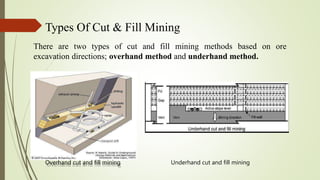
There are two types of cut and fill mining methods based on ore
excavation directions; overhand method and underhand method.
Overhand cut and fill mining Underhand cut and fill mining
Cut And Fill Mining
Underhand
Method
Underhand method is the method to
extract the ore deposit from the top
downwards. The ore is drilled from the
shallow level and continue by mining
the deep deposits along the stope. This
method enables us to obtain the ore
product from the earlier stage.
Overhand
Method
Overhand is a method to extract the ore
from bottom upwards. Intact vein is
hanging over the stope and the lower void
is filled with waste materials. The
advantage of this method is location of
backfill under the working area enable the
use of backfill material with relatively
low strength to reduce mining costs.
 Ore Strength: Moderate to Weak.
 Rock Strength: Weak
 Deposit Shape: Any, regular to irregular
 Deposit Dip: Usually steep but can be applied for flat dips also than it will
be similar to longwall mining.
 Size and Thickness: fairly large extent, thin to thick (2-30 m).
 Ore grade: High but uniformity can be variable.
 Depth: Practiced up to 2.5 km.
Conditions
Stope Preparation
 Access from the main level to the stope by a drive or crosscut (at both the levels)
 Connecting the two levels by service raises at a proper interval for mine services including
ventilation and conveyance of the filling material.
 Development for the extraction layout includes driving the extraction drive, and
construction of chutes for the ore passes.
 If the stope is mined overhand, development commences at the sill and progress
upward with mining the ore slices. The ore and man passes are built simultaneously
using timber or tubing as the stope advances upward.
 To have an access to mobile equipment such as drill jumbos, LHDs etc., a ramp
sometimes becomes necessary; otherwise, maintenance of such sets of equipment
sometimes may prove a bottleneck.
 If underhand stoping is used, mining begins just after the crown pillar in the downward
direction in slices.
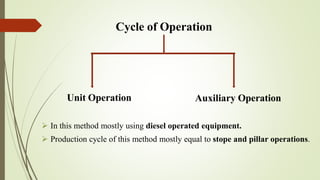
Cycle of Operation
Unit Operation Auxiliary Operation
 In this method mostly using diesel operated equipment.
 Production cycle of this method mostly equal to stope and pillar operations.
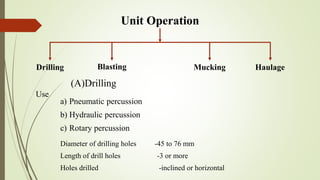
Unit Operation
Drilling Blasting Mucking Haulage
(A)Drilling
Use
a) Pneumatic percussion
b) Hydraulic percussion
c) Rotary percussion
Diameter of drilling holes -45 to 76 mm
Length of drill holes -3 or more
Holes drilled -inclined or horizontal
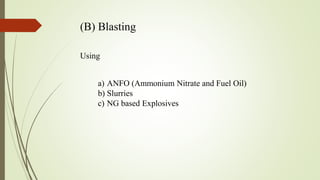
(B) Blasting
Using
a) ANFO (Ammonium Nitrate and Fuel Oil)
b) Slurries
c) NG based Explosives
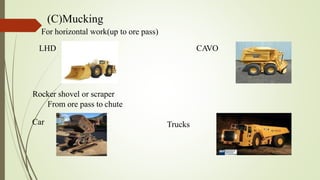
(C)Mucking
For horizontal work(up to ore pass)
LHD CAVO
Rocker shovel or scraper
From ore pass to chute
Car Trucks
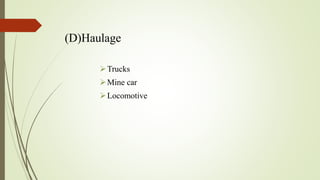
(D)Haulage
Trucks
Mine car
Locomotive
Auxiliary operation
Back filling Supporting work Ground control
 Back filling
At work out area
At require area
At drainage area
 Supporting work
Cable bolting
Timbering
Packs walling
 Ground control
Merits
 Productivity: Moderate 10-20 tons/man/shift.
Max. up to 30-40 ton/man/shift.
 Production Rate: Moderate.
Applicable for irregular bodies.
 Scope of Mechanization: Moderate.
 Ground Condition: Suitable for worst ground condition.
 Recovery: Maximum if pillar mined, up to 95% or more.
 Depth: Proved vital for deep mining at high rock pressure.
Demerits
 Cost of backfilling: Up to 50% of total mining cost.
 Operational skill: Requires skilled labor.
 Working atmosphere: At depth wet filling create humidity problems
 Low grade: Not suitable for low grade ore due to high mining cost.
Variants
 Cut and fill with flat back:
(a) Conventional
(b) Mechanized
 Cut and fill with inclined slicing
 Longwall cut and fill stoping
 Post and pillar- Cut and fill stoping
 Stope-drive cut and fill stoping:
(a) starting from upper level
(b) starting form lower level
Filling Material
 The fill material used in this method varies, depending on the support
required and the material that may be available to the mine operator.
 Crandall (1992) list the major types of fill as follows:
Waste fill.
Pneumatic fill.
Hydraulic fill with dilute slurry.
High density hydraulic fill.
Cut & fill mining method

Cut & fill mining method

  • 1.
    Group Members Mst. RajiaKhatun(150819) Md. Jarjis Rahman(150828) Md. Sohanur Rahman(140820) Tanvir Ahmed Tanin(******)
  • 2.
  • 3.
    Introduction  As thename suggests, in this method the ore body is cut in slices and a fill of some kind replaces the void so created.  During this operation the unit operations are carried out in a cyclic order i.e. drilling, blasting, mucking, transporting and filling.  Cut and fill stoping can be applied for not only the thin and steep ore bodies with weaker walls but also for the wider and even weaker ore bodies than those suitable for the stull stoping.  In fact, this method can be applied where the deposit cannot be mined by any of the open stoping methods, or in simple words, where open stoping fails, the substitute is the cut and fills stoping.
  • 4.
    Types Of Cut& Fill Mining There are two types of cut and fill mining methods based on ore excavation directions; overhand method and underhand method. Overhand cut and fill mining Underhand cut and fill mining
  • 5.
    Cut And FillMining Underhand Method Underhand method is the method to extract the ore deposit from the top downwards. The ore is drilled from the shallow level and continue by mining the deep deposits along the stope. This method enables us to obtain the ore product from the earlier stage. Overhand Method Overhand is a method to extract the ore from bottom upwards. Intact vein is hanging over the stope and the lower void is filled with waste materials. The advantage of this method is location of backfill under the working area enable the use of backfill material with relatively low strength to reduce mining costs.
  • 6.
     Ore Strength:Moderate to Weak.  Rock Strength: Weak  Deposit Shape: Any, regular to irregular  Deposit Dip: Usually steep but can be applied for flat dips also than it will be similar to longwall mining.  Size and Thickness: fairly large extent, thin to thick (2-30 m).  Ore grade: High but uniformity can be variable.  Depth: Practiced up to 2.5 km. Conditions
  • 7.
    Stope Preparation  Accessfrom the main level to the stope by a drive or crosscut (at both the levels)  Connecting the two levels by service raises at a proper interval for mine services including ventilation and conveyance of the filling material.  Development for the extraction layout includes driving the extraction drive, and construction of chutes for the ore passes.  If the stope is mined overhand, development commences at the sill and progress upward with mining the ore slices. The ore and man passes are built simultaneously using timber or tubing as the stope advances upward.  To have an access to mobile equipment such as drill jumbos, LHDs etc., a ramp sometimes becomes necessary; otherwise, maintenance of such sets of equipment sometimes may prove a bottleneck.  If underhand stoping is used, mining begins just after the crown pillar in the downward direction in slices.
  • 8.
    Cycle of Operation UnitOperation Auxiliary Operation  In this method mostly using diesel operated equipment.  Production cycle of this method mostly equal to stope and pillar operations.
  • 9.
    Unit Operation Drilling BlastingMucking Haulage (A)Drilling Use a) Pneumatic percussion b) Hydraulic percussion c) Rotary percussion Diameter of drilling holes -45 to 76 mm Length of drill holes -3 or more Holes drilled -inclined or horizontal
  • 10.
    (B) Blasting Using a) ANFO(Ammonium Nitrate and Fuel Oil) b) Slurries c) NG based Explosives
  • 11.
    (C)Mucking For horizontal work(upto ore pass) LHD CAVO Rocker shovel or scraper From ore pass to chute Car Trucks
  • 12.
  • 13.
    Auxiliary operation Back fillingSupporting work Ground control  Back filling At work out area At require area At drainage area  Supporting work Cable bolting Timbering Packs walling  Ground control
  • 14.
    Merits  Productivity: Moderate10-20 tons/man/shift. Max. up to 30-40 ton/man/shift.  Production Rate: Moderate. Applicable for irregular bodies.  Scope of Mechanization: Moderate.  Ground Condition: Suitable for worst ground condition.  Recovery: Maximum if pillar mined, up to 95% or more.  Depth: Proved vital for deep mining at high rock pressure.
  • 15.
    Demerits  Cost ofbackfilling: Up to 50% of total mining cost.  Operational skill: Requires skilled labor.  Working atmosphere: At depth wet filling create humidity problems  Low grade: Not suitable for low grade ore due to high mining cost.
  • 16.
    Variants  Cut andfill with flat back: (a) Conventional (b) Mechanized  Cut and fill with inclined slicing  Longwall cut and fill stoping  Post and pillar- Cut and fill stoping  Stope-drive cut and fill stoping: (a) starting from upper level (b) starting form lower level
  • 17.
    Filling Material  Thefill material used in this method varies, depending on the support required and the material that may be available to the mine operator.  Crandall (1992) list the major types of fill as follows: Waste fill. Pneumatic fill. Hydraulic fill with dilute slurry. High density hydraulic fill.