Discourse &
Context 1:
Function
2
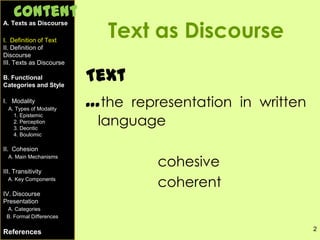
Text as Discourse
Text
…the representation in written
language
cohesive
coherent
A. Texts as Discourse
I. Definition of Text
II. Definition of
Discourse
III. Texts as Discourse
B. Functional
Categories and Style
I. Modality
A. Types of Modality
1. Epistemic
2. Perception
3. Deontic
4. Boulomic
II. Cohesion
A. Main Mechanisms
III. Transitivity
A. Key Components
IV. Discourse
Presentation
A. Categories
B. Formal Differences
References
Content
3
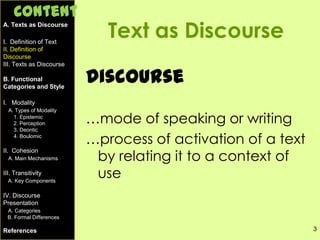
Text as Discourse
Discourse
…mode of speaking or writing
…process of activation of a text
by relating it to a context of
use
A. Texts as Discourse
I. Definition of Text
II. Definition of
Discourse
III. Texts as Discourse
B. Functional
Categories and Style
I. Modality
A. Types of Modality
1. Epistemic
2. Perception
3. Deontic
4. Boulomic
II. Cohesion
A. Main Mechanisms
III. Transitivity
A. Key Components
IV. Discourse
Presentation
A. Categories
B. Formal Differences
References
Content
4
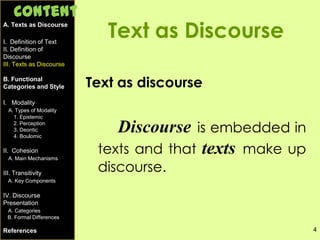
Text as Discourse
Text as discourse
Discourse is embedded in
texts and that texts make up
discourse.
A. Texts as Discourse
I. Definition of Text
II. Definition of
Discourse
III. Texts as Discourse
B. Functional
Categories and Style
I. Modality
A. Types of Modality
1. Epistemic
2. Perception
3. Deontic
4. Boulomic
II. Cohesion
A. Main Mechanisms
III. Transitivity
A. Key Components
IV. Discourse
Presentation
A. Categories
B. Formal Differences
References
Content
5
Text as Discourse
Text as discourse
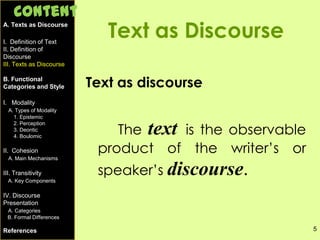
The text is the observable
product of the writer’s or
speaker’s discourse.
A. Texts as Discourse
I. Definition of Text
II. Definition of
Discourse
III. Texts as Discourse
B. Functional
Categories and Style
I. Modality
A. Types of Modality
1. Epistemic
2. Perception
3. Deontic
4. Boulomic
II. Cohesion
A. Main Mechanisms
III. Transitivity
A. Key Components
IV. Discourse
Presentation
A. Categories
B. Formal Differences
References
Content
6
Functional Categories
& Style
modality
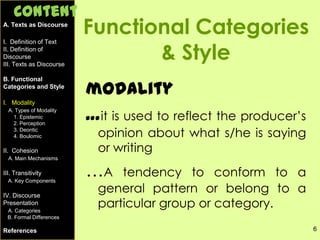
…it is used to reflect the producer’s
opinion about what s/he is saying
or writing
…A tendency to conform to a
general pattern or belong to a
particular group or category.
A. Texts as Discourse
I. Definition of Text
II. Definition of
Discourse
III. Texts as Discourse
B. Functional
Categories and Style
I. Modality
A. Types of Modality
1. Epistemic
2. Perception
3. Deontic
4. Boulomic
II. Cohesion
A. Main Mechanisms
III. Transitivity
A. Key Components
IV. Discourse
Presentation
A. Categories
B. Formal Differences
References
Content
7
Functional Categories
& Style
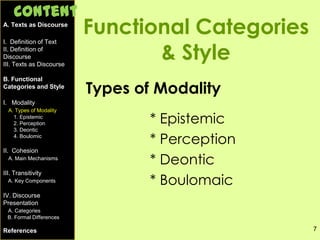
Types of Modality
* Epistemic
* Perception
* Deontic
* Boulomaic
A. Texts as Discourse
I. Definition of Text
II. Definition of
Discourse
III. Texts as Discourse
B. Functional
Categories and Style
I. Modality
A. Types of Modality
1. Epistemic
2. Perception
3. Deontic
4. Boulomic
II. Cohesion
A. Main Mechanisms
III. Transitivity
A. Key Components
IV. Discourse
Presentation
A. Categories
B. Formal Differences
References
Content
8
Functional Categories
& Style
Epistemic
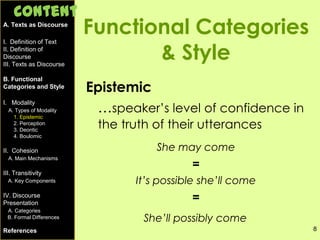
…speaker’s level of confidence in
the truth of their utterances
She may come
=
It’s possible she’ll come
=
She’ll possibly come
A. Texts as Discourse
I. Definition of Text
II. Definition of
Discourse
III. Texts as Discourse
B. Functional
Categories and Style
I. Modality
A. Types of Modality
1. Epistemic
2. Perception
3. Deontic
4. Boulomic
II. Cohesion
A. Main Mechanisms
III. Transitivity
A. Key Components
IV. Discourse
Presentation
A. Categories
B. Formal Differences
References
Content
9
Functional Categories
& Style
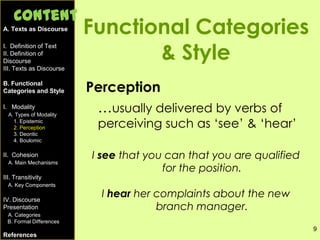
Perception
…usually delivered by verbs of
perceiving such as ‘see’ & ‘hear’
I see that you can that you are qualified
for the position.
I hear her complaints about the new
branch manager.
A. Texts as Discourse
I. Definition of Text
II. Definition of
Discourse
III. Texts as Discourse
B. Functional
Categories and Style
I. Modality
A. Types of Modality
1. Epistemic
2. Perception
3. Deontic
4. Boulomic
II. Cohesion
A. Main Mechanisms
III. Transitivity
A. Key Components
IV. Discourse
Presentation
A. Categories
B. Formal Differences
References
Content
10
Functional Categories
& Style
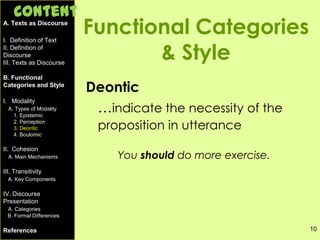
Deontic
…indicate the necessity of the
proposition in utterance
You should do more exercise.
A. Texts as Discourse
I. Definition of Text
II. Definition of
Discourse
III. Texts as Discourse
B. Functional
Categories and Style
I. Modality
A. Types of Modality
1. Epistemic
2. Perception
3. Deontic
4. Boulomic
II. Cohesion
A. Main Mechanisms
III. Transitivity
A. Key Components
IV. Discourse
Presentation
A. Categories
B. Formal Differences
References
Content
11
Functional Categories
& Style
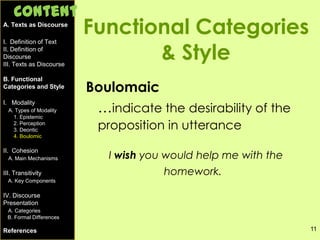
Boulomaic
…indicate the desirability of the
proposition in utterance
I wish you would help me with the
homework.
A. Texts as Discourse
I. Definition of Text
II. Definition of
Discourse
III. Texts as Discourse
B. Functional
Categories and Style
I. Modality
A. Types of Modality
1. Epistemic
2. Perception
3. Deontic
4. Boulomic
II. Cohesion
A. Main Mechanisms
III. Transitivity
A. Key Components
IV. Discourse
Presentation
A. Categories
B. Formal Differences
References
Content
12
Functional Categories
& Style
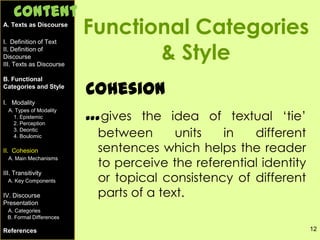
Cohesion
…gives the idea of textual ‘tie’
between units in different
sentences which helps the reader
to perceive the referential identity
or topical consistency of different
parts of a text.
A. Texts as Discourse
I. Definition of Text
II. Definition of
Discourse
III. Texts as Discourse
B. Functional
Categories and Style
I. Modality
A. Types of Modality
1. Epistemic
2. Perception
3. Deontic
4. Boulomic
II. Cohesion
A. Main Mechanisms
III. Transitivity
A. Key Components
IV. Discourse
Presentation
A. Categories
B. Formal Differences
References
Content
13
Functional Categories
& Style
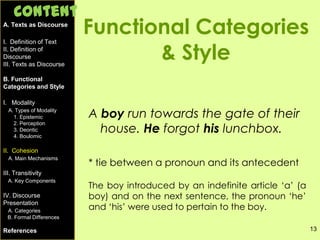
A boy run towards the gate of their
house. He forgot his lunchbox.
* tie between a pronoun and its antecedent
The boy introduced by an indefinite article ‘a’ (a
boy) and on the next sentence, the pronoun ‘he’
and ‘his’ were used to pertain to the boy.
A. Texts as Discourse
I. Definition of Text
II. Definition of
Discourse
III. Texts as Discourse
B. Functional
Categories and Style
I. Modality
A. Types of Modality
1. Epistemic
2. Perception
3. Deontic
4. Boulomic
II. Cohesion
A. Main Mechanisms
III. Transitivity
A. Key Components
IV. Discourse
Presentation
A. Categories
B. Formal Differences
References
Content
14
Functional Categories
& Style
Main Mechanisms of Cohesion
* Repetition
* Reference
* Substitution
* Ellipsis
* Conjunction
* Lexical Cohesion
A. Texts as Discourse
I. Definition of Text
II. Definition of
Discourse
III. Texts as Discourse
B. Functional
Categories and Style
I. Modality
A. Types of Modality
1. Epistemic
2. Perception
3. Deontic
4. Boulomic
II. Cohesion
A. Main Mechanisms
III. Transitivity
A. Key Components
IV. Discourse
Presentation
A. Categories
B. Formal Differences
References
Content
15
Functional Categories
& Style
Transitivity
…the way meanings are encoded
in the clause to the way different
types of process is represented in
language.
A. Texts as Discourse
I. Definition of Text
II. Definition of
Discourse
III. Texts as Discourse
B. Functional
Categories and Style
I. Modality
A. Types of Modality
1. Epistemic
2. Perception
3. Deontic
4. Boulomic
II. Cohesion
A. Main Mechanisms
III. Transitivity
A. Key Components
IV. Discourse
Presentation
A. Categories
B. Formal Differences
References
Content
16
Functional Categories
& Style
Transitivity Key Components
* Verb Phrase
* Participants
* Prepositional &
Adverb Phrases
A. Texts as Discourse
I. Definition of Text
II. Definition of
Discourse
III. Texts as Discourse
B. Functional
Categories and Style
I. Modality
A. Types of Modality
1. Epistemic
2. Perception
3. Deontic
4. Boulomic
II. Cohesion
A. Main Mechanisms
III. Transitivity
A. Key Components
IV. Discourse
Presentation
A. Categories
B. Formal Differences
References
Content
17
Functional Categories
& Style
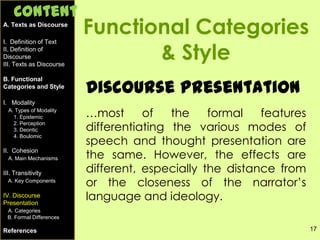
Discourse Presentation
…most of the formal features
differentiating the various modes of
speech and thought presentation are
the same. However, the effects are
different, especially the distance from
or the closeness of the narrator’s
language and ideology.
A. Texts as Discourse
I. Definition of Text
II. Definition of
Discourse
III. Texts as Discourse
B. Functional
Categories and Style
I. Modality
A. Types of Modality
1. Epistemic
2. Perception
3. Deontic
4. Boulomic
II. Cohesion
A. Main Mechanisms
III. Transitivity
A. Key Components
IV. Discourse
Presentation
A. Categories
B. Formal Differences
References
Content
18
Functional Categories
& Style
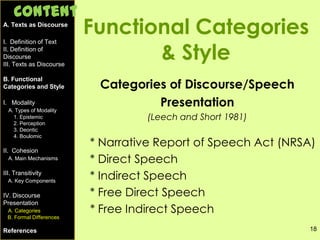
Categories of Discourse/Speech
Presentation
(Leech and Short 1981)
* Narrative Report of Speech Act (NRSA)
* Direct Speech
* Indirect Speech
* Free Direct Speech
* Free Indirect Speech
A. Texts as Discourse
I. Definition of Text
II. Definition of
Discourse
III. Texts as Discourse
B. Functional
Categories and Style
I. Modality
A. Types of Modality
1. Epistemic
2. Perception
3. Deontic
4. Boulomic
II. Cohesion
A. Main Mechanisms
III. Transitivity
A. Key Components
IV. Discourse
Presentation
A. Categories
B. Formal Differences
References
Content
19
Functional Categories
& Style
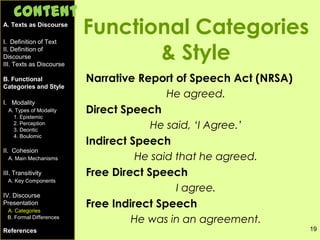
Narrative Report of Speech Act (NRSA)
He agreed.
Direct Speech
He said, ‘I Agree.’
Indirect Speech
He said that he agreed.
Free Direct Speech
I agree.
Free Indirect Speech
He was in an agreement.
A. Texts as Discourse
I. Definition of Text
II. Definition of
Discourse
III. Texts as Discourse
B. Functional
Categories and Style
I. Modality
A. Types of Modality
1. Epistemic
2. Perception
3. Deontic
4. Boulomic
II. Cohesion
A. Main Mechanisms
III. Transitivity
A. Key Components
IV. Discourse
Presentation
A. Categories
B. Formal Differences
References
Content
20
Functional Categories
& Style
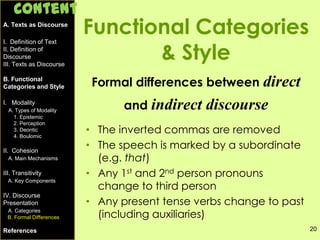
Formal differences between direct
and indirect discourse
• The inverted commas are removed
• The speech is marked by a subordinate
(e.g. that)
• Any 1st and 2nd person pronouns
change to third person
• Any present tense verbs change to past
(including auxiliaries)
A. Texts as Discourse
I. Definition of Text
II. Definition of
Discourse
III. Texts as Discourse
B. Functional
Categories and Style
I. Modality
A. Types of Modality
1. Epistemic
2. Perception
3. Deontic
4. Boulomic
II. Cohesion
A. Main Mechanisms
III. Transitivity
A. Key Components
IV. Discourse
Presentation
A. Categories
B. Formal Differences
References
Content
References
http://books.google.com.ph/books?id=JOHAfctPly8C&p
g=PA71&lpg=PA71&dq=functional+categories+and+sty
le+in+stylistics&source
http://stylistics.minb.de/index.php?c=Speech%20and%
20Thought%20Presentation
Simpson, P. (2004). Stylistics : A resource Book for Students.
New York, Routledge
21
A. Texts as Discourse
I. Definition of Text
II. Definition of
Discourse
III. Texts as Discourse
B. Functional
Categories and Style
I. Modality
A. Types of Modality
1. Epistemic
2. Perception
3. Deontic
4. Boulomic
II. Cohesion
A. Main Mechanisms
III. Transitivity
A. Key Components
IV. Discourse
Presentation
A. Categories
Content
21
A. Texts as Discourse
I. Definition of Text
II. Definition of
Discourse
III. Texts as Discourse
B. Functional
Categories and Style
I. Modality
A. Types of Modality
1. Epistemic
2. Perception
3. Deontic
4. Boulomic
II. Cohesion
A. Main Mechanisms
III. Transitivity
A. Key Components
IV. Discourse
Presentation
A. Categories
B. Formal Differences
References
Content

STYLISTICS: Discourse and Context 1: Function

  • 1.
  • 2.
    2 Text as Discourse Text …therepresentation in written language cohesive coherent A. Texts as Discourse I. Definition of Text II. Definition of Discourse III. Texts as Discourse B. Functional Categories and Style I. Modality A. Types of Modality 1. Epistemic 2. Perception 3. Deontic 4. Boulomic II. Cohesion A. Main Mechanisms III. Transitivity A. Key Components IV. Discourse Presentation A. Categories B. Formal Differences References Content
  • 3.
    3 Text as Discourse Discourse …modeof speaking or writing …process of activation of a text by relating it to a context of use A. Texts as Discourse I. Definition of Text II. Definition of Discourse III. Texts as Discourse B. Functional Categories and Style I. Modality A. Types of Modality 1. Epistemic 2. Perception 3. Deontic 4. Boulomic II. Cohesion A. Main Mechanisms III. Transitivity A. Key Components IV. Discourse Presentation A. Categories B. Formal Differences References Content
  • 4.
    4 Text as Discourse Textas discourse Discourse is embedded in texts and that texts make up discourse. A. Texts as Discourse I. Definition of Text II. Definition of Discourse III. Texts as Discourse B. Functional Categories and Style I. Modality A. Types of Modality 1. Epistemic 2. Perception 3. Deontic 4. Boulomic II. Cohesion A. Main Mechanisms III. Transitivity A. Key Components IV. Discourse Presentation A. Categories B. Formal Differences References Content
  • 5.
    5 Text as Discourse Textas discourse The text is the observable product of the writer’s or speaker’s discourse. A. Texts as Discourse I. Definition of Text II. Definition of Discourse III. Texts as Discourse B. Functional Categories and Style I. Modality A. Types of Modality 1. Epistemic 2. Perception 3. Deontic 4. Boulomic II. Cohesion A. Main Mechanisms III. Transitivity A. Key Components IV. Discourse Presentation A. Categories B. Formal Differences References Content
  • 6.
    6 Functional Categories & Style modality …itis used to reflect the producer’s opinion about what s/he is saying or writing …A tendency to conform to a general pattern or belong to a particular group or category. A. Texts as Discourse I. Definition of Text II. Definition of Discourse III. Texts as Discourse B. Functional Categories and Style I. Modality A. Types of Modality 1. Epistemic 2. Perception 3. Deontic 4. Boulomic II. Cohesion A. Main Mechanisms III. Transitivity A. Key Components IV. Discourse Presentation A. Categories B. Formal Differences References Content
  • 7.
    7 Functional Categories & Style Typesof Modality * Epistemic * Perception * Deontic * Boulomaic A. Texts as Discourse I. Definition of Text II. Definition of Discourse III. Texts as Discourse B. Functional Categories and Style I. Modality A. Types of Modality 1. Epistemic 2. Perception 3. Deontic 4. Boulomic II. Cohesion A. Main Mechanisms III. Transitivity A. Key Components IV. Discourse Presentation A. Categories B. Formal Differences References Content
  • 8.
    8 Functional Categories & Style Epistemic …speaker’slevel of confidence in the truth of their utterances She may come = It’s possible she’ll come = She’ll possibly come A. Texts as Discourse I. Definition of Text II. Definition of Discourse III. Texts as Discourse B. Functional Categories and Style I. Modality A. Types of Modality 1. Epistemic 2. Perception 3. Deontic 4. Boulomic II. Cohesion A. Main Mechanisms III. Transitivity A. Key Components IV. Discourse Presentation A. Categories B. Formal Differences References Content
  • 9.
    9 Functional Categories & Style Perception …usuallydelivered by verbs of perceiving such as ‘see’ & ‘hear’ I see that you can that you are qualified for the position. I hear her complaints about the new branch manager. A. Texts as Discourse I. Definition of Text II. Definition of Discourse III. Texts as Discourse B. Functional Categories and Style I. Modality A. Types of Modality 1. Epistemic 2. Perception 3. Deontic 4. Boulomic II. Cohesion A. Main Mechanisms III. Transitivity A. Key Components IV. Discourse Presentation A. Categories B. Formal Differences References Content
  • 10.
    10 Functional Categories & Style Deontic …indicatethe necessity of the proposition in utterance You should do more exercise. A. Texts as Discourse I. Definition of Text II. Definition of Discourse III. Texts as Discourse B. Functional Categories and Style I. Modality A. Types of Modality 1. Epistemic 2. Perception 3. Deontic 4. Boulomic II. Cohesion A. Main Mechanisms III. Transitivity A. Key Components IV. Discourse Presentation A. Categories B. Formal Differences References Content
  • 11.
    11 Functional Categories & Style Boulomaic …indicatethe desirability of the proposition in utterance I wish you would help me with the homework. A. Texts as Discourse I. Definition of Text II. Definition of Discourse III. Texts as Discourse B. Functional Categories and Style I. Modality A. Types of Modality 1. Epistemic 2. Perception 3. Deontic 4. Boulomic II. Cohesion A. Main Mechanisms III. Transitivity A. Key Components IV. Discourse Presentation A. Categories B. Formal Differences References Content
  • 12.
    12 Functional Categories & Style Cohesion …givesthe idea of textual ‘tie’ between units in different sentences which helps the reader to perceive the referential identity or topical consistency of different parts of a text. A. Texts as Discourse I. Definition of Text II. Definition of Discourse III. Texts as Discourse B. Functional Categories and Style I. Modality A. Types of Modality 1. Epistemic 2. Perception 3. Deontic 4. Boulomic II. Cohesion A. Main Mechanisms III. Transitivity A. Key Components IV. Discourse Presentation A. Categories B. Formal Differences References Content
  • 13.
    13 Functional Categories & Style Aboy run towards the gate of their house. He forgot his lunchbox. * tie between a pronoun and its antecedent The boy introduced by an indefinite article ‘a’ (a boy) and on the next sentence, the pronoun ‘he’ and ‘his’ were used to pertain to the boy. A. Texts as Discourse I. Definition of Text II. Definition of Discourse III. Texts as Discourse B. Functional Categories and Style I. Modality A. Types of Modality 1. Epistemic 2. Perception 3. Deontic 4. Boulomic II. Cohesion A. Main Mechanisms III. Transitivity A. Key Components IV. Discourse Presentation A. Categories B. Formal Differences References Content
  • 14.
    14 Functional Categories & Style MainMechanisms of Cohesion * Repetition * Reference * Substitution * Ellipsis * Conjunction * Lexical Cohesion A. Texts as Discourse I. Definition of Text II. Definition of Discourse III. Texts as Discourse B. Functional Categories and Style I. Modality A. Types of Modality 1. Epistemic 2. Perception 3. Deontic 4. Boulomic II. Cohesion A. Main Mechanisms III. Transitivity A. Key Components IV. Discourse Presentation A. Categories B. Formal Differences References Content
  • 15.
    15 Functional Categories & Style Transitivity …theway meanings are encoded in the clause to the way different types of process is represented in language. A. Texts as Discourse I. Definition of Text II. Definition of Discourse III. Texts as Discourse B. Functional Categories and Style I. Modality A. Types of Modality 1. Epistemic 2. Perception 3. Deontic 4. Boulomic II. Cohesion A. Main Mechanisms III. Transitivity A. Key Components IV. Discourse Presentation A. Categories B. Formal Differences References Content
  • 16.
    16 Functional Categories & Style TransitivityKey Components * Verb Phrase * Participants * Prepositional & Adverb Phrases A. Texts as Discourse I. Definition of Text II. Definition of Discourse III. Texts as Discourse B. Functional Categories and Style I. Modality A. Types of Modality 1. Epistemic 2. Perception 3. Deontic 4. Boulomic II. Cohesion A. Main Mechanisms III. Transitivity A. Key Components IV. Discourse Presentation A. Categories B. Formal Differences References Content
  • 17.
    17 Functional Categories & Style DiscoursePresentation …most of the formal features differentiating the various modes of speech and thought presentation are the same. However, the effects are different, especially the distance from or the closeness of the narrator’s language and ideology. A. Texts as Discourse I. Definition of Text II. Definition of Discourse III. Texts as Discourse B. Functional Categories and Style I. Modality A. Types of Modality 1. Epistemic 2. Perception 3. Deontic 4. Boulomic II. Cohesion A. Main Mechanisms III. Transitivity A. Key Components IV. Discourse Presentation A. Categories B. Formal Differences References Content
  • 18.
    18 Functional Categories & Style Categoriesof Discourse/Speech Presentation (Leech and Short 1981) * Narrative Report of Speech Act (NRSA) * Direct Speech * Indirect Speech * Free Direct Speech * Free Indirect Speech A. Texts as Discourse I. Definition of Text II. Definition of Discourse III. Texts as Discourse B. Functional Categories and Style I. Modality A. Types of Modality 1. Epistemic 2. Perception 3. Deontic 4. Boulomic II. Cohesion A. Main Mechanisms III. Transitivity A. Key Components IV. Discourse Presentation A. Categories B. Formal Differences References Content
  • 19.
    19 Functional Categories & Style NarrativeReport of Speech Act (NRSA) He agreed. Direct Speech He said, ‘I Agree.’ Indirect Speech He said that he agreed. Free Direct Speech I agree. Free Indirect Speech He was in an agreement. A. Texts as Discourse I. Definition of Text II. Definition of Discourse III. Texts as Discourse B. Functional Categories and Style I. Modality A. Types of Modality 1. Epistemic 2. Perception 3. Deontic 4. Boulomic II. Cohesion A. Main Mechanisms III. Transitivity A. Key Components IV. Discourse Presentation A. Categories B. Formal Differences References Content
  • 20.
    20 Functional Categories & Style Formaldifferences between direct and indirect discourse • The inverted commas are removed • The speech is marked by a subordinate (e.g. that) • Any 1st and 2nd person pronouns change to third person • Any present tense verbs change to past (including auxiliaries) A. Texts as Discourse I. Definition of Text II. Definition of Discourse III. Texts as Discourse B. Functional Categories and Style I. Modality A. Types of Modality 1. Epistemic 2. Perception 3. Deontic 4. Boulomic II. Cohesion A. Main Mechanisms III. Transitivity A. Key Components IV. Discourse Presentation A. Categories B. Formal Differences References Content
  • 21.
    References http://books.google.com.ph/books?id=JOHAfctPly8C&p g=PA71&lpg=PA71&dq=functional+categories+and+sty le+in+stylistics&source http://stylistics.minb.de/index.php?c=Speech%20and% 20Thought%20Presentation Simpson, P. (2004).Stylistics : A resource Book for Students. New York, Routledge 21 A. Texts as Discourse I. Definition of Text II. Definition of Discourse III. Texts as Discourse B. Functional Categories and Style I. Modality A. Types of Modality 1. Epistemic 2. Perception 3. Deontic 4. Boulomic II. Cohesion A. Main Mechanisms III. Transitivity A. Key Components IV. Discourse Presentation A. Categories Content 21 A. Texts as Discourse I. Definition of Text II. Definition of Discourse III. Texts as Discourse B. Functional Categories and Style I. Modality A. Types of Modality 1. Epistemic 2. Perception 3. Deontic 4. Boulomic II. Cohesion A. Main Mechanisms III. Transitivity A. Key Components IV. Discourse Presentation A. Categories B. Formal Differences References Content