



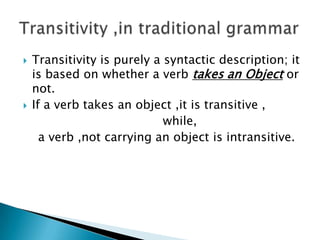
Transitivity is purely a syntactic description; it
is based on whether a verb takes an Object or
not.
If a verb takes an object ,it is transitive ,
while,
a verb ,not carrying an object is intransitive.
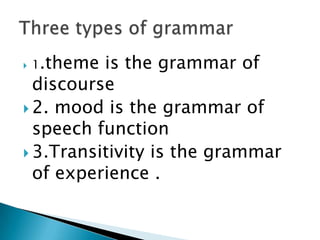
is the grammar of
discourse
 2. mood is the grammar of
speech function
 3.Transitivity is the grammar
of experience .


1.theme
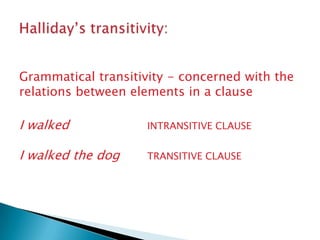
Grammatical transitivity - concerned with the
relations between elements in a clause

I walked

INTRANSITIVE CLAUSE

I walked the dog

TRANSITIVE CLAUSE
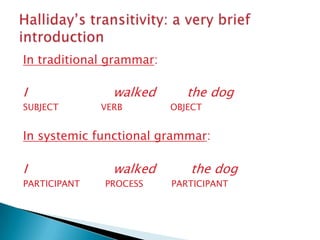
In traditional grammar:

I
SUBJECT

walked
VERB

the dog
OBJECT

In systemic functional grammar:

I
PARTICIPANT

walked
PROCESS

the dog
PARTICIPANT






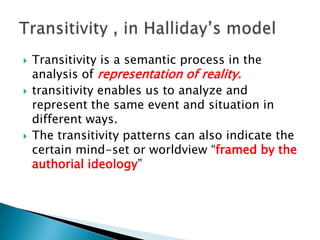
Transitivity is a semantic process in the
analysis of representation of reality.
transitivity enables us to analyze and
represent the same event and situation in
different ways.
The transitivity patterns can also indicate the
certain mind-set or worldview “framed by the
authorial ideology”
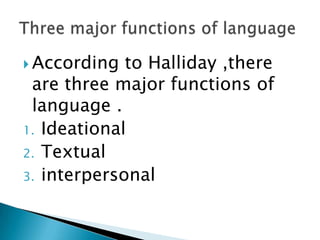
 According

to Halliday ,there
are three major functions of
language .
1. Ideational
2. Textual
3. interpersonal
 The

ideational function is the
use of language to express
content(speaker‟s attitude
towards the world) and to
communicate information
 The

textual function is the
use of language to signify
discourse.( how the speaker
or a writer constructs a text
)
 Interpersonal

function is the
use of language to establish
and maintain social relations.




The ideational function of the clause is
concerned with the “transmission of ideas.”
Its function is that of “representing
„processes‟ or „experiences‟.
(actions, events, processes of consciousness
and relations) .





all phenomena…and
anything that can be expressed by a verb :
event, whether physical or not, state, or
relation,
the “processes” expressed through language
are product of our conception of the world or
point of view.




Our most powerful conception of reality is
that it consists of “goings-on” : of doing,
happening, feeling, being.
These goings-on are sorted out in the
semantic system of the language, and
expressed through the grammar of the
clause…




Transitivity specifies the different types of
process that are recognized in the language,
and the structures by which they are
expressed.
The task of transitivity analysis, is to discover
the relation between meanings and wordings
that accounts for the organization of
linguistic features in a text.
The semantic processes expressed by clauses
have potentially three components
1. the process itself, which will be expressed
by the verb phrase in a clause.
2. the participants in the clause, which refer to
the roles of entities that are directly involved
in the process







the one that does, behaves or says, together
with the passive one that is done to, said to,
etc.
. The participants are not necessarily humans
or even animate
The participant entities are normally realized
by noun phrases in the clause.
3. the circumstances associated with the
process, which are typically expressed by
adverbial and prepositional phrases.


The transitivity model provides a means of
discovering how certain linguistic structures
of a text encode the particular worldview or
ideological stance of a reader/speaker.


Linguistic codes do not reflect reality
neutrally; they interpret, organize, and
classify the subjects of discourse. They
embody theories of how the world is
arranged: world-views or ideologies.


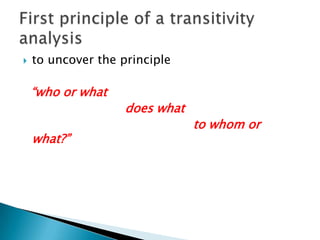
to uncover the principle

“who or what

what?”

does what

to whom or


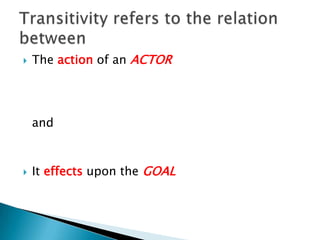
The action of an ACTOR

and



It effects upon the GOAL


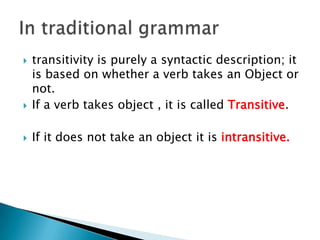
transitivity is purely a syntactic description; it
is based on whether a verb takes an Object or
not.
If a verb takes object , it is called Transitive.



If it does not take an object it is intransitive.






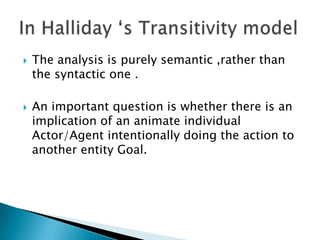
The analysis is purely semantic ,rather than
the syntactic one .
An important question is whether there is an
implication of an animate individual
Actor/Agent intentionally doing the action to
another entity Goal.


social and cultural factors



as well as any individual mind-set.



Different social structures and value systems
require different patterns of transitivity.
Three things are to be found out :
1. Isolate the process per se, and determine
which participant who or what is doing each
process ;
2. Determine what sorts of process they
are, and which participant is engaged in
which type of process ;
3. Determine who or what is affected or
seems to be affected by each of these
processes.

1.
2.
3.

4.
5.
6.

Transitivity processes can be classified into :
Material (doing){ kick ,run ,paint ,send}
Relational (being or becoming) {be ,have
,become}
Mental
(sensing){see,hear,know ,like}
Verbal
(saying){say ,tell
,warn,argue,ask}
Behavioral (behaving){laugh,talk ,cry,breath}
Existential (existing){there is…………….}




Material processes are processes of doing in
the physical world.
Two inherent participants are Actor and Goal
,the first being an obligatory element and
expresses the doer of the process , and later
being an optional element and expresses the
person or entity affected by the process








Material Processes: physical actions in the
real world and their Participants:
- Actor: the one who does the action
- Goal: The one who is affected by the action
- Recipient: the one who receives something
- Beneficiary: the one for whom something is
done


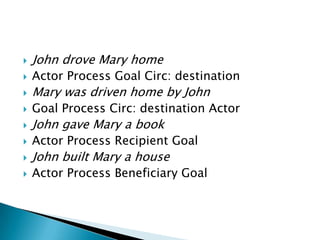
John drove Mary home



Actor Process Goal Circ: destination



Mary was driven home by John



Goal Process Circ: destination Actor



John gave Mary a book



Actor Process Recipient Goal



John built Mary a house



Actor Process Beneficiary Goal




There is an extra element called
CIRCUMSTANCE which provides additional
information on the “when, where, how, and
why” of the process.
The Circumstantial meaning is realized, not in
nominal phrases, but as either adverbial
phrases or prepositional phrases, and so is
subsidiary in status to the process.


Circumstance expresses supplementary
information, such as
place, time, extent, matter, manner, duration,
condition, means, etc.






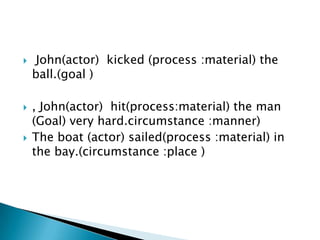
John(actor) kicked (process :material) the
ball.(goal )
, John(actor) hit(process:material) the man
(Goal) very hard.circumstance :manner)
The boat (actor) sailed(process :material) in
the bay.(circumstance :place )




Of course, it is possible to reverse Actor/Goal
in a passive form, placing a Goal at an initial
position and Actor at the end of the sentence,
such as :

The man was hit by John.




Relational processes are concerned with the
process of being in the world of abstract
relations.
Normally, an abstract relationship that exists
between two participants associated with the
process is considered, but unlike the case of
material process, a participant does not affect
the other participant in a physical sense.


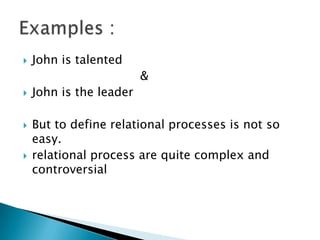
John is talented
&







John is the leader
But to define relational processes is not so
easy.
relational process are quite complex and
controversial
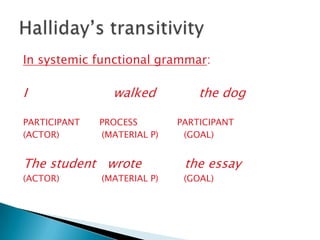
In systemic functional grammar:

I
PARTICIPANT
(ACTOR)

walked
PROCESS
(MATERIAL P)

the dog
PARTICIPANT
(GOAL)

The student wrote

the essay

(ACTOR)

(GOAL)

(MATERIAL P)
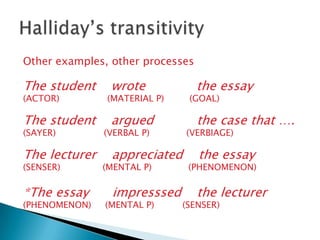
Other examples, other processes

The student
(ACTOR)

The student
(SAYER)

The lecturer
(SENSER)

*The essay

(PHENOMENON)

wrote

the essay

(MATERIAL P)

(GOAL)

argued

the case that ….

(VERBAL P)

(VERBIAGE)

appreciated

(MENTAL P)

impresssed

(MENTAL P)

the essay

(PHENOMENON)

the lecturer

(SENSER)


Halliday: The system of transitivity in
language is concerned with
representing patterns of experience,
“of goings on” and “happenings” in the
world….It construes the world into a
manageable set of PROCESS types and
of PARTICIPANTS
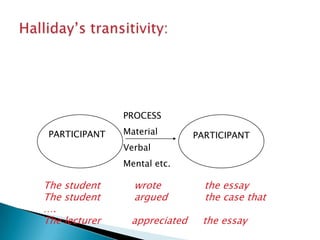
PROCESS

PARTICIPANT

Material

PARTICIPANT

Verbal
Mental etc.

The student
The student
….
The lecturer

wrote
argued

the essay
the case that

appreciated

the essay
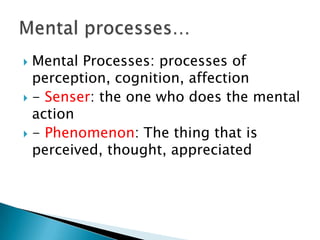
Mental Processes: processes of
perception, cognition, affection
 - Senser: the one who does the mental
action
 - Phenomenon: The thing that is
perceived, thought, appreciated

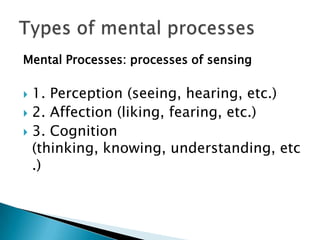
Mental Processes: processes of sensing

1. Perception (seeing, hearing, etc.)
 2. Affection (liking, fearing, etc.)
 3. Cognition
(thinking, knowing, understanding, etc
.)










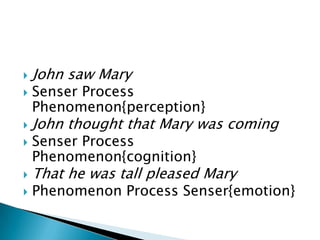
John saw Mary

Senser Process
Phenomenon{perception}

John thought that Mary was coming
Senser Process
Phenomenon{cognition}

That he was tall pleased Mary

Phenomenon Process Senser{emotion}
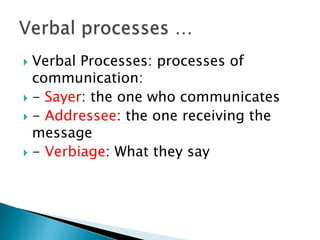
Verbal Processes: processes of
communication:
 - Sayer: the one who communicates
 - Addressee: the one receiving the
message
 - Verbiage: What they say



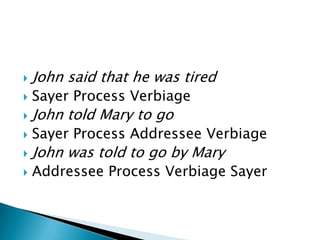
John said that he was tired



Sayer Process Verbiage



John told Mary to go



Sayer Process Addressee Verbiage



John was told to go by Mary



Addressee Process Verbiage Sayer
Relational Processes: expressing
possession, equivalence, attributes...
 - Carrier: An entity being described
 - Attribute: The description of the
entity




John is tall



Carrier Process Attribute










- Possessor: the one owning or containing
something
- Possessed: the thing owned or contained.

John owns a Mercedes

Possessor Process Possession
- Token: an entity being equated with
another
- Value: the other description.

John is the president
Token Process Value
 As

a rule of thumb, a behavioral
process verb is
 a. Intransitive (it has only one

participant) and

 b.

Indicates an activity in which
both the physical and mental
aspects are inseparable and
indispensable to it.






In this process, there is only one participant,
namely: behaver (the agent who behaves),
example:
Buff neither laughs ,nor smiles.
Behaver
(process)




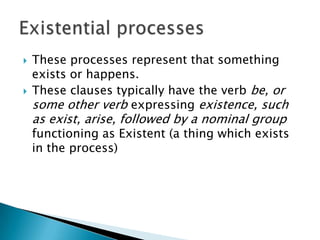
These processes represent that something
exists or happens.
These clauses typically have the verb be, or
some other verb expressing existence, such

as exist, arise, followed by a nominal group

functioning as Existent (a thing which exists
in the process)






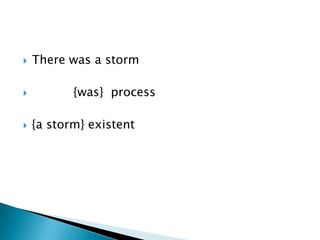
There was a storm
{was} process
{a storm} existent
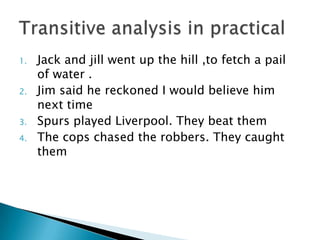
1.
2.
3.

4.

Jack and jill went up the hill ,to fetch a pail
of water .
Jim said he reckoned I would believe him
next time
Spurs played Liverpool. They beat them
The cops chased the robbers. They caught
them











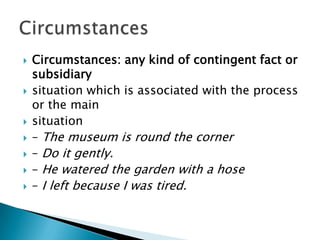
Circumstances: any kind of contingent fact or
subsidiary
situation which is associated with the process
or the main
situation
– The museum is round the corner
– Do it gently.
– He watered the garden with a hose
– I left because I was tired.

Functional stylistics

  • 2.
      Transitivity is purelya syntactic description; it is based on whether a verb takes an Object or not. If a verb takes an object ,it is transitive , while, a verb ,not carrying an object is intransitive.
  • 3.
    is the grammarof discourse  2. mood is the grammar of speech function  3.Transitivity is the grammar of experience .  1.theme
  • 4.
    Grammatical transitivity -concerned with the relations between elements in a clause I walked INTRANSITIVE CLAUSE I walked the dog TRANSITIVE CLAUSE
  • 5.
    In traditional grammar: I SUBJECT walked VERB thedog OBJECT In systemic functional grammar: I PARTICIPANT walked PROCESS the dog PARTICIPANT
  • 6.
       Transitivity is asemantic process in the analysis of representation of reality. transitivity enables us to analyze and represent the same event and situation in different ways. The transitivity patterns can also indicate the certain mind-set or worldview “framed by the authorial ideology”
  • 7.
     According to Halliday,there are three major functions of language . 1. Ideational 2. Textual 3. interpersonal
  • 8.
     The ideational functionis the use of language to express content(speaker‟s attitude towards the world) and to communicate information
  • 9.
     The textual functionis the use of language to signify discourse.( how the speaker or a writer constructs a text )
  • 10.
     Interpersonal function isthe use of language to establish and maintain social relations.
  • 11.
      The ideational functionof the clause is concerned with the “transmission of ideas.” Its function is that of “representing „processes‟ or „experiences‟. (actions, events, processes of consciousness and relations) .
  • 12.
       all phenomena…and anything thatcan be expressed by a verb : event, whether physical or not, state, or relation, the “processes” expressed through language are product of our conception of the world or point of view.
  • 13.
      Our most powerfulconception of reality is that it consists of “goings-on” : of doing, happening, feeling, being. These goings-on are sorted out in the semantic system of the language, and expressed through the grammar of the clause…
  • 14.
      Transitivity specifies thedifferent types of process that are recognized in the language, and the structures by which they are expressed. The task of transitivity analysis, is to discover the relation between meanings and wordings that accounts for the organization of linguistic features in a text.
  • 15.
    The semantic processesexpressed by clauses have potentially three components 1. the process itself, which will be expressed by the verb phrase in a clause. 2. the participants in the clause, which refer to the roles of entities that are directly involved in the process 
  • 16.
       the one thatdoes, behaves or says, together with the passive one that is done to, said to, etc. . The participants are not necessarily humans or even animate The participant entities are normally realized by noun phrases in the clause.
  • 17.
    3. the circumstancesassociated with the process, which are typically expressed by adverbial and prepositional phrases.
  • 18.
     The transitivity modelprovides a means of discovering how certain linguistic structures of a text encode the particular worldview or ideological stance of a reader/speaker.
  • 19.
     Linguistic codes donot reflect reality neutrally; they interpret, organize, and classify the subjects of discourse. They embody theories of how the world is arranged: world-views or ideologies.
  • 20.
     to uncover theprinciple “who or what what?” does what to whom or
  • 21.
     The action ofan ACTOR and  It effects upon the GOAL
  • 22.
     transitivity is purelya syntactic description; it is based on whether a verb takes an Object or not. If a verb takes object , it is called Transitive.  If it does not take an object it is intransitive. 
  • 23.
      The analysis ispurely semantic ,rather than the syntactic one . An important question is whether there is an implication of an animate individual Actor/Agent intentionally doing the action to another entity Goal.
  • 24.
     social and culturalfactors  as well as any individual mind-set.  Different social structures and value systems require different patterns of transitivity.
  • 25.
    Three things areto be found out : 1. Isolate the process per se, and determine which participant who or what is doing each process ; 2. Determine what sorts of process they are, and which participant is engaged in which type of process ;
  • 26.
    3. Determine whoor what is affected or seems to be affected by each of these processes.
  • 27.
     1. 2. 3. 4. 5. 6. Transitivity processes canbe classified into : Material (doing){ kick ,run ,paint ,send} Relational (being or becoming) {be ,have ,become} Mental (sensing){see,hear,know ,like} Verbal (saying){say ,tell ,warn,argue,ask} Behavioral (behaving){laugh,talk ,cry,breath} Existential (existing){there is…………….}
  • 28.
      Material processes areprocesses of doing in the physical world. Two inherent participants are Actor and Goal ,the first being an obligatory element and expresses the doer of the process , and later being an optional element and expresses the person or entity affected by the process
  • 29.
         Material Processes: physicalactions in the real world and their Participants: - Actor: the one who does the action - Goal: The one who is affected by the action - Recipient: the one who receives something - Beneficiary: the one for whom something is done
  • 30.
     John drove Maryhome  Actor Process Goal Circ: destination  Mary was driven home by John  Goal Process Circ: destination Actor  John gave Mary a book  Actor Process Recipient Goal  John built Mary a house  Actor Process Beneficiary Goal
  • 31.
      There is anextra element called CIRCUMSTANCE which provides additional information on the “when, where, how, and why” of the process. The Circumstantial meaning is realized, not in nominal phrases, but as either adverbial phrases or prepositional phrases, and so is subsidiary in status to the process.
  • 32.
     Circumstance expresses supplementary information,such as place, time, extent, matter, manner, duration, condition, means, etc.
  • 33.
       John(actor) kicked (process:material) the ball.(goal ) , John(actor) hit(process:material) the man (Goal) very hard.circumstance :manner) The boat (actor) sailed(process :material) in the bay.(circumstance :place )
  • 34.
      Of course, itis possible to reverse Actor/Goal in a passive form, placing a Goal at an initial position and Actor at the end of the sentence, such as : The man was hit by John.
  • 35.
      Relational processes areconcerned with the process of being in the world of abstract relations. Normally, an abstract relationship that exists between two participants associated with the process is considered, but unlike the case of material process, a participant does not affect the other participant in a physical sense.
  • 36.
     John is talented &    Johnis the leader But to define relational processes is not so easy. relational process are quite complex and controversial
  • 37.
    In systemic functionalgrammar: I PARTICIPANT (ACTOR) walked PROCESS (MATERIAL P) the dog PARTICIPANT (GOAL) The student wrote the essay (ACTOR) (GOAL) (MATERIAL P)
  • 38.
    Other examples, otherprocesses The student (ACTOR) The student (SAYER) The lecturer (SENSER) *The essay (PHENOMENON) wrote the essay (MATERIAL P) (GOAL) argued the case that …. (VERBAL P) (VERBIAGE) appreciated (MENTAL P) impresssed (MENTAL P) the essay (PHENOMENON) the lecturer (SENSER)
  • 39.
     Halliday: The systemof transitivity in language is concerned with representing patterns of experience, “of goings on” and “happenings” in the world….It construes the world into a manageable set of PROCESS types and of PARTICIPANTS
  • 40.
    PROCESS PARTICIPANT Material PARTICIPANT Verbal Mental etc. The student Thestudent …. The lecturer wrote argued the essay the case that appreciated the essay
  • 41.
    Mental Processes: processesof perception, cognition, affection  - Senser: the one who does the mental action  - Phenomenon: The thing that is perceived, thought, appreciated 
  • 42.
    Mental Processes: processesof sensing 1. Perception (seeing, hearing, etc.)  2. Affection (liking, fearing, etc.)  3. Cognition (thinking, knowing, understanding, etc .) 
  • 43.
          John saw Mary SenserProcess Phenomenon{perception} John thought that Mary was coming Senser Process Phenomenon{cognition} That he was tall pleased Mary Phenomenon Process Senser{emotion}
  • 44.
    Verbal Processes: processesof communication:  - Sayer: the one who communicates  - Addressee: the one receiving the message  - Verbiage: What they say 
  • 45.
     John said thathe was tired  Sayer Process Verbiage  John told Mary to go  Sayer Process Addressee Verbiage  John was told to go by Mary  Addressee Process Verbiage Sayer
  • 46.
    Relational Processes: expressing possession,equivalence, attributes...  - Carrier: An entity being described  - Attribute: The description of the entity   John is tall  Carrier Process Attribute
  • 47.
            - Possessor: theone owning or containing something - Possessed: the thing owned or contained. John owns a Mercedes Possessor Process Possession - Token: an entity being equated with another - Value: the other description. John is the president Token Process Value
  • 48.
     As a ruleof thumb, a behavioral process verb is  a. Intransitive (it has only one participant) and  b. Indicates an activity in which both the physical and mental aspects are inseparable and indispensable to it.
  • 49.
       In this process,there is only one participant, namely: behaver (the agent who behaves), example: Buff neither laughs ,nor smiles. Behaver (process)
  • 50.
      These processes representthat something exists or happens. These clauses typically have the verb be, or some other verb expressing existence, such as exist, arise, followed by a nominal group functioning as Existent (a thing which exists in the process)
  • 51.
       There was astorm {was} process {a storm} existent
  • 52.
    1. 2. 3. 4. Jack and jillwent up the hill ,to fetch a pail of water . Jim said he reckoned I would believe him next time Spurs played Liverpool. They beat them The cops chased the robbers. They caught them
  • 53.
           Circumstances: any kindof contingent fact or subsidiary situation which is associated with the process or the main situation – The museum is round the corner – Do it gently. – He watered the garden with a hose – I left because I was tired.