Discourse Analysis 
The Role of Context in 
Interpretation 
Group 1 
Siti Purwaningsih 11.321.159 
Wahyu Febrianti 11.321.164 
Lingga Widi Pradana 11.321.165 
Bagus Rudiantoro 11.321.169 
Ririn Desy Ariyani 11.321.176
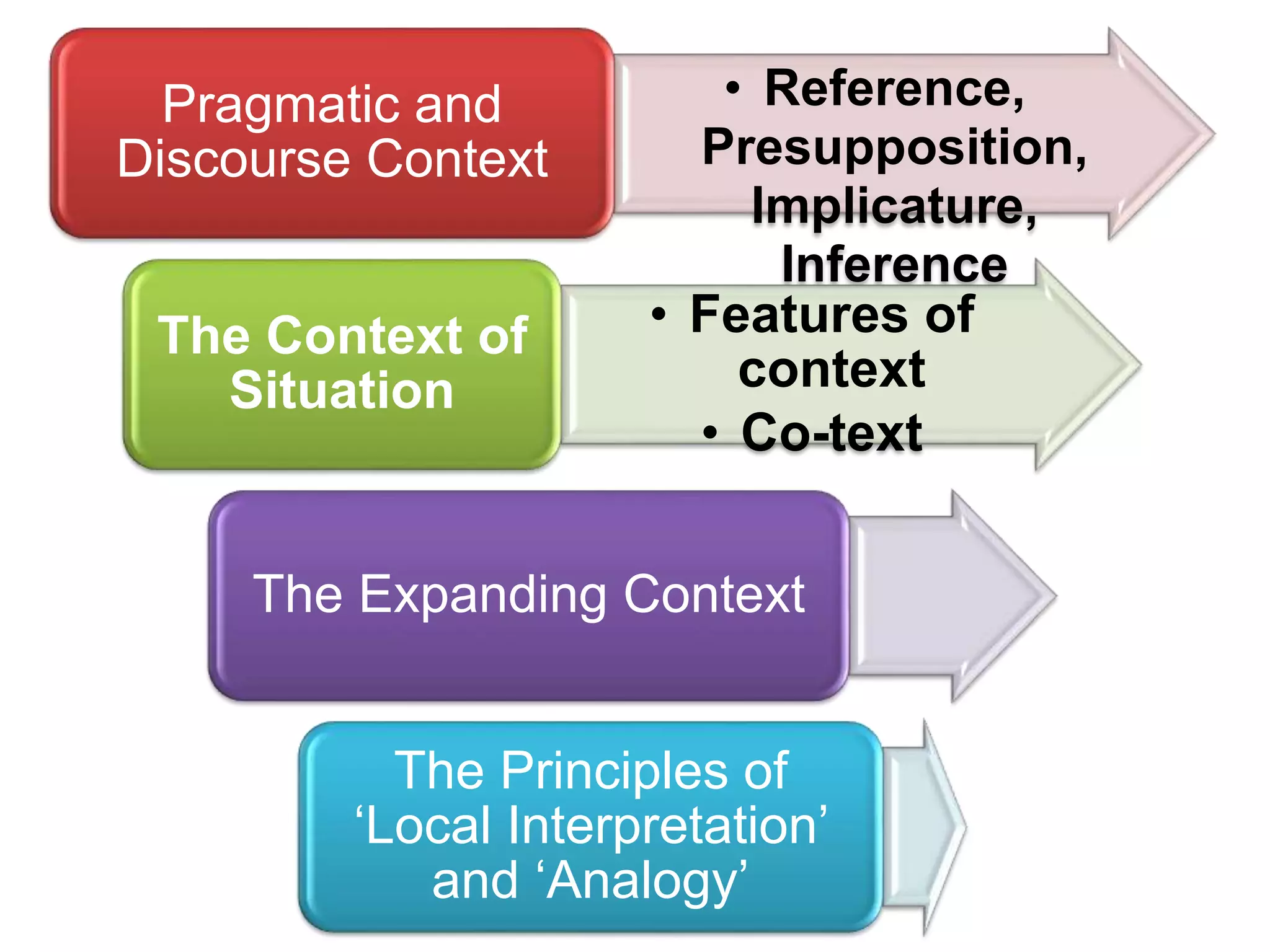
• Reference, 
Presupposition, 
Implicature, 
Inference 
Pragmatic and 
Discourse Context 
• Features of 
context 
• Co-text 
The Context of 
Situation 
The Expanding Context 
The Principles of 
‘Local Interpretation’ 
and ‘Analogy’
I. Pragmatic and Discourse Context 
 Discourse analyst necessarily takes a 
pragmatic approach to the study of 
language in use. 
 The discourse analyst is investigating 
the use of language in the relationship 
between the speaker and the 
utterance, on the particular occasion of 
use. Siti Purwaningsih
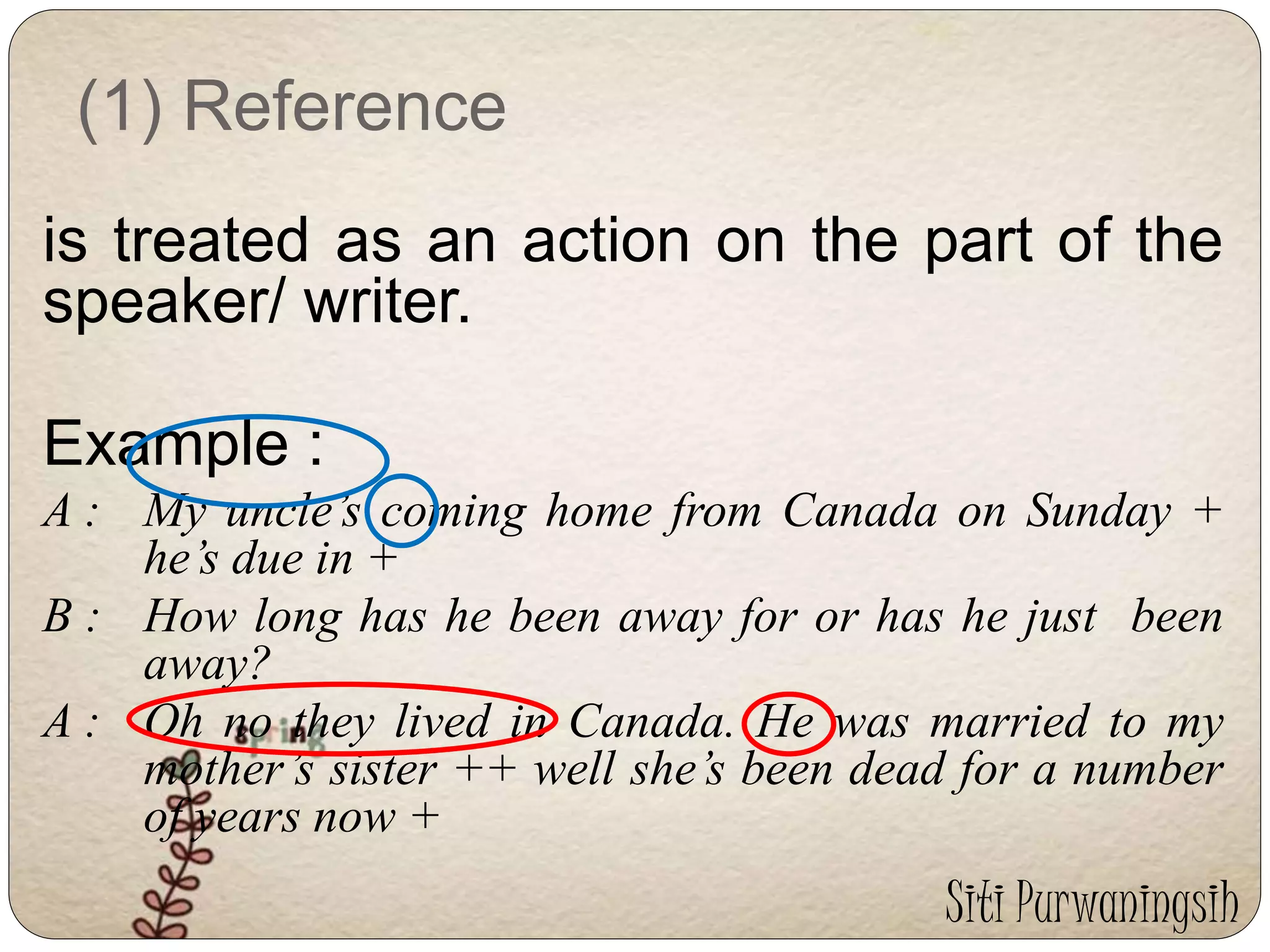
(1) Reference 
is treated as an action on the part of the 
speaker/ writer. 
Example : 
A : My uncle’s coming home from Canada on Sunday + 
he’s due in + 
B : How long has he been away for or has he just been 
away? 
A : Oh no they lived in Canada. He was married to my 
mother’s sister ++ well she’s been dead for a number 
of years now + 
Siti Purwaningsih
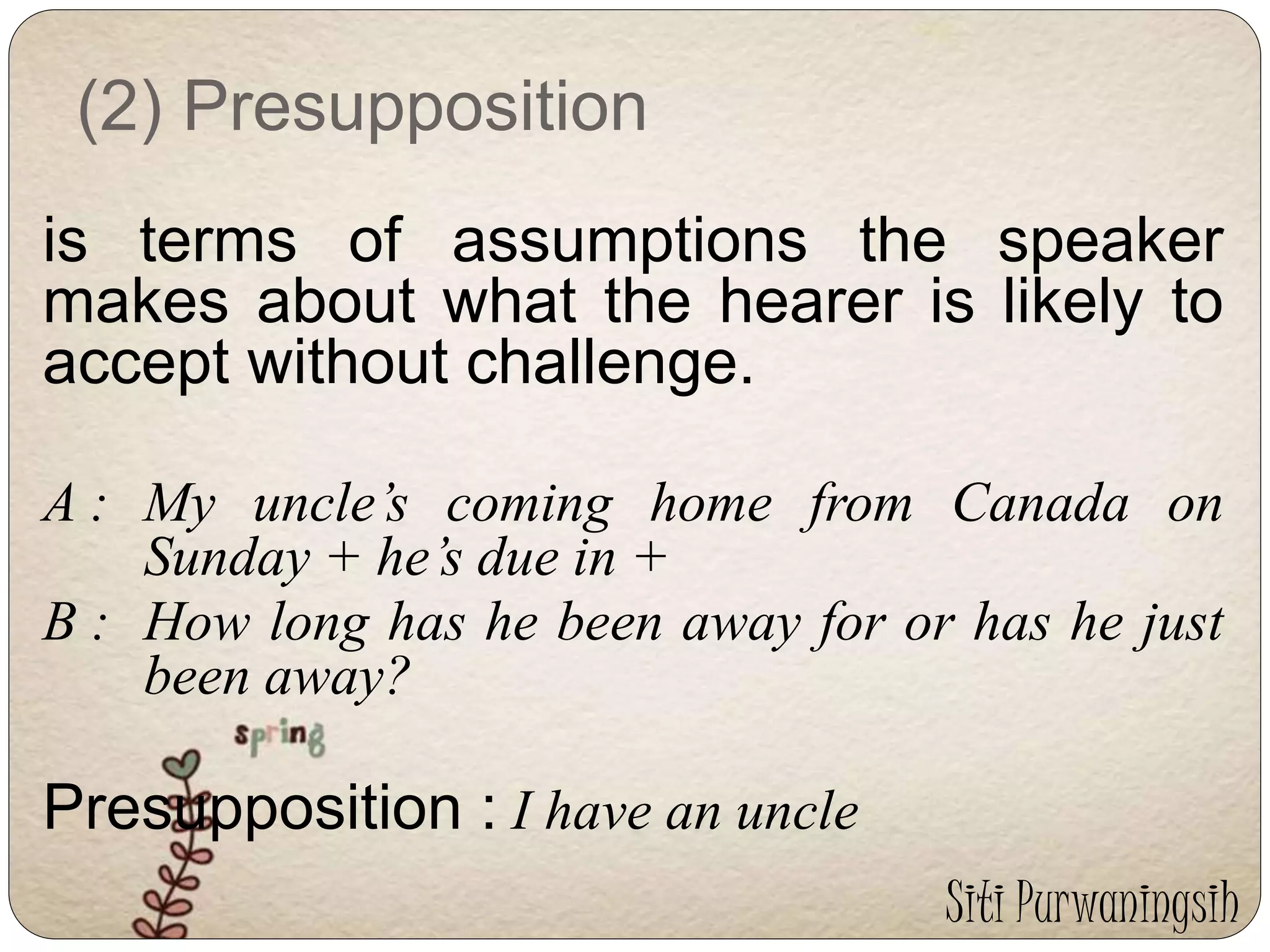
(2) Presupposition 
is terms of assumptions the speaker 
makes about what the hearer is likely to 
accept without challenge. 
A : My uncle’s coming home from Canada on 
Sunday + he’s due in + 
B : How long has he been away for or has he just 
been away? 
Presupposition : I have an uncle 
Siti Purwaningsih
(3) Implicature 
is the term that is used to account what 
the speaker literally says. 
There are conventional implicatures 
and conversational implicatures. 
Siti Purwaningsih
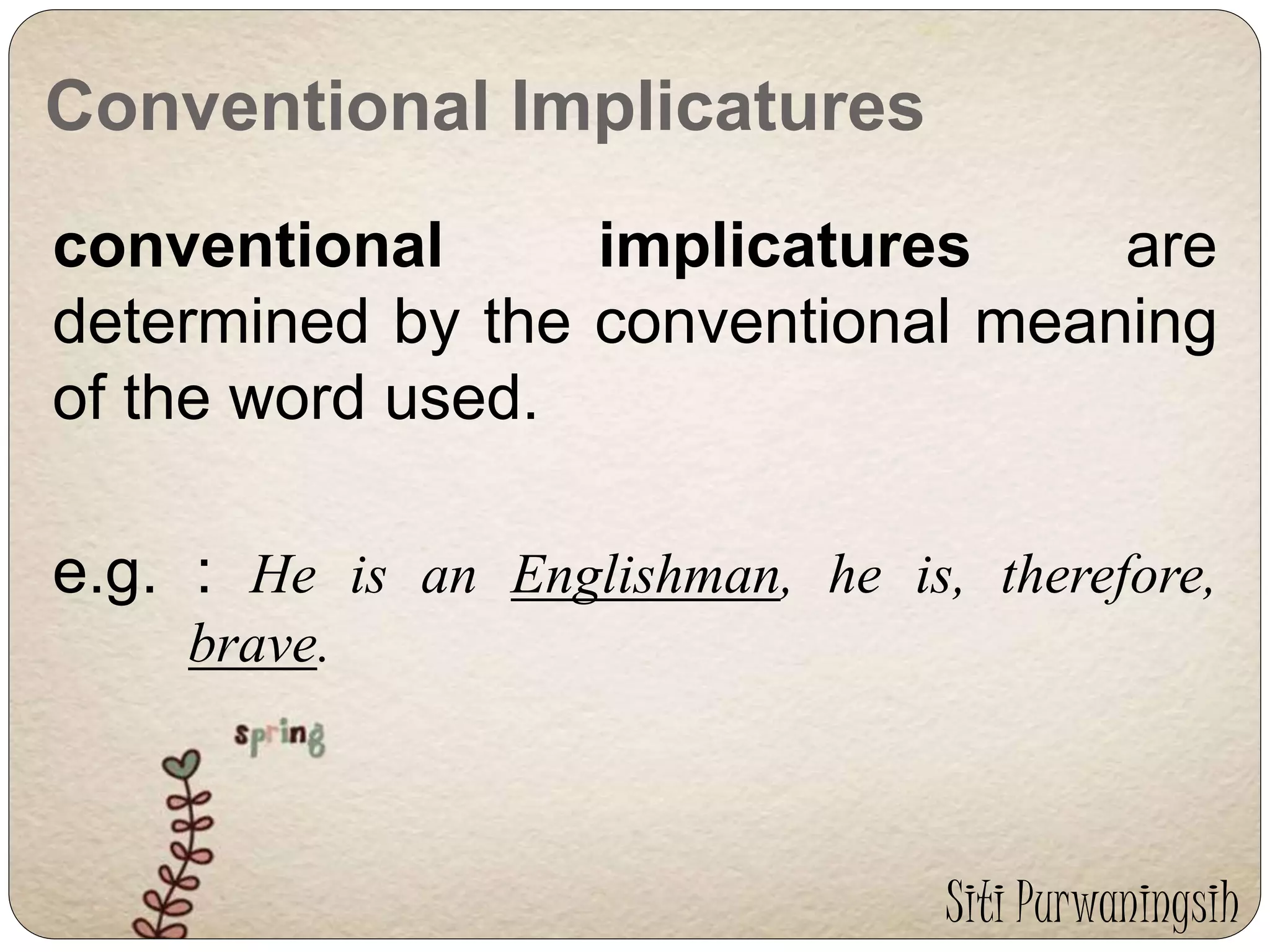
Conventional Implicatures 
conventional implicatures are 
determined by the conventional meaning 
of the word used. 
e.g. : He is an Englishman, he is, therefore, 
brave. 
Siti Purwaningsih
Conversational Implicatures 
derived from a general principle of 
conversation plus a number of maxims 
which speakers will normally obey. (→ 
Cooperative Principle) 
Siti Purwaningsih
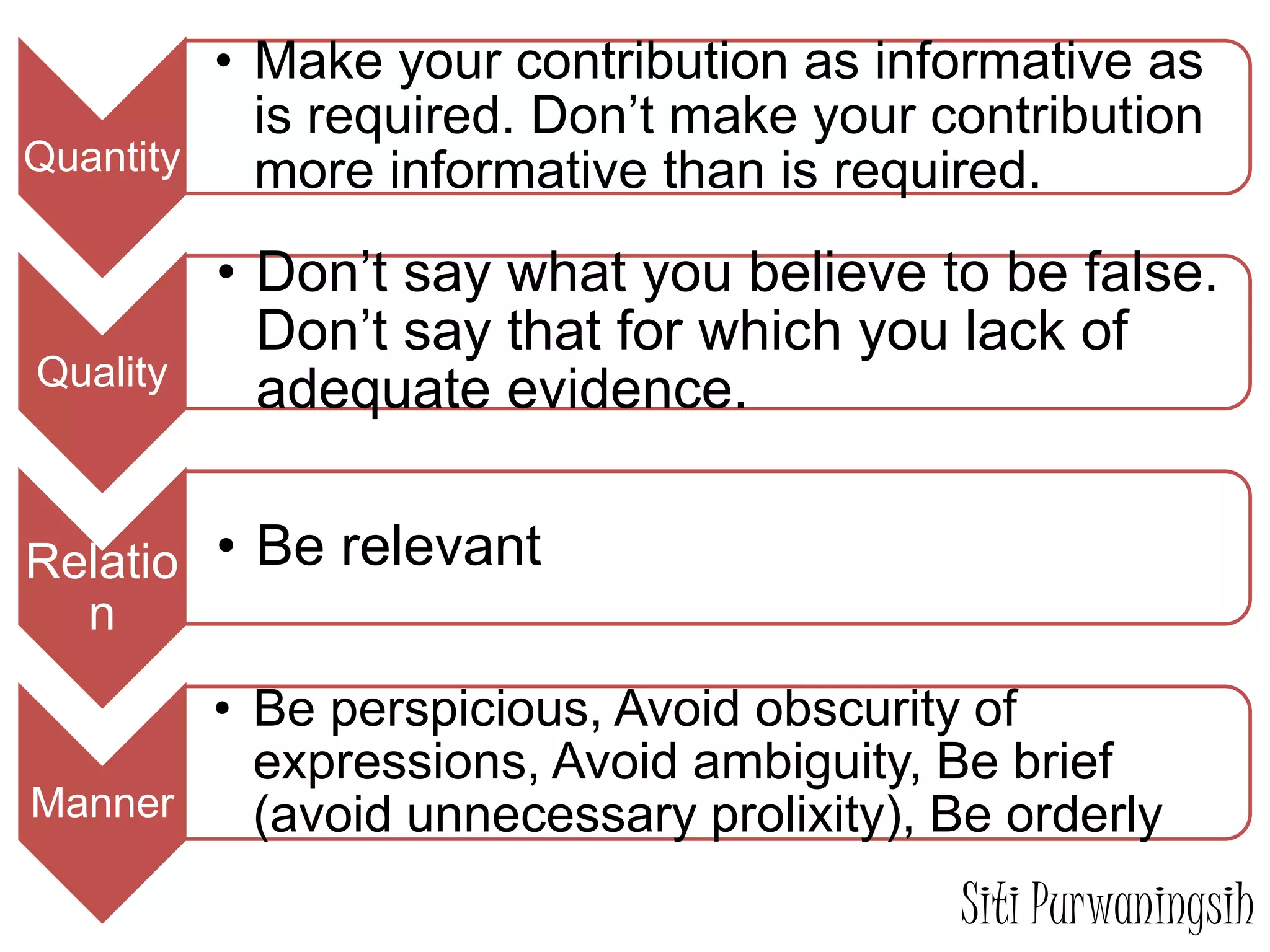
Quantity 
• Make your contribution as informative as 
is required. Don’t make your contribution 
more informative than is required. 
Quality 
• Don’t say what you believe to be false. 
Don’t say that for which you lack of 
adequate evidence. 
Relatio 
n 
• Be relevant 
Manner 
• Be perspicious, Avoid obscurity of 
expressions, Avoid ambiguity, Be brief 
(avoid unnecessary prolixity), Be orderly 
Siti Purwaningsih
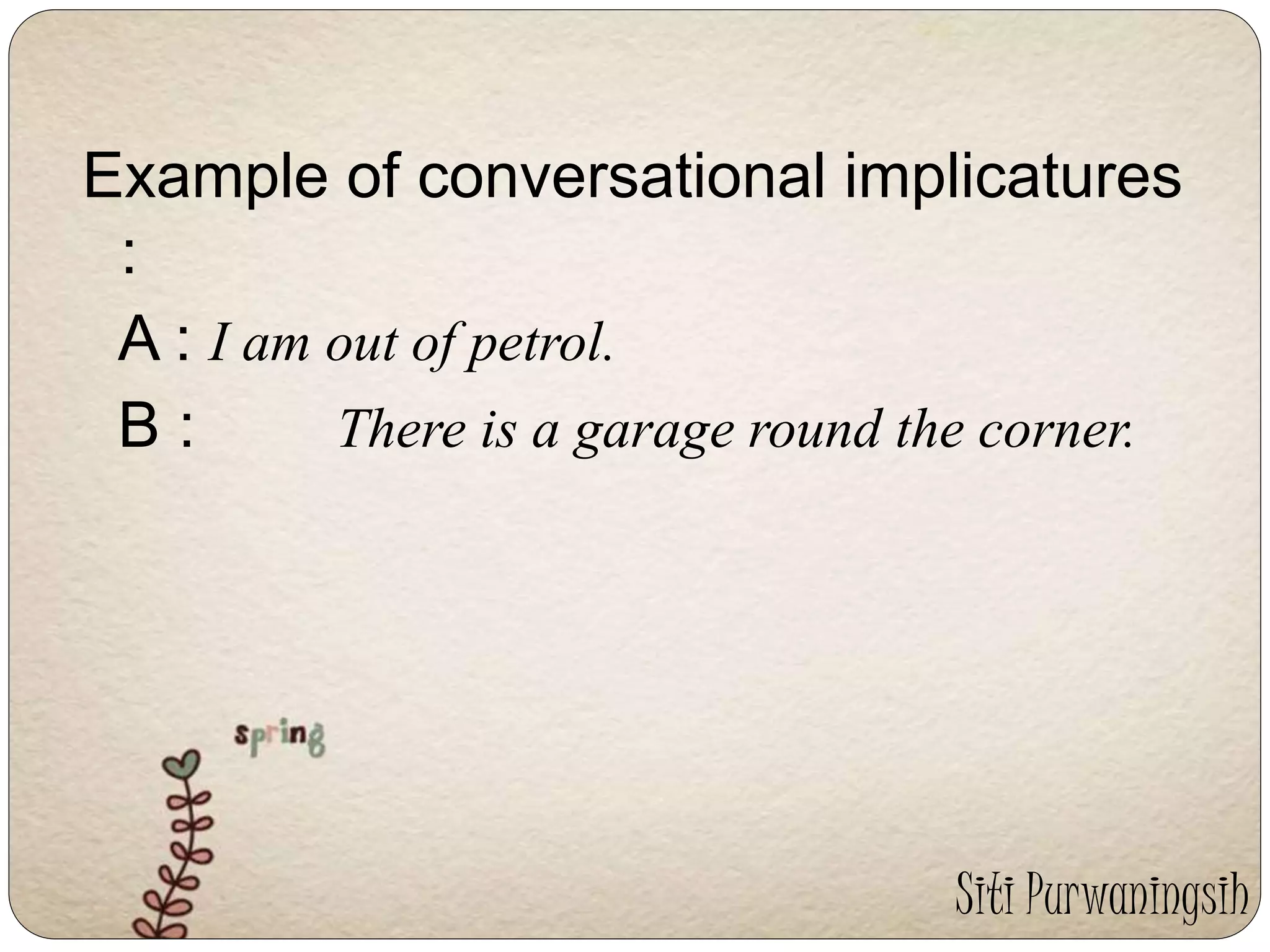
Example of conversational implicatures 
: 
A : I am out of petrol. 
B : There is a garage round the corner. 
Siti Purwaningsih
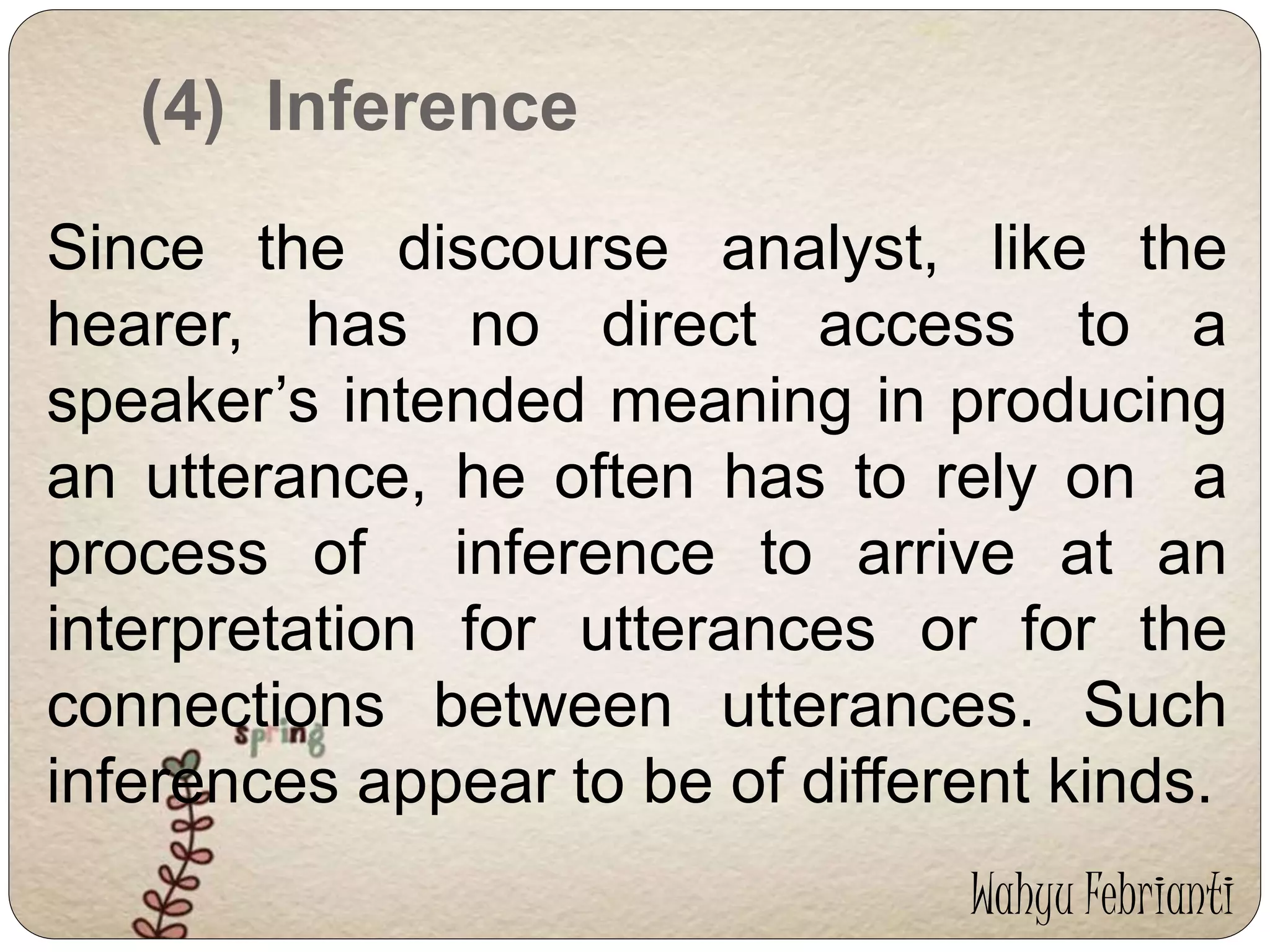
(4) Inference 
Since the discourse analyst, like the 
hearer, has no direct access to a 
speaker’s intended meaning in producing 
an utterance, he often has to rely on a 
process of inference to arrive at an 
interpretation for utterances or for the 
connections between utterances. Such 
inferences appear to be of different kinds. 
Wahyu Febrianti
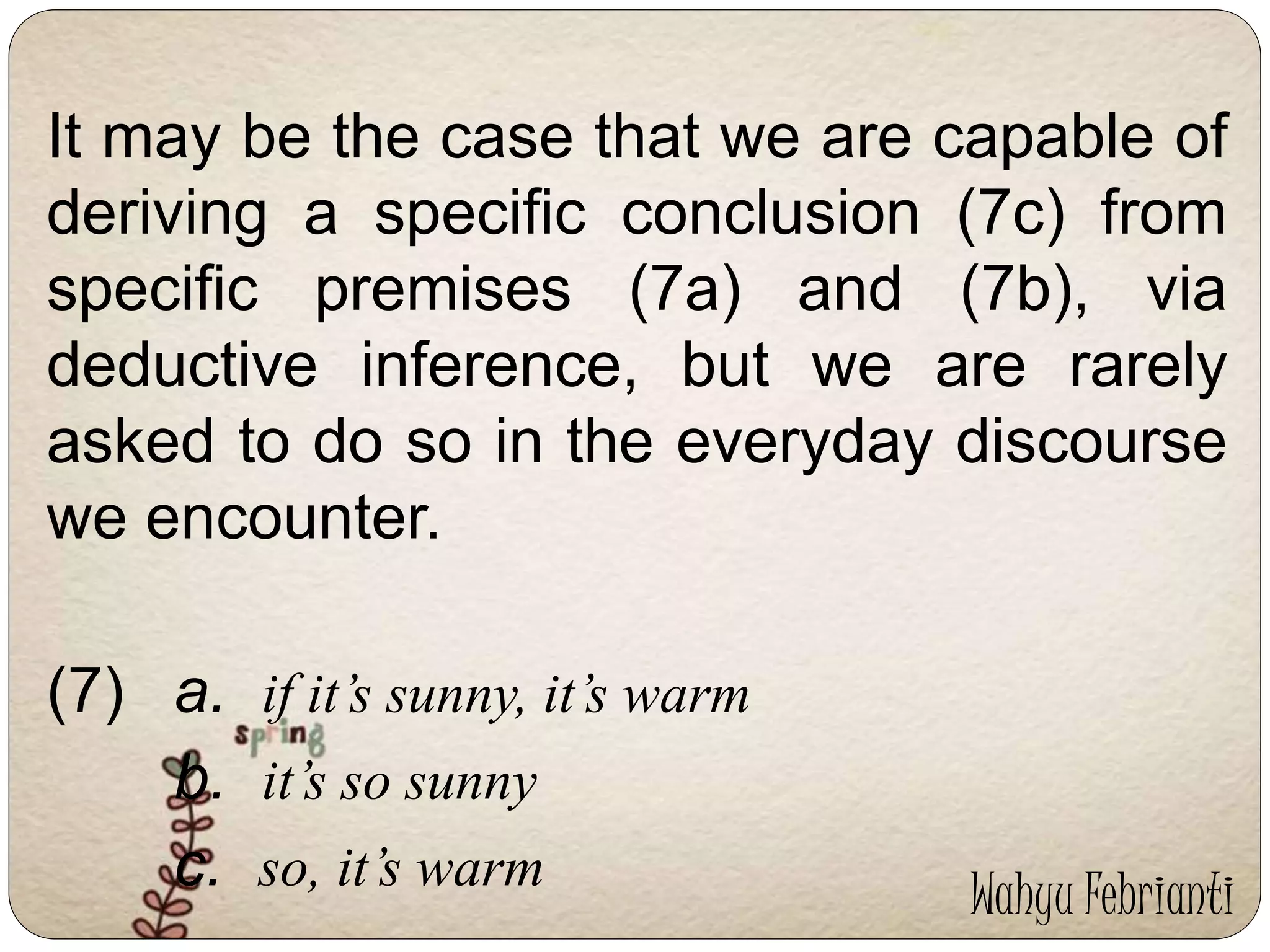
It may be the case that we are capable of 
deriving a specific conclusion (7c) from 
specific premises (7a) and (7b), via 
deductive inference, but we are rarely 
asked to do so in the everyday discourse 
we encounter. 
(7) a. if it’s sunny, it’s warm 
b. it’s so sunny 
c. so, it’s warm Wahyu Febrianti
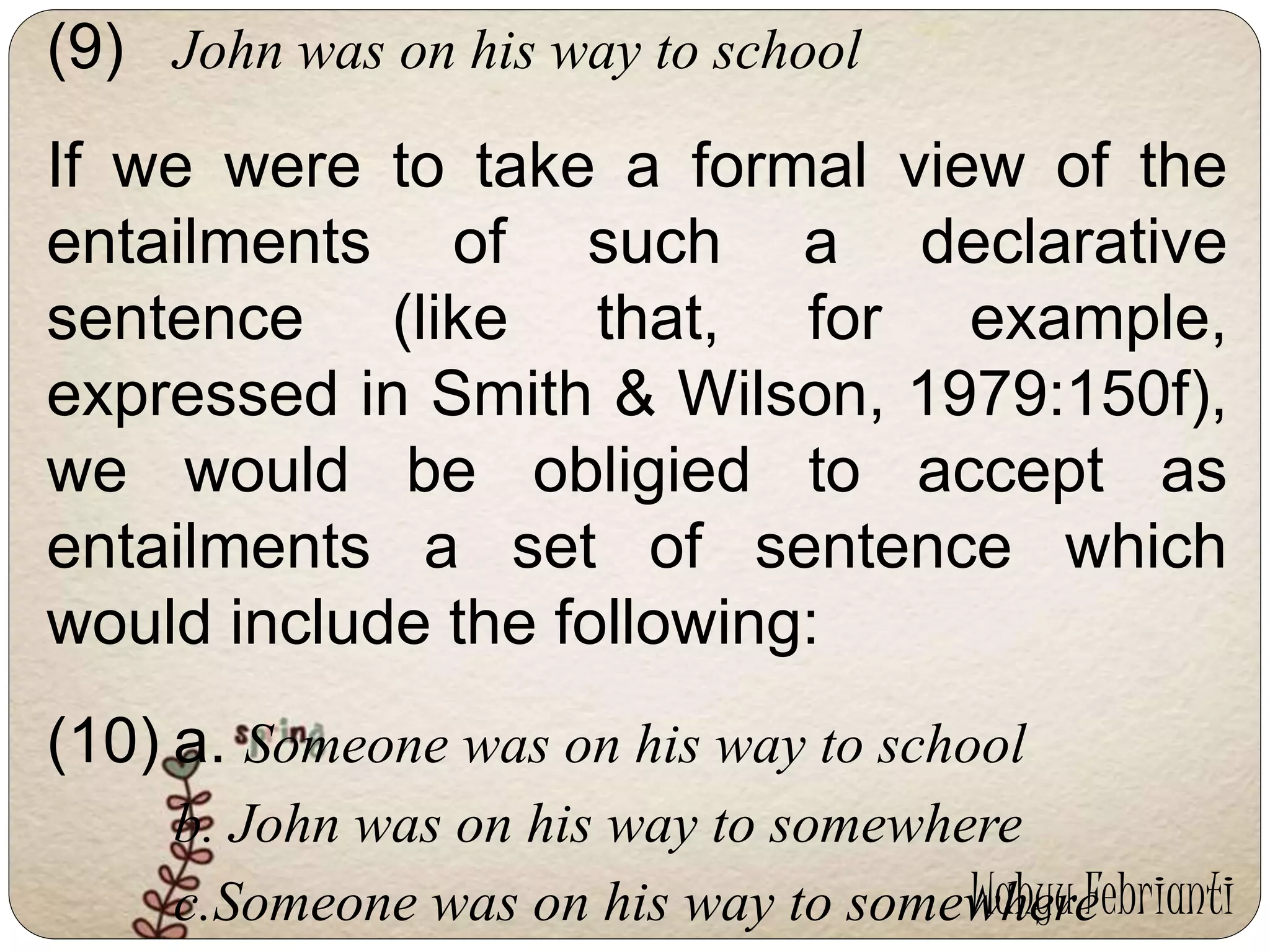
(9) John was on his way to school 
If we were to take a formal view of the 
entailments of such a declarative 
sentence (like that, for example, 
expressed in Smith & Wilson, 1979:150f), 
we would be obligied to accept as 
entailments a set of sentence which 
would include the following: 
(10) a. Someone was on his way to school 
b. John was on his way to somewhere 
c.Someone was on his way to somewhere 
Wahyu Febrianti
I. The Context of Situation 
Since the beginning of the 1970s, 
linguists have become increasingly 
aware of the importance of context in the 
interpretation of sentences. The 
implications of taking context into 
account are well expressed by Sadock 
(1978:281) . 
Wahyu Febrianti
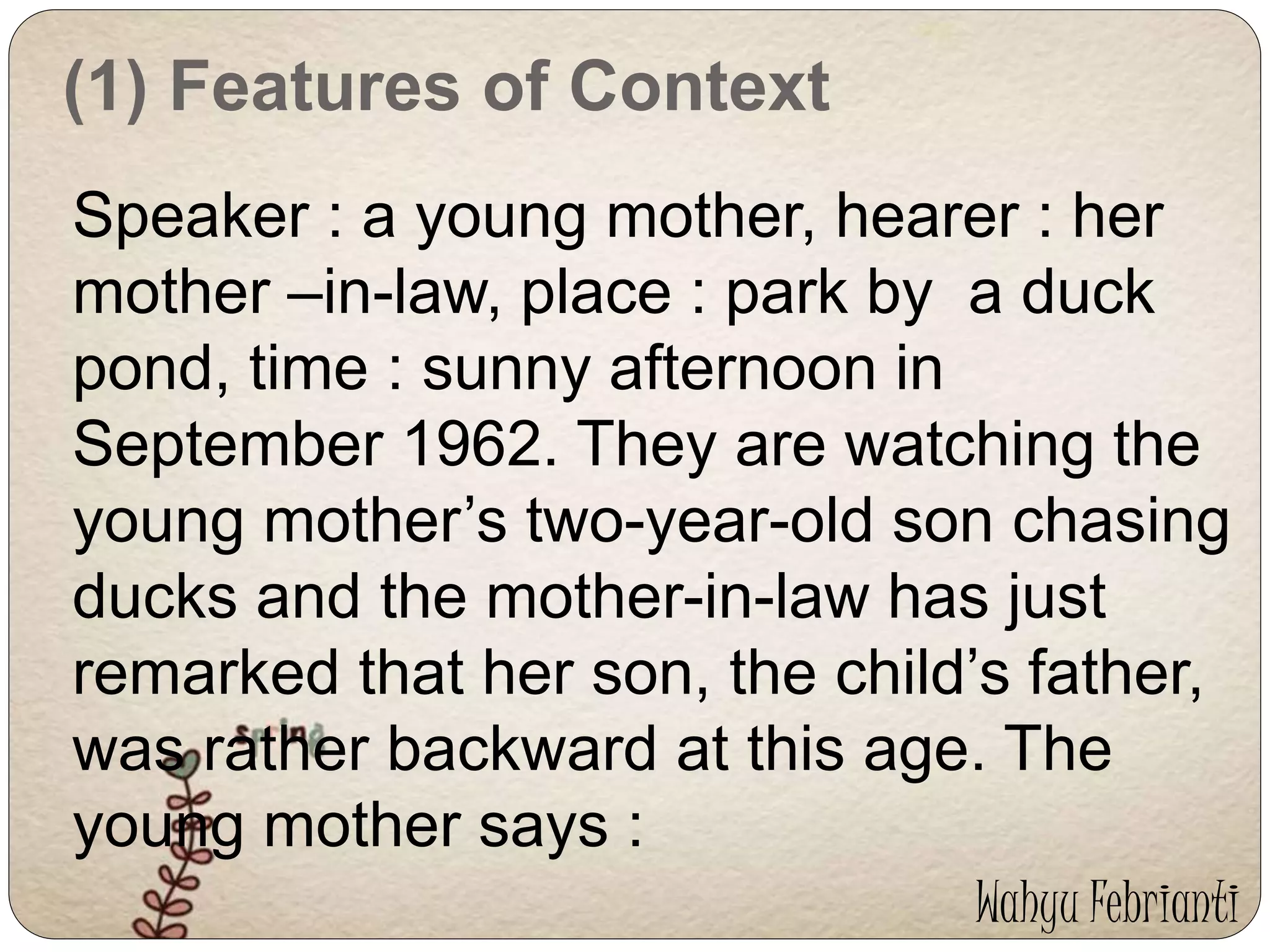
(1) Features of Context 
Speaker : a young mother, hearer : her 
mother –in-law, place : park by a duck 
pond, time : sunny afternoon in 
September 1962. They are watching the 
young mother’s two-year-old son chasing 
ducks and the mother-in-law has just 
remarked that her son, the child’s father, 
was rather backward at this age. The 
young mother says : 
Wahyu Febrianti
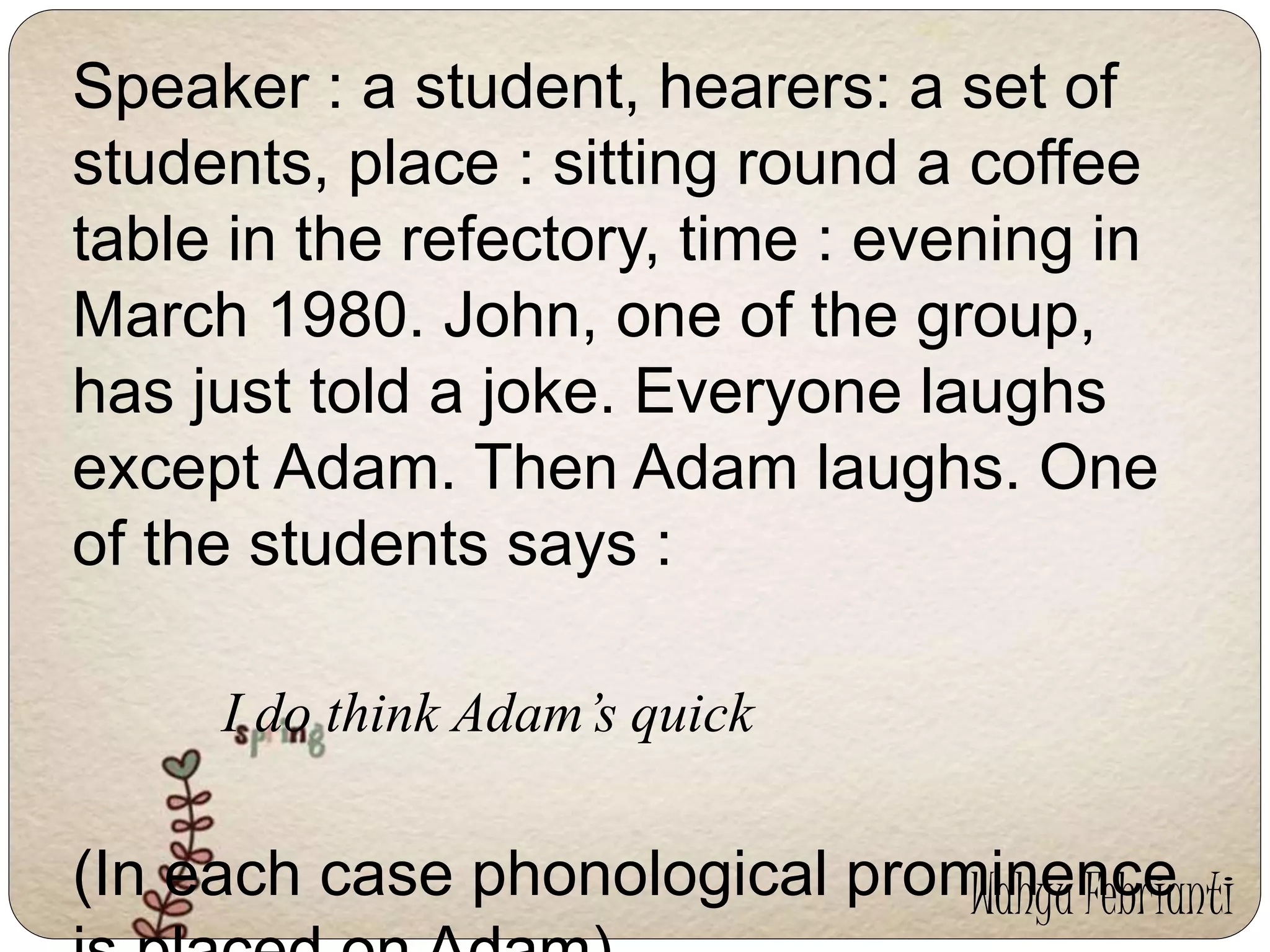
Speaker : a student, hearers: a set of 
students, place : sitting round a coffee 
table in the refectory, time : evening in 
March 1980. John, one of the group, 
has just told a joke. Everyone laughs 
except Adam. Then Adam laughs. One 
of the students says : 
I do think Adam’s quick 
(In each case phonological prominence 
is placed on Adam) 
Wahyu Febrianti
In addition to the long-term identity 
of speakers (Speaker identity) which 
can be indicated by how they 
produce language, there are factors 
in the contexts in which language is 
used that affect both how we use 
language and how it is received. Ririn Desy
Features of context are : 
 Setting and scene 
 Participants 
 Ends 
 Act sequence 
Ririn Desy
(2) Co-text 
concentrated particularly on the physical 
context in which single utterances are 
embedded and we have paid rather little 
attention to the previous dicourse co-ordinate. 
Lewis introduced this co-ordinate 
to take account of sentences 
which include specific reference to what 
Ririn Desy
III. Expanding Context 
We have been concerned to impose 
some sort of analytic structure on the 
lumpen mass of context. 
It is relevant to be identification of a 
speech event as being of a particular 
kind, to the ability of the hearer to 
predict what sort of thing the speaker is 
likely to say in a given type of context, 
and to the constraining of interpretation 
Lingga Widi
Problem of discourse analyst 
When a particular feature is relevant 
to the specification of a particural 
context and what degree of 
specification is required. 
Lingga Widi
Expression 
Those features which relate directly to 
the deictic context, interpretation for 
deictic expressions like : 
Temporal expression now 
e.g calp altogether now (gym 
mistress to class) 
 Spatial expression here 
e.g It’s really nasty day here Lingga Widi
Consider the response of a five and year old 
girl in a Yorkshire infant school where. She is 
asked to say how two pictures are different 
from each other. She replies : 
a. That one’s over there in that but it in’t there. 
The teacher then holds the little girl’s hands, so 
she can’t point shuts her own eyes and says to 
the child. 
b. Now I can’t see the picture. Tell me the 
difference again. 
This time the child says : 
Lingga Widi 
c. In this picture the teddy’s on the chair but there ain’t
IV. The Principles of ‘Local Interpretation’ 
and of ‘Analogy’ 
One principle which we can identify we 
shall call the principle of local 
interpretation. This principle instructs 
the hearer not to construct a context 
any larger than he needs to arrive at an 
interpretation. 
Bagus Rudi
Consider the extract presented 
here, 
a man and woman sitting in the living room.... 
The man’s bored goes to window looks out the 
window.... And goes out + goes to his goes to 
club + has a drink talks to the borman. 
Bagus Rudi
It is this principle, which instructs not to 
construct a context any larger than 
necesssary to secure an interpretation, 
which accounts for how we understand 
Sacks’ (1972) much quoted sequence : 
The Baby cried 
The mommy picked it up 
Bagus Rudi
Experience of similar events which 
enables him to judge what the purpose 
of an utterance might be. It is his 
knowledge of the world which 
constrains his local interpretation. 
Consider the extract presented here, 
a man and women sitting in the living room. . . 
the man’s bored goes to the window . . . goes 
out. . . goes to a club. 
Bagus Rudi
The principle of analogy provide a 
reasonably secure framework for 
interpretation for the hearer and for the 
analyst most of the time, things will 
indeed conform to our expectation. 
Discourse is interpreted in the light of 
past experience of similar discourse, by 
analogy with previous similar texts. Bagus Rudi
Conclusion 
In order to interpret the deictic 
elements in a piece of discourse, it is 
necessary to know (at least) who the 
speaker and hearer are, and time and 
place of the production of the discourse. 
Because the analyst is investigating 
the use of language in context by 
speaker/writer, he is more concerned 
with the relation between the speaker 
and the utterance, on the particular 
occasion of use, than with the potential
thanks

DISCOURSE The Role of Context in Interpretation

  • 1.
    Discourse Analysis TheRole of Context in Interpretation Group 1 Siti Purwaningsih 11.321.159 Wahyu Febrianti 11.321.164 Lingga Widi Pradana 11.321.165 Bagus Rudiantoro 11.321.169 Ririn Desy Ariyani 11.321.176
  • 2.
    • Reference, Presupposition, Implicature, Inference Pragmatic and Discourse Context • Features of context • Co-text The Context of Situation The Expanding Context The Principles of ‘Local Interpretation’ and ‘Analogy’
  • 3.
    I. Pragmatic andDiscourse Context  Discourse analyst necessarily takes a pragmatic approach to the study of language in use.  The discourse analyst is investigating the use of language in the relationship between the speaker and the utterance, on the particular occasion of use. Siti Purwaningsih
  • 4.
    (1) Reference istreated as an action on the part of the speaker/ writer. Example : A : My uncle’s coming home from Canada on Sunday + he’s due in + B : How long has he been away for or has he just been away? A : Oh no they lived in Canada. He was married to my mother’s sister ++ well she’s been dead for a number of years now + Siti Purwaningsih
  • 5.
    (2) Presupposition isterms of assumptions the speaker makes about what the hearer is likely to accept without challenge. A : My uncle’s coming home from Canada on Sunday + he’s due in + B : How long has he been away for or has he just been away? Presupposition : I have an uncle Siti Purwaningsih
  • 6.
    (3) Implicature isthe term that is used to account what the speaker literally says. There are conventional implicatures and conversational implicatures. Siti Purwaningsih
  • 7.
    Conventional Implicatures conventionalimplicatures are determined by the conventional meaning of the word used. e.g. : He is an Englishman, he is, therefore, brave. Siti Purwaningsih
  • 8.
    Conversational Implicatures derivedfrom a general principle of conversation plus a number of maxims which speakers will normally obey. (→ Cooperative Principle) Siti Purwaningsih
  • 9.
    Quantity • Makeyour contribution as informative as is required. Don’t make your contribution more informative than is required. Quality • Don’t say what you believe to be false. Don’t say that for which you lack of adequate evidence. Relatio n • Be relevant Manner • Be perspicious, Avoid obscurity of expressions, Avoid ambiguity, Be brief (avoid unnecessary prolixity), Be orderly Siti Purwaningsih
  • 10.
    Example of conversationalimplicatures : A : I am out of petrol. B : There is a garage round the corner. Siti Purwaningsih
  • 11.
    (4) Inference Sincethe discourse analyst, like the hearer, has no direct access to a speaker’s intended meaning in producing an utterance, he often has to rely on a process of inference to arrive at an interpretation for utterances or for the connections between utterances. Such inferences appear to be of different kinds. Wahyu Febrianti
  • 12.
    It may bethe case that we are capable of deriving a specific conclusion (7c) from specific premises (7a) and (7b), via deductive inference, but we are rarely asked to do so in the everyday discourse we encounter. (7) a. if it’s sunny, it’s warm b. it’s so sunny c. so, it’s warm Wahyu Febrianti
  • 13.
    (9) John wason his way to school If we were to take a formal view of the entailments of such a declarative sentence (like that, for example, expressed in Smith & Wilson, 1979:150f), we would be obligied to accept as entailments a set of sentence which would include the following: (10) a. Someone was on his way to school b. John was on his way to somewhere c.Someone was on his way to somewhere Wahyu Febrianti
  • 14.
    I. The Contextof Situation Since the beginning of the 1970s, linguists have become increasingly aware of the importance of context in the interpretation of sentences. The implications of taking context into account are well expressed by Sadock (1978:281) . Wahyu Febrianti
  • 15.
    (1) Features ofContext Speaker : a young mother, hearer : her mother –in-law, place : park by a duck pond, time : sunny afternoon in September 1962. They are watching the young mother’s two-year-old son chasing ducks and the mother-in-law has just remarked that her son, the child’s father, was rather backward at this age. The young mother says : Wahyu Febrianti
  • 16.
    Speaker : astudent, hearers: a set of students, place : sitting round a coffee table in the refectory, time : evening in March 1980. John, one of the group, has just told a joke. Everyone laughs except Adam. Then Adam laughs. One of the students says : I do think Adam’s quick (In each case phonological prominence is placed on Adam) Wahyu Febrianti
  • 17.
    In addition tothe long-term identity of speakers (Speaker identity) which can be indicated by how they produce language, there are factors in the contexts in which language is used that affect both how we use language and how it is received. Ririn Desy
  • 18.
    Features of contextare :  Setting and scene  Participants  Ends  Act sequence Ririn Desy
  • 19.
    (2) Co-text concentratedparticularly on the physical context in which single utterances are embedded and we have paid rather little attention to the previous dicourse co-ordinate. Lewis introduced this co-ordinate to take account of sentences which include specific reference to what Ririn Desy
  • 20.
    III. Expanding Context We have been concerned to impose some sort of analytic structure on the lumpen mass of context. It is relevant to be identification of a speech event as being of a particular kind, to the ability of the hearer to predict what sort of thing the speaker is likely to say in a given type of context, and to the constraining of interpretation Lingga Widi
  • 21.
    Problem of discourseanalyst When a particular feature is relevant to the specification of a particural context and what degree of specification is required. Lingga Widi
  • 22.
    Expression Those featureswhich relate directly to the deictic context, interpretation for deictic expressions like : Temporal expression now e.g calp altogether now (gym mistress to class)  Spatial expression here e.g It’s really nasty day here Lingga Widi
  • 23.
    Consider the responseof a five and year old girl in a Yorkshire infant school where. She is asked to say how two pictures are different from each other. She replies : a. That one’s over there in that but it in’t there. The teacher then holds the little girl’s hands, so she can’t point shuts her own eyes and says to the child. b. Now I can’t see the picture. Tell me the difference again. This time the child says : Lingga Widi c. In this picture the teddy’s on the chair but there ain’t
  • 24.
    IV. The Principlesof ‘Local Interpretation’ and of ‘Analogy’ One principle which we can identify we shall call the principle of local interpretation. This principle instructs the hearer not to construct a context any larger than he needs to arrive at an interpretation. Bagus Rudi
  • 25.
    Consider the extractpresented here, a man and woman sitting in the living room.... The man’s bored goes to window looks out the window.... And goes out + goes to his goes to club + has a drink talks to the borman. Bagus Rudi
  • 26.
    It is thisprinciple, which instructs not to construct a context any larger than necesssary to secure an interpretation, which accounts for how we understand Sacks’ (1972) much quoted sequence : The Baby cried The mommy picked it up Bagus Rudi
  • 27.
    Experience of similarevents which enables him to judge what the purpose of an utterance might be. It is his knowledge of the world which constrains his local interpretation. Consider the extract presented here, a man and women sitting in the living room. . . the man’s bored goes to the window . . . goes out. . . goes to a club. Bagus Rudi
  • 28.
    The principle ofanalogy provide a reasonably secure framework for interpretation for the hearer and for the analyst most of the time, things will indeed conform to our expectation. Discourse is interpreted in the light of past experience of similar discourse, by analogy with previous similar texts. Bagus Rudi
  • 29.
    Conclusion In orderto interpret the deictic elements in a piece of discourse, it is necessary to know (at least) who the speaker and hearer are, and time and place of the production of the discourse. Because the analyst is investigating the use of language in context by speaker/writer, he is more concerned with the relation between the speaker and the utterance, on the particular occasion of use, than with the potential
  • 30.