Discourse
What is discourse?
Discourse can be defined in three ways:
 1. Language beyond the level of a sentence
 2. Language behaviors linked to social practices
 3. Language as a system of thought.
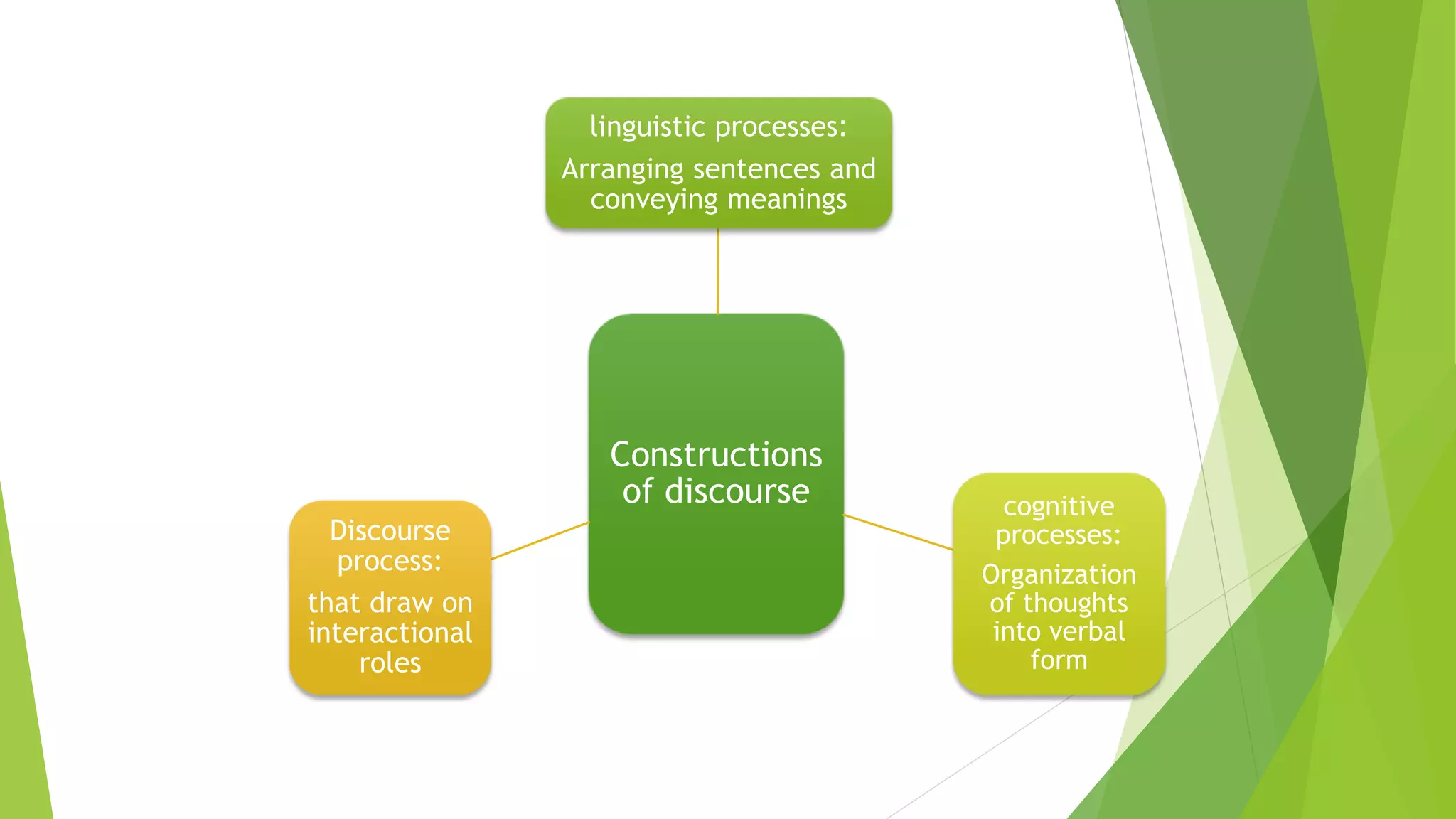
Constructions
of discourse
linguistic processes:
Arranging sentences and
conveying meanings
cognitive
processes:
Organization
of thoughts
into verbal
form
Discourse
process:
that draw on
interactional
roles
Discourse analysis
 Discourse analysis focuses on the patterns in which
sentences (and other units such as acts and turns)
appear in the texts that are constructed as people
interact with one another in social contexts.
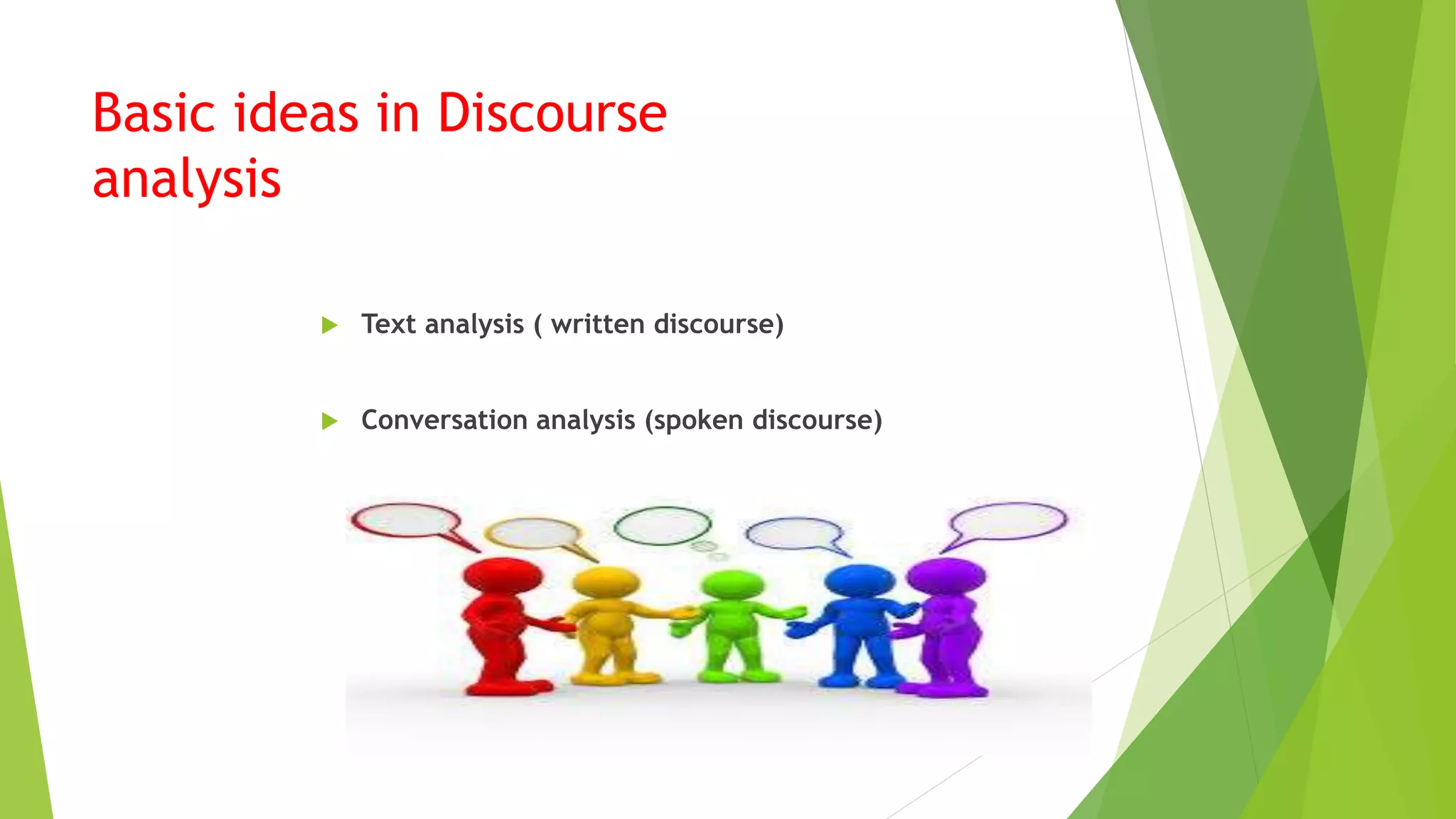
Basic ideas in Discourse
analysis
 Text analysis ( written discourse)
 Conversation analysis (spoken discourse)
Goals of speaking
 1. Verbalize thoughts
 2. Introduce new information
 3. Repair errors
 4. Take turns
 5. Think of others
 6. Perform acts
Spoken discourse
 Sequential and distributional analysis
 Repair and recipient design
 Adjacency pairs
 Participation frameworks
 Narratives
Sequential and distributional analysis
Readings which focuses on:
 Sequential analysis:
the sequence of what happens
 Distributional analysis:
the distribution of specific features or qualities of language in
the discourse
Repair and recipient design
 Repair :
a term for ways in which errors, unintended form or
misunderstandings are corrected by the speaker.
 Recipient design:
The process whereby a speaker takes the listener into account
when presenting information.
Adjacency pairs
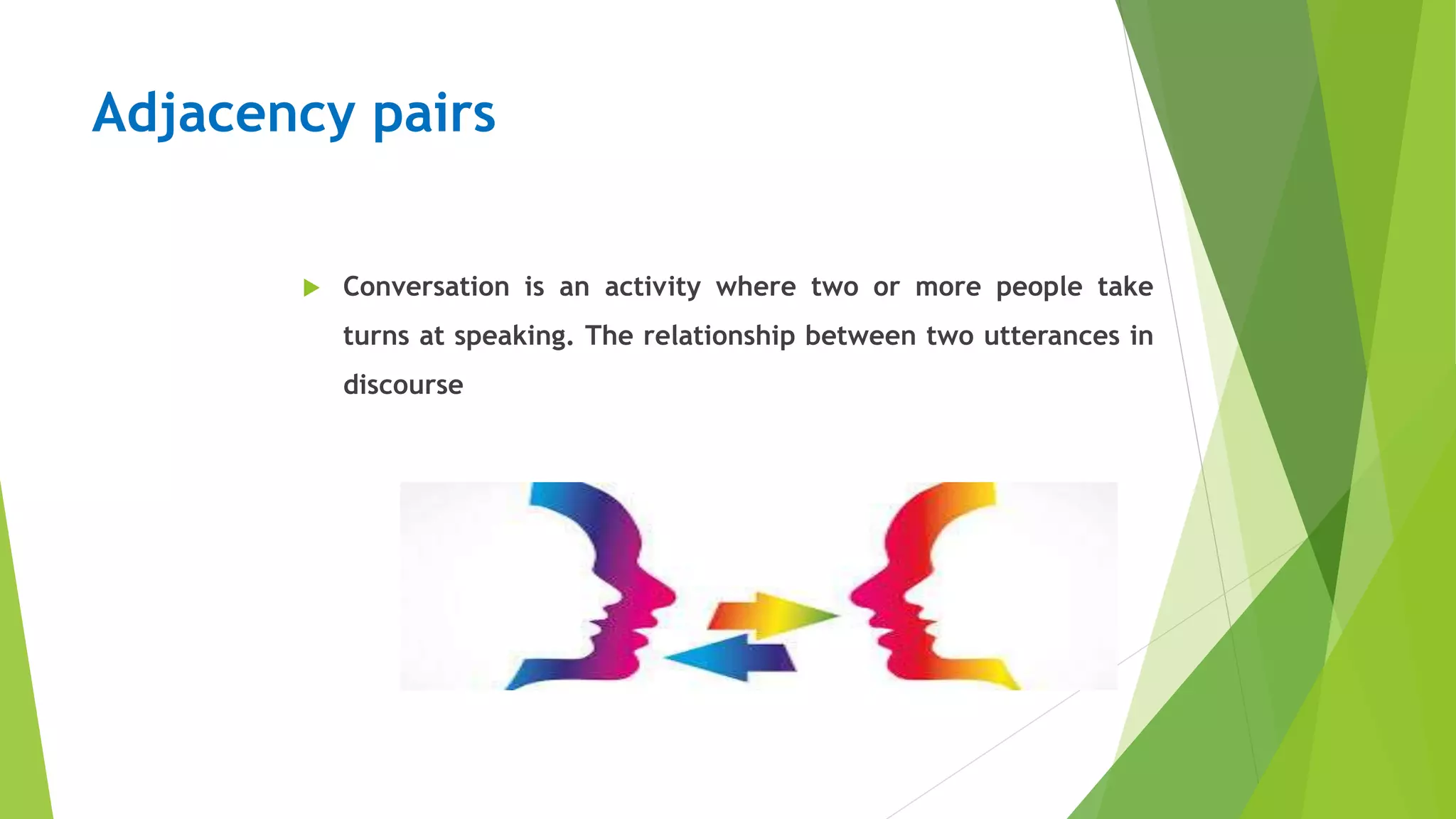
 Conversation is an activity where two or more people take
turns at speaking. The relationship between two utterances in
discourse
Participation frameworks
 The ways that people interacting with one another take
responsibility for speaking, listening, and acting are part of the
participation framework.
 Turn transition place / transition relevance place:
A place where another speaker can take a turn
o Other-repair:
a repair at problematic item in another speakers’ utterance
Narratives
 Narratives organize information differently than other genres, such as
descriptions, explanations, and lists. For example, narratives present
events in temporal order of occurrence, but lists need not
Narrative structure
 •Abstract: a summary of the experience or its point
 •Orientation: background description
 •Complicating action: “what happened,” a series of temporally ordered
events that have beginning and end points
 •Evaluation: syntactic, prosodic, textual alterations of the narrative norm
that highlight important parts of the story and/or help convey why the
story is being told
 •Coda: closure that brings the “past” of the narrative to the “present” of
the interaction in which it was told
Schemas and scripts
 Schema is a conventional knowledge which exists in
memory.(school, office….)
 Script is essentially a dynamic schema in which conventional
actions take place.(taking the train, traveling on an airplane,
eating at a restaurant
Cohesion
cohesion is the grammatical and/or lexical relationships
between the different elements of a text. For Example:
My father once bought a Lincoln convertible. He did it by saving every
penny he could. That car would be worth a fortune nowadays.
However, he sold it to help pay for my college education. Sometimes I
think I‟d rather have the convertible.
Cohesive ties ( In reference):
Father- he- he- he;
“A” Lincoln convertible- that car- it- “the” convertible
Cohesive Devices
Pronouns or Substitution:
In order to avoid repeating the same words several times in one paragraph
it is replaced, most often by one, do or so.
Ellipsis:
It is very similar to substitution, however, it replaces a phrase by a gap.
(Omission of noun, verb, or a clause on the assumption)
Conjunctions:
Specifies the relationship between clauses or sentences. Most frequent
relations of sentences are: addition (and, moreover), temporality
(afterwards, next) and causality (because, or since).
 Reference:
The use of words which do not have meanings of their own, such as
pronouns and articles.
 Lexical cohesion:
Denotes links between words which carry meanings: verbs, nouns,
adjectives. There are two types of lexical cohesion namely
reiteration and collocation
Coherence
Coherence is the relationships which link the meanings of
utterances in a discourse or of the sentences in a text.
Example:
HER: That‟s the telephone
HIM: I‟m in the bath
HER: O.K.
There are certainly no cohesive ties within this fragment of discourse.
Here we see coherence but no cohesion.
Cohesion and coherence
Cohesion helps to create coherence.
Cohesion does not entail coherence
Coherence can be made with/out cohesive ties/ devises.
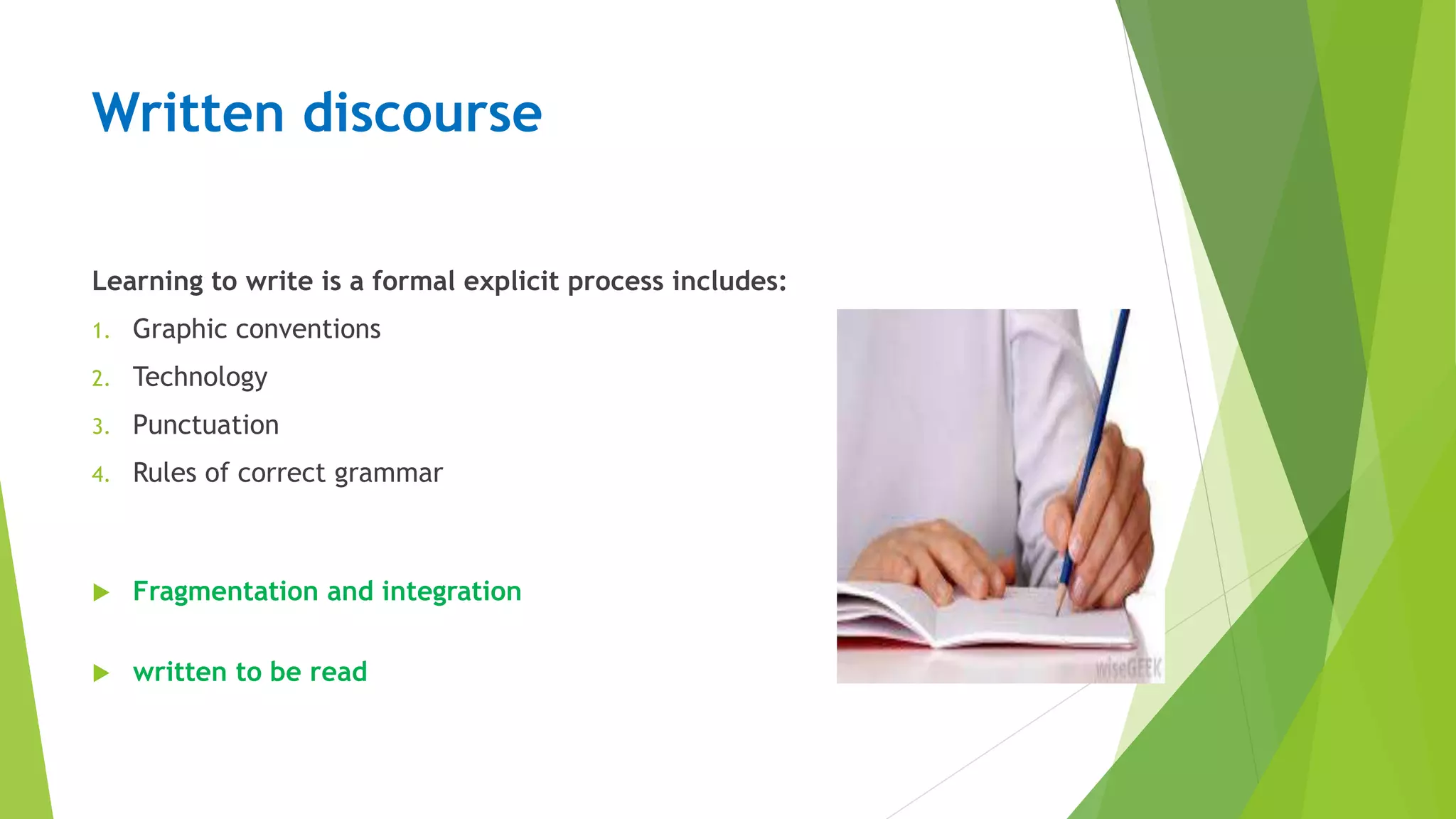
Written discourse
Learning to write is a formal explicit process includes:
1. Graphic conventions
2. Technology
3. Punctuation
4. Rules of correct grammar
 Fragmentation and integration
 written to be read
Fragmentation and integration
 Fragmentation:
the segmentation of information into small, syntactically simple
chunks of language that present roughly one idea at a time.
 Integration:
the arrangement of information into long, syntactically complex
chunks of language that present more than one idea at a time.
Written to be read
In written discourse:
 The writer has to anticipate
the informational need
 The writer anticipates what
maintains the readers
interests
In spoken discourse:
 Provides feedback
 Has a chance to speak
Register and register variation:
 Registers:
ways of using the language that reflects different facets of its context
 Register variation:
language variation according to situation
Values to describe a situation:
 Setting
Physical location and social significance
 Participant
Respective social status, local roles in interaction
 Ends
Purpose of the event, respective goals of the participants
 Act sequences
Speech acts that are functionally or conventionally appropriate to the
situation
Values to describe a situation:
 Key
Tone or mood (e.g. serious, ironic)
 Instrumentalities
Mode of communication (e.g. spoken, written, via telephone)
 Norms
Expectations of behavior and their interpretation
 Genres
Type of event (e.g. conversation, lecture, sermon)
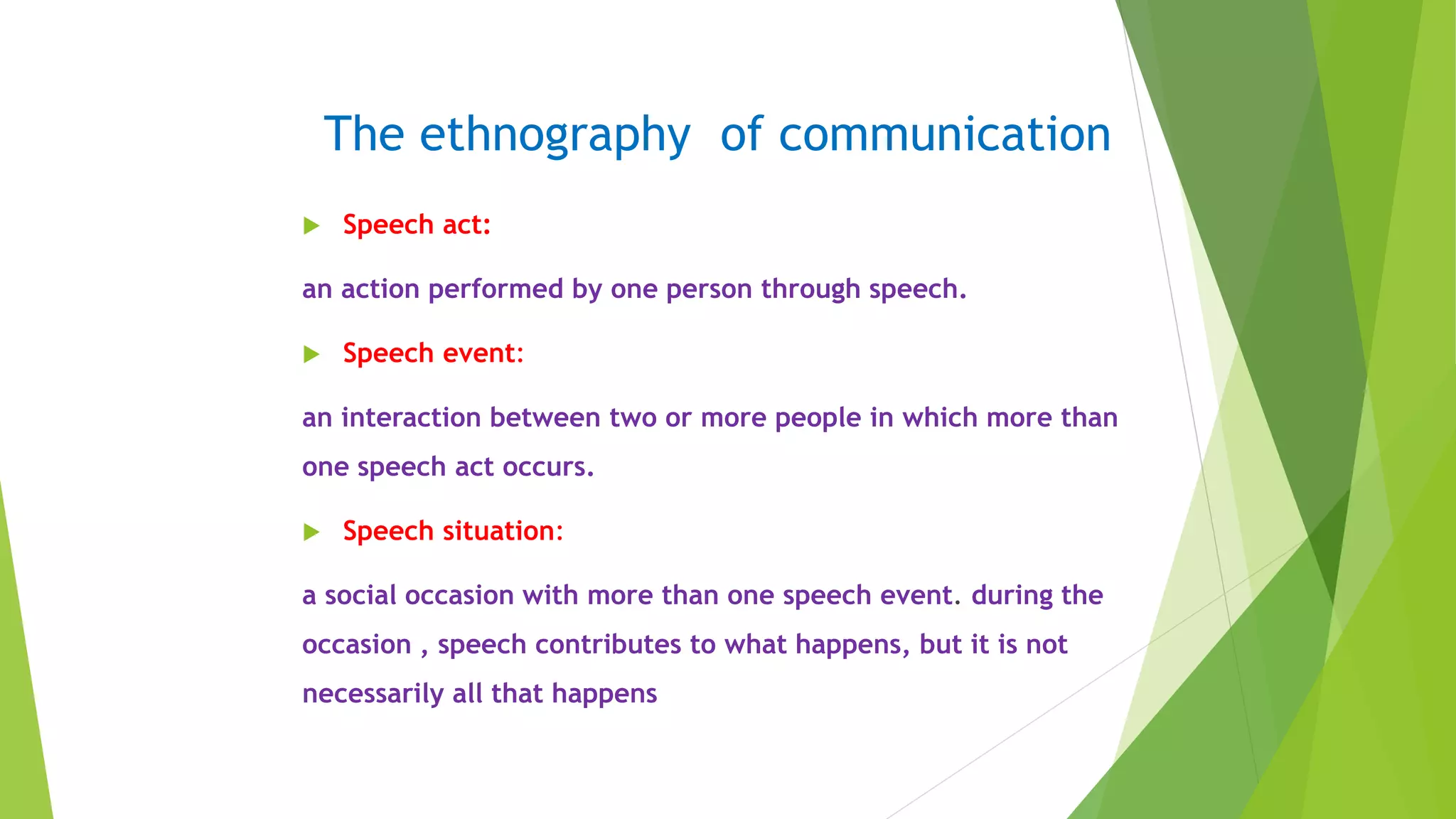
The ethnography of communication
 Speech act:
an action performed by one person through speech.
 Speech event:
an interaction between two or more people in which more than
one speech act occurs.
 Speech situation:
a social occasion with more than one speech event. during the
occasion , speech contributes to what happens, but it is not
necessarily all that happens
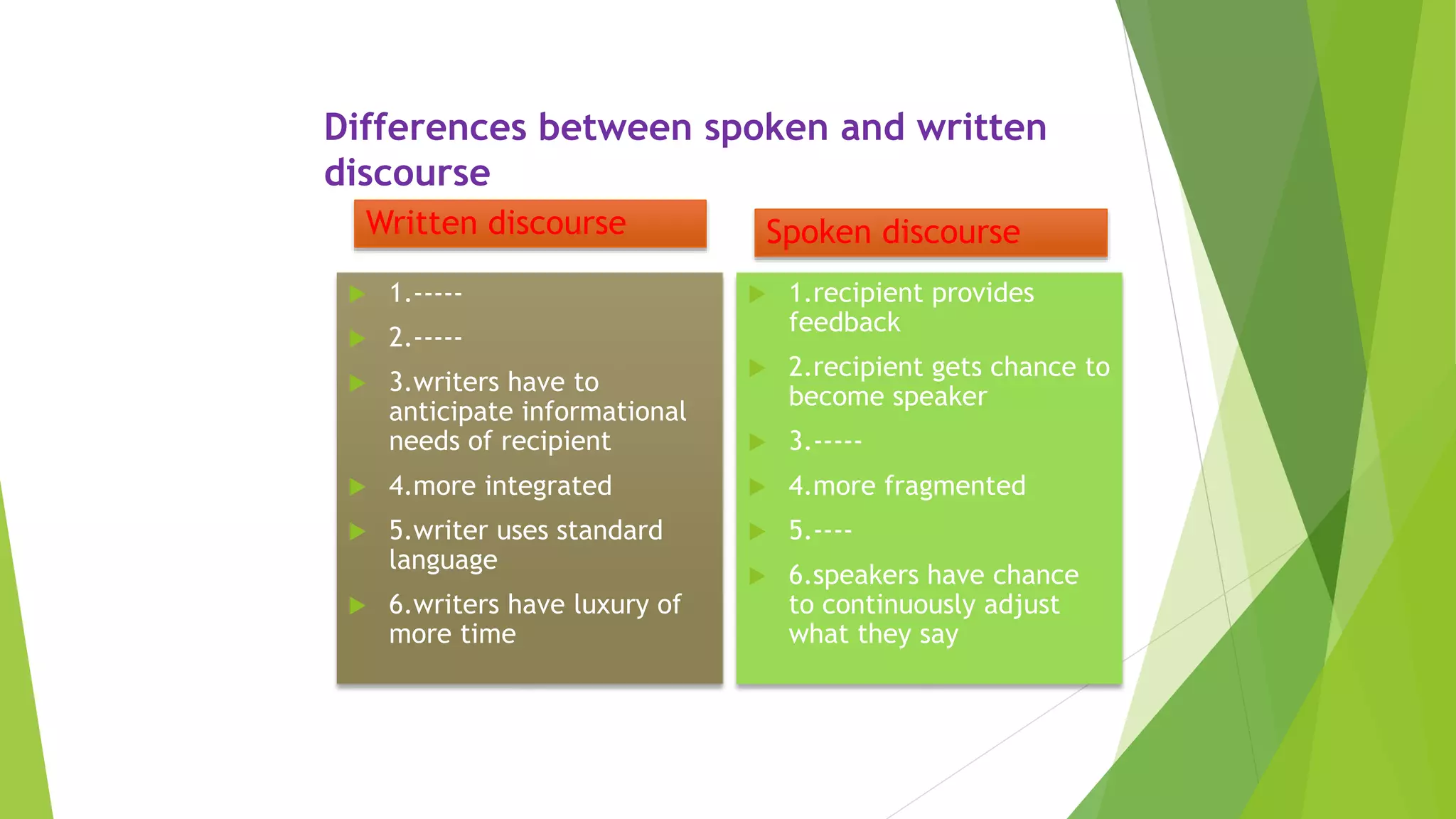
Differences between spoken and written
discourse
Written discourse
 1.-----
 2.-----
 3.writers have to
anticipate informational
needs of recipient
 4.more integrated
 5.writer uses standard
language
 6.writers have luxury of
more time
Spoken discourse
 1.recipient provides
feedback
 2.recipient gets chance to
become speaker
 3.-----
 4.more fragmented
 5.----
 6.speakers have chance
to continuously adjust
what they say
Language function
 All approaches to discourse analysis address the functions of language, the
structures of texts, and the relationship between text and context. A main
function of language is referential. Other functions are social and expressive
functions .
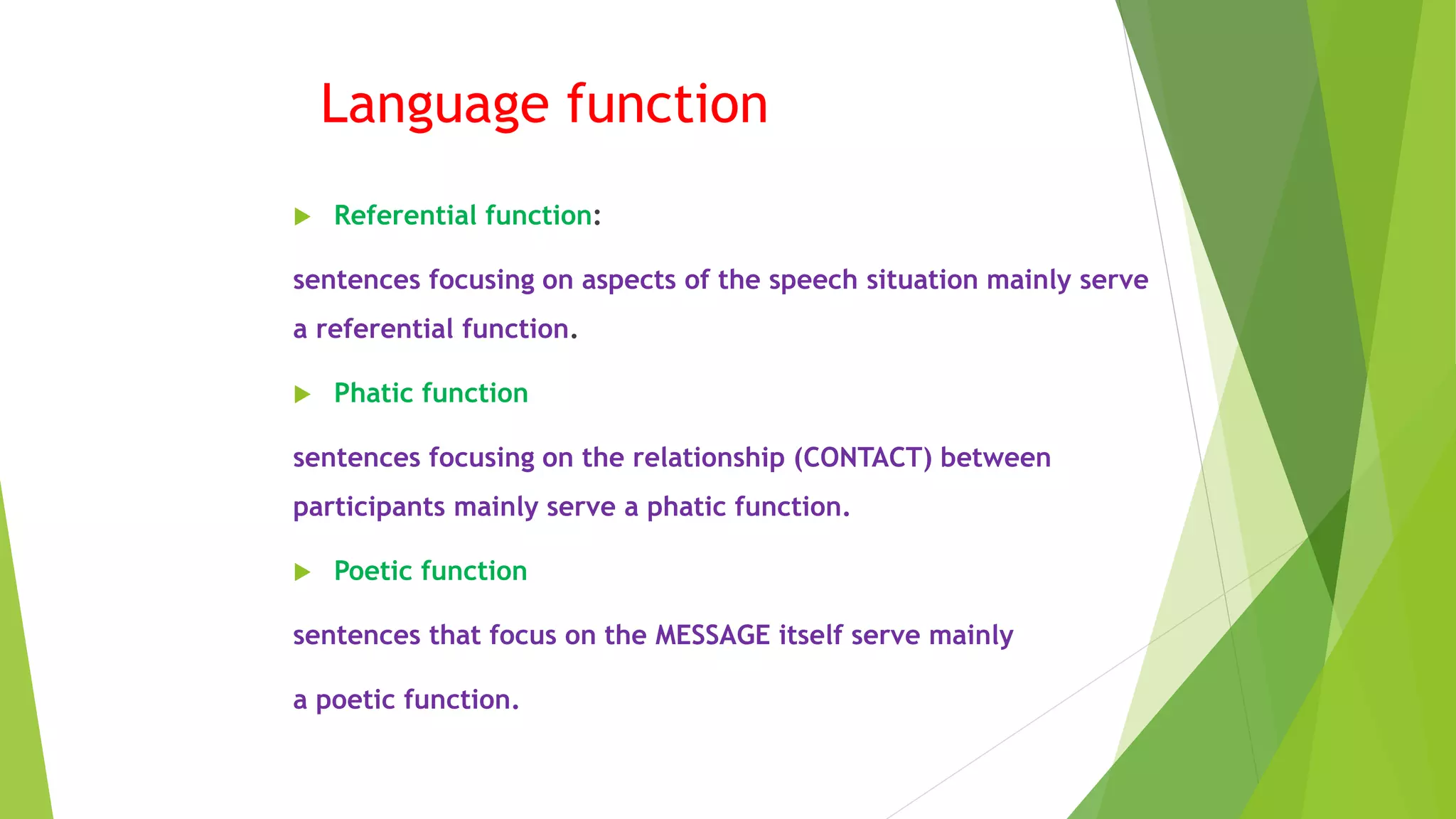
Language function
 Referential function:
sentences focusing on aspects of the speech situation mainly serve
a referential function.
 Phatic function
sentences focusing on the relationship (CONTACT) between
participants mainly serve a phatic function.
 Poetic function
sentences that focus on the MESSAGE itself serve mainly
a poetic function.
Language function
 Emotive function
sentences that express the impact of some facet of the external
world (context) or internal world (feelings, sensations) on the
ADDRESSOR mainly serve the emotive function.
 Conative function
sentences that focus on the relation of the ADDRESSEE to the
context or the interaction mainly serve the conative function.
 Metalinguistic function
sentences focusing on the relation between code and situation
serve mainly a metalinguistic function.
Planes of discourse
 An utterance expresses far more meaning than the sentence it contains.
Focusing on utterances allows us to see how several planes of context are
related to, and expressed through, the language used in an utterance.
Planes of discourse
 Participation framework
is the way that people organize and maintain an interaction by
adopting and adapting roles, identities, and ways of acting and
interacting.
 Exchange structure
It concerns the way people take turns in talk: how do we know
when to start talking? Do we ever overlap, and if so, where,
when, how and why?
Planes of discourse
 Act structures:
Act structures are ordered sequences of actions performed through
speech
 Information state
It is the distribution of knowledge among people inter-acting with
one another. Speakers take into account their listeners’
informational needs as they construct their utterances
 Idea structure
It concerns the organization of information within a sentence and
the organization of propositions in a text
Thanks

discourse analysis

  • 1.
  • 2.
    What is discourse? Discoursecan be defined in three ways:  1. Language beyond the level of a sentence  2. Language behaviors linked to social practices  3. Language as a system of thought.
  • 3.
    Constructions of discourse linguistic processes: Arrangingsentences and conveying meanings cognitive processes: Organization of thoughts into verbal form Discourse process: that draw on interactional roles
  • 4.
    Discourse analysis  Discourseanalysis focuses on the patterns in which sentences (and other units such as acts and turns) appear in the texts that are constructed as people interact with one another in social contexts.
  • 5.
    Basic ideas inDiscourse analysis  Text analysis ( written discourse)  Conversation analysis (spoken discourse)
  • 6.
    Goals of speaking 1. Verbalize thoughts  2. Introduce new information  3. Repair errors  4. Take turns  5. Think of others  6. Perform acts
  • 7.
    Spoken discourse  Sequentialand distributional analysis  Repair and recipient design  Adjacency pairs  Participation frameworks  Narratives
  • 8.
    Sequential and distributionalanalysis Readings which focuses on:  Sequential analysis: the sequence of what happens  Distributional analysis: the distribution of specific features or qualities of language in the discourse
  • 9.
    Repair and recipientdesign  Repair : a term for ways in which errors, unintended form or misunderstandings are corrected by the speaker.  Recipient design: The process whereby a speaker takes the listener into account when presenting information.
  • 10.
    Adjacency pairs  Conversationis an activity where two or more people take turns at speaking. The relationship between two utterances in discourse
  • 11.
    Participation frameworks  Theways that people interacting with one another take responsibility for speaking, listening, and acting are part of the participation framework.  Turn transition place / transition relevance place: A place where another speaker can take a turn o Other-repair: a repair at problematic item in another speakers’ utterance
  • 12.
    Narratives  Narratives organizeinformation differently than other genres, such as descriptions, explanations, and lists. For example, narratives present events in temporal order of occurrence, but lists need not
  • 13.
    Narrative structure  •Abstract:a summary of the experience or its point  •Orientation: background description  •Complicating action: “what happened,” a series of temporally ordered events that have beginning and end points  •Evaluation: syntactic, prosodic, textual alterations of the narrative norm that highlight important parts of the story and/or help convey why the story is being told  •Coda: closure that brings the “past” of the narrative to the “present” of the interaction in which it was told
  • 14.
    Schemas and scripts Schema is a conventional knowledge which exists in memory.(school, office….)  Script is essentially a dynamic schema in which conventional actions take place.(taking the train, traveling on an airplane, eating at a restaurant
  • 15.
    Cohesion cohesion is thegrammatical and/or lexical relationships between the different elements of a text. For Example: My father once bought a Lincoln convertible. He did it by saving every penny he could. That car would be worth a fortune nowadays. However, he sold it to help pay for my college education. Sometimes I think I‟d rather have the convertible. Cohesive ties ( In reference): Father- he- he- he; “A” Lincoln convertible- that car- it- “the” convertible
  • 16.
    Cohesive Devices Pronouns orSubstitution: In order to avoid repeating the same words several times in one paragraph it is replaced, most often by one, do or so. Ellipsis: It is very similar to substitution, however, it replaces a phrase by a gap. (Omission of noun, verb, or a clause on the assumption) Conjunctions: Specifies the relationship between clauses or sentences. Most frequent relations of sentences are: addition (and, moreover), temporality (afterwards, next) and causality (because, or since).
  • 17.
     Reference: The useof words which do not have meanings of their own, such as pronouns and articles.  Lexical cohesion: Denotes links between words which carry meanings: verbs, nouns, adjectives. There are two types of lexical cohesion namely reiteration and collocation
  • 18.
    Coherence Coherence is therelationships which link the meanings of utterances in a discourse or of the sentences in a text. Example: HER: That‟s the telephone HIM: I‟m in the bath HER: O.K. There are certainly no cohesive ties within this fragment of discourse. Here we see coherence but no cohesion.
  • 19.
    Cohesion and coherence Cohesionhelps to create coherence. Cohesion does not entail coherence Coherence can be made with/out cohesive ties/ devises.
  • 20.
    Written discourse Learning towrite is a formal explicit process includes: 1. Graphic conventions 2. Technology 3. Punctuation 4. Rules of correct grammar  Fragmentation and integration  written to be read
  • 21.
    Fragmentation and integration Fragmentation: the segmentation of information into small, syntactically simple chunks of language that present roughly one idea at a time.  Integration: the arrangement of information into long, syntactically complex chunks of language that present more than one idea at a time.
  • 22.
    Written to beread In written discourse:  The writer has to anticipate the informational need  The writer anticipates what maintains the readers interests In spoken discourse:  Provides feedback  Has a chance to speak
  • 23.
    Register and registervariation:  Registers: ways of using the language that reflects different facets of its context  Register variation: language variation according to situation
  • 24.
    Values to describea situation:  Setting Physical location and social significance  Participant Respective social status, local roles in interaction  Ends Purpose of the event, respective goals of the participants  Act sequences Speech acts that are functionally or conventionally appropriate to the situation
  • 25.
    Values to describea situation:  Key Tone or mood (e.g. serious, ironic)  Instrumentalities Mode of communication (e.g. spoken, written, via telephone)  Norms Expectations of behavior and their interpretation  Genres Type of event (e.g. conversation, lecture, sermon)
  • 26.
    The ethnography ofcommunication  Speech act: an action performed by one person through speech.  Speech event: an interaction between two or more people in which more than one speech act occurs.  Speech situation: a social occasion with more than one speech event. during the occasion , speech contributes to what happens, but it is not necessarily all that happens
  • 27.
    Differences between spokenand written discourse Written discourse  1.-----  2.-----  3.writers have to anticipate informational needs of recipient  4.more integrated  5.writer uses standard language  6.writers have luxury of more time Spoken discourse  1.recipient provides feedback  2.recipient gets chance to become speaker  3.-----  4.more fragmented  5.----  6.speakers have chance to continuously adjust what they say
  • 28.
    Language function  Allapproaches to discourse analysis address the functions of language, the structures of texts, and the relationship between text and context. A main function of language is referential. Other functions are social and expressive functions .
  • 29.
    Language function  Referentialfunction: sentences focusing on aspects of the speech situation mainly serve a referential function.  Phatic function sentences focusing on the relationship (CONTACT) between participants mainly serve a phatic function.  Poetic function sentences that focus on the MESSAGE itself serve mainly a poetic function.
  • 30.
    Language function  Emotivefunction sentences that express the impact of some facet of the external world (context) or internal world (feelings, sensations) on the ADDRESSOR mainly serve the emotive function.  Conative function sentences that focus on the relation of the ADDRESSEE to the context or the interaction mainly serve the conative function.  Metalinguistic function sentences focusing on the relation between code and situation serve mainly a metalinguistic function.
  • 31.
    Planes of discourse An utterance expresses far more meaning than the sentence it contains. Focusing on utterances allows us to see how several planes of context are related to, and expressed through, the language used in an utterance.
  • 32.
    Planes of discourse Participation framework is the way that people organize and maintain an interaction by adopting and adapting roles, identities, and ways of acting and interacting.  Exchange structure It concerns the way people take turns in talk: how do we know when to start talking? Do we ever overlap, and if so, where, when, how and why?
  • 33.
    Planes of discourse Act structures: Act structures are ordered sequences of actions performed through speech  Information state It is the distribution of knowledge among people inter-acting with one another. Speakers take into account their listeners’ informational needs as they construct their utterances  Idea structure It concerns the organization of information within a sentence and the organization of propositions in a text
  • 34.