Stylistic
SPEC. 20
Prepared by:
Aira E. Mandreza
Pamela C. Gipit
Rozel Grafil
BSE-IV (3:30-4:30)
RGCC
“not only [is style] not a science but [it is] a version of fiction – a
narrative form – tied to the literary trope of synecdoche in which
one feature is an ingredient in all the others.”
-Berel Lang
Stylistic analysis – definition
Stylistic analysis in linguistics refers to the identification
of patterns of usage in speech and writing.
Stylistic analysis in literary studies is usually made for the
purpose of commenting on quality and meaning in a text.
By
Emily Dickinson
I DIED FOR BEAUTY
BUT WAS SCARCE
I died for beauty but was scarce
Adjusted in the tomb,
When one who died for truth was lain
In an adjoining room.
He questioned softly why I failed?
'For beauty,' I replied.
'And I for truth,--the two are one;
We brethren are,' he said.
And so, as kinsmen met a night,
We talked between the rooms,
Until the moss had reached our lips,
And covered up our names.
I died for beauty but was scarce
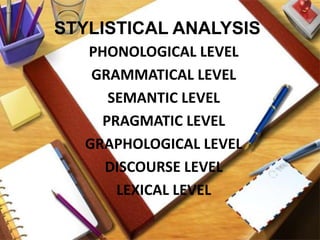
PHONOLOGICAL LEVEL
GRAMMATICAL LEVEL
SEMANTIC LEVEL
PRAGMATIC LEVEL
GRAPHOLOGICAL LEVEL
DISCOURSE LEVEL
LEXICAL LEVEL
STYLISTICAL ANALYSIS
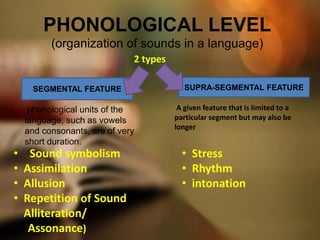
A given feature that is limited to a
particular segment but may also be
longer
• Sound symbolism
• Assimilation
• Allusion
• Repetition of Sound
Alliteration/
Assonance)
phonological units of the
language, such as vowels
and consonants, are of very
short duration.
SEGMENTAL FEATURE SUPRA-SEGMENTAL FEATURE
2 types
PHONOLOGICAL LEVEL
(organization of sounds in a language)
• Stress
• Rhythm
• intonation
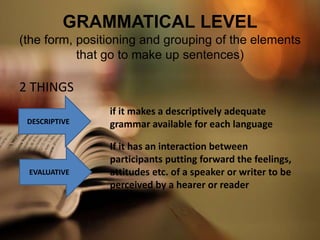
GRAMMATICAL LEVEL
(the form, positioning and grouping of the elements
that go to make up sentences)
2 THINGS
DESCRIPTIVE
EVALUATIVE
if it makes a descriptively adequate
grammar available for each language
If it has an interaction between
participants putting forward the feelings,
attitudes etc. of a speaker or writer to be
perceived by a hearer or reader
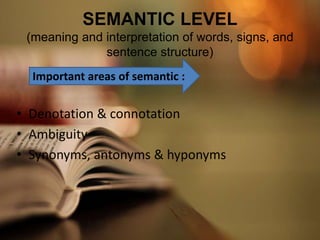
SEMANTIC LEVEL
(meaning and interpretation of words, signs, and
sentence structure)
• Denotation & connotation
• Ambiguity
• Synonyms, antonyms & hyponyms
Important areas of semantic :
PRAGMATIC LEVEL
( is concerned with characterizing the behavior of
language users [as performance])
DEIXIS
PRESUPPOSITION
IMPLICATURE
SPEECH ACT
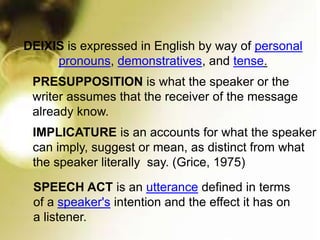
DEIXIS is expressed in English by way of personal
pronouns, demonstratives, and tense.
IMPLICATURE is an accounts for what the speaker
can imply, suggest or mean, as distinct from what
the speaker literally say. (Grice, 1975)
PRESUPPOSITION is what the speaker or the
writer assumes that the receiver of the message
already know.
SPEECH ACT is an utterance defined in terms
of a speaker's intention and the effect it has on
a listener.
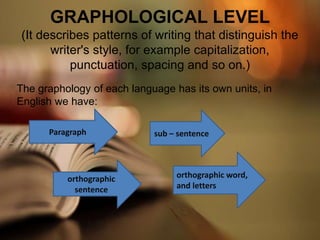
GRAPHOLOGICAL LEVEL
(It describes patterns of writing that distinguish the
writer's style, for example capitalization,
punctuation, spacing and so on.)
The graphology of each language has its own units, in
English we have:
Paragraph
orthographic
sentence
sub – sentence
orthographic word,
and letters
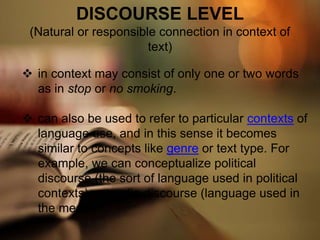
DISCOURSE LEVEL
(Natural or responsible connection in context of
text)
 in context may consist of only one or two words
as in stop or no smoking.
 can also be used to refer to particular contexts of
language use, and in this sense it becomes
similar to concepts like genre or text type. For
example, we can conceptualize political
discourse (the sort of language used in political
contexts) or media discourse (language used in
the media)
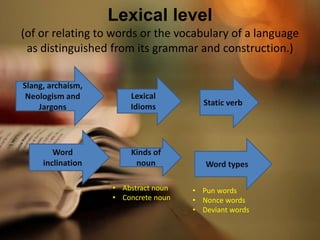
Lexical level
(of or relating to words or the vocabulary of a language
as distinguished from its grammar and construction.)
Slang, archaism,
Neologism and
Jargons
Word
inclination
Lexical
Idioms
Kinds of
noun
Static verb
Word types
• Pun words
• Nonce words
• Deviant words
• Abstract noun
• Concrete noun
Stylistic analysis

Stylistic analysis

  • 1.
    Stylistic SPEC. 20 Prepared by: AiraE. Mandreza Pamela C. Gipit Rozel Grafil BSE-IV (3:30-4:30) RGCC
  • 2.
    “not only [isstyle] not a science but [it is] a version of fiction – a narrative form – tied to the literary trope of synecdoche in which one feature is an ingredient in all the others.” -Berel Lang Stylistic analysis – definition Stylistic analysis in linguistics refers to the identification of patterns of usage in speech and writing. Stylistic analysis in literary studies is usually made for the purpose of commenting on quality and meaning in a text.
  • 3.
    By Emily Dickinson I DIEDFOR BEAUTY BUT WAS SCARCE
  • 4.
    I died forbeauty but was scarce Adjusted in the tomb, When one who died for truth was lain In an adjoining room. He questioned softly why I failed? 'For beauty,' I replied. 'And I for truth,--the two are one; We brethren are,' he said. And so, as kinsmen met a night, We talked between the rooms, Until the moss had reached our lips, And covered up our names. I died for beauty but was scarce
  • 5.
    PHONOLOGICAL LEVEL GRAMMATICAL LEVEL SEMANTICLEVEL PRAGMATIC LEVEL GRAPHOLOGICAL LEVEL DISCOURSE LEVEL LEXICAL LEVEL STYLISTICAL ANALYSIS
  • 6.
    A given featurethat is limited to a particular segment but may also be longer • Sound symbolism • Assimilation • Allusion • Repetition of Sound Alliteration/ Assonance) phonological units of the language, such as vowels and consonants, are of very short duration. SEGMENTAL FEATURE SUPRA-SEGMENTAL FEATURE 2 types PHONOLOGICAL LEVEL (organization of sounds in a language) • Stress • Rhythm • intonation
  • 7.
    GRAMMATICAL LEVEL (the form,positioning and grouping of the elements that go to make up sentences) 2 THINGS DESCRIPTIVE EVALUATIVE if it makes a descriptively adequate grammar available for each language If it has an interaction between participants putting forward the feelings, attitudes etc. of a speaker or writer to be perceived by a hearer or reader
  • 8.
    SEMANTIC LEVEL (meaning andinterpretation of words, signs, and sentence structure) • Denotation & connotation • Ambiguity • Synonyms, antonyms & hyponyms Important areas of semantic :
  • 9.
    PRAGMATIC LEVEL ( isconcerned with characterizing the behavior of language users [as performance]) DEIXIS PRESUPPOSITION IMPLICATURE SPEECH ACT
  • 10.
    DEIXIS is expressedin English by way of personal pronouns, demonstratives, and tense. IMPLICATURE is an accounts for what the speaker can imply, suggest or mean, as distinct from what the speaker literally say. (Grice, 1975) PRESUPPOSITION is what the speaker or the writer assumes that the receiver of the message already know. SPEECH ACT is an utterance defined in terms of a speaker's intention and the effect it has on a listener.
  • 11.
    GRAPHOLOGICAL LEVEL (It describespatterns of writing that distinguish the writer's style, for example capitalization, punctuation, spacing and so on.) The graphology of each language has its own units, in English we have: Paragraph orthographic sentence sub – sentence orthographic word, and letters
  • 12.
    DISCOURSE LEVEL (Natural orresponsible connection in context of text)  in context may consist of only one or two words as in stop or no smoking.  can also be used to refer to particular contexts of language use, and in this sense it becomes similar to concepts like genre or text type. For example, we can conceptualize political discourse (the sort of language used in political contexts) or media discourse (language used in the media)
  • 13.
    Lexical level (of orrelating to words or the vocabulary of a language as distinguished from its grammar and construction.) Slang, archaism, Neologism and Jargons Word inclination Lexical Idioms Kinds of noun Static verb Word types • Pun words • Nonce words • Deviant words • Abstract noun • Concrete noun