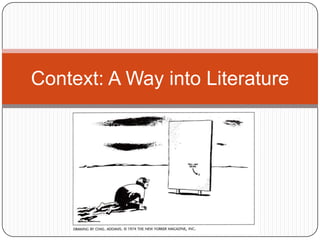
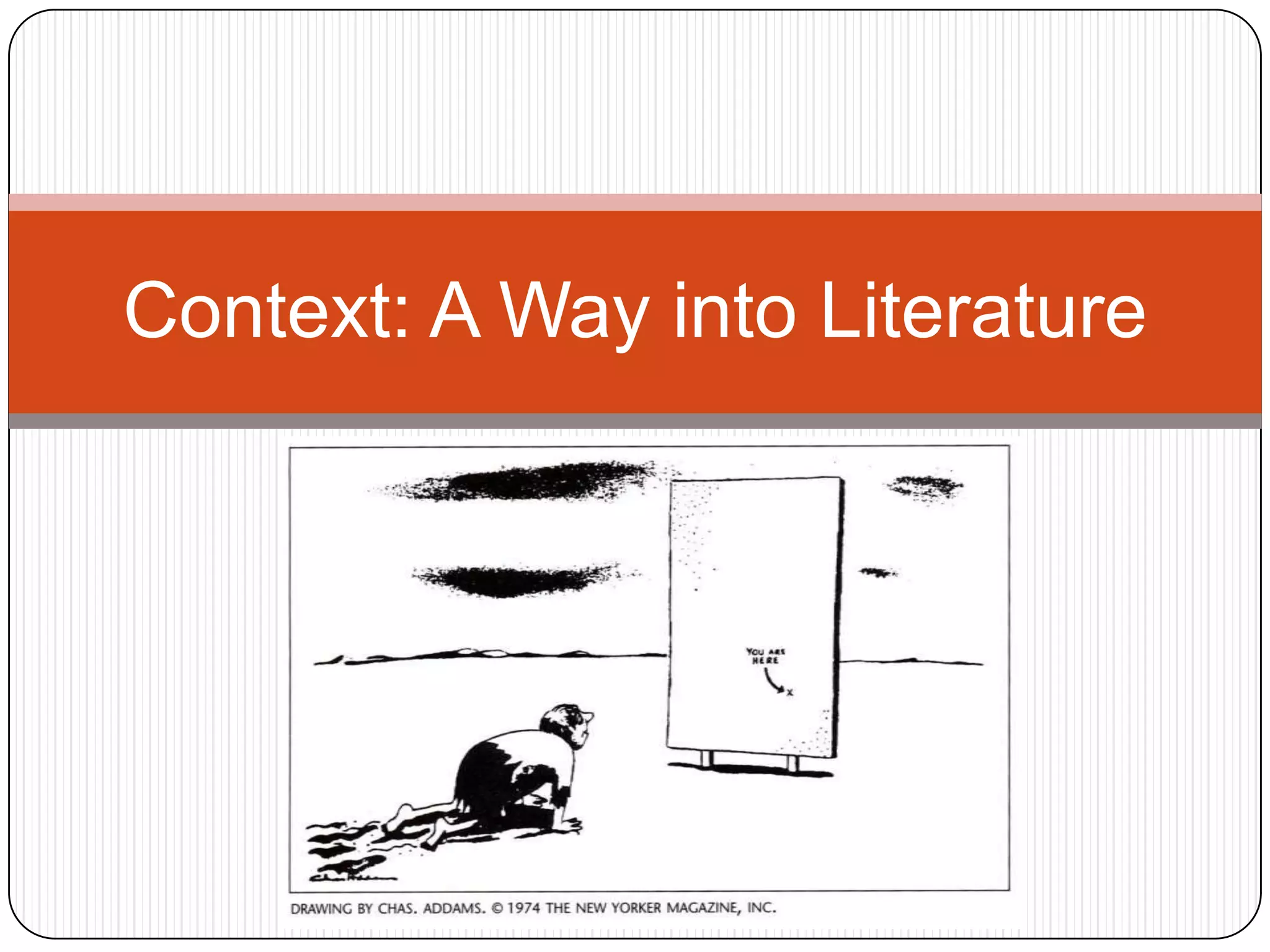
Context: A Way into Literature
What information is missing?I can’t believe I got a C+ on my test!The Taliban are heroes.
I can’t believe I got a C+ on my test!Is this a better or worse score than normal?The Taliban are heroes.To who? When? Why? (For example, the Taliban helped to stop Russian rule in Afghanistan and were seen by many Afghanis as heroes for at least a short time.)
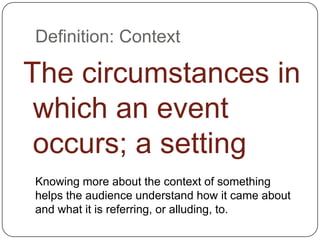
Definition: ContextThe circumstances in which an event occurs; a settingKnowing more about the context of something helps the audience understand how it came about and what it is referring, or alluding, to.
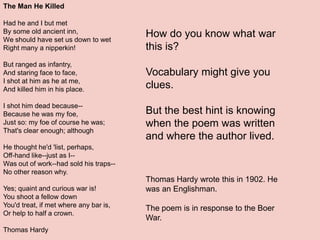
Why pay attention to context?The Man He KilledHad he and I but met By some old ancient inn, We should have set us down to wet Right many a nipperkin! But ranged as infantry, And staring face to face, I shot at him as he at me, And killed him in his place. I shot him dead because-- Because he was my foe, Just so: my foe of course he was; That's clear enough; although He thought he'd 'list, perhaps, Off-hand like--just as I-- Was out of work--had sold his traps-- No other reason why. Yes; quaint and curious war is! You shoot a fellow down You'd treat, if met where any bar is, Or help to half a crown.Thomas HardyHow do you know what war this is?Vocabulary might give you clues.But the best hint is knowing when the poem was written and where the author lived.Understanding the conditions under which the piece was written can illuminate difficult, vague, or ambiguous partsThomas Hardy wrote this in 1902. He was an Englishman.The poem is in response to the Boer War.
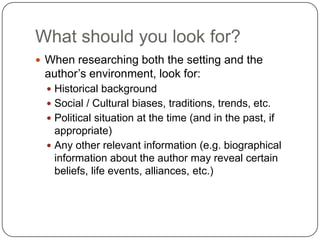
What should you look for?When researching both the setting and the author’s environment, look for:Historical backgroundSocial / Cultural biases, traditions, trends, etc.Political situation at the time (and in the past, if appropriate)Any other relevant information (e.g. biographical information about the author may reveal certain beliefs, life events, alliances, etc.)
How do you determine context?Background knowledgeClues in the literary piece iteselfResearch
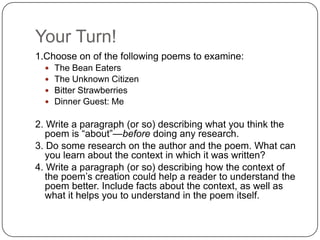
Your Turn!1.Choose on of the following poems to examine:The Bean Eaters

Context in Literature

  • 1.
    Context: A Wayinto Literature
  • 2.
    What information ismissing?I can’t believe I got a C+ on my test!The Taliban are heroes.
  • 3.
    I can’t believeI got a C+ on my test!Is this a better or worse score than normal?The Taliban are heroes.To who? When? Why? (For example, the Taliban helped to stop Russian rule in Afghanistan and were seen by many Afghanis as heroes for at least a short time.)
  • 4.
    Definition: ContextThe circumstancesin which an event occurs; a settingKnowing more about the context of something helps the audience understand how it came about and what it is referring, or alluding, to.
  • 5.
    Why pay attentionto context?The Man He KilledHad he and I but met By some old ancient inn, We should have set us down to wet Right many a nipperkin! But ranged as infantry, And staring face to face, I shot at him as he at me, And killed him in his place. I shot him dead because-- Because he was my foe, Just so: my foe of course he was; That's clear enough; although He thought he'd 'list, perhaps, Off-hand like--just as I-- Was out of work--had sold his traps-- No other reason why. Yes; quaint and curious war is! You shoot a fellow down You'd treat, if met where any bar is, Or help to half a crown.Thomas HardyHow do you know what war this is?Vocabulary might give you clues.But the best hint is knowing when the poem was written and where the author lived.Understanding the conditions under which the piece was written can illuminate difficult, vague, or ambiguous partsThomas Hardy wrote this in 1902. He was an Englishman.The poem is in response to the Boer War.
  • 6.
    What should youlook for?When researching both the setting and the author’s environment, look for:Historical backgroundSocial / Cultural biases, traditions, trends, etc.Political situation at the time (and in the past, if appropriate)Any other relevant information (e.g. biographical information about the author may reveal certain beliefs, life events, alliances, etc.)
  • 7.
    How do youdetermine context?Background knowledgeClues in the literary piece iteselfResearch
  • 8.
    Your Turn!1.Choose onof the following poems to examine:The Bean Eaters
  • 9.
  • 10.
  • 11.
    Dinner Guest: Me2.Write a paragraph (or so) describing what you think the poem is “about”—before doing any research.3. Do some research on the author and the poem. What can you learn about the context in which it was written?4. Write a paragraph (or so) describing how the context of the poem’s creation could help a reader to understand the poem better. Include facts about the context, as well as what it helps you to understand in the poem itself.