Discourse
Discourse
Setyo Prasiyanto C, S.S., M.Pd.
Discourse
Discourse
Definition
• Language use beyond sentence
• Language use in contexts
• Social practice
Text
Text
• Discourse is realised by texts
• Communication happens in text
• Text is central to discourse analysis
• What is text?
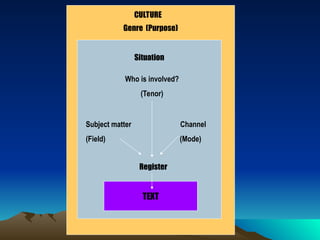
TEXT
CULTURE
Genre (Purpose)
Situation
Who is involved?
(Tenor)
Subject matter Channel
(Field) (Mode)
Register
Text
Text
• It is a semantic unit.
• Something is called a text when it is
meaningful.
• It is spoken and written.
• It is not a phonological or a graphological
unit.
• It occurs in a context of situation.
Context of situation
There are three elements
• Subject matter (field)
• Participants involved (tenor)
• Channel (mode)
Context of culture
Context of culture
• Every culture produces text types.
• A text type is a genre
• Two general purposes: Transactional and
Interpersonal genres
• Transactional: to get something done
• Interpersonal: for different purposes of
communication
Basic English genres
• Procedure
• Descriptive
• Narrative
• Recount
• report
• News item
• Discussion
• Explanation
• Exposition
• Review
Text analysis
Text analysis
• Needs linguistic analysis
• Interpretation is based on linguistic
evidence
• Text analysts need the right ‘knife’ to cut
the right ‘bread’
• Different ‘knives’ for different ‘bread’
Discourse analysis
Discourse analysis
• How texts relate to contexts of situation and
context of culture
• How texts are produced as a social practice
• What texts tell us about happenings, what
people think, believe etc.
• How texts represent ideology (power struggle
etc.)
Text & Discourse Analyses
(Nunan, 1993)
(Nunan, 1993)
• Text analysis is the study of formal linguistic devices
that distinguish a text from random sentences.
• Discourse analysts study these text-forming devices
with reference to the purposes and functions for which
the discourse was produced, and the context within
which the discourse was created. The ultimate goal is
to show how the linguistic elements enable language
users to communicate.
Communication
Communication
• Exchange of meanings
• Happens in texts
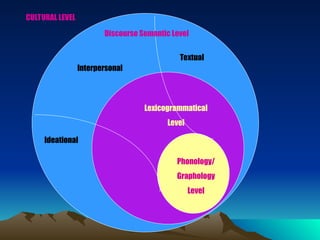
• See the following diagram on stratification and
metafunctions
Ideational
Interpersonal
Textual
Discourse Semantic Level
Lexicogrammatical
Level
Phonology/
Graphology
Level
CULTURAL LEVEL
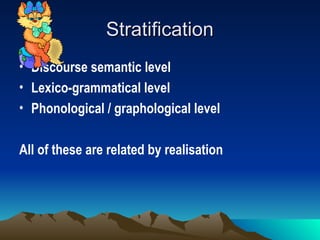
Stratification
Stratification
• Discourse semantic level
• Lexico-grammatical level
• Phonological / graphological level
All of these are related by realisation
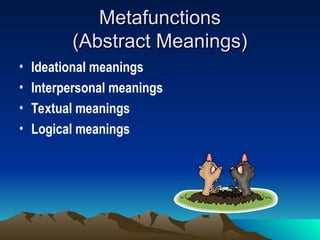
Metafunctions
Metafunctions
(Abstract Meanings)
(Abstract Meanings)
• Ideational meanings
• Interpersonal meanings
• Textual meanings
• Logical meanings
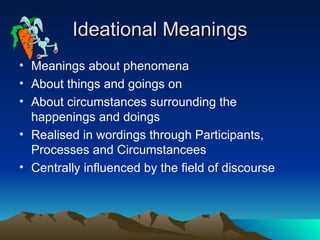
Ideational Meanings
Ideational Meanings
• Meanings about phenomena
• About things and goings on
• About circumstances surrounding the
happenings and doings
• Realised in wordings through Participants,
Processes and Circumstancees
• Centrally influenced by the field of discourse
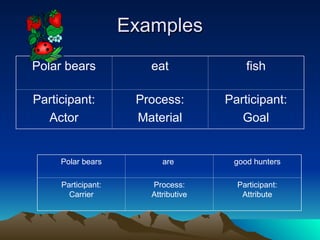
Examples
Examples
Polar bears eat fish
Participant:
Actor
Process:
Material
Participant:
Goal
Polar bears are good hunters
Participant:
Carrier
Process:
Attributive
Participant:
Attribute
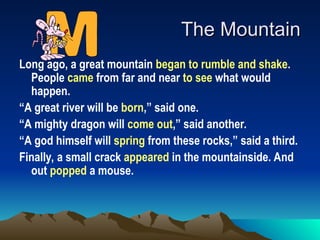
The Mountain
The Mountain
Long ago, a great mountain began to rumble and shake.
People came from far and near to see what would
happen.
“A great river will be born,” said one.
“A mighty dragon will come out,” said another.
“A god himself will spring from these rocks,” said a third.
Finally, a small crack appeared in the mountainside. And
out popped a mouse.
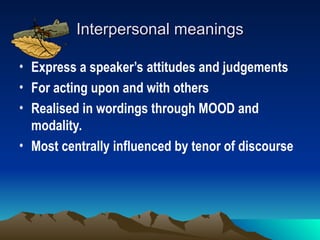
Interpersonal meanings
• Express a speaker’s attitudes and judgements
• For acting upon and with others
• Realised in wordings through MOOD and
modality.
• Most centrally influenced by tenor of discourse
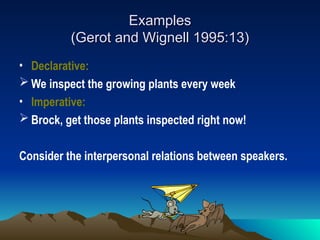
Examples
Examples
(Gerot and Wignell 1995:13)
• Declarative:
 We inspect the growing plants every week
• Imperative:
 Brock, get those plants inspected right now!
Consider the interpersonal relations between speakers.
examples
examples
• Brock, do you really expect me to believe this
crap?
• Mr. Brock, I find your position unatenable
Consider the degree of informality or formality
Examples
Examples
• Mr. Brock is a fine, upstanding employee.
• Brock is a lazy, incompetent fool.
Consider the attitudinal lexis which express affect,
the degree of like and dislike
Examples: Modality
Examples: Modality
• Unfortunately, Brock is an inspector.
• Fortunately, Brock is an inspector.
Consider the Mood Adjunct which reveal attitude or judgment.
• The crop might be inspected.
• The crop should be inspected
• The crop must be inspected
Consider modal operators revealing the speaker’ certainty.
The Prayer
The Prayer
I pray you'll be our eyes
And watch us where we go
And help us to be wise
In times when we don't know
Let this be our prayer
As we go our way
Lead us to a place
Guide us with your Grace
To a place where we'll be safe
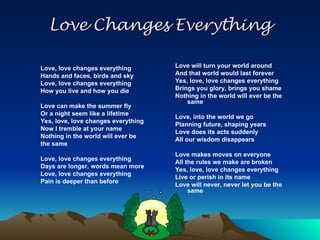
Love Changes Everything
Love, love changes everything
Hands and faces, birds and sky
Love, love changes everything
How you live and how you die
Love can make the summer fly
Or a night seem like a lifetime
Yes, love, love changes everything
Now I tremble at your name
Nothing in the world will ever be
the same
Love, love changes everything
Days are longer, words mean more
Love, love changes everything
Pain is deeper than before
Love will turn your world around
And that world would last forever
Yes, love, love changes everything
Brings you glory, brings you shame
Nothing in the world will ever be the
same
Love, into the world we go
Planning future, shaping years
Love does its acts suddenly
All our wisdom disappears
Love makes moves on everyone
All the rules we make are broken
Yes, love, love changes everything
Live or perish in its name
Love will never, never let you be the
same
Textual Meanings
Textual Meanings
• Express the relation of language to its
environment (including what has been spoken
or written before).
• Realised through patterns of Theme and
cohesion.
• Most centrally influenced by mode of discourse
The linguistic differences between the following spoken and written texts
below relate primarily to differences in thematic choices and patterns of
cohesion.
cohesion.
• This is yer phone bill and you hafta go to the
Post Office to pay it – uh, by next Monday –
that’s what this box tells ya – or they’ll cut yer
phone off!
• All phone bills must be paid by the date shown
or service will be discontinued.
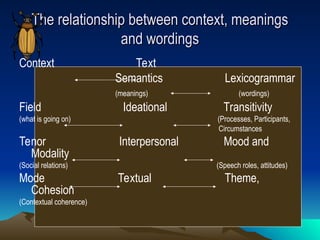
The relationship between context, meanings
and wordings
and wordings
Context Text
Semantics Lexicogrammar
(meanings) (wordings)
Field Ideational Transitivity
(what is going on) (Processes, Participants,
Circumstances
Tenor Interpersonal Mood and
Modality
(Social relations) (Speech roles, attitudes)
Mode Textual Theme,
Cohesion
(Contextual coherence)

What_bjnjnhjkhjhis_Discouse_analysis.ppt

  • 1.
    Discourse Discourse Setyo Prasiyanto C,S.S., M.Pd. Setyo Prasiyanto C, S.S., M.Pd.
  • 2.
    Discourse Discourse Definition • Language usebeyond sentence • Language use in contexts • Social practice
  • 3.
    Text Text • Discourse isrealised by texts • Communication happens in text • Text is central to discourse analysis • What is text?
  • 4.
    TEXT CULTURE Genre (Purpose) Situation Who isinvolved? (Tenor) Subject matter Channel (Field) (Mode) Register
  • 5.
    Text Text • It isa semantic unit. • Something is called a text when it is meaningful. • It is spoken and written. • It is not a phonological or a graphological unit. • It occurs in a context of situation.
  • 6.
    Context of situation Contextof situation There are three elements • Subject matter (field) • Participants involved (tenor) • Channel (mode)
  • 7.
    Context of culture Contextof culture • Every culture produces text types. • A text type is a genre • Two general purposes: Transactional and Interpersonal genres • Transactional: to get something done • Interpersonal: for different purposes of communication
  • 8.
    Basic English genres BasicEnglish genres • Procedure • Descriptive • Narrative • Recount • report • News item • Discussion • Explanation • Exposition • Review
  • 9.
    Text analysis Text analysis •Needs linguistic analysis • Interpretation is based on linguistic evidence • Text analysts need the right ‘knife’ to cut the right ‘bread’ • Different ‘knives’ for different ‘bread’
  • 10.
    Discourse analysis Discourse analysis •How texts relate to contexts of situation and context of culture • How texts are produced as a social practice • What texts tell us about happenings, what people think, believe etc. • How texts represent ideology (power struggle etc.)
  • 11.
    Text & DiscourseAnalyses Text & Discourse Analyses (Nunan, 1993) (Nunan, 1993) • Text analysis is the study of formal linguistic devices that distinguish a text from random sentences. • Discourse analysts study these text-forming devices with reference to the purposes and functions for which the discourse was produced, and the context within which the discourse was created. The ultimate goal is to show how the linguistic elements enable language users to communicate.
  • 12.
    Communication Communication • Exchange ofmeanings • Happens in texts • See the following diagram on stratification and metafunctions
  • 13.
  • 14.
    Stratification Stratification • Discourse semanticlevel • Lexico-grammatical level • Phonological / graphological level All of these are related by realisation
  • 15.
    Metafunctions Metafunctions (Abstract Meanings) (Abstract Meanings) •Ideational meanings • Interpersonal meanings • Textual meanings • Logical meanings
  • 16.
    Ideational Meanings Ideational Meanings •Meanings about phenomena • About things and goings on • About circumstances surrounding the happenings and doings • Realised in wordings through Participants, Processes and Circumstancees • Centrally influenced by the field of discourse
  • 17.
    Examples Examples Polar bears eatfish Participant: Actor Process: Material Participant: Goal Polar bears are good hunters Participant: Carrier Process: Attributive Participant: Attribute
  • 18.
    The Mountain The Mountain Longago, a great mountain began to rumble and shake. People came from far and near to see what would happen. “A great river will be born,” said one. “A mighty dragon will come out,” said another. “A god himself will spring from these rocks,” said a third. Finally, a small crack appeared in the mountainside. And out popped a mouse.
  • 19.
    Interpersonal meanings Interpersonal meanings •Express a speaker’s attitudes and judgements • For acting upon and with others • Realised in wordings through MOOD and modality. • Most centrally influenced by tenor of discourse
  • 20.
    Examples Examples (Gerot and Wignell1995:13) (Gerot and Wignell 1995:13) • Declarative:  We inspect the growing plants every week • Imperative:  Brock, get those plants inspected right now! Consider the interpersonal relations between speakers.
  • 21.
    examples examples • Brock, doyou really expect me to believe this crap? • Mr. Brock, I find your position unatenable Consider the degree of informality or formality
  • 22.
    Examples Examples • Mr. Brockis a fine, upstanding employee. • Brock is a lazy, incompetent fool. Consider the attitudinal lexis which express affect, the degree of like and dislike
  • 23.
    Examples: Modality Examples: Modality •Unfortunately, Brock is an inspector. • Fortunately, Brock is an inspector. Consider the Mood Adjunct which reveal attitude or judgment. • The crop might be inspected. • The crop should be inspected • The crop must be inspected Consider modal operators revealing the speaker’ certainty.
  • 24.
    The Prayer The Prayer Ipray you'll be our eyes And watch us where we go And help us to be wise In times when we don't know Let this be our prayer As we go our way Lead us to a place Guide us with your Grace To a place where we'll be safe
  • 25.
    Love Changes Everything LoveChanges Everything Love, love changes everything Hands and faces, birds and sky Love, love changes everything How you live and how you die Love can make the summer fly Or a night seem like a lifetime Yes, love, love changes everything Now I tremble at your name Nothing in the world will ever be the same Love, love changes everything Days are longer, words mean more Love, love changes everything Pain is deeper than before Love will turn your world around And that world would last forever Yes, love, love changes everything Brings you glory, brings you shame Nothing in the world will ever be the same Love, into the world we go Planning future, shaping years Love does its acts suddenly All our wisdom disappears Love makes moves on everyone All the rules we make are broken Yes, love, love changes everything Live or perish in its name Love will never, never let you be the same
  • 26.
    Textual Meanings Textual Meanings •Express the relation of language to its environment (including what has been spoken or written before). • Realised through patterns of Theme and cohesion. • Most centrally influenced by mode of discourse
  • 27.
    The linguistic differencesbetween the following spoken and written texts The linguistic differences between the following spoken and written texts below relate primarily to differences in thematic choices and patterns of below relate primarily to differences in thematic choices and patterns of cohesion. cohesion. • This is yer phone bill and you hafta go to the Post Office to pay it – uh, by next Monday – that’s what this box tells ya – or they’ll cut yer phone off! • All phone bills must be paid by the date shown or service will be discontinued.
  • 28.
    The relationship betweencontext, meanings The relationship between context, meanings and wordings and wordings Context Text Semantics Lexicogrammar (meanings) (wordings) Field Ideational Transitivity (what is going on) (Processes, Participants, Circumstances Tenor Interpersonal Mood and Modality (Social relations) (Speech roles, attitudes) Mode Textual Theme, Cohesion (Contextual coherence)