ENG 110 Introduction to Literary Studies – Week 1

Text and Context
What is Literary Studies?
…what is it for, and how do we do it?
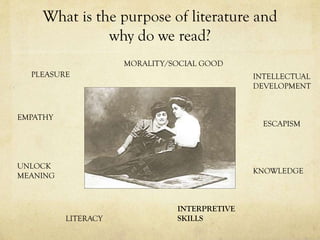
What is the purpose of literature and
why do we read?
MORALITY/SOCIAL GOOD
PLEASURE

INTELLECTUAL
DEVELOPMENT

EMPATHY

ESCAPISM

UNLOCK
MEANING

KNOWLEDGE

LITERACY

INTERPRETIVE
SKILLS
Aesthetics (OED)
Adjective:
concerned with beauty or the appreciation of beauty:the pictures
give great aesthetic pleasure
giving or designed to give pleasure through beauty:the law applies
to both functional and aesthetic objects
Noun:
a set of principles underlying the work of a particular artist or
artistic movement:the Cubist aesthetic
Origin: late 18th century (in the sense 'relating to perception by the
senses'): from Greek aisthētikos, from aisthēta 'perceptible things',
from aisthesthai 'perceive'. The sense 'concerned with beauty' was
coined in German in the mid 18th century and adopted into English
in the early 19th century.
Ethics (OED)
Noun
[usually treated as plural] moral principles that govern a
person’s behaviour or the conducting of an activity:
medical ethics also enter into the question
[usually treated as singular] the branch of knowledge that
deals with moral principles: neither metaphysics nor ethics
is the home of religion
The term ‘ethics’ has perhaps come to replace the idea
of ‘morality’ in the way we think about literary texts in
C20th and C21st.
What is Literary Studies?
✎a discipline and a method
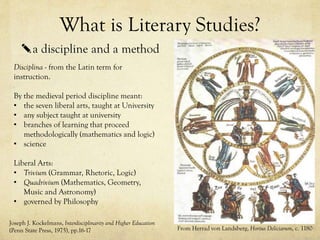
Disciplina - from the Latin term for
instruction.
By the medieval period discipline meant:
• the seven liberal arts, taught at University
• any subject taught at university
• branches of learning that proceed
methodologically (mathematics and logic)
• science
Liberal Arts:
• Trivium (Grammar, Rhetoric, Logic)
• Quadrivium (Mathematics, Geometry,
Music and Astronomy)
• governed by Philosophy
Joseph J. Kockelmans, Interdisciplinarity and Higher Education
(Penn State Press, 1975), pp.16-17

From Herrad von Landsberg, Hortus Deliciarum, c. 1180
Literary Studies and the
Renaissance Humanities
Renaissance Humanism (15th century Italy)

• studia humanitatis (the studies of humanity)
• this new curriculum included grammar, rhetoric, history, poetry, and moral philosophy

“… a) the concept of a unique, autonomous,
personal self, to be shaped through b) the study
of the language and literature of ancient Greece
and Rome, c) according to the perspectives of a
group of primarily literary academic disciplines.”
Proctor, Robert E. Defining the Humanities: How Rediscovering a Tradition Can Improve
Our Schools : With a Curriculum for Today’s Students (Indiana University Press, 1998),
p.13.
Philip Sidney - the beginnings
of English literary criticism?
In 1580 Sidney writes the “Defense of Poesy” in response to Stephen Gosson’s attack
on the literary arts, and theatre.

“Poesy” he says “is an art of imitation,” it produces a speaking
picture, with this end, - to teach and delight.”

Poets “indeed, do merely make to imitate, and imitate both to
delight and teach, and delight to move men to take that goodness
in hand, which without delight they would fly as from a stranger;
and teach to make them know that goodness whereunto they are
moved: - which being the noblest scope to which ever any
learning was directed”
Literary Studies from the mid-C20th
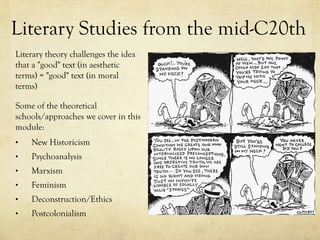
Literary theory challenges the idea
that a "good" text (in aesthetic
terms) = "good" text (in moral
terms)
Some of the theoretical
schools/approaches we cover in this
module:
•

New Historicism

•

Psychoanalysis

•

Marxism

•

Feminism

•

Deconstruction/Ethics

•

Postcolonialism
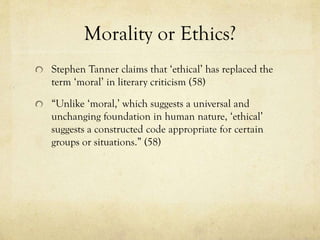
Morality or Ethics?
Stephen Tanner claims that ‘ethical’ has replaced the
term ‘moral’ in literary criticism (58)
“Unlike ‘moral,’ which suggests a universal and
unchanging foundation in human nature, ‘ethical’
suggests a constructed code appropriate for certain
groups or situations.” (58)
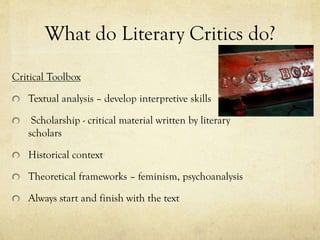
What do Literary Critics do?
Critical Toolbox
Textual analysis – develop interpretive skills
Scholarship - critical material written by literary
scholars
Historical context
Theoretical frameworks – feminism, psychoanalysis
Always start and finish with the text

Text and Context

  • 1.
    ENG 110 Introductionto Literary Studies – Week 1 Text and Context What is Literary Studies? …what is it for, and how do we do it?
  • 2.
    What is thepurpose of literature and why do we read? MORALITY/SOCIAL GOOD PLEASURE INTELLECTUAL DEVELOPMENT EMPATHY ESCAPISM UNLOCK MEANING KNOWLEDGE LITERACY INTERPRETIVE SKILLS
  • 3.
    Aesthetics (OED) Adjective: concerned withbeauty or the appreciation of beauty:the pictures give great aesthetic pleasure giving or designed to give pleasure through beauty:the law applies to both functional and aesthetic objects Noun: a set of principles underlying the work of a particular artist or artistic movement:the Cubist aesthetic Origin: late 18th century (in the sense 'relating to perception by the senses'): from Greek aisthētikos, from aisthēta 'perceptible things', from aisthesthai 'perceive'. The sense 'concerned with beauty' was coined in German in the mid 18th century and adopted into English in the early 19th century.
  • 4.
    Ethics (OED) Noun [usually treatedas plural] moral principles that govern a person’s behaviour or the conducting of an activity: medical ethics also enter into the question [usually treated as singular] the branch of knowledge that deals with moral principles: neither metaphysics nor ethics is the home of religion The term ‘ethics’ has perhaps come to replace the idea of ‘morality’ in the way we think about literary texts in C20th and C21st.
  • 5.
    What is LiteraryStudies? ✎a discipline and a method Disciplina - from the Latin term for instruction. By the medieval period discipline meant: • the seven liberal arts, taught at University • any subject taught at university • branches of learning that proceed methodologically (mathematics and logic) • science Liberal Arts: • Trivium (Grammar, Rhetoric, Logic) • Quadrivium (Mathematics, Geometry, Music and Astronomy) • governed by Philosophy Joseph J. Kockelmans, Interdisciplinarity and Higher Education (Penn State Press, 1975), pp.16-17 From Herrad von Landsberg, Hortus Deliciarum, c. 1180
  • 6.
    Literary Studies andthe Renaissance Humanities Renaissance Humanism (15th century Italy) • studia humanitatis (the studies of humanity) • this new curriculum included grammar, rhetoric, history, poetry, and moral philosophy “… a) the concept of a unique, autonomous, personal self, to be shaped through b) the study of the language and literature of ancient Greece and Rome, c) according to the perspectives of a group of primarily literary academic disciplines.” Proctor, Robert E. Defining the Humanities: How Rediscovering a Tradition Can Improve Our Schools : With a Curriculum for Today’s Students (Indiana University Press, 1998), p.13.
  • 7.
    Philip Sidney -the beginnings of English literary criticism? In 1580 Sidney writes the “Defense of Poesy” in response to Stephen Gosson’s attack on the literary arts, and theatre. “Poesy” he says “is an art of imitation,” it produces a speaking picture, with this end, - to teach and delight.” Poets “indeed, do merely make to imitate, and imitate both to delight and teach, and delight to move men to take that goodness in hand, which without delight they would fly as from a stranger; and teach to make them know that goodness whereunto they are moved: - which being the noblest scope to which ever any learning was directed”
  • 8.
    Literary Studies fromthe mid-C20th Literary theory challenges the idea that a "good" text (in aesthetic terms) = "good" text (in moral terms) Some of the theoretical schools/approaches we cover in this module: • New Historicism • Psychoanalysis • Marxism • Feminism • Deconstruction/Ethics • Postcolonialism
  • 9.
    Morality or Ethics? StephenTanner claims that ‘ethical’ has replaced the term ‘moral’ in literary criticism (58) “Unlike ‘moral,’ which suggests a universal and unchanging foundation in human nature, ‘ethical’ suggests a constructed code appropriate for certain groups or situations.” (58)
  • 10.
    What do LiteraryCritics do? Critical Toolbox Textual analysis – develop interpretive skills Scholarship - critical material written by literary scholars Historical context Theoretical frameworks – feminism, psychoanalysis Always start and finish with the text