Connected
Discourse
Lesson 1
reading AND WRITING 11
Learning
Objectives
01
The students should be able to identify the
nature and purpose of a discourse.
02
The students should be able to differentiate
between the types of discourses.
03
The students should be able to differentiate
between the types of literary discourses.
What is a
discourse?
What is a
discourse?
What is a
discourse?
Discourse is a term used to describe various
forms of communication, such as written,
verbal, and visual. It is a concept used to
analyze language and communication as
social phenomena.
In writing, a discourse is a formal and often
lengthy discussion of a topic, where
concepts and insights are arranged in an
organized and logical manner.
Purposes of a
Discourse:
To inform
Discourse shares information through conversations,
debates, and other forms of communication. It can
involve multiple people discussing a particular topic
in order to gain new perspectives and exchange
ideas.
Through discourse, people can learn new information
and develop better understanding of a topic.
Purposes of a
Discourse:
To Persuade
A discourse can persuade by presenting an argument
in favor of a particular point of view. This can be done
through the use of persuasive language, logical
reasoning, rhetorical devices, and the use of evidence.
can also make use of personal anecdotes and stories
to illustrate the point and make it more relatable to
the audience.
Purposes of a
Discourse:
To Entertain
Discourse can entertain by providing interesting
topics of conversation or debate. It can also be
entertaining through the use of humor, storytelling, or
anecdotes.
Additionally, discourse can engage an audience by
providing thought-provoking questions and fresh
perspectives on topics.
Argumentative Discourse
Descriptive Discourse
Expository Discourse
Narrative Discourse
01
02
03
04
Types of
Discourses
Expository Discourse
Expository discourse is a type of communication that is used to explain,
inform, or describe a topic or issue. It is a form of discourse that is based
on facts and data, and is usually objective in nature. Expository discourse
is often used in essays, research papers, and other academic writings.
Descriptive Discourse
Descriptive discourse is a form of discourse that uses language to create a
vivid mental image of the topic being described. It is often used to paint a
picture of a person, place, thing, or idea in the reader's mind. Descriptive
discourse typically includes sensory details to create a vivid image.
Narrative Discourse
Narrative discourse is the way in which stories are told, usually through
written or spoken language. It is a form of communication in which ideas,
events, and experiences are sequenced in a logical and meaningful way. It is
often used to tell stories, convey information, and create a sense of purpose.
Argumentative Discourse
Argumentative discourse is a form of discourse that involves making a claim
and providing evidence to support it. It is used to present evidence-based
arguments in a logical and convincing manner in order to persuade an
audience to accept a point of view.
Literary
Discourse
Academic
Discourse
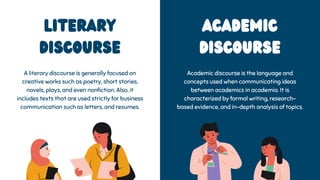
A literary discourse is generally focused on
creative works such as poetry, short stories,
novels, plays, and even nonfiction. Also, it
includes texts that are used strictly for business
communication such as letters, and resumes.
Academic discourse is the language and
concepts used when communicating ideas
between academics in academia. It is
characterized by formal writing, research-
based evidence, and in-depth analysis of topics.
Thank you for listening!
Reading and Writing 11
Harmful impacts of
technology
Impact of technology
on literature
Explain how music
affects your life
Importance of artificial
intelligence
01
02
03
04
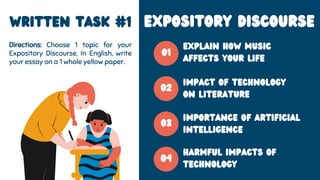
Written task #1 Expository discourse
Directions: Choose 1 topic for your
Expository Discourse. In English, write
your essay on a 1 whole yellow paper.
Reading and Writing - Lesson 1 - Connected Discourse

  • 1.
  • 2.
    Learning Objectives 01 The students shouldbe able to identify the nature and purpose of a discourse. 02 The students should be able to differentiate between the types of discourses. 03 The students should be able to differentiate between the types of literary discourses.
  • 3.
  • 4.
  • 5.
    What is a discourse? Discourseis a term used to describe various forms of communication, such as written, verbal, and visual. It is a concept used to analyze language and communication as social phenomena. In writing, a discourse is a formal and often lengthy discussion of a topic, where concepts and insights are arranged in an organized and logical manner.
  • 6.
    Purposes of a Discourse: Toinform Discourse shares information through conversations, debates, and other forms of communication. It can involve multiple people discussing a particular topic in order to gain new perspectives and exchange ideas. Through discourse, people can learn new information and develop better understanding of a topic.
  • 7.
    Purposes of a Discourse: ToPersuade A discourse can persuade by presenting an argument in favor of a particular point of view. This can be done through the use of persuasive language, logical reasoning, rhetorical devices, and the use of evidence. can also make use of personal anecdotes and stories to illustrate the point and make it more relatable to the audience.
  • 8.
    Purposes of a Discourse: ToEntertain Discourse can entertain by providing interesting topics of conversation or debate. It can also be entertaining through the use of humor, storytelling, or anecdotes. Additionally, discourse can engage an audience by providing thought-provoking questions and fresh perspectives on topics.
  • 9.
    Argumentative Discourse Descriptive Discourse ExpositoryDiscourse Narrative Discourse 01 02 03 04 Types of Discourses
  • 10.
    Expository Discourse Expository discourseis a type of communication that is used to explain, inform, or describe a topic or issue. It is a form of discourse that is based on facts and data, and is usually objective in nature. Expository discourse is often used in essays, research papers, and other academic writings. Descriptive Discourse Descriptive discourse is a form of discourse that uses language to create a vivid mental image of the topic being described. It is often used to paint a picture of a person, place, thing, or idea in the reader's mind. Descriptive discourse typically includes sensory details to create a vivid image.
  • 11.
    Narrative Discourse Narrative discourseis the way in which stories are told, usually through written or spoken language. It is a form of communication in which ideas, events, and experiences are sequenced in a logical and meaningful way. It is often used to tell stories, convey information, and create a sense of purpose. Argumentative Discourse Argumentative discourse is a form of discourse that involves making a claim and providing evidence to support it. It is used to present evidence-based arguments in a logical and convincing manner in order to persuade an audience to accept a point of view.
  • 12.
    Literary Discourse Academic Discourse A literary discourseis generally focused on creative works such as poetry, short stories, novels, plays, and even nonfiction. Also, it includes texts that are used strictly for business communication such as letters, and resumes. Academic discourse is the language and concepts used when communicating ideas between academics in academia. It is characterized by formal writing, research- based evidence, and in-depth analysis of topics.
  • 13.
    Thank you forlistening! Reading and Writing 11
  • 14.
    Harmful impacts of technology Impactof technology on literature Explain how music affects your life Importance of artificial intelligence 01 02 03 04 Written task #1 Expository discourse Directions: Choose 1 topic for your Expository Discourse. In English, write your essay on a 1 whole yellow paper.