Designs
• Case-crossover design
– When investigating an intermittent exposure with
immediate and transient effect on risk related to an
abrupt outcome
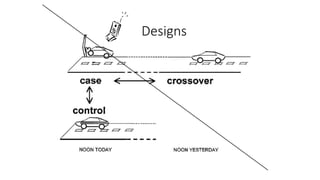
– All cases are incident occurrences of the disease of
interest
– Cases at another time (or other times) serve as their
own controls
Designs
• Case-crossover design
– Developed in 1988 due to concerns about ability to
find controls representing the study base for a study
of causes of MI peaks in the morning
– Realized could compare each patient’s experience on
their MI day with their experience the day before (or
multiple control days before)
Designs
• Case-crossover design
– Analogous to the experimental cross-over design
except that the data are:
• Non-experimental
• Observed retrospectively
Designs
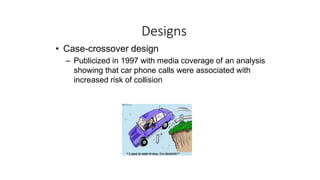
• Case-crossover design
– Publicized in 1997 with media coverage of an analysis
showing that car phone calls were associated with
increased risk of collision
Designs
Designs
• Case-crossover design
– For each case, can sample:
• One control time
• Multiple control times
• Sample of the person-time over a defined period
Designs
• Case-crossover design
– Trends in time (e.g., seasonality) are main challenge
specific to this design
Case crossover example• Valent et al. A case-crossover study of sleep and childhood injury. Ped 2001;107:
E23
• Research question
• Does lack of sleep result in a greater number of unintentional childhood
injuries?
• Exposure = sleep <10 hours (EXP +) vs. >= 10 hours (EXP -)
• Outcome = Childhood unintentional injury
• Study population = 292 children with unintentional injuries
• Sleep time data collected for two periods (0-24 hours before injury) and (25-48
hours before injury)
• “Case period” = 24 hour period before injury; “Control period” = 25-48 hour period
before injury
• Note that each child has both one case and one control period...these two
periods together form a pair
• Analysis is done through a matched analysis in which the time periods (case and
control periods) are matched
• Four possible scenarios
• a. Case period = (EXP +) and Control period = (EXP +)...”concordant”
• b. Case period = (EXP +) and Control period = (EXP -)...”discordant”
• c. Case period = (EXP -) and Control period = (EXP +)...”discordant”
• d. Case period = (EXP -) and Control period = (EXP -)...”concordant”
• Concordant pairs offer no “information” about the effect of sleep < 10 hours (EXP +)
vs. sleep > 10 hours (EXP -)
6.4.4 designs case-crossover

6.4.4 designs case-crossover

  • 1.
    Designs • Case-crossover design –When investigating an intermittent exposure with immediate and transient effect on risk related to an abrupt outcome – All cases are incident occurrences of the disease of interest – Cases at another time (or other times) serve as their own controls
  • 2.
    Designs • Case-crossover design –Developed in 1988 due to concerns about ability to find controls representing the study base for a study of causes of MI peaks in the morning – Realized could compare each patient’s experience on their MI day with their experience the day before (or multiple control days before)
  • 3.
    Designs • Case-crossover design –Analogous to the experimental cross-over design except that the data are: • Non-experimental • Observed retrospectively
  • 4.
    Designs • Case-crossover design –Publicized in 1997 with media coverage of an analysis showing that car phone calls were associated with increased risk of collision
  • 5.
  • 6.
    Designs • Case-crossover design –For each case, can sample: • One control time • Multiple control times • Sample of the person-time over a defined period
  • 7.
    Designs • Case-crossover design –Trends in time (e.g., seasonality) are main challenge specific to this design
  • 8.
    Case crossover example•Valent et al. A case-crossover study of sleep and childhood injury. Ped 2001;107: E23 • Research question • Does lack of sleep result in a greater number of unintentional childhood injuries? • Exposure = sleep <10 hours (EXP +) vs. >= 10 hours (EXP -) • Outcome = Childhood unintentional injury • Study population = 292 children with unintentional injuries • Sleep time data collected for two periods (0-24 hours before injury) and (25-48 hours before injury) • “Case period” = 24 hour period before injury; “Control period” = 25-48 hour period before injury • Note that each child has both one case and one control period...these two periods together form a pair • Analysis is done through a matched analysis in which the time periods (case and control periods) are matched • Four possible scenarios • a. Case period = (EXP +) and Control period = (EXP +)...”concordant” • b. Case period = (EXP +) and Control period = (EXP -)...”discordant” • c. Case period = (EXP -) and Control period = (EXP +)...”discordant” • d. Case period = (EXP -) and Control period = (EXP -)...”concordant” • Concordant pairs offer no “information” about the effect of sleep < 10 hours (EXP +) vs. sleep > 10 hours (EXP -)