Study Design   Yvonne Lee Yin Leng, MPH Clinical Epidemiology Unit, CRC
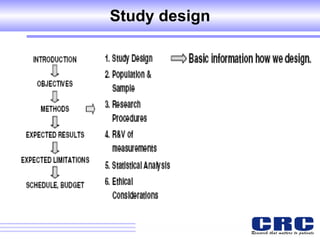
Study design
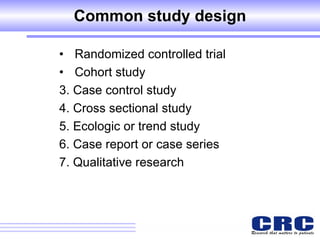
Common study design Randomized controlled trial  Cohort study  3. Case control study 4. Cross sectional study 5. Ecologic or trend study  6. Case report or case series  7. Qualitative research
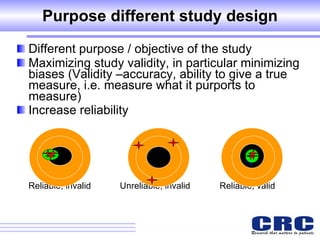
Purpose different study design Different purpose / objective of the study Maximizing study validity, in particular minimizing biases  (Validity –accuracy, ability to give a true measure, i.e. measure what it purports to measure) Increase reliability     Reliable, invalid    Unreliable, invalid  Reliable, valid
Which study design?  Research questions  Objective of the study Occurrence of disease / exposure -rare/ common Ethical issue Resources- money, manpower, machine Several designs may well be suitable for a particular study. Choice must then be guided by considerations of strength of design, cost and ethics.
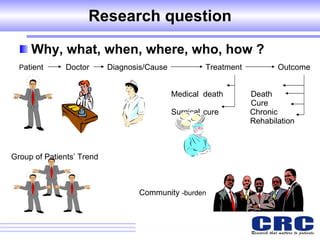
Research question Why, what, when, where, who, how ? P atient  Doctor  Diagnosis/Cause  Treatment  Outcome    Medical death   Death      Cure Surgical cure  Chronic     Rehabilation   Group of Patients’ Trend  Community  -burden
Randomized controlled trial Evaluate new forms of therapy and prevention Treatment - drug Health care technology - device Methods of primary prevention - screening  Organizing and delivering health services (community trial) Impact of new policies in health care and health care financing (community trial)
Randomized controlled trial Strongest design - randomization, minimize  selection bias Must be ethical - no harmful intervention, no poor clinical outcome  Difficult  for intervention in rare disease / rare outcome Participation of subjects is crucial
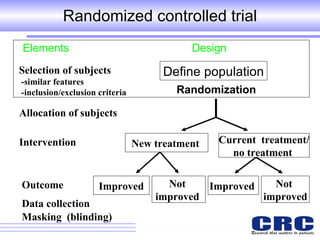
Elements   Design   Randomization Randomized controlled trial New treatment   Current  treatment/ no treatment   Improved Not  improved   Improved  Not  improved Intervention Outcome Selection of subjects -similar features  -inclusion/exclusion criteria Allocation of   subjects Data collection Masking   (blinding) Define population
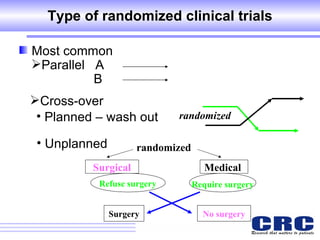
Type of randomized clinical trials Surgical Medical  randomized randomized Refuse surgery Require surgery No surgery Surgery Most common  Parallel  A B Cross-over Planned – wash out Unplanned
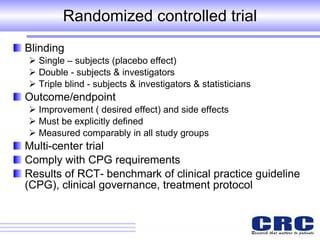
Randomized controlled trial Blinding Single – subjects (placebo effect)  Double - subjects & investigators Triple blind - subjects & investigators & statisticians Outcome/endpoint Improvement ( desired effect) and side effects Must be explicitly defined  Measured comparably in all study groups Multi-center trial Comply with CPG requirements Results of RCT- benchmark of clinical practice guideline (CPG), clinical governance, treatment protocol
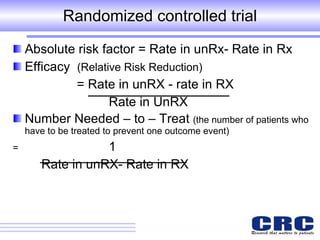
Randomized controlled trial Absolute risk factor = Rate in unRx- Rate in Rx Efficacy  (Relative Risk Reduction)   = Rate in unRX - rate in RX Rate in UnRX Number Needed – to – Treat  (the number of patients who have to be treated to prevent one outcome event) =   1 Rate in unRX- Rate in RX
Randomized controlled trial ? Effective in uncontrolled community Consent refusal - automatic selection  (people who participate are different from those who do not) Non-compliance  (people who complaint are very different from those who are not) Drop-out: not adherence to experimental regimen, loss to follow-up Drop-in: not adherence to control regimen  Compliance -Need monitoring  Most costly
Observational studies Cohort study  Case-control study Cross sectional study Ecologic or trend study  Case report or series  Qualitative research Direction, timing, +/- control
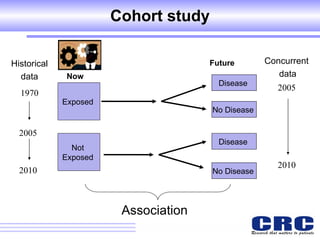
Cohort study Exposed  Disease  Future  Now  Not  Exposed  No Disease  Disease  No Disease  Association Historical data Concurrent  data 1970 2005 2010 2005 2010
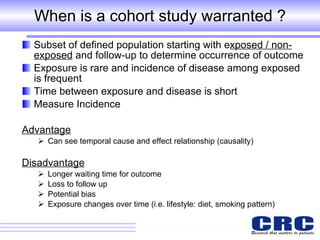
When is a cohort study warranted ? Subset of defined population starting with e xposed / non-exposed  and follow-up to determine occurrence of outcome Exposure is rare and incidence of disease among exposed is frequent Time between exposure and disease is short Measure Incidence Advantage Can see temporal cause and effect relationship (causality) Disadvantage Longer waiting time for outcome  Loss to follow up Potential bias Exposure changes over time (i.e. lifestyle: diet, smoking pattern)
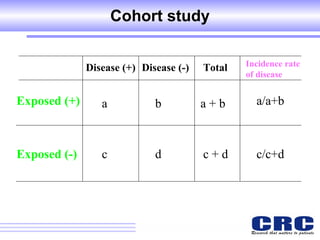
Cohort study Disease (+) Exposed (+) Exposed (-) Disease (-) Total Incidence rate of disease a b c d a + b c + d a/a+b c/c+d
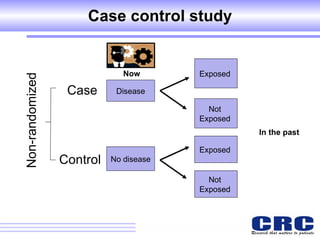
Case control study Exposed  Disease In the past  Now  No disease  Not  Exposed  Exposed  Not  Exposed  Case Control Non-randomized
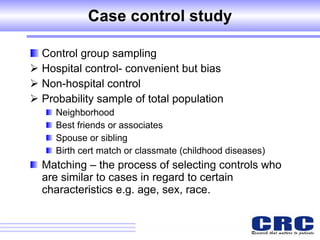
Case control study Control group sampling Hospital control- convenient but bias Non-hospital control Probability sample of total population Neighborhood Best friends or associates Spouse or sibling Birth cert match or classmate (childhood diseases) Matching – the process of selecting controls who are similar to cases in regard to certain characteristics e.g. age, sex, race.
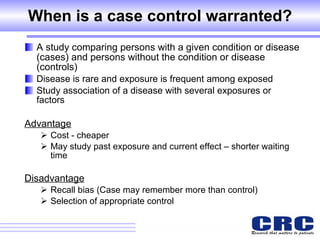
When is a case control warranted? A study comparing persons with a given condition or disease (cases) and persons without the condition or disease (controls) Disease is rare and exposure is frequent among exposed Study association of a disease with several exposures or factors Advantage Cost - cheaper May study past exposure and current effect – shorter waiting time  Disadvantage Recall bias (Case may remember more than control)  Selection of appropriate control
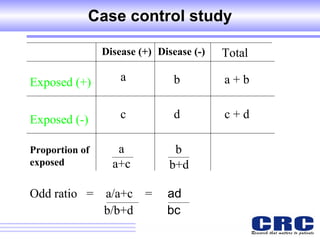
Case control study Disease (+) Exposed (+) Exposed (-) Disease (-) Total a b c d a + b c + d Odd ratio  =  a/a+c  =  ad b/b+d  bc Proportion of exposed   a a+c b b+d
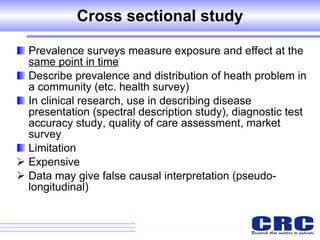
Cross sectional study Prevalence surveys measure exposure and effect at the  same point in time Describe prevalence and distribution of heath problem in a community (etc. health survey) In clinical research, use in describing disease presentation (spectral description study), diagnostic test accuracy study, quality of care assessment, market survey Limitation Expensive Data may give false causal interpretation (pseudo-longitudinal)
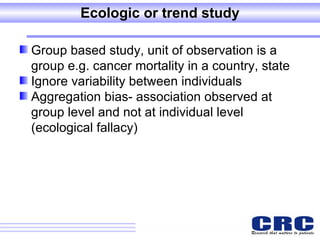
Ecologic or trend study Group based study, unit of observation is a group e.g. cancer mortality in a country, state  Ignore variability between individuals Aggregation bias- association observed at group level and not at individual level (ecological fallacy)
Case report or case studies Description of one or several cases in which no attempt is made to answer specific hypotheses or to compare results with another group of cases No control Classical clinical study Its value probably under rated
Qualitative study Development of concepts which help us to understand social phenomena in natural settings, giving due emphasis to the meanings, experiences, and views of all the participants Explaining complex phenomena not amenable to quantitative research  Method - Focus group, observation, interview, diary Application  Doctor-patient relationship, treatment compliance, clinical decision making process, issues on health service organization and policy issues
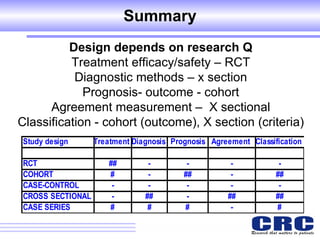
Summary Design depends on research Q Treatment efficacy/safety – RCT Diagnostic methods – x section Prognosis- outcome - cohort Agreement measurement –  X sectional Classification - cohort (outcome), X section (criteria)

Study Designs_YL

  • 1.
    Study Design Yvonne Lee Yin Leng, MPH Clinical Epidemiology Unit, CRC
  • 2.
  • 3.
    Common study designRandomized controlled trial Cohort study 3. Case control study 4. Cross sectional study 5. Ecologic or trend study 6. Case report or case series 7. Qualitative research
  • 4.
    Purpose different studydesign Different purpose / objective of the study Maximizing study validity, in particular minimizing biases (Validity –accuracy, ability to give a true measure, i.e. measure what it purports to measure) Increase reliability   Reliable, invalid Unreliable, invalid Reliable, valid
  • 5.
    Which study design? Research questions Objective of the study Occurrence of disease / exposure -rare/ common Ethical issue Resources- money, manpower, machine Several designs may well be suitable for a particular study. Choice must then be guided by considerations of strength of design, cost and ethics.
  • 6.
    Research question Why,what, when, where, who, how ? P atient Doctor Diagnosis/Cause Treatment Outcome Medical death Death Cure Surgical cure Chronic Rehabilation Group of Patients’ Trend Community -burden
  • 7.
    Randomized controlled trialEvaluate new forms of therapy and prevention Treatment - drug Health care technology - device Methods of primary prevention - screening Organizing and delivering health services (community trial) Impact of new policies in health care and health care financing (community trial)
  • 8.
    Randomized controlled trialStrongest design - randomization, minimize selection bias Must be ethical - no harmful intervention, no poor clinical outcome Difficult for intervention in rare disease / rare outcome Participation of subjects is crucial
  • 9.
    Elements Design Randomization Randomized controlled trial New treatment Current treatment/ no treatment Improved Not improved Improved Not improved Intervention Outcome Selection of subjects -similar features -inclusion/exclusion criteria Allocation of subjects Data collection Masking (blinding) Define population
  • 10.
    Type of randomizedclinical trials Surgical Medical randomized randomized Refuse surgery Require surgery No surgery Surgery Most common Parallel A B Cross-over Planned – wash out Unplanned
  • 11.
    Randomized controlled trialBlinding Single – subjects (placebo effect) Double - subjects & investigators Triple blind - subjects & investigators & statisticians Outcome/endpoint Improvement ( desired effect) and side effects Must be explicitly defined Measured comparably in all study groups Multi-center trial Comply with CPG requirements Results of RCT- benchmark of clinical practice guideline (CPG), clinical governance, treatment protocol
  • 12.
    Randomized controlled trialAbsolute risk factor = Rate in unRx- Rate in Rx Efficacy (Relative Risk Reduction) = Rate in unRX - rate in RX Rate in UnRX Number Needed – to – Treat (the number of patients who have to be treated to prevent one outcome event) = 1 Rate in unRX- Rate in RX
  • 13.
    Randomized controlled trial? Effective in uncontrolled community Consent refusal - automatic selection (people who participate are different from those who do not) Non-compliance (people who complaint are very different from those who are not) Drop-out: not adherence to experimental regimen, loss to follow-up Drop-in: not adherence to control regimen Compliance -Need monitoring Most costly
  • 14.
    Observational studies Cohortstudy Case-control study Cross sectional study Ecologic or trend study Case report or series Qualitative research Direction, timing, +/- control
  • 15.
    Cohort study Exposed Disease Future Now Not Exposed No Disease Disease No Disease Association Historical data Concurrent data 1970 2005 2010 2005 2010
  • 16.
    When is acohort study warranted ? Subset of defined population starting with e xposed / non-exposed and follow-up to determine occurrence of outcome Exposure is rare and incidence of disease among exposed is frequent Time between exposure and disease is short Measure Incidence Advantage Can see temporal cause and effect relationship (causality) Disadvantage Longer waiting time for outcome Loss to follow up Potential bias Exposure changes over time (i.e. lifestyle: diet, smoking pattern)
  • 17.
    Cohort study Disease(+) Exposed (+) Exposed (-) Disease (-) Total Incidence rate of disease a b c d a + b c + d a/a+b c/c+d
  • 18.
    Case control studyExposed Disease In the past Now No disease Not Exposed Exposed Not Exposed Case Control Non-randomized
  • 19.
    Case control studyControl group sampling Hospital control- convenient but bias Non-hospital control Probability sample of total population Neighborhood Best friends or associates Spouse or sibling Birth cert match or classmate (childhood diseases) Matching – the process of selecting controls who are similar to cases in regard to certain characteristics e.g. age, sex, race.
  • 20.
    When is acase control warranted? A study comparing persons with a given condition or disease (cases) and persons without the condition or disease (controls) Disease is rare and exposure is frequent among exposed Study association of a disease with several exposures or factors Advantage Cost - cheaper May study past exposure and current effect – shorter waiting time Disadvantage Recall bias (Case may remember more than control) Selection of appropriate control
  • 21.
    Case control studyDisease (+) Exposed (+) Exposed (-) Disease (-) Total a b c d a + b c + d Odd ratio = a/a+c = ad b/b+d bc Proportion of exposed a a+c b b+d
  • 22.
    Cross sectional studyPrevalence surveys measure exposure and effect at the same point in time Describe prevalence and distribution of heath problem in a community (etc. health survey) In clinical research, use in describing disease presentation (spectral description study), diagnostic test accuracy study, quality of care assessment, market survey Limitation Expensive Data may give false causal interpretation (pseudo-longitudinal)
  • 23.
    Ecologic or trendstudy Group based study, unit of observation is a group e.g. cancer mortality in a country, state Ignore variability between individuals Aggregation bias- association observed at group level and not at individual level (ecological fallacy)
  • 24.
    Case report orcase studies Description of one or several cases in which no attempt is made to answer specific hypotheses or to compare results with another group of cases No control Classical clinical study Its value probably under rated
  • 25.
    Qualitative study Developmentof concepts which help us to understand social phenomena in natural settings, giving due emphasis to the meanings, experiences, and views of all the participants Explaining complex phenomena not amenable to quantitative research Method - Focus group, observation, interview, diary Application Doctor-patient relationship, treatment compliance, clinical decision making process, issues on health service organization and policy issues
  • 26.
    Summary Design dependson research Q Treatment efficacy/safety – RCT Diagnostic methods – x section Prognosis- outcome - cohort Agreement measurement – X sectional Classification - cohort (outcome), X section (criteria)

Editor's Notes

  • #2 Question – what r the study designs you know of?
  • #6 Research question will be followed desc by my colleague
  • #7 For this session we will discuss some of the most commonly used study designs
  • #24 More than 2 contacts regular interval but can vary from weeks, months, year Longer period Info gathered each time is identical Data from Same study population but NOT necessary same respondent