Types of primarystudies
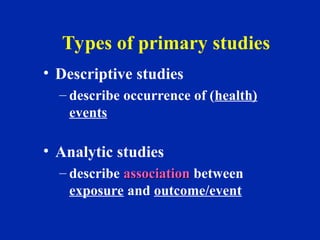
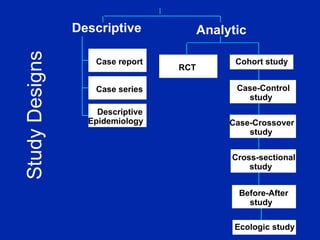
• Descriptive studies
– describe occurrence of (health)
events
• Analytic studies
– describe association
association between
exposure and outcome/event
3.
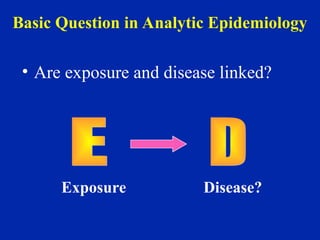
Basic Question inAnalytic Epidemiology
• Are exposure and disease linked?
Exposure Disease?
4.
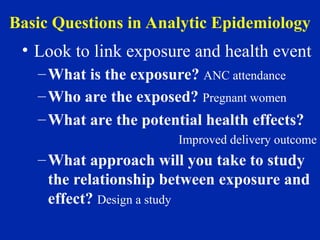
Basic Questions inAnalytic Epidemiology
• Look to link exposure and health event
–What is the exposure? ANC attendance
–Who are the exposed? Pregnant women
–What are the potential health effects?
Improved delivery outcome
–What approach will you take to study
the relationship between exposure and
effect? Design a study
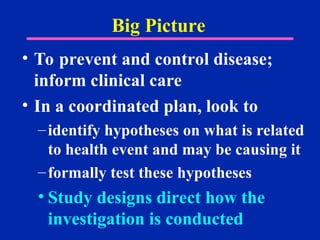
Big Picture
• Toprevent and control disease;
inform clinical care
• In a coordinated plan, look to
–identify hypotheses on what is related
to health event and may be causing it
–formally test these hypotheses
• Study designs direct how the
investigation is conducted
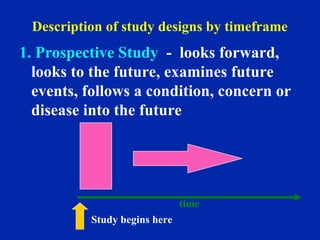
Description of studydesigns by timeframe
1. Prospective Study - looks forward,
looks to the future, examines future
events, follows a condition, concern or
disease into the future
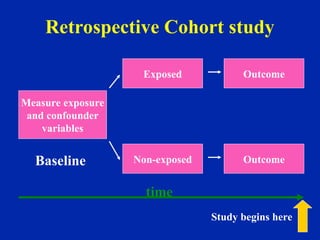
time
Study begins here
10.
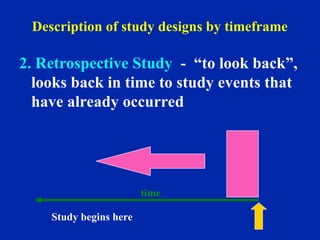
Description of studydesigns by timeframe
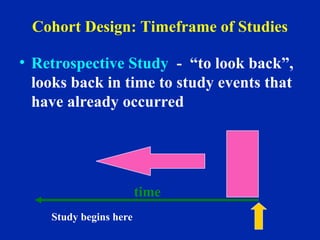
2. Retrospective Study - “to look back”,
looks back in time to study events that
have already occurred
time
Study begins here
11.
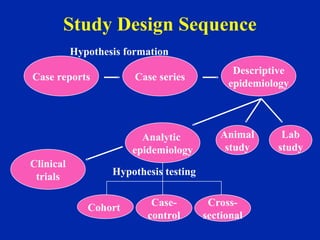
Study Design Sequence
Casereports Case series
Descriptive
epidemiology
Analytic
epidemiology
Clinical
trials
Animal
study
Lab
study
Cohort Case-
control
Cross-
sectional
Hypothesis formation
Hypothesis testing
12.
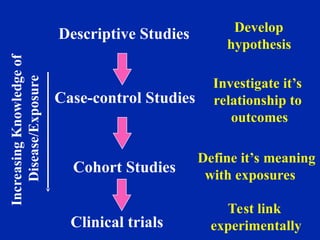
Descriptive Studies
Case-control Studies
CohortStudies
Develop
hypothesis
Investigate it’s
relationship to
outcomes
Define it’s meaning
with exposures
Clinical trials
Test link
experimentally
Increasing
Knowledge
of
Disease/Exposure
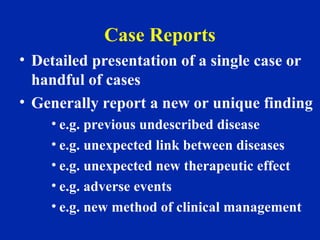
Case Reports
• Detailedpresentation of a single case or
handful of cases
• Generally report a new or unique finding
• e.g. previous undescribed disease
• e.g. unexpected link between diseases
• e.g. unexpected new therapeutic effect
• e.g. adverse events
• e.g. new method of clinical management
15.
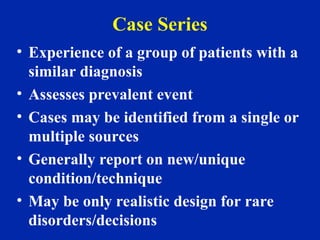
Case Series
• Experienceof a group of patients with a
similar diagnosis
• Assesses prevalent event
• Cases may be identified from a single or
multiple sources
• Generally report on new/unique
condition/technique
• May be only realistic design for rare
disorders/decisions
16.
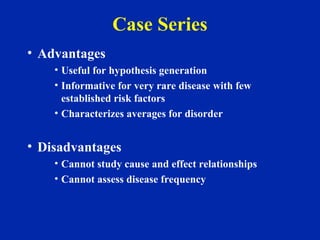
Case Series
• Advantages
•Useful for hypothesis generation
• Informative for very rare disease with few
established risk factors
• Characterizes averages for disorder
• Disadvantages
• Cannot study cause and effect relationships
• Cannot assess disease frequency
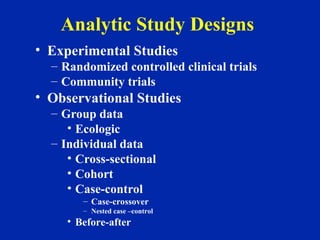
Analytic Study Designs
•Experimental Studies
– Randomized controlled clinical trials
– Community trials
• Observational Studies
– Group data
• Ecologic
– Individual data
• Cross-sectional
• Cohort
• Case-control
– Case-crossover
– Nested case –control
• Before-after
20.
Experimental Studies
• treatmentand exposures occur in a
“controlled” environment
• planned research designs
• clinical trials are the most well known
experimental design. Clinical trials use
randomly assigned data.
• Community trials use nonrandom data
21.
Observational Studies
• non-experimental
•observational because there is no
individual intervention
• treatment and exposures occur in a “non-
controlled” environment
• individuals can be observed prospectively,
retrospectively, or currently
22.
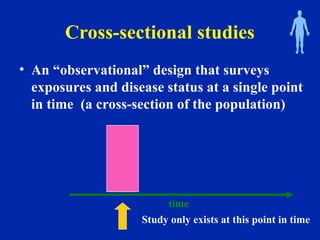
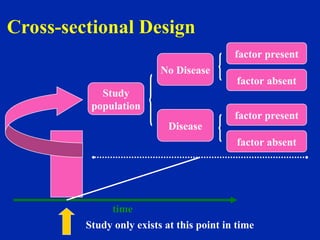
Cross-sectional studies
• An“observational” design that surveys
exposures and disease status at a single point
in time (a cross-section of the population)
time
Study only exists at this point in time
23.
Cross-sectional Design
time
Study onlyexists at this point in time
Study
population
No Disease
Disease
factor present
factor absent
factor present
factor absent
24.
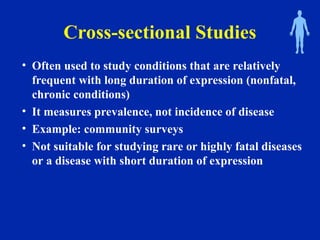
Cross-sectional Studies
• Oftenused to study conditions that are relatively
frequent with long duration of expression (nonfatal,
chronic conditions)
• It measures prevalence, not incidence of disease
• Example: community surveys
• Not suitable for studying rare or highly fatal diseases
or a disease with short duration of expression
25.
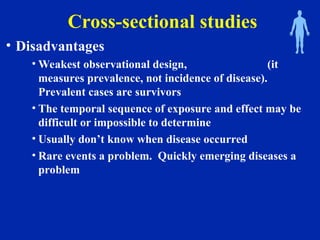
Cross-sectional studies
• Disadvantages
•Weakest observational design, (it
measures prevalence, not incidence of disease).
Prevalent cases are survivors
• The temporal sequence of exposure and effect may be
difficult or impossible to determine
• Usually don’t know when disease occurred
• Rare events a problem. Quickly emerging diseases a
problem
26.
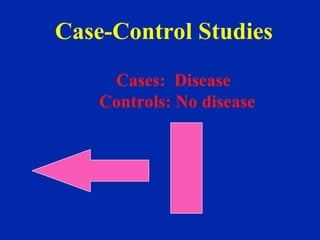
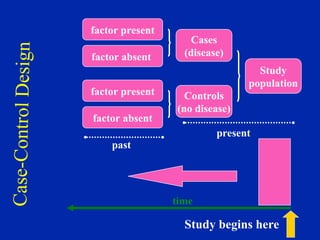
Case-Control Studies
• an“observational” design
comparing exposures in disease
cases vs. healthy controls from same
population
• exposure data collected
retrospectively
• most feasible design where disease
outcomes are rare
Case-Control Study
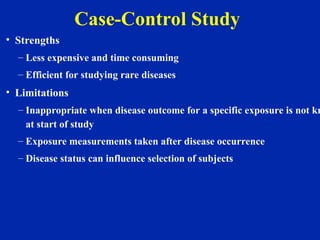
• Strengths
–Less expensive and time consuming
– Efficient for studying rare diseases
• Limitations
– Inappropriate when disease outcome for a specific exposure is not kn
at start of study
– Exposure measurements taken after disease occurrence
– Disease status can influence selection of subjects
30.
Hypothesis Testing: Case-CrossoverStudies
• Study of “triggers” within an individual
• ”Case" and "control" component, but information of
both components will come from the same individual
• ”Case component" = hazard period which is the time
period right before the disease or event onset
• ”Control component" = control period which is a
specified time interval other than the hazard period
31.
Cohort Studies
• an“observational” design comparing
individuals with a known risk factor or
exposure with others without the risk
factor or exposure
• looking for a difference in the risk
(incidence) of a disease over time
• best observational design
• data usually collected prospectively
(some retrospective)
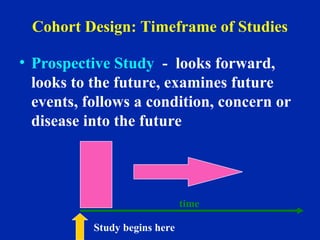
Cohort Design: Timeframeof Studies
• Prospective Study - looks forward,
looks to the future, examines future
events, follows a condition, concern or
disease into the future
time
Study begins here
34.
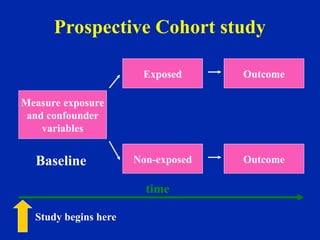
Prospective Cohort study
Measureexposure
and confounder
variables
Exposed
Non-exposed
Outcome
Outcome
Baseline
time
Study begins here
35.
Cohort Design: Timeframeof Studies
• Retrospective Study - “to look back”,
looks back in time to study events that
have already occurred
time
Study begins here
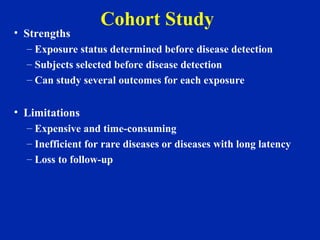
Cohort Study
• Strengths
–Exposure status determined before disease detection
– Subjects selected before disease detection
– Can study several outcomes for each exposure
• Limitations
– Expensive and time-consuming
– Inefficient for rare diseases or diseases with long latency
– Loss to follow-up
38.
Experimental Studies
• investigatorcan “control” the exposure
• akin to laboratory experiments except living
populations are the subjects
• generally involves random assignment to groups
• clinical trials are the most well known
experimental design
• the ultimate step in testing causal hypotheses
39.
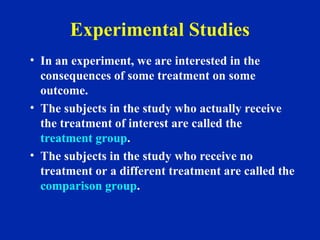
Experimental Studies
• Inan experiment, we are interested in the
consequences of some treatment on some
outcome.
• The subjects in the study who actually receive
the treatment of interest are called the
treatment group.
• The subjects in the study who receive no
treatment or a different treatment are called the
comparison group.
40.
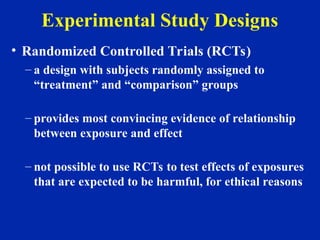
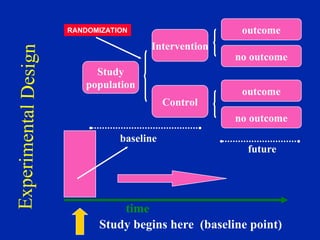
Experimental Study Designs
•Randomized Controlled Trials (RCTs)
– a design with subjects randomly assigned to
“treatment” and “comparison” groups
– provides most convincing evidence of relationship
between exposure and effect
– not possible to use RCTs to test effects of exposures
that are expected to be harmful, for ethical reasons
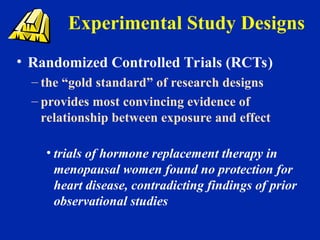
Experimental Study Designs
•Randomized Controlled Trials (RCTs)
– the “gold standard” of research designs
– provides most convincing evidence of
relationship between exposure and effect
• trials of hormone replacement therapy in
menopausal women found no protection for
heart disease, contradicting findings of prior
observational studies
43.
Randomized Controlled Trials
•Disadvantages
–Very expensive
–Not appropriate to answer certain
types of questions
• it may be unethical, for example, to
assign persons to certain treatment
or comparison groups
44.
Review Questions (Developedby
the Supercourse team)
• Describe the link between exposure and
disease
• Describe study design sequence
• Describe strengths and weaknesses of
each design
#2 Descriptive studies may examine the frequency to which diseases occur. Analytic studies evaluates the relationship of disease/event to different exposures
#3 Basic designs in epidemiology examine if exposures are associated with disease/health event. Does ANC attendance lead to delivery in a health facility?
#4 In order to examine the link of exposure to health event, there needs to be standardized evaluation of exposure, as well as the event
#5 • Society will be healthier
• Society can save money on health care budgets
• It will improve life expectancy
• It will improve the economy
Responses to this question vary. As outlined below, some believe that altruistically, society should pursue disease prevention to improve health and save money. These are noble goals, but I will demonstrate later that prevention does not always save money. The desire to prevent NCDs probably is a repercussion of our efforts to prevent infectious diseases. We have had great success in preventing communicable diseases. This has led to an initiative to prevent NCDs.
#6 Prevention and control, can be defined as the reduction of the incidence of disease . May also imply improving convalescence or minimizing disability from disease
#8 Health research studies may be descriptive in nature (describing the frequency or characteristics of events) or analytic (testing relationships between common traits and outcomes). Differing forms of descriptive studies exist. These designs are outlined in the next slide.
Analytic studies include experimental designs (the randomized controlled trial) and observational designs (case-control studies, cohort studies, etc.). The case-crossover study design has received a lot of attention in the past few years.
#9 With a prospective study one starts with cohorts of well individuals, and we wait until events occurs.
#10 Looking backward is often difficult because of recall bias,, however, the case control studies are very inexpensive in comparison with prospective studies.
#11 There are many different types of designs that are in the arsenal of the epidemiologists to investigate disease
#12 To further illustrate, if one seeks to identify the etiologic factors (e.g. causal factors) behind an outcome (e.g. an MI), then each step in the epidemiologic framework provides new and important information.
Descriptive studies are useful for identifying hypotheses to test in analytic studies. Case-control studies are then usually applied to evaluate if the hypothesized factor is related to the outcome of interest. Subsequently, cohort or longitudinal studies are applied to further define the importance of exposure to the causal agent for the development of the outcome.
#13 • Society will be healthier
• Society can save money on health care budgets
• It will improve life expectancy
• It will improve the economy
Responses to this question vary. As outlined below, some believe that altruistically, society should pursue disease prevention to improve health and save money. These are noble goals, but I will demonstrate later that prevention does not always save money. The desire to prevent NCDs probably is a repercussion of our efforts to prevent infectious diseases. We have had great success in preventing communicable diseases. This has led to an initiative to prevent NCDs.
#14 Case reports are in many ways “sentinel events” which can lead to testable hypotheses
#15 Case series also provide suggestive evidence many times leading to more extensive testing.
#16 Case series
From Wikipedia, the free encyclopedia
http://en.wikipedia.org/wiki/Case_series
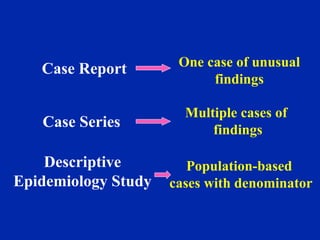
#17 Descriptive study designs include case reports, case series, incidence studies, and ecologic studies. The case report is the most elementary study design in the literature. It generally describes an injury or injuries to one or two individuals that have been identified in a medical setting. There is also usually a unique feature to the noted chronic disease . The case series design is an extension of the case report. In a case series, a number of events are described. These events usually have been observed over a set period of time (such as one year) and are identified from one reporting source (e.g. a hospital).
The descriptive epidemiology study is noted by the collection of events over a defined population base and by the use of denominator data to determine rates. The most frequent information generated from these designs are incidence rates for injuries. The ecologic study is a hypothesis generating study. Usually using group-level data, it examines if two factors are correlated with each other.
#18
Responses to this question vary. As outlined below, some believe that altruistically, society should pursue disease prevention to improve health and save money. These are noble goals, but I will demonstrate later that prevention does not always save money. The desire to prevent NCDs probably is a repercussion of our efforts to prevent infectious diseases. We have had great success in preventing communicable diseases. This has led to an initiative to prevent NCDs.
#19 An Introduction to Epidemiology (CDC)
http://www.cdc.gov/excite/classroom/intro_epi.htm
#20 Experimental studies are stronger in determining the etiology of disease than descriptive studies
#22 Cross section al studies are some of the first studies completed because of ease and low cost
#23 Cross-sectional studies examine a point in time
#24 Cross-sectional studies involve point prevalence, not incidence. For very infrequent diseases they are of limited utility
#25 Cross-sectional study
From Wikipedia, the free encyclopedia
http://en.wikipedia.org/wiki/Cross-sectional_study
#26 Case-control studies in epidemiology are the most used type of study design
#27 Case-Control studies represent one form of analytic study that provides information on the relationship between causal factors and injuries. In a case-control study, subjects who have been injured are identified and their past exposure to suspected causal factors is compared with that of controls (persons who have not been injured).
Many case-control studies ascertain exposure from personal recall, using either a self administered questionnaire or an interview. The validity of such information will depend in part on the subject matter. People may be able to remember recent events quite well. On the other hand, long term recall is generally less reliable.
Source: Chapter 8: Case-control and cross-sectional studies, Epidemiology for the Uninitiated
#29 Case control studies provide low cost answers to health questions.
#30 Case cross over studies are the newest form of epidemiologic design.
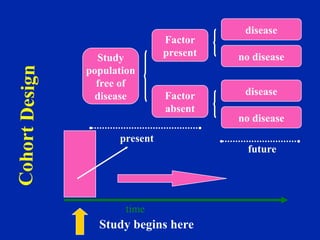
#31 The cohort studies is the best for observational studies as the environmental event can be assessed before any disease outcome
#32 A cohort studies follows a cohort of individuals who do not have disease, and then identified over time those individuals who have an outcome
#33 Prospective cohort study
From Wikipedia, the free encyclopedia
http://en.wikipedia.org/wiki/Prospective_cohort_study
#34 Case-control studies are perhaps the most frequent form of analytic study design. These designs are very good for events that are rare in occurrence..
Still, there are some situations where cohort study designs would be appropriate in the field. The classic design in a cohort study is shown here. The study begins by assessing baseline levels of the exposure and other variables. Study subjects are then followed on a regular basis to identify the outcome. The frequency of outcomes are tested between persons who had exposure to the possible risk factor at baseline and persons with no exposure.
#35 Prospective vs. retrospective studies
http://www.statsdirect.com/help/basics/prospective.htm
#36 An alternative form of the cohort study is something termed the retrospective cohort study. Other researchers may also call this a historical prospective study. This design is nearly identical to the prospective cohort study. The sequence of baseline exposure determination and longitudinal follow-up for outcomes is similar. The difference lies in the time in which the study begins. In this retrospective design, the researcher constructs the cohort study by looking back in time and placing data in the appropriate order and sequence. These studies are possible to do with large medical databases, such as the membership files of the Health Maintenance Organizations, or the medical files in the Scandinavian countries.
#37 -- Exp. Measured before disease - so no temporal ambiguity
-- Exposure measured before disease - so disease cannot influence the amount of error with which exposure status is measured
-- Subject selection before disease, disease status does not influence of subjects
#38 Experimental studies are the ultimate form of design in assessing causality as there is random assignment to groups.
#40 RCT should be conducted for hypotheses that have not been tested. Great care must be taken to evaluate possible negative outcomes as well as positive outcomes
#41 Experimental and observational studies
A common goal for a statistical research project is to investigate causality, and in particular to draw a conclusion on the effect of changes in the values of predictors or independent variables on dependent variables or response. There are two major types of causal statistical studies: experimental studies and observational studies. In both types of studies, the effect of differences of an independent variable (or variables) on the behavior of the dependent variable are observed. The difference between the two types lies in how the study is actually conducted. Each can be very effective. An experimental study involves taking measurements of the system under study, manipulating the system, and then taking additional measurements using the same procedure to determine if the manipulation has modified the values of the measurements. In contrast, an observational study does not involve experimental manipulation. Instead, data are gathered and correlations between predictors and response are investigated.
From Wikipedia, the free encyclopedia
http://en.wikipedia.org/wiki/Statistics
#42 It is not unexpected to find that observational studies find different results than for clinical trials. For example there have been 100s of observational studies demonstrating that hormone replacement was protective for women. However, when this was put to a clinical trail, the surprising result was that hormone replacement was not protective
#43 Understanding controlled trials: Why are randomised controlled trials important? By Bonnie Sibbald and Martin Roland
http://www.bmj.com/content/316/7126/201.full
#44 We would appreciate your help with evaluating the content of this course. Please send completed Evaluation Form to super1@pitt.edu with the subject "chronic disease supercourse evaluation"
If you have any comments or questions, please send a message to super1@pitt.edu