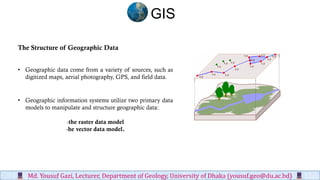
The Structure of Geographic Data
• Geographic data come from a variety of sources, such as
digitized maps, aerial photography, GPS, and field data.
• Geographic information systems utilize two primary data
models to manipulate and structure geographic data:
-the raster data model
-he vector data model.
GIS
Md. Yousuf Gazi, Lecturer, Department of Geology, University of Dhaka (yousuf.geo@du.ac.bd)
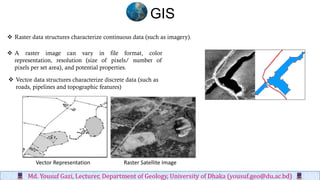
❖ Raster data structures characterize continuous data (such as imagery).
❖ A raster image can vary in file format, color
representation, resolution (size of pixels/ number of
pixels per set area), and potential properties.
❖ Vector data structures characterize discrete data (such as
roads, pipelines and topographic features)
Vector Representation Raster Satellite Image
Md. Yousuf Gazi, Lecturer, Department of Geology, University of Dhaka (yousuf.geo@du.ac.bd)
GIS
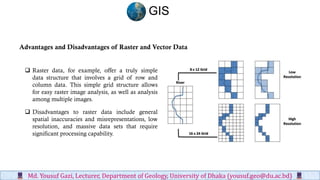
Advantages and Disadvantages of Raster and Vector Data
❑ Raster data, for example, offer a truly simple
data structure that involves a grid of row and
column data. This simple grid structure allows
for easy raster image analysis, as well as analysis
among multiple images.
❑ Disadvantages to raster data include general
spatial inaccuracies and misrepresentations, low
resolution, and massive data sets that require
significant processing capability.
GIS
Md. Yousuf Gazi, Lecturer, Department of Geology, University of Dhaka (yousuf.geo@du.ac.bd)
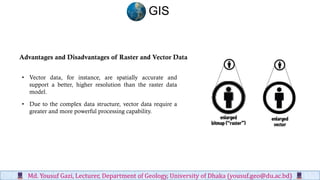
• Vector data, for instance, are spatially accurate and
support a better, higher resolution than the raster data
model.
Advantages and Disadvantages of Raster and Vector Data
• Due to the complex data structure, vector data require a
greater and more powerful processing capability.
GIS
Md. Yousuf Gazi, Lecturer, Department of Geology, University of Dhaka (yousuf.geo@du.ac.bd)
Vector Feature Geometry
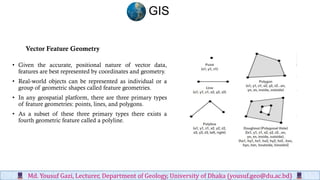
• Given the accurate, positional nature of vector data,
features are best represented by coordinates and geometry.
• Real-world objects can be represented as individual or a
group of geometric shapes called feature geometries.
• In any geospatial platform, there are three primary types
of feature geometries: points, lines, and polygons.
• As a subset of these three primary types there exists a
fourth geometric feature called a polyline.
GIS
Md. Yousuf Gazi, Lecturer, Department of Geology, University of Dhaka (yousuf.geo@du.ac.bd)
Raster Image Structures
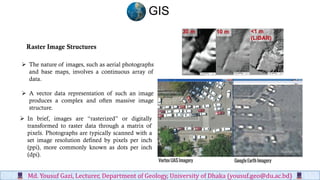
➢ The nature of images, such as aerial photographs
and base maps, involves a continuous array of
data.
➢ A vector data representation of such an image
produces a complex and often massive image
structure.
➢ In brief, images are “rasterized” or digitally
transformed to raster data through a matrix of
pixels. Photographs are typically scanned with a
set image resolution defined by pixels per inch
(ppi), more commonly known as dots per inch
(dpi).
GIS
Md. Yousuf Gazi, Lecturer, Department of Geology, University of Dhaka (yousuf.geo@du.ac.bd)
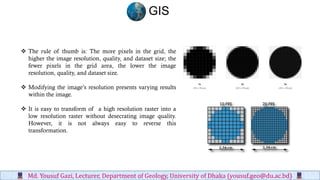
❖ The rule of thumb is: The more pixels in the grid, the
higher the image resolution, quality, and dataset size; the
fewer pixels in the grid area, the lower the image
resolution, quality, and dataset size.
❖ Modifying the image’s resolution presents varying results
within the image.
❖ It is easy to transform of a high resolution raster into a
low resolution raster without desecrating image quality.
However, it is not always easy to reverse this
transformation.
GIS
Md. Yousuf Gazi, Lecturer, Department of Geology, University of Dhaka (yousuf.geo@du.ac.bd)
Topology
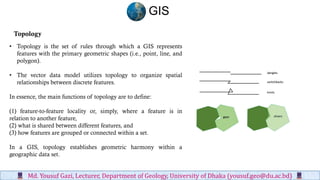
• Topology is the set of rules through which a GIS represents
features with the primary geometric shapes (i.e., point, line, and
polygon).
• The vector data model utilizes topology to organize spatial
relationships between discrete features.
In essence, the main functions of topology are to define:
(1) feature-to-feature locality or, simply, where a feature is in
relation to another feature,
(2) what is shared between different features, and
(3) how features are grouped or connected within a set.
In a GIS, topology establishes geometric harmony within a
geographic data set.
GIS
Md. Yousuf Gazi, Lecturer, Department of Geology, University of Dhaka (yousuf.geo@du.ac.bd)
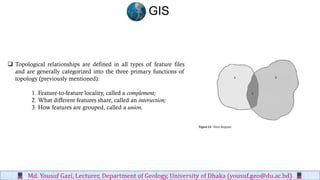
❑ Topological relationships are defined in all types of feature files
and are generally categorized into the three primary functions of
topology (previously mentioned):
1. Feature-to-feature locality, called a complement;
2. What different features share, called an intersection;
3. How features are grouped, called a union.
GIS
Md. Yousuf Gazi, Lecturer, Department of Geology, University of Dhaka (yousuf.geo@du.ac.bd)
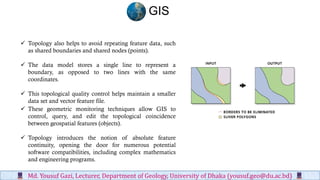
✓ Topology also helps to avoid repeating feature data, such
as shared boundaries and shared nodes (points).
✓ The data model stores a single line to represent a
boundary, as opposed to two lines with the same
coordinates.
✓ This topological quality control helps maintain a smaller
data set and vector feature file.
✓ These geometric monitoring techniques allow GIS to
control, query, and edit the topological coincidence
between geospatial features (objects).
✓ Topology introduces the notion of absolute feature
continuity, opening the door for numerous potential
software compatibilities, including complex mathematics
and engineering programs.
GIS
Md. Yousuf Gazi, Lecturer, Department of Geology, University of Dhaka (yousuf.geo@du.ac.bd)
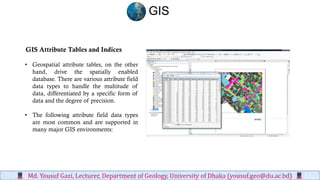
GIS Attribute Tables and Indices
• Geospatial attribute tables, on the other
hand, drive the spatially enabled
database. There are various attribute field
data types to handle the multitude of
data, differentiated by a specific form of
data and the degree of precision.
• The following attribute field data types
are most common and are supported in
many major GIS environments:
GIS
Md. Yousuf Gazi, Lecturer, Department of Geology, University of Dhaka (yousuf.geo@du.ac.bd)
Double. A more complex form of the Float attribute type with one sign bit, seven exponent bits, and 56 mantissa bits. As
with the Long Integer, the Double attribute type holds greater precision than the Float attribute type.
Text. Contains varying forms of data, such as numbers, letters, and symbols. The Text attribute type is a character string that
can hold any amount of characters, but each character is stored using eight bits.
Date. Though not apparent from the attribute data type name, a Date type contains date and time data.
BLOB. Short for Binary Large Object. A BLOB is a complex (and large) object stored in the database that may include an
image, sound, video, or geometry.
GUID. Acronym for Globally Unique Identifier. A GUID is a unique 128-bit (16 byte) number that is produced to identify
a particular application, file, database entry, hardware, or user.
Short Integer. A basic attribute data type that includes one signed bit and 15 binary bits.
Long Integer. A more complex form of the basic attribute type that incorporates one signed bit and 31 binary bits. As you
can imagine, the Long Integer offers greater precision than the Short Integer.
Float. Contains one signed bit, seven exponent bits, and 24 mantissa bits.
GIS
Md. Yousuf Gazi, Lecturer, Department of Geology, University of Dhaka (yousuf.geo@du.ac.bd)

Structure of geographic data

  • 1.
    The Structure ofGeographic Data • Geographic data come from a variety of sources, such as digitized maps, aerial photography, GPS, and field data. • Geographic information systems utilize two primary data models to manipulate and structure geographic data: -the raster data model -he vector data model. GIS Md. Yousuf Gazi, Lecturer, Department of Geology, University of Dhaka (yousuf.geo@du.ac.bd)
  • 2.
    ❖ Raster datastructures characterize continuous data (such as imagery). ❖ A raster image can vary in file format, color representation, resolution (size of pixels/ number of pixels per set area), and potential properties. ❖ Vector data structures characterize discrete data (such as roads, pipelines and topographic features) Vector Representation Raster Satellite Image Md. Yousuf Gazi, Lecturer, Department of Geology, University of Dhaka (yousuf.geo@du.ac.bd) GIS
  • 3.
    Advantages and Disadvantagesof Raster and Vector Data ❑ Raster data, for example, offer a truly simple data structure that involves a grid of row and column data. This simple grid structure allows for easy raster image analysis, as well as analysis among multiple images. ❑ Disadvantages to raster data include general spatial inaccuracies and misrepresentations, low resolution, and massive data sets that require significant processing capability. GIS Md. Yousuf Gazi, Lecturer, Department of Geology, University of Dhaka (yousuf.geo@du.ac.bd)
  • 4.
    • Vector data,for instance, are spatially accurate and support a better, higher resolution than the raster data model. Advantages and Disadvantages of Raster and Vector Data • Due to the complex data structure, vector data require a greater and more powerful processing capability. GIS Md. Yousuf Gazi, Lecturer, Department of Geology, University of Dhaka (yousuf.geo@du.ac.bd)
  • 5.
    Vector Feature Geometry •Given the accurate, positional nature of vector data, features are best represented by coordinates and geometry. • Real-world objects can be represented as individual or a group of geometric shapes called feature geometries. • In any geospatial platform, there are three primary types of feature geometries: points, lines, and polygons. • As a subset of these three primary types there exists a fourth geometric feature called a polyline. GIS Md. Yousuf Gazi, Lecturer, Department of Geology, University of Dhaka (yousuf.geo@du.ac.bd)
  • 6.
    Raster Image Structures ➢The nature of images, such as aerial photographs and base maps, involves a continuous array of data. ➢ A vector data representation of such an image produces a complex and often massive image structure. ➢ In brief, images are “rasterized” or digitally transformed to raster data through a matrix of pixels. Photographs are typically scanned with a set image resolution defined by pixels per inch (ppi), more commonly known as dots per inch (dpi). GIS Md. Yousuf Gazi, Lecturer, Department of Geology, University of Dhaka (yousuf.geo@du.ac.bd)
  • 7.
    ❖ The ruleof thumb is: The more pixels in the grid, the higher the image resolution, quality, and dataset size; the fewer pixels in the grid area, the lower the image resolution, quality, and dataset size. ❖ Modifying the image’s resolution presents varying results within the image. ❖ It is easy to transform of a high resolution raster into a low resolution raster without desecrating image quality. However, it is not always easy to reverse this transformation. GIS Md. Yousuf Gazi, Lecturer, Department of Geology, University of Dhaka (yousuf.geo@du.ac.bd)
  • 8.
    Topology • Topology isthe set of rules through which a GIS represents features with the primary geometric shapes (i.e., point, line, and polygon). • The vector data model utilizes topology to organize spatial relationships between discrete features. In essence, the main functions of topology are to define: (1) feature-to-feature locality or, simply, where a feature is in relation to another feature, (2) what is shared between different features, and (3) how features are grouped or connected within a set. In a GIS, topology establishes geometric harmony within a geographic data set. GIS Md. Yousuf Gazi, Lecturer, Department of Geology, University of Dhaka (yousuf.geo@du.ac.bd)
  • 9.
    ❑ Topological relationshipsare defined in all types of feature files and are generally categorized into the three primary functions of topology (previously mentioned): 1. Feature-to-feature locality, called a complement; 2. What different features share, called an intersection; 3. How features are grouped, called a union. GIS Md. Yousuf Gazi, Lecturer, Department of Geology, University of Dhaka (yousuf.geo@du.ac.bd)
  • 10.
    ✓ Topology alsohelps to avoid repeating feature data, such as shared boundaries and shared nodes (points). ✓ The data model stores a single line to represent a boundary, as opposed to two lines with the same coordinates. ✓ This topological quality control helps maintain a smaller data set and vector feature file. ✓ These geometric monitoring techniques allow GIS to control, query, and edit the topological coincidence between geospatial features (objects). ✓ Topology introduces the notion of absolute feature continuity, opening the door for numerous potential software compatibilities, including complex mathematics and engineering programs. GIS Md. Yousuf Gazi, Lecturer, Department of Geology, University of Dhaka (yousuf.geo@du.ac.bd)
  • 11.
    GIS Attribute Tablesand Indices • Geospatial attribute tables, on the other hand, drive the spatially enabled database. There are various attribute field data types to handle the multitude of data, differentiated by a specific form of data and the degree of precision. • The following attribute field data types are most common and are supported in many major GIS environments: GIS Md. Yousuf Gazi, Lecturer, Department of Geology, University of Dhaka (yousuf.geo@du.ac.bd)
  • 12.
    Double. A morecomplex form of the Float attribute type with one sign bit, seven exponent bits, and 56 mantissa bits. As with the Long Integer, the Double attribute type holds greater precision than the Float attribute type. Text. Contains varying forms of data, such as numbers, letters, and symbols. The Text attribute type is a character string that can hold any amount of characters, but each character is stored using eight bits. Date. Though not apparent from the attribute data type name, a Date type contains date and time data. BLOB. Short for Binary Large Object. A BLOB is a complex (and large) object stored in the database that may include an image, sound, video, or geometry. GUID. Acronym for Globally Unique Identifier. A GUID is a unique 128-bit (16 byte) number that is produced to identify a particular application, file, database entry, hardware, or user. Short Integer. A basic attribute data type that includes one signed bit and 15 binary bits. Long Integer. A more complex form of the basic attribute type that incorporates one signed bit and 31 binary bits. As you can imagine, the Long Integer offers greater precision than the Short Integer. Float. Contains one signed bit, seven exponent bits, and 24 mantissa bits. GIS Md. Yousuf Gazi, Lecturer, Department of Geology, University of Dhaka (yousuf.geo@du.ac.bd)