Md. Yousuf Gazi, Lecturer, Department of Geology, University of Dhaka (yousuf.geo@du.ac.bd)
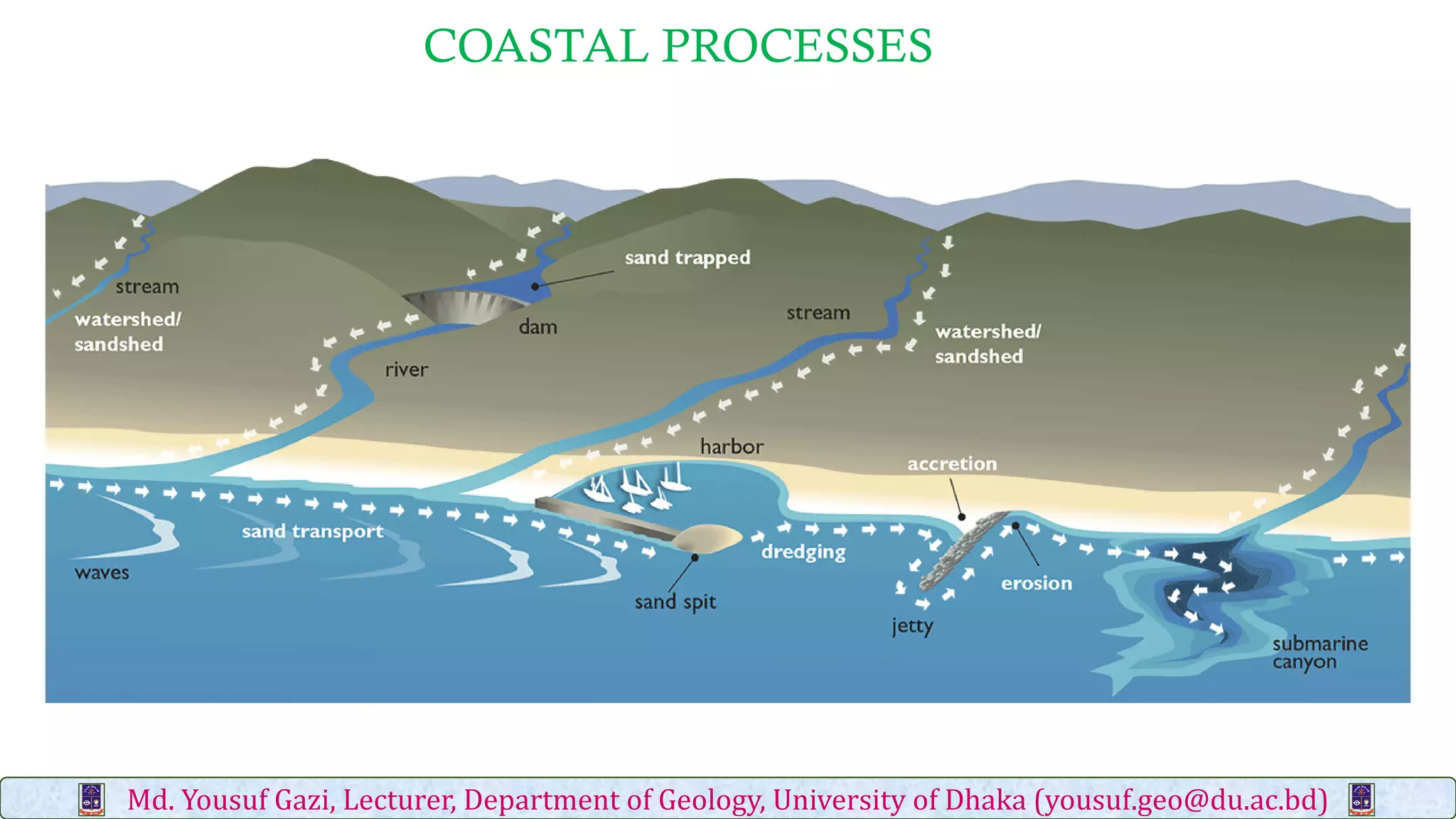
COASTAL PROCESSES
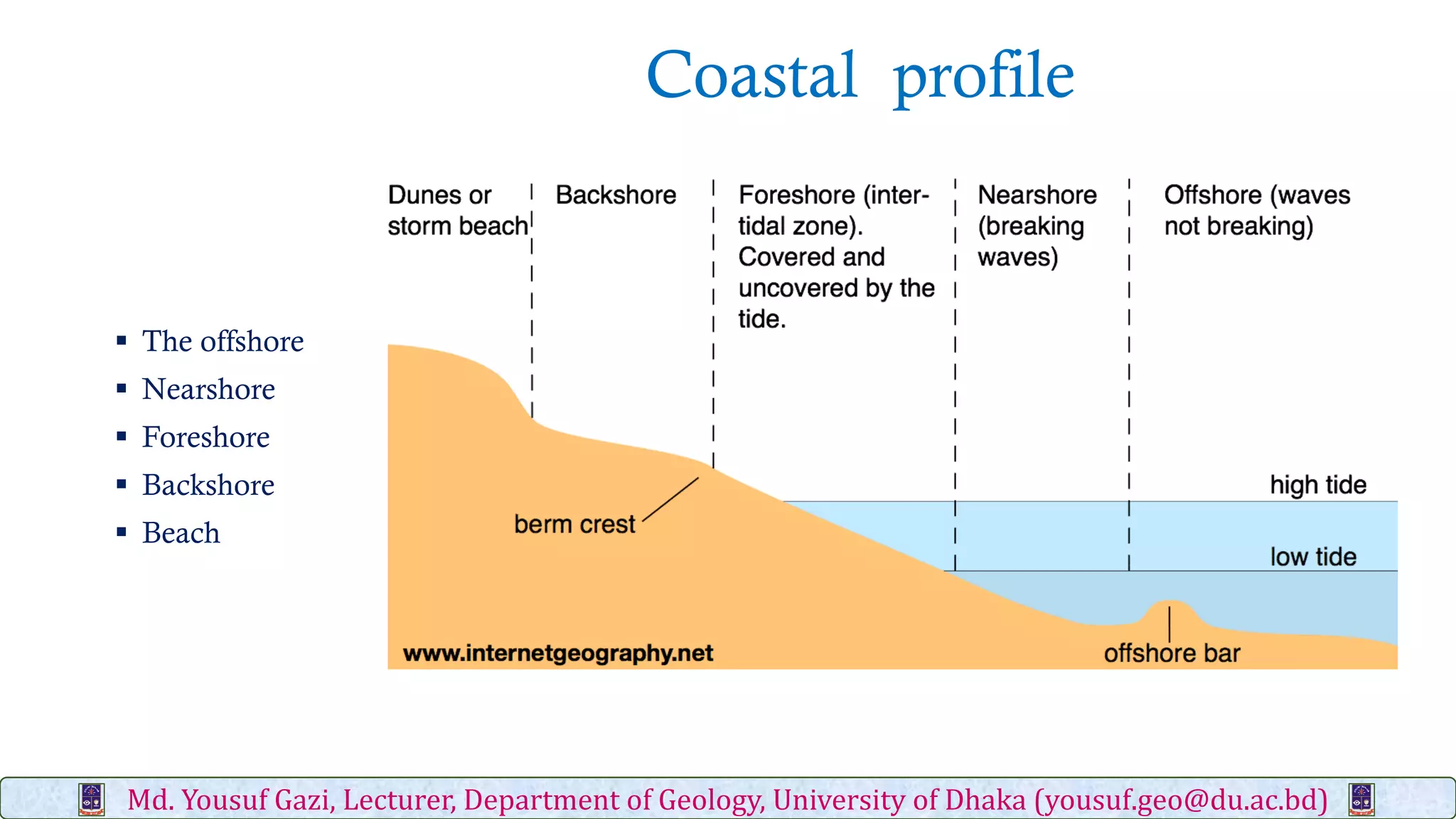
▪ The offshore
▪ Nearshore
▪ Foreshore
▪ Backshore
▪ Beach
Coastal profile
Md. Yousuf Gazi, Lecturer, Department of Geology, University of Dhaka (yousuf.geo@du.ac.bd)
COASTAL PROCESSES
▪ Coastal processes are the set of mechanisms that operate along a coastline, bringing about various
combinations of erosion and deposition.
▪ The energy due to tide, waves, wind and currents is constantly working in the coastal zone.
Dissipation of energy (due to tide, wind, waves and current) is often provided by the beaches,
mudflats, marshes and mangroves.
 Sediment transport
 Currents
 Denudation
 Deposition
 Erosion
 Flooding
 Diffraction
 Refraction
Md. Yousuf Gazi, Lecturer, Department of Geology, University of Dhaka (yousuf.geo@du.ac.bd)
▪ Changes in water level
▪ Tides
▪ Waves
▪ Currents
▪ Stream outflow
❑ Processes responsible for initiating sediment Transportation:
Md. Yousuf Gazi, Lecturer, Department of Geology, University of Dhaka (yousuf.geo@du.ac.bd)
 Sediment transport
❑ Another nearshore dynamical system is littoral transport - the movement of sediments
in the nearshore zone by waves and currents.
❑ Littoral transport is divided into two general classes:
▪ Longshore transport: Transport parallel to the shore.
▪ Onshore-offshore transport: Transport perpendicular to the shore.
Md. Yousuf Gazi, Lecturer, Department of Geology, University of Dhaka (yousuf.geo@du.ac.bd)
 It is the movement of sediments most often sand, along a coast parallel to its shoreline - a zig-zag
movement of sediment along the beach .
 The largest beach sediment is found where the process begins, updrift, and the smallest, most
easily moved, downdrift.
Longshore drift:
Md. Yousuf Gazi, Lecturer, Department of Geology, University of Dhaka (yousuf.geo@du.ac.bd)
 Where waves are strong, the coast will be eroded and sediment carried away and where they are
weak sediment will be deposited.
 Longshore drift can have undesirable effects for humans, such as beach erosion. To prevent this, sea
defences such as groynes or gabions may be employed.
Md. Yousuf Gazi, Lecturer, Department of Geology, University of Dhaka (yousuf.geo@du.ac.bd)
Swash and Backwash
▪ Swash – the rush of water up a beach after a wave breaks (powerful)
▪ Backwash – the returning water to the sea (less powerful)
▪ Constructive Waves – Break gently, far from shore and swash pushes material into shore, very
weak backwash
▪ Destructive Waves – Break very close to shore, very powerful backwash
Md. Yousuf Gazi, Lecturer, Department of Geology, University of Dhaka (yousuf.geo@du.ac.bd)
Modes of Sediment transport:
Sediments are transported as:
 Bed load transport
The bed load is the part of the total load that
is more or less in contact with the bed
during the transport. It primarily includes
grains that roll, slide or bounce along the
bed.
Md. Yousuf Gazi, Lecturer, Department of Geology, University of Dhaka (yousuf.geo@du.ac.bd)
➢ Suspended load transport:
It is the part of the total load that is moving in suspension without continuous contact with the bed.
▪ The determination of the rate of suspended load transport is straightforward by comparison with
measurement of the rate of bedload transport.
➢ Wash load transport:
▪ It consists of very fine particles transported in water.
Md. Yousuf Gazi, Lecturer, Department of Geology, University of Dhaka (yousuf.geo@du.ac.bd)
Modes of Sediment transport
❑ Coastal Processes:
▪ Accretion - natural or artificial deposition of sediment in a particular location
▪ Beach nourishment - the restoration of a beach by the mechanical placement of sand on the beach
for recreational and/ or shore protection purposes.
▪ Cross shore transport - the displacement of sediment perpendicular to the shore
▪ Erosion - the removal of sediment from a particular location by the action of wind or water.
Md. Yousuf Gazi, Lecturer, Department of Geology, University of Dhaka (yousuf.geo@du.ac.bd)
Accretion
Beach nourishment
Md. Yousuf Gazi, Lecturer, Department of Geology, University of Dhaka (yousuf.geo@du.ac.bd)
Cross shore transport Erosion
Md. Yousuf Gazi, Lecturer, Department of Geology, University of Dhaka (yousuf.geo@du.ac.bd)
▪ Groin - Shore perpendicular structure, installed singly or as a field of groins, designed to trap sand from
the littoral drift system .
Md. Yousuf Gazi, Lecturer, Department of Geology, University of Dhaka (yousuf.geo@du.ac.bd)
❑ Coastal Processes:
Groin
▪ Longshore Bar - offshore ridge or mound of sand, gravel or other loose material running parallel to the
Shore which is submerged (at least at high tide) and located a short distance from the shore.
Md. Yousuf Gazi, Lecturer, Department of Geology, University of Dhaka (yousuf.geo@du.ac.bd)
❑ Coastal Processes:
▪ Tombolo - the combination of an offshore rock or island which is connected to the beach by a sand spit.
❑ Coastal Processes:
Md. Yousuf Gazi, Lecturer, Department of Geology, University of Dhaka (yousuf.geo@du.ac.bd)
▪ Sand spit - low tongue of land or a relatively long, narrow shoal extending from the land.
❑ Coastal Processes:
Md. Yousuf Gazi, Lecturer, Department of Geology, University of Dhaka (yousuf.geo@du.ac.bd)
▪ Gabions- Boulders and rocks are wired into mesh cages and usually placed in front of areas vulnerable
to heavy to moderate erosion.
▪ Onshore transport - movement of sediment or water toward the shore.
Md. Yousuf Gazi, Lecturer, Department of Geology, University of Dhaka (yousuf.geo@du.ac.bd)
❑ Coastal Processes:
❑ Processes of Erosion:
▪ Hydraulic action – power of water (waves)
▪ Abrasion – Rocks/sand thrown against the coast
▪ Compressed Air – trapped in small crevices in the rock
by waves, this causes mini “explosions” which eventually
shatter the rock
▪ Attrition – Rocks wearing off each other
▪ Solution – Salts in seawater dissolving rock (sedimentary
rock)
▪ Wave refraction – waves bending on contact with the
coast, concentrating it’s effects in certain areas
Md. Yousuf Gazi, Lecturer, Department of Geology, University of Dhaka (yousuf.geo@du.ac.bd)
Wave refraction
Md. Yousuf Gazi, Lecturer, Department of Geology, University of Dhaka (yousuf.geo@du.ac.bd)
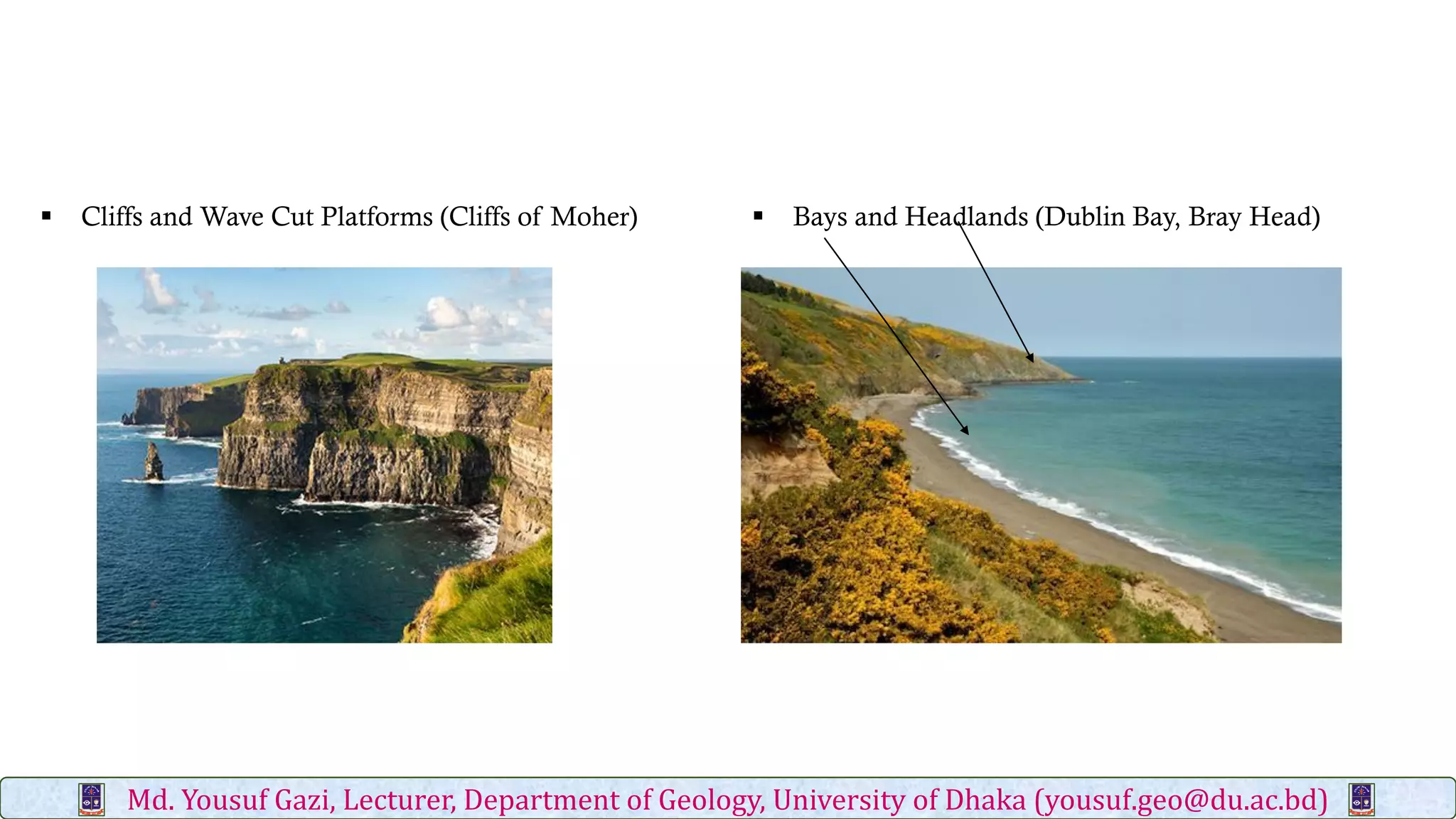
Landforms of Erosion
▪ Cliffs and Wave Cut Platforms (Cliffs of Moher)
▪ Bays and Headlands (Dublin Bay, Bray Head)
▪ Sea Caves (Cliffs of Moher)
▪ Sea Arches (Old Head of Kinsale)
▪ Sea Stacks (Dun Briste, Co. Mayo)
▪ Sea Stumps (Cliffs of Moher)
Md. Yousuf Gazi, Lecturer, Department of Geology, University of Dhaka (yousuf.geo@du.ac.bd)
▪ Cliffs and Wave Cut Platforms (Cliffs of Moher) ▪ Bays and Headlands (Dublin Bay, Bray Head)
Md. Yousuf Gazi, Lecturer, Department of Geology, University of Dhaka (yousuf.geo@du.ac.bd)
▪ Sea Caves (Cliffs of Moher) ▪ Sea Arches (Old Head of Kinsale)
Md. Yousuf Gazi, Lecturer, Department of Geology, University of Dhaka (yousuf.geo@du.ac.bd)
▪ Sea Stumps (Cliffs of Moher)▪ Sea Stacks (Dun Briste, Co. Mayo)
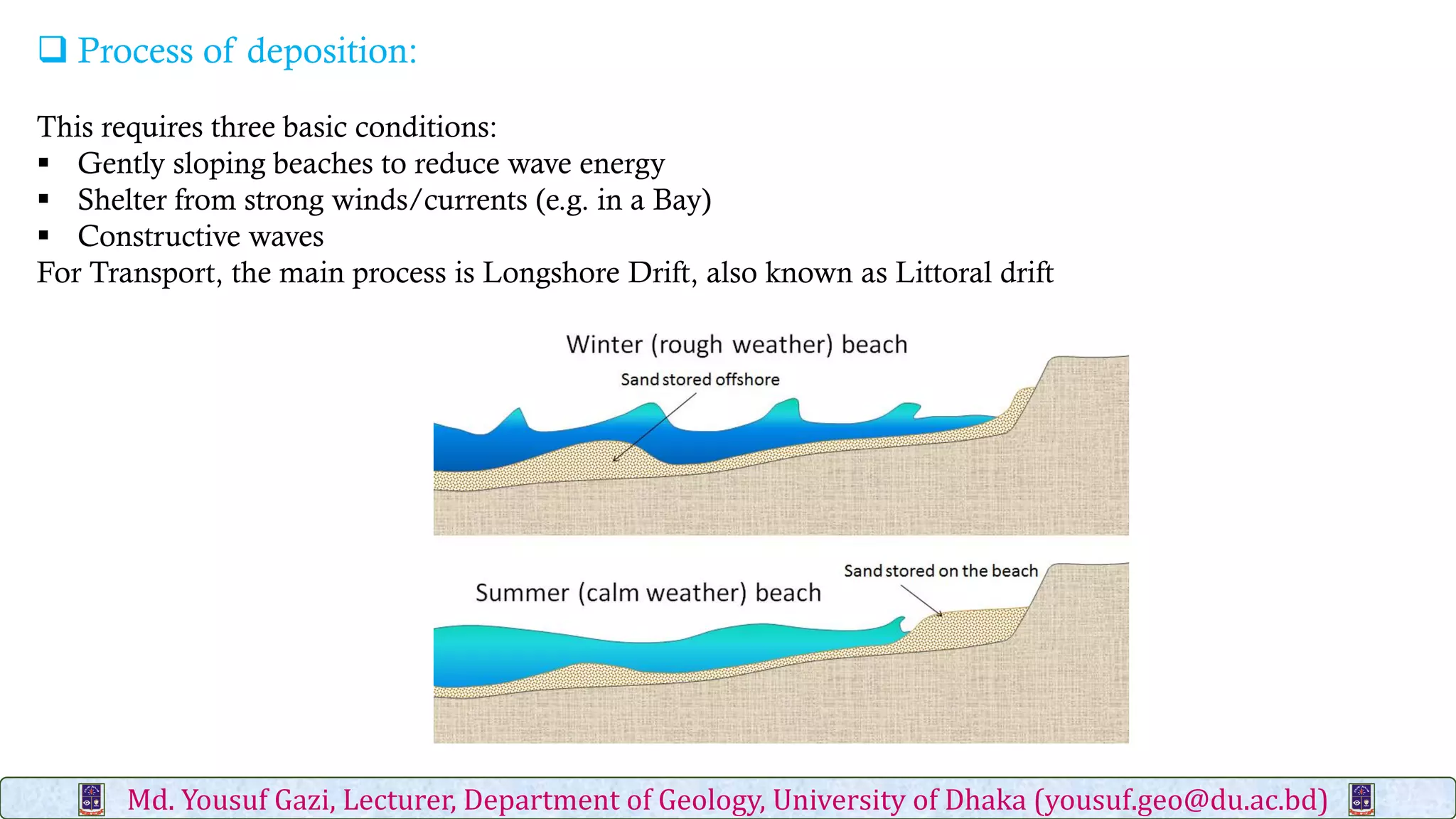
❑ Process of deposition:
This requires three basic conditions:
▪ Gently sloping beaches to reduce wave energy
▪ Shelter from strong winds/currents (e.g. in a Bay)
▪ Constructive waves
For Transport, the main process is Longshore Drift, also known as Littoral drift
Md. Yousuf Gazi, Lecturer, Department of Geology, University of Dhaka (yousuf.geo@du.ac.bd)
Coastal Deposition:
▪ Whatever gets eroded from one area on the coast eventually gets deposited in another area – nature
always balances the books.
▪ The rate of erosion also affects the rate of deposition – an area with mostly hard rock (e.g. Granite)
will erode slowly and thus have little material for deposition.
▪ Coastal deposition features (e.g. beaches) often have important economic benefits such as tourism
Md. Yousuf Gazi, Lecturer, Department of Geology, University of Dhaka (yousuf.geo@du.ac.bd)
Beaches:
▪ Beaches are not only formed from sand – mud, shingle and stones can also form beaches – however
these beaches are unattractive for tourism.
For a beach to form you need-
• A sheltered area to trap sediment
• Longshore drift to transport material to the beach
• Constructive waves to deposit beach material between the high and low tide marks
Md. Yousuf Gazi, Lecturer, Department of Geology, University of Dhaka (yousuf.geo@du.ac.bd)
Muddy Beach Shingle Beach
Md. Yousuf Gazi, Lecturer, Department of Geology, University of Dhaka (yousuf.geo@du.ac.bd)

Coastal physical processes md. yousuf gazi

  • 1.
    Md. Yousuf Gazi,Lecturer, Department of Geology, University of Dhaka (yousuf.geo@du.ac.bd) COASTAL PROCESSES
  • 2.
    ▪ The offshore ▪Nearshore ▪ Foreshore ▪ Backshore ▪ Beach Coastal profile Md. Yousuf Gazi, Lecturer, Department of Geology, University of Dhaka (yousuf.geo@du.ac.bd)
  • 3.
    COASTAL PROCESSES ▪ Coastalprocesses are the set of mechanisms that operate along a coastline, bringing about various combinations of erosion and deposition. ▪ The energy due to tide, waves, wind and currents is constantly working in the coastal zone. Dissipation of energy (due to tide, wind, waves and current) is often provided by the beaches, mudflats, marshes and mangroves.  Sediment transport  Currents  Denudation  Deposition  Erosion  Flooding  Diffraction  Refraction Md. Yousuf Gazi, Lecturer, Department of Geology, University of Dhaka (yousuf.geo@du.ac.bd)
  • 4.
    ▪ Changes inwater level ▪ Tides ▪ Waves ▪ Currents ▪ Stream outflow ❑ Processes responsible for initiating sediment Transportation: Md. Yousuf Gazi, Lecturer, Department of Geology, University of Dhaka (yousuf.geo@du.ac.bd)  Sediment transport
  • 5.
    ❑ Another nearshoredynamical system is littoral transport - the movement of sediments in the nearshore zone by waves and currents. ❑ Littoral transport is divided into two general classes: ▪ Longshore transport: Transport parallel to the shore. ▪ Onshore-offshore transport: Transport perpendicular to the shore. Md. Yousuf Gazi, Lecturer, Department of Geology, University of Dhaka (yousuf.geo@du.ac.bd)
  • 6.
     It isthe movement of sediments most often sand, along a coast parallel to its shoreline - a zig-zag movement of sediment along the beach .  The largest beach sediment is found where the process begins, updrift, and the smallest, most easily moved, downdrift. Longshore drift: Md. Yousuf Gazi, Lecturer, Department of Geology, University of Dhaka (yousuf.geo@du.ac.bd)
  • 7.
     Where wavesare strong, the coast will be eroded and sediment carried away and where they are weak sediment will be deposited.  Longshore drift can have undesirable effects for humans, such as beach erosion. To prevent this, sea defences such as groynes or gabions may be employed. Md. Yousuf Gazi, Lecturer, Department of Geology, University of Dhaka (yousuf.geo@du.ac.bd)
  • 8.
    Swash and Backwash ▪Swash – the rush of water up a beach after a wave breaks (powerful) ▪ Backwash – the returning water to the sea (less powerful) ▪ Constructive Waves – Break gently, far from shore and swash pushes material into shore, very weak backwash ▪ Destructive Waves – Break very close to shore, very powerful backwash Md. Yousuf Gazi, Lecturer, Department of Geology, University of Dhaka (yousuf.geo@du.ac.bd)
  • 9.
    Modes of Sedimenttransport: Sediments are transported as:  Bed load transport The bed load is the part of the total load that is more or less in contact with the bed during the transport. It primarily includes grains that roll, slide or bounce along the bed. Md. Yousuf Gazi, Lecturer, Department of Geology, University of Dhaka (yousuf.geo@du.ac.bd)
  • 10.
    ➢ Suspended loadtransport: It is the part of the total load that is moving in suspension without continuous contact with the bed. ▪ The determination of the rate of suspended load transport is straightforward by comparison with measurement of the rate of bedload transport. ➢ Wash load transport: ▪ It consists of very fine particles transported in water. Md. Yousuf Gazi, Lecturer, Department of Geology, University of Dhaka (yousuf.geo@du.ac.bd)
  • 11.
    Md. Yousuf Gazi,Lecturer, Department of Geology, University of Dhaka (yousuf.geo@du.ac.bd) Modes of Sediment transport
  • 12.
    ❑ Coastal Processes: ▪Accretion - natural or artificial deposition of sediment in a particular location ▪ Beach nourishment - the restoration of a beach by the mechanical placement of sand on the beach for recreational and/ or shore protection purposes. ▪ Cross shore transport - the displacement of sediment perpendicular to the shore ▪ Erosion - the removal of sediment from a particular location by the action of wind or water. Md. Yousuf Gazi, Lecturer, Department of Geology, University of Dhaka (yousuf.geo@du.ac.bd)
  • 13.
    Accretion Beach nourishment Md. YousufGazi, Lecturer, Department of Geology, University of Dhaka (yousuf.geo@du.ac.bd)
  • 14.
    Cross shore transportErosion Md. Yousuf Gazi, Lecturer, Department of Geology, University of Dhaka (yousuf.geo@du.ac.bd)
  • 15.
    ▪ Groin -Shore perpendicular structure, installed singly or as a field of groins, designed to trap sand from the littoral drift system . Md. Yousuf Gazi, Lecturer, Department of Geology, University of Dhaka (yousuf.geo@du.ac.bd) ❑ Coastal Processes: Groin
  • 16.
    ▪ Longshore Bar- offshore ridge or mound of sand, gravel or other loose material running parallel to the Shore which is submerged (at least at high tide) and located a short distance from the shore. Md. Yousuf Gazi, Lecturer, Department of Geology, University of Dhaka (yousuf.geo@du.ac.bd) ❑ Coastal Processes:
  • 17.
    ▪ Tombolo -the combination of an offshore rock or island which is connected to the beach by a sand spit. ❑ Coastal Processes: Md. Yousuf Gazi, Lecturer, Department of Geology, University of Dhaka (yousuf.geo@du.ac.bd)
  • 18.
    ▪ Sand spit- low tongue of land or a relatively long, narrow shoal extending from the land. ❑ Coastal Processes: Md. Yousuf Gazi, Lecturer, Department of Geology, University of Dhaka (yousuf.geo@du.ac.bd)
  • 19.
    ▪ Gabions- Bouldersand rocks are wired into mesh cages and usually placed in front of areas vulnerable to heavy to moderate erosion. ▪ Onshore transport - movement of sediment or water toward the shore. Md. Yousuf Gazi, Lecturer, Department of Geology, University of Dhaka (yousuf.geo@du.ac.bd) ❑ Coastal Processes:
  • 20.
    ❑ Processes ofErosion: ▪ Hydraulic action – power of water (waves) ▪ Abrasion – Rocks/sand thrown against the coast ▪ Compressed Air – trapped in small crevices in the rock by waves, this causes mini “explosions” which eventually shatter the rock ▪ Attrition – Rocks wearing off each other ▪ Solution – Salts in seawater dissolving rock (sedimentary rock) ▪ Wave refraction – waves bending on contact with the coast, concentrating it’s effects in certain areas Md. Yousuf Gazi, Lecturer, Department of Geology, University of Dhaka (yousuf.geo@du.ac.bd)
  • 21.
    Wave refraction Md. YousufGazi, Lecturer, Department of Geology, University of Dhaka (yousuf.geo@du.ac.bd)
  • 22.
    Landforms of Erosion ▪Cliffs and Wave Cut Platforms (Cliffs of Moher) ▪ Bays and Headlands (Dublin Bay, Bray Head) ▪ Sea Caves (Cliffs of Moher) ▪ Sea Arches (Old Head of Kinsale) ▪ Sea Stacks (Dun Briste, Co. Mayo) ▪ Sea Stumps (Cliffs of Moher) Md. Yousuf Gazi, Lecturer, Department of Geology, University of Dhaka (yousuf.geo@du.ac.bd)
  • 23.
    ▪ Cliffs andWave Cut Platforms (Cliffs of Moher) ▪ Bays and Headlands (Dublin Bay, Bray Head) Md. Yousuf Gazi, Lecturer, Department of Geology, University of Dhaka (yousuf.geo@du.ac.bd)
  • 24.
    ▪ Sea Caves(Cliffs of Moher) ▪ Sea Arches (Old Head of Kinsale) Md. Yousuf Gazi, Lecturer, Department of Geology, University of Dhaka (yousuf.geo@du.ac.bd)
  • 25.
    ▪ Sea Stumps(Cliffs of Moher)▪ Sea Stacks (Dun Briste, Co. Mayo)
  • 26.
    ❑ Process ofdeposition: This requires three basic conditions: ▪ Gently sloping beaches to reduce wave energy ▪ Shelter from strong winds/currents (e.g. in a Bay) ▪ Constructive waves For Transport, the main process is Longshore Drift, also known as Littoral drift Md. Yousuf Gazi, Lecturer, Department of Geology, University of Dhaka (yousuf.geo@du.ac.bd)
  • 27.
    Coastal Deposition: ▪ Whatevergets eroded from one area on the coast eventually gets deposited in another area – nature always balances the books. ▪ The rate of erosion also affects the rate of deposition – an area with mostly hard rock (e.g. Granite) will erode slowly and thus have little material for deposition. ▪ Coastal deposition features (e.g. beaches) often have important economic benefits such as tourism Md. Yousuf Gazi, Lecturer, Department of Geology, University of Dhaka (yousuf.geo@du.ac.bd)
  • 28.
    Beaches: ▪ Beaches arenot only formed from sand – mud, shingle and stones can also form beaches – however these beaches are unattractive for tourism. For a beach to form you need- • A sheltered area to trap sediment • Longshore drift to transport material to the beach • Constructive waves to deposit beach material between the high and low tide marks Md. Yousuf Gazi, Lecturer, Department of Geology, University of Dhaka (yousuf.geo@du.ac.bd)
  • 29.
    Md. Yousuf Gazi,Lecturer, Department of Geology, University of Dhaka (yousuf.geo@du.ac.bd) Muddy Beach Shingle Beach
  • 30.
    Md. Yousuf Gazi,Lecturer, Department of Geology, University of Dhaka (yousuf.geo@du.ac.bd)