
Pregnancy Associated Breast Cancer
Presented by- Dr. Noopur Priya
13/10/2020
Headings
• Definition
• Incidence
• Challenges
• Triple Assessment
• Termination of pregnancy
• Treatment strategies
• Fetal Monitoring
• Outcomes
• NCCN Guideline
Definition
• Gestation or Pregnancy Associated Breast Cancer
Breast Cancer diagnosed during pregnancy or within a year after
delivery .
Incidence
1/100 cancers in reproductive age are diagnosed
during pregnancy-
1/1000 pregnancies are complicated with cancer
Azim HA Jret al; ActaOncol2012
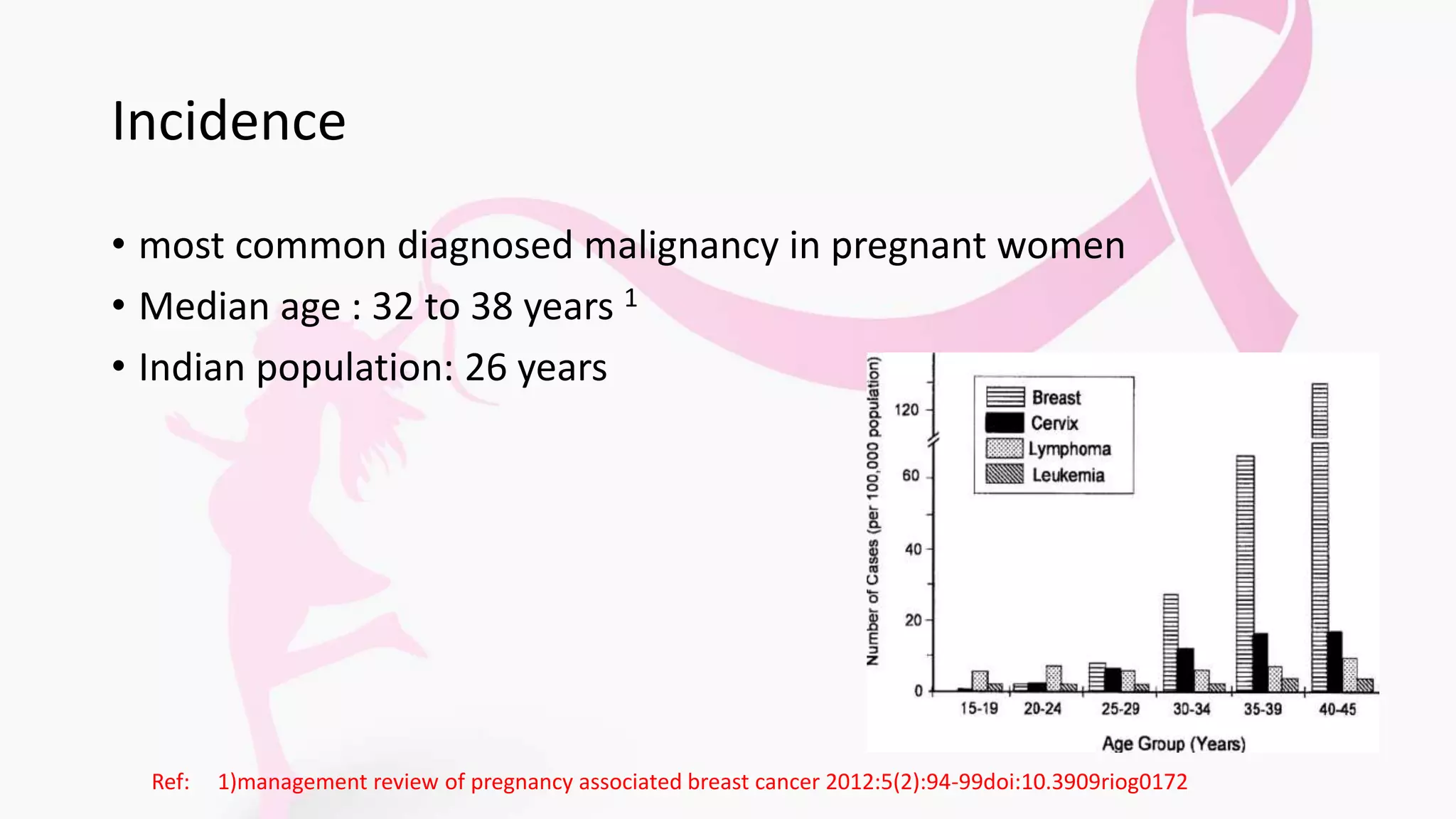
Incidence
• most common diagnosed malignancy in pregnant women
• Median age : 32 to 38 years 1
• Indian population: 26 years
Ref: 1)management review of pregnancy associated breast cancer 2012:5(2):94-99doi:10.3909riog0172
Challenges
• Challenging clinical situation
• Aggressive tumor biology as younger age at presentation
• Delayed Diagnosis  advanced stage
• No RCT in this setting
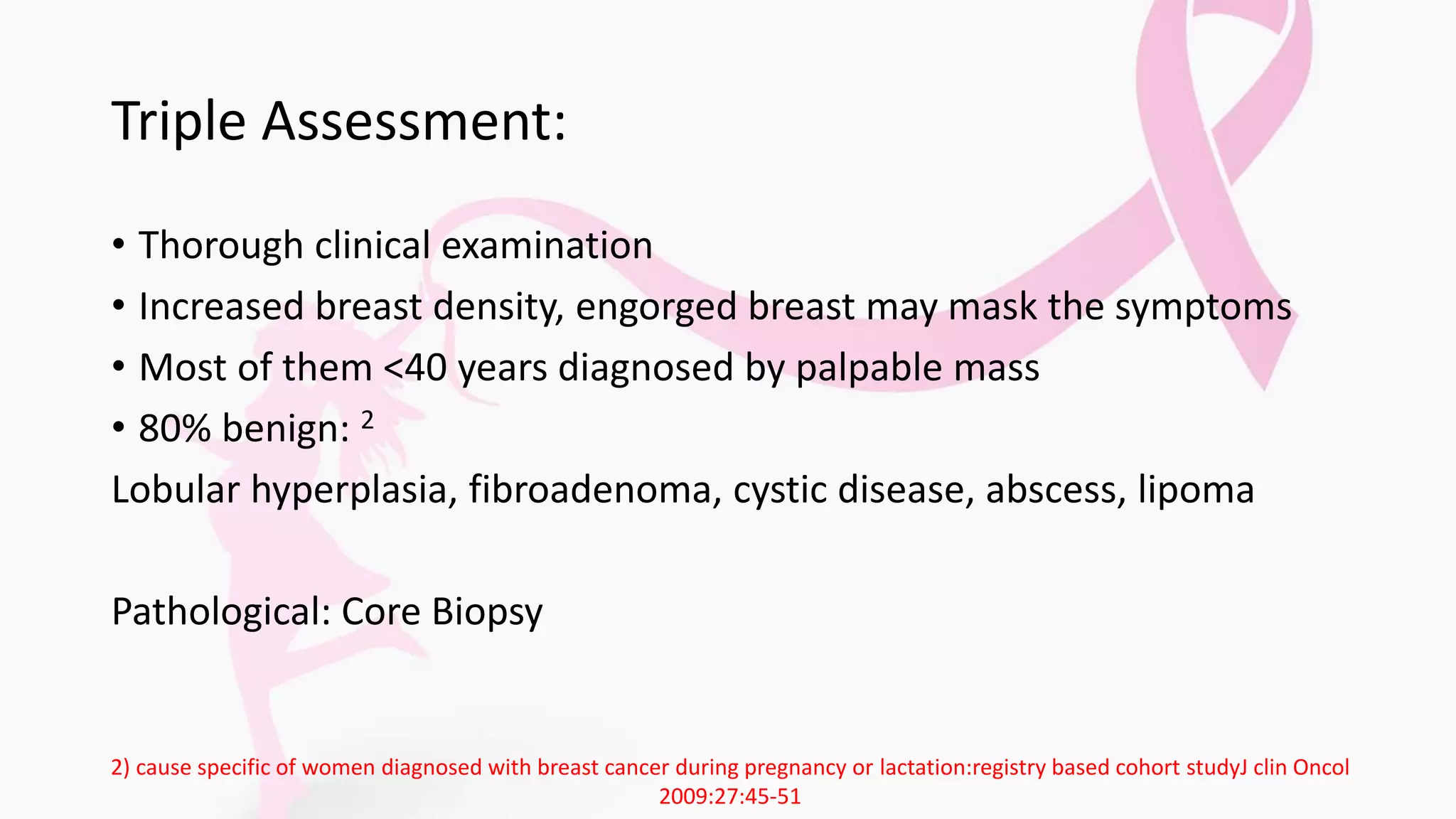
Triple Assessment:
• Thorough clinical examination
• Increased breast density, engorged breast may mask the symptoms
• Most of them <40 years diagnosed by palpable mass
• 80% benign: 2
Lobular hyperplasia, fibroadenoma, cystic disease, abscess, lipoma
Pathological: Core Biopsy
2) cause specific of women diagnosed with breast cancer during pregnancy or lactation:registry based cohort studyJ clin Oncol
2009:27:45-51
Pathological
• Core biopsy:
PABC when compared with non pregnant BC:3
• Higher prevalence of ER,PR negative
• Her2 positive
• Ki76- positive
• TNBC
BCY2: Genetic counselling needed in most of them
3) breast cancer during pregnancy-current paradigns,paths to explore Ayelet Alfasi18 october2019
Biological features
Azim HA Jret al; ActaOncol2012
Radiological
• Challenges of radiation exposure
Modality
Ultrasound Recommended No radiation Diagnosing lump, staging
abdomen pelvis
Mammography Recommended with
abdomen shielding
0.04 cGy considered safe Breast lump
Increased breast density,
sensitivity 78%
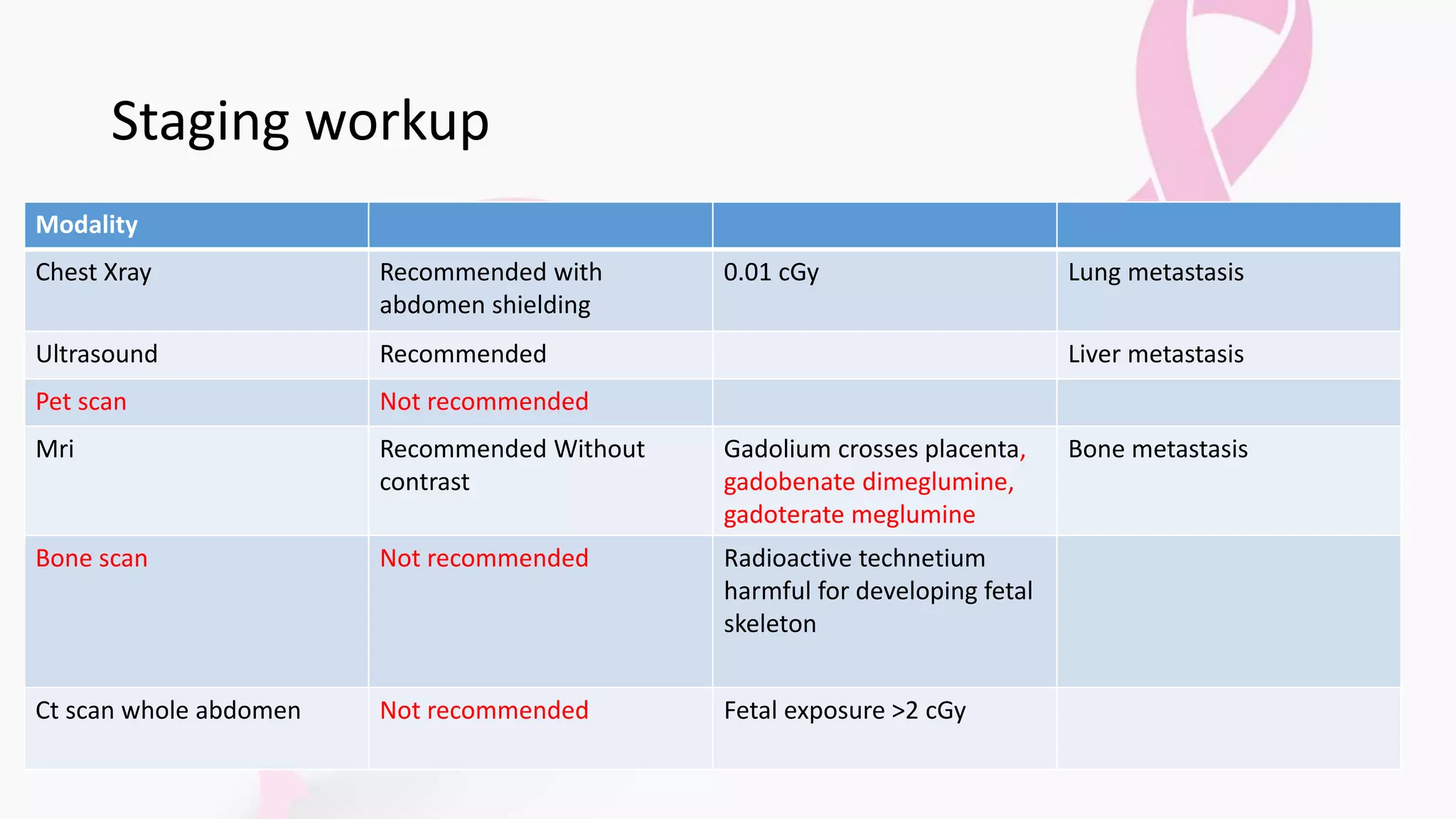
Staging workup
• Staging work up
Modality
Chest Xray Recommended with
abdomen shielding
0.01 cGy Lung metastasis
Ultrasound Recommended Liver metastasis
Pet scan Not recommended
Mri Recommended Without
contrast
Gadolium crosses placenta,
gadobenate dimeglumine,
gadoterate meglumine
Bone metastasis
Bone scan Not recommended Radioactive technetium
harmful for developing fetal
skeleton
Ct scan whole abdomen Not recommended Fetal exposure >2 cGy
Medical Termination Of Pregnancy
• When diagnosis is in very early first trimester
• No impact on Prognosis
• Always parents decision, irrespective of time of diagnosis
• If continuing pregnancy the goal is to “ Avoid Premature Delivery”
Treatment
Surgery
• Considered safe in all trimesters
• BCS:
• First Trimester: increased local recurrence due to delay in
radiotherapy4
• Second and Third : No impact on overall survival
• Reconstruction – postpartum
Avoids prolonged anesthesia
Optimal symmetry after delivery
4) Conservative surgery and chemotherapy for breast carcinoma during
pregnancy.Kuerer HM, Gwyn K, Ames FC, Theriault RL. Surgery. 2002 Jan;
131(1):108-10.
SLNB
• Insufficient data
• ASCO:
• NCCN: recommends
• Blue dye: fetal distress, anaphylactic reaction
• Tc99: 0.1mcGy after injection of 92.5 Mbq
• Recent study:
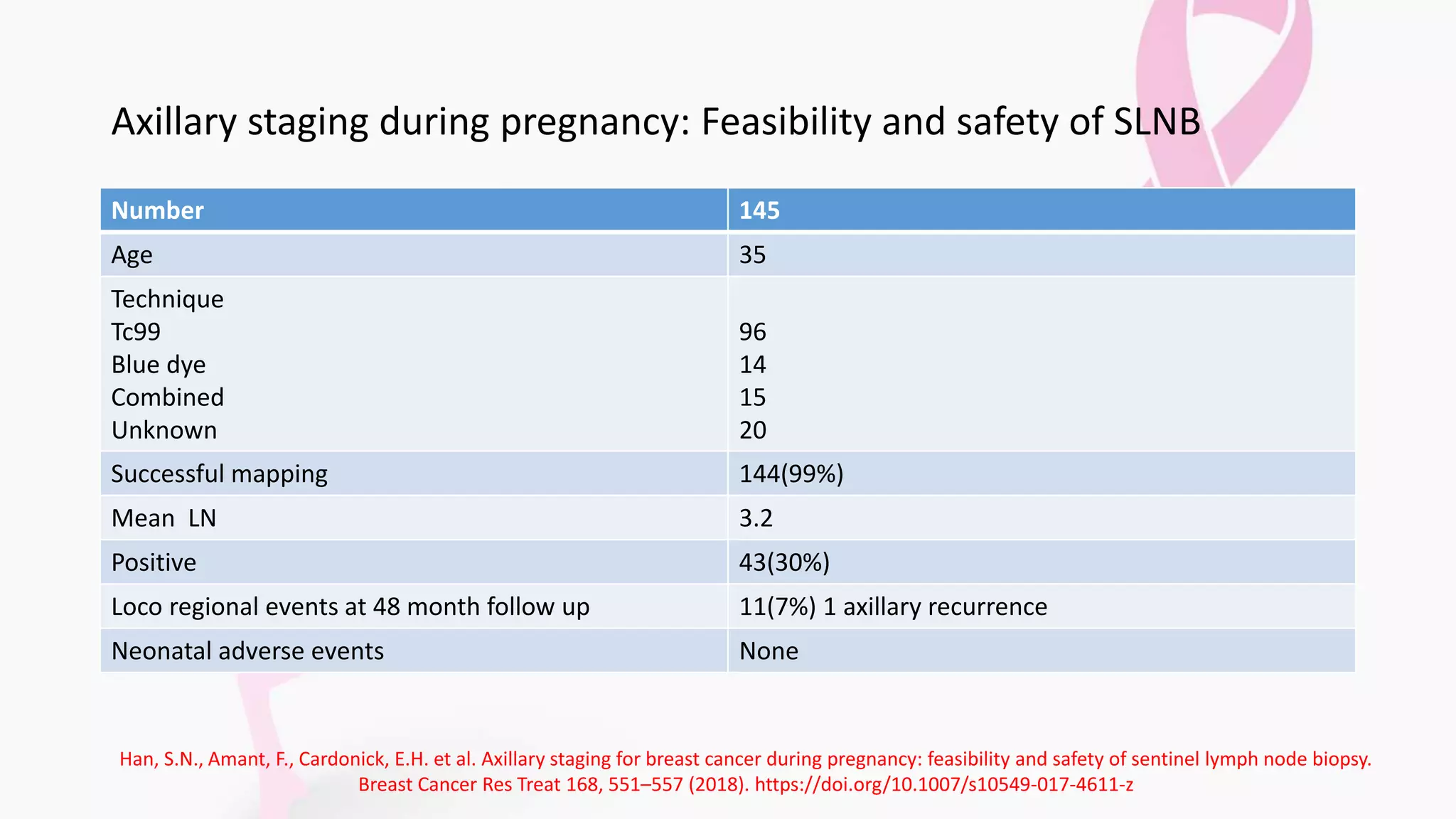
Axillary staging during pregnancy: Feasibility and safety of SLNB
Number 145
Age 35
Technique
Tc99
Blue dye
Combined
Unknown
96
14
15
20
Successful mapping 144(99%)
Mean LN 3.2
Positive 43(30%)
Loco regional events at 48 month follow up 11(7%) 1 axillary recurrence
Neonatal adverse events None
Han, S.N., Amant, F., Cardonick, E.H. et al. Axillary staging for breast cancer during pregnancy: feasibility and safety of sentinel lymph node biopsy.
Breast Cancer Res Treat 168, 551–557 (2018). https://doi.org/10.1007/s10549-017-4611-z
Chemotherapy
• First 10 days- All or none event
• 10 days till 14 weeks- organogenesis , congenital malformations- 14%
13% abortion rate = healthy women
• 2 and 3 rd trimester- IUGR, Prematurity, myelosupression- 3%
• Beyond 35 weeks: myelosupression during delivery may lead to
bleeding sepsis , death
• Anthracyclines based regimen- most studied drug
• Taxanes- clinical use is limited
• Due to better toxicity profile, no need of G-CSF nor premedication,
weekly paclitaxel is preferred
Dose dense Chemotherapy
• Limited study
• Only one retrospective study available- showed no increased risk
• Not recommended
Anti- Her2 Agents:
• Her 2 pathway plays role in organogenesis, migration of neural crest
cells, seems to be involved in early conception and implantation
phases
• Exposure beyond 2nd trimester- oligo-hydramnios
(targets her2 oncogene in fetal kidneys responsible for producing amniotic fluid)
• Pertuzumab and TDM-1- similar molecule like Tz
• Lapatinib- small molecule , crosses placenta
Endocrine Therapy
• Contradicted due to fetal malformations
• Stop 2 months before conception
• Little information on long term outcome of exposed infants
• Ongoing POSITIVE trial by 2028: pregnancy ,outcome, safety of HT in
ER positive breast cancer
Expected Neonatal side effects
Breast cancer during pregnancy current paradigms, paths to explore Ayelet alfasi,irit ben aharon, 18 October 2019
Radiation Therapy
• Delayed till delivery
• First 2 weeks- malformations
• 8-25 weeks- reduction in intelligence quotient and mental retardation
• Risk of adverse events decreased after 25 weeks
• General carcinogenic effect
• If necessary , consider with fetal sheilding
Fetal Monitoring
• Routine check up every 3 weeks
• Fetal development assessment before initiating treatment
• Time interval of 3 weeks between chemotherapy and delivery
• Pathological examination of placenta for metastases
• Delivery: Vaginal preferred
Breast Feeding
• Not recommended two weeks following chemotherapy
• Milk production should be inhibited to avoid accumulation of
lipophilic anti-neoplastic agents in milk.
• Lactation from treated breast is not contraindicated.5
• Reduced milk volume and possibly scar tissue , limiting ability to
breast feed.
Ref: 5)management review of pregnancy associated breast cancer 2012:5(2):94-99doi:10.3909riog0172
NCCN Guidelines: Version 6 2020
Workup- chest xray with shielding, usg, mri non contrast
First trimester
Discuss termination
If continuing surgery
f/b CT in 2nd trimester
Postpartum HT/RT
2ND/Early 3rd trimester
MRM/BCS/AD/SLNB
Adjuvant Postpartum
RT/HT
Late 3rd trimester
Surgery
Adjuvant
CT/Postpartum HT/RT
Confirmed breast
cancer • Blue dye C/I
• Sulfur colloid
safe
• Insufficient data
on taxanes
• Her2 C/I
• If pregnancy in
1st trimester
consider preop
chemo in 2nd
Trimester
Conclusion
Thank You

Pabc

  • 1.
    Pregnancy Associated BreastCancer Presented by- Dr. Noopur Priya 13/10/2020
  • 2.
    Headings • Definition • Incidence •Challenges • Triple Assessment • Termination of pregnancy • Treatment strategies • Fetal Monitoring • Outcomes • NCCN Guideline
  • 3.
    Definition • Gestation orPregnancy Associated Breast Cancer Breast Cancer diagnosed during pregnancy or within a year after delivery .
  • 4.
    Incidence 1/100 cancers inreproductive age are diagnosed during pregnancy- 1/1000 pregnancies are complicated with cancer Azim HA Jret al; ActaOncol2012
  • 5.
    Incidence • most commondiagnosed malignancy in pregnant women • Median age : 32 to 38 years 1 • Indian population: 26 years Ref: 1)management review of pregnancy associated breast cancer 2012:5(2):94-99doi:10.3909riog0172
  • 6.
    Challenges • Challenging clinicalsituation • Aggressive tumor biology as younger age at presentation • Delayed Diagnosis  advanced stage • No RCT in this setting
  • 7.
    Triple Assessment: • Thoroughclinical examination • Increased breast density, engorged breast may mask the symptoms • Most of them <40 years diagnosed by palpable mass • 80% benign: 2 Lobular hyperplasia, fibroadenoma, cystic disease, abscess, lipoma Pathological: Core Biopsy 2) cause specific of women diagnosed with breast cancer during pregnancy or lactation:registry based cohort studyJ clin Oncol 2009:27:45-51
  • 8.
    Pathological • Core biopsy: PABCwhen compared with non pregnant BC:3 • Higher prevalence of ER,PR negative • Her2 positive • Ki76- positive • TNBC BCY2: Genetic counselling needed in most of them 3) breast cancer during pregnancy-current paradigns,paths to explore Ayelet Alfasi18 october2019
  • 9.
    Biological features Azim HAJret al; ActaOncol2012
  • 10.
    Radiological • Challenges ofradiation exposure Modality Ultrasound Recommended No radiation Diagnosing lump, staging abdomen pelvis Mammography Recommended with abdomen shielding 0.04 cGy considered safe Breast lump Increased breast density, sensitivity 78%
  • 11.
    Staging workup • Stagingwork up Modality Chest Xray Recommended with abdomen shielding 0.01 cGy Lung metastasis Ultrasound Recommended Liver metastasis Pet scan Not recommended Mri Recommended Without contrast Gadolium crosses placenta, gadobenate dimeglumine, gadoterate meglumine Bone metastasis Bone scan Not recommended Radioactive technetium harmful for developing fetal skeleton Ct scan whole abdomen Not recommended Fetal exposure >2 cGy
  • 12.
    Medical Termination OfPregnancy • When diagnosis is in very early first trimester • No impact on Prognosis • Always parents decision, irrespective of time of diagnosis • If continuing pregnancy the goal is to “ Avoid Premature Delivery”
  • 13.
  • 14.
    Surgery • Considered safein all trimesters • BCS: • First Trimester: increased local recurrence due to delay in radiotherapy4 • Second and Third : No impact on overall survival • Reconstruction – postpartum Avoids prolonged anesthesia Optimal symmetry after delivery 4) Conservative surgery and chemotherapy for breast carcinoma during pregnancy.Kuerer HM, Gwyn K, Ames FC, Theriault RL. Surgery. 2002 Jan; 131(1):108-10.
  • 15.
    SLNB • Insufficient data •ASCO: • NCCN: recommends • Blue dye: fetal distress, anaphylactic reaction • Tc99: 0.1mcGy after injection of 92.5 Mbq • Recent study:
  • 16.
    Axillary staging duringpregnancy: Feasibility and safety of SLNB Number 145 Age 35 Technique Tc99 Blue dye Combined Unknown 96 14 15 20 Successful mapping 144(99%) Mean LN 3.2 Positive 43(30%) Loco regional events at 48 month follow up 11(7%) 1 axillary recurrence Neonatal adverse events None Han, S.N., Amant, F., Cardonick, E.H. et al. Axillary staging for breast cancer during pregnancy: feasibility and safety of sentinel lymph node biopsy. Breast Cancer Res Treat 168, 551–557 (2018). https://doi.org/10.1007/s10549-017-4611-z
  • 17.
    Chemotherapy • First 10days- All or none event • 10 days till 14 weeks- organogenesis , congenital malformations- 14% 13% abortion rate = healthy women • 2 and 3 rd trimester- IUGR, Prematurity, myelosupression- 3% • Beyond 35 weeks: myelosupression during delivery may lead to bleeding sepsis , death
  • 18.
    • Anthracyclines basedregimen- most studied drug • Taxanes- clinical use is limited • Due to better toxicity profile, no need of G-CSF nor premedication, weekly paclitaxel is preferred
  • 19.
    Dose dense Chemotherapy •Limited study • Only one retrospective study available- showed no increased risk • Not recommended
  • 20.
    Anti- Her2 Agents: •Her 2 pathway plays role in organogenesis, migration of neural crest cells, seems to be involved in early conception and implantation phases • Exposure beyond 2nd trimester- oligo-hydramnios (targets her2 oncogene in fetal kidneys responsible for producing amniotic fluid) • Pertuzumab and TDM-1- similar molecule like Tz • Lapatinib- small molecule , crosses placenta
  • 21.
    Endocrine Therapy • Contradicteddue to fetal malformations • Stop 2 months before conception • Little information on long term outcome of exposed infants • Ongoing POSITIVE trial by 2028: pregnancy ,outcome, safety of HT in ER positive breast cancer
  • 22.
    Expected Neonatal sideeffects Breast cancer during pregnancy current paradigms, paths to explore Ayelet alfasi,irit ben aharon, 18 October 2019
  • 23.
    Radiation Therapy • Delayedtill delivery • First 2 weeks- malformations • 8-25 weeks- reduction in intelligence quotient and mental retardation • Risk of adverse events decreased after 25 weeks • General carcinogenic effect • If necessary , consider with fetal sheilding
  • 24.
    Fetal Monitoring • Routinecheck up every 3 weeks • Fetal development assessment before initiating treatment • Time interval of 3 weeks between chemotherapy and delivery • Pathological examination of placenta for metastases • Delivery: Vaginal preferred
  • 25.
    Breast Feeding • Notrecommended two weeks following chemotherapy • Milk production should be inhibited to avoid accumulation of lipophilic anti-neoplastic agents in milk. • Lactation from treated breast is not contraindicated.5 • Reduced milk volume and possibly scar tissue , limiting ability to breast feed. Ref: 5)management review of pregnancy associated breast cancer 2012:5(2):94-99doi:10.3909riog0172
  • 26.
    NCCN Guidelines: Version6 2020 Workup- chest xray with shielding, usg, mri non contrast First trimester Discuss termination If continuing surgery f/b CT in 2nd trimester Postpartum HT/RT 2ND/Early 3rd trimester MRM/BCS/AD/SLNB Adjuvant Postpartum RT/HT Late 3rd trimester Surgery Adjuvant CT/Postpartum HT/RT Confirmed breast cancer • Blue dye C/I • Sulfur colloid safe • Insufficient data on taxanes • Her2 C/I • If pregnancy in 1st trimester consider preop chemo in 2nd Trimester
  • 27.
  • 28.