Chemistry of Opioid Analgesics
Well known for their ability
to reduce the perception of
pain without a loss of
consciousness.
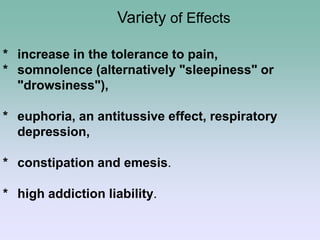
* increase in the tolerance to pain,
* somnolence (alternatively "sleepiness" or
"drowsiness"),
* euphoria, an antitussive effect, respiratory
depression,
* constipation and emesis.
* high addiction liability.
Variety of Effects
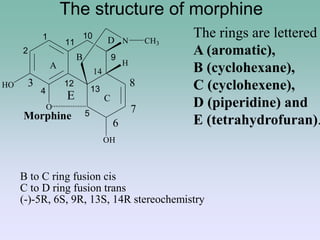
The structure of morphine
O
OH
HO
N
H
CH3
B to C ring fusion cis
C to D ring fusion trans
(-)-5R, 6S, 9R, 13S, 14R stereochemistry
Morphine
A
B
C
D
E
3
6
7
8
14
9
10
11
12
13
1
2
4
5
The rings are lettered
A (aromatic),
B (cyclohexane),
C (cyclohexene),
D (piperidine) and
E (tetrahydrofuran).
1
2
3
4
5
6
7
8
9
10
11
12
13 14
O
OR
H
HO
NCH3
H
Alcohol
Phenol
Amine
Ether
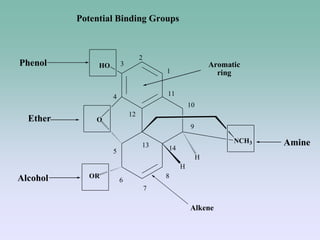
Potential Binding Groups
Aromatic
ring
Alkene
Opium contains
 morphine,
 codeine,
 noscapine,
 papaverine, and
 thebaine.
Structure/Activity Relationships
 Mask or remove a functional group
 Test the analogue for activity
 Determines the importance or other wise
of a functional group for activity
1
2
3
4
5
6
7
8
9
10
11
12
13 14
O
OR
H
HO
NCH3
H
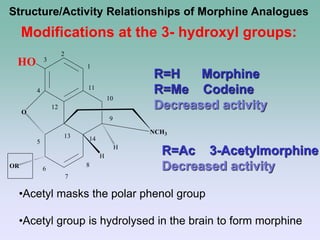
Modifications at the 3- hydroxyl groups:
Structure/Activity Relationships of Morphine Analogues
R=Ac 3-Acetylmorphine
Decreased activity
•Acetyl masks the polar phenol group
•Acetyl group is hydrolysed in the brain to form morphine
R=H Morphine
R=Me Codeine
Decreased activity
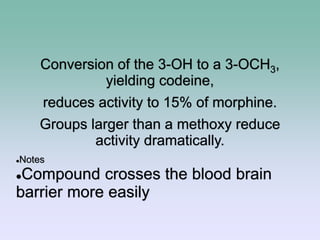
Conversion of the 3-OH to a 3-OCH3,
yielding codeine,
reduces activity to 15% of morphine.
Groups larger than a methoxy reduce
activity dramatically.
Notes
Compound crosses the blood brain
barrier more easily
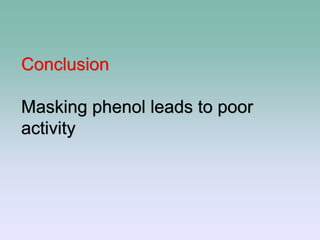
Conclusion
Masking phenol leads to poor
activity
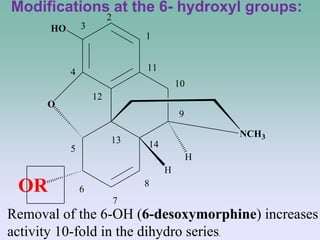
Modifications at the 6- hydroxyl groups:
1
2
3
4
5
6
7
8
9
10
11
12
13 14
O
OR
H
HO
NCH3
H
Removal of the 6-OH (6-desoxymorphine) increases
activity 10-fold in the dihydro series.
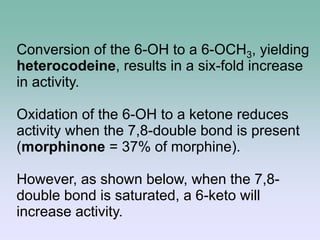
Conversion of the 6-OH to a 6-OCH3, yielding
heterocodeine, results in a six-fold increase
in activity.
Oxidation of the 6-OH to a ketone reduces
activity when the 7,8-double bond is present
(morphinone = 37% of morphine).
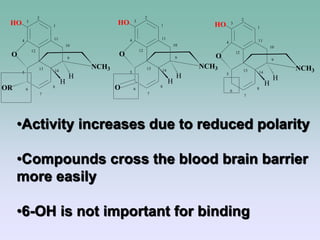
However, as shown below, when the 7,8-
double bond is saturated, a 6-keto will
increase activity.
1
2
3
4
5
6
7
8
9
10
11
12
13 14
O
OR
H
HO
NCH3
H
1
2
3
4
5
6
7
8
9
10
11
12
13 14
O
O
H
HO
NCH3
H
1
2
3
4
5
6
7
8
9
10
11
12
13 14
O
H
HO
NCH3
H
•Activity increases due to reduced polarity
•Compounds cross the blood brain barrier
more easily
•6-OH is not important for binding
1
2
3
4
5
6
7
8
9
10
11
12
13 14
O
OR
H
HO
NCH3
H
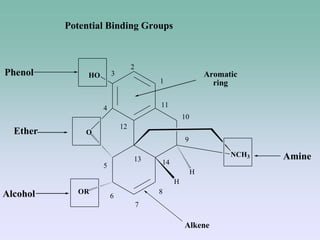
Alcohol
Phenol
Amine
Ether
Potential Binding Groups
Aromatic
ring
Alkene
1
2
3
4
5
6
7
8
9
10
11
12
13 14
O
OR
H
HO
NCH3
H
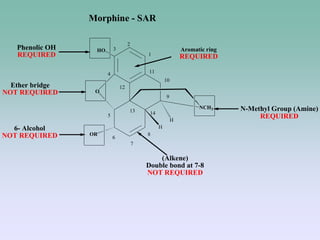
6- Alcohol
NOT REQUIRED
N-Methyl Group (Amine)
REQUIRED
Ether bridge
NOT REQUIRED
Aromatic ring
REQUIRED
(Alkene)
Double bond at 7-8
NOT REQUIRED
Phenolic OH
REQUIRED
Morphine - SAR
O
O
RO
N
H
CH3
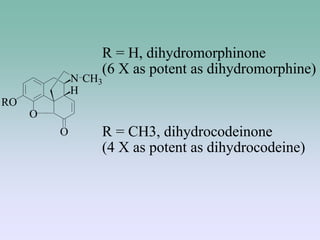
R = H, dihydromorphinone
(6 X as potent as dihydromorphine)
R = CH3, dihydrocodeinone
(4 X as potent as dihydrocodeine)
O
O
N
H
CH3
O CH3
O
O
H3C
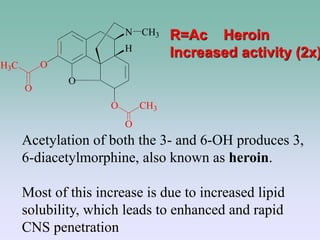
Acetylation of both the 3- and 6-OH produces 3,
6-diacetylmorphine, also known as heroin.
Most of this increase is due to increased lipid
solubility, which leads to enhanced and rapid
CNS penetration
R=Ac Heroin
Increased activity (2x)
O
HO
N
H
CH3
O CH3
O
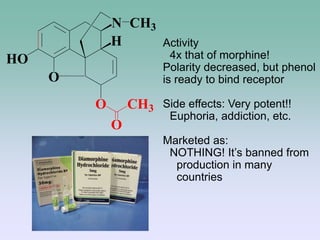
Activity
4x that of morphine!
Polarity decreased, but phenol
is ready to bind receptor
Side effects: Very potent!!
Euphoria, addiction, etc.
Marketed as:
NOTHING! It’s banned from
production in many
countries
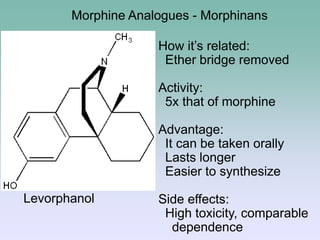
Morphine Analogues - Morphinans
How it’s related:
Ether bridge removed
Activity:
5x that of morphine
Advantage:
It can be taken orally
Lasts longer
Easier to synthesize
Side effects:
High toxicity, comparable
dependence
Levorphanol
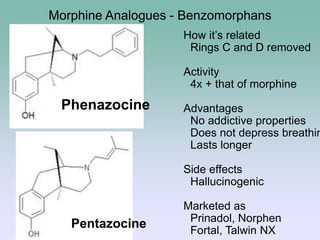
Morphine Analogues - Benzomorphans
How it’s related
Rings C and D removed
Activity
4x + that of morphine
Advantages
No addictive properties
Does not depress breathin
Lasts longer
Side effects
Hallucinogenic
Marketed as
Prinadol, Norphen
Fortal, Talwin NX
Phenazocine
Pentazocine
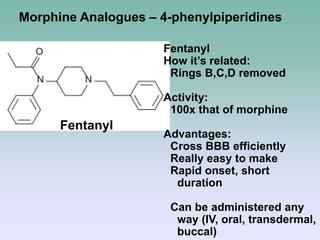
Fentanyl
Morphine Analogues – 4-phenylpiperidines
Fentanyl
How it’s related:
Rings B,C,D removed
Activity:
100x that of morphine
Advantages:
Cross BBB efficiently
Really easy to make
Rapid onset, short
duration
Can be administered any
way (IV, oral, transdermal,
buccal)
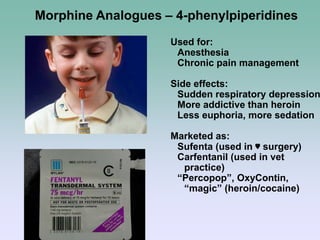
Morphine Analogues – 4-phenylpiperidines
Used for:
Anesthesia
Chronic pain management
Side effects:
Sudden respiratory depression
More addictive than heroin
Less euphoria, more sedation
Marketed as:
Sufenta (used in ♥ surgery)
Carfentanil (used in vet
practice)
“Percopop”, OxyContin,
“magic” (heroin/cocaine)
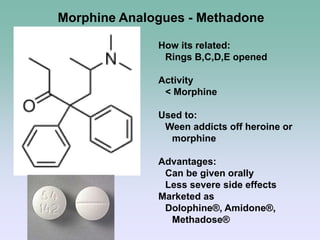
Morphine Analogues - Methadone
How its related:
Rings B,C,D,E opened
Activity
< Morphine
Used to:
Ween addicts off heroine or
morphine
Advantages:
Can be given orally
Less severe side effects
Marketed as
Dolophine®, Amidone®,
Methadose®
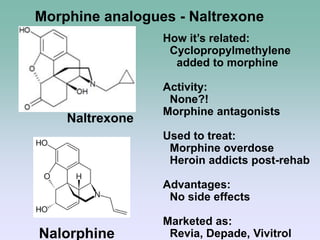
Morphine analogues - Naltrexone
How it’s related:
Cyclopropylmethylene
added to morphine
Activity:
None?!
Morphine antagonists
Used to treat:
Morphine overdose
Heroin addicts post-rehab
Advantages:
No side effects
Marketed as:
Revia, Depade, Vivitrol
Naltrexone
Nalorphine

PHC 601 - Narcotics for Master Degree Students ppt

  • 1.
    Chemistry of OpioidAnalgesics Well known for their ability to reduce the perception of pain without a loss of consciousness.
  • 2.
    * increase inthe tolerance to pain, * somnolence (alternatively "sleepiness" or "drowsiness"), * euphoria, an antitussive effect, respiratory depression, * constipation and emesis. * high addiction liability. Variety of Effects
  • 3.
    The structure ofmorphine O OH HO N H CH3 B to C ring fusion cis C to D ring fusion trans (-)-5R, 6S, 9R, 13S, 14R stereochemistry Morphine A B C D E 3 6 7 8 14 9 10 11 12 13 1 2 4 5 The rings are lettered A (aromatic), B (cyclohexane), C (cyclohexene), D (piperidine) and E (tetrahydrofuran).
  • 4.
  • 5.
    Opium contains  morphine, codeine,  noscapine,  papaverine, and  thebaine.
  • 6.
    Structure/Activity Relationships  Maskor remove a functional group  Test the analogue for activity  Determines the importance or other wise of a functional group for activity
  • 7.
    1 2 3 4 5 6 7 8 9 10 11 12 13 14 O OR H HO NCH3 H Modifications atthe 3- hydroxyl groups: Structure/Activity Relationships of Morphine Analogues R=Ac 3-Acetylmorphine Decreased activity •Acetyl masks the polar phenol group •Acetyl group is hydrolysed in the brain to form morphine R=H Morphine R=Me Codeine Decreased activity
  • 8.
    Conversion of the3-OH to a 3-OCH3, yielding codeine, reduces activity to 15% of morphine. Groups larger than a methoxy reduce activity dramatically. Notes Compound crosses the blood brain barrier more easily
  • 9.
  • 10.
    Modifications at the6- hydroxyl groups: 1 2 3 4 5 6 7 8 9 10 11 12 13 14 O OR H HO NCH3 H Removal of the 6-OH (6-desoxymorphine) increases activity 10-fold in the dihydro series.
  • 11.
    Conversion of the6-OH to a 6-OCH3, yielding heterocodeine, results in a six-fold increase in activity. Oxidation of the 6-OH to a ketone reduces activity when the 7,8-double bond is present (morphinone = 37% of morphine). However, as shown below, when the 7,8- double bond is saturated, a 6-keto will increase activity.
  • 12.
    1 2 3 4 5 6 7 8 9 10 11 12 13 14 O OR H HO NCH3 H 1 2 3 4 5 6 7 8 9 10 11 12 13 14 O O H HO NCH3 H 1 2 3 4 5 6 7 8 9 10 11 12 1314 O H HO NCH3 H •Activity increases due to reduced polarity •Compounds cross the blood brain barrier more easily •6-OH is not important for binding
  • 13.
  • 14.
    1 2 3 4 5 6 7 8 9 10 11 12 13 14 O OR H HO NCH3 H 6- Alcohol NOTREQUIRED N-Methyl Group (Amine) REQUIRED Ether bridge NOT REQUIRED Aromatic ring REQUIRED (Alkene) Double bond at 7-8 NOT REQUIRED Phenolic OH REQUIRED Morphine - SAR
  • 15.
    O O RO N H CH3 R = H,dihydromorphinone (6 X as potent as dihydromorphine) R = CH3, dihydrocodeinone (4 X as potent as dihydrocodeine)
  • 16.
    O O N H CH3 O CH3 O O H3C Acetylation ofboth the 3- and 6-OH produces 3, 6-diacetylmorphine, also known as heroin. Most of this increase is due to increased lipid solubility, which leads to enhanced and rapid CNS penetration R=Ac Heroin Increased activity (2x)
  • 17.
    O HO N H CH3 O CH3 O Activity 4x thatof morphine! Polarity decreased, but phenol is ready to bind receptor Side effects: Very potent!! Euphoria, addiction, etc. Marketed as: NOTHING! It’s banned from production in many countries
  • 18.
    Morphine Analogues -Morphinans How it’s related: Ether bridge removed Activity: 5x that of morphine Advantage: It can be taken orally Lasts longer Easier to synthesize Side effects: High toxicity, comparable dependence Levorphanol
  • 19.
    Morphine Analogues -Benzomorphans How it’s related Rings C and D removed Activity 4x + that of morphine Advantages No addictive properties Does not depress breathin Lasts longer Side effects Hallucinogenic Marketed as Prinadol, Norphen Fortal, Talwin NX Phenazocine Pentazocine
  • 20.
    Fentanyl Morphine Analogues –4-phenylpiperidines Fentanyl How it’s related: Rings B,C,D removed Activity: 100x that of morphine Advantages: Cross BBB efficiently Really easy to make Rapid onset, short duration Can be administered any way (IV, oral, transdermal, buccal)
  • 21.
    Morphine Analogues –4-phenylpiperidines Used for: Anesthesia Chronic pain management Side effects: Sudden respiratory depression More addictive than heroin Less euphoria, more sedation Marketed as: Sufenta (used in ♥ surgery) Carfentanil (used in vet practice) “Percopop”, OxyContin, “magic” (heroin/cocaine)
  • 22.
    Morphine Analogues -Methadone How its related: Rings B,C,D,E opened Activity < Morphine Used to: Ween addicts off heroine or morphine Advantages: Can be given orally Less severe side effects Marketed as Dolophine®, Amidone®, Methadose®
  • 23.
    Morphine analogues -Naltrexone How it’s related: Cyclopropylmethylene added to morphine Activity: None?! Morphine antagonists Used to treat: Morphine overdose Heroin addicts post-rehab Advantages: No side effects Marketed as: Revia, Depade, Vivitrol Naltrexone Nalorphine