OPIOIDS
Dr. Nadeem akhtar
MBBS.M.Phil
Asst. Professor Pharmacology
Amna Inayat Medical College
Shaikhupura
History
• Opium is the source of morphine obtained
from poppy, Papaver somniferum and P
album
• It was isolated in 1803 and was named after
Morpheus, the Greek god of dreams.
Papver somniferum
Classification
• 1) Agonist:
• Strong---Morphine, Heroin,Mepridine, -
Methadone, Fentanyl, Sufentanil.
• Moderate---Codeine, Oxycodone, Hydrocodone,
Pholcodeine
• Weak---Propoxyphene
• 2) MixedAgonist/Antagonist:
Pentazocine,Nalbuphine,Buprenorphine,
Butorphenol
• Antagonist: Naloxone, Naltrexone,Nalorphine
• Pure agonist: has affinity for binding plus
efficacy
• Pure antagonist: affinity for binding but no
efficacy
• Mixed agonist: antagonist produces an
agonist effect at one receptor and antagonist
at other
• Partial agonist: has affinity for binding but low
efficacy.
Opioid receptors
• In 1973 a graduate student Candance pert
used radioactive morphine to evaluate the
location of site of action of morphine, and he
found that drug attaches to very specific
areas of brain dubbed as opioid receptors
Opioid receptors
• There are opioid receptors within the CNS as
well as throughout the peripheral tissues.
These receptors are normally stimulated by
endogenous peptides
(endorphins,enkephalins and dynorphins)
Opioid Receptors
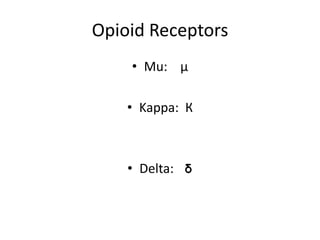
• Mu: µ
• Kappa: К
• Delta: δ
Functions of opiod receptors
• Mu (µ): supraspinal and spinal analgesia,
sedation, inhibition of respiration, slow
gastrointestinal transit, modulation of hormone
and neurotransmitter release
• Kppa (К): supraspinal and spinal analgesia,
psychotomimetic effects, slowed gastrointestinal
transit
• Delta (δ): supraspinal and spinal analgesia,
modulation of hormone and neurotransmitter
release
Functions of opiod receptors
• All these receptors possess strong affinity for
endogeneous opioid peptides e.g endorphins,
enkephalins, and dynorphins
Organ system effects of morphine and
its surrogates
• 1)CNS: due to the affinity for µ receptors, they
produce analgesia, euphoria, sedation, and
respiratory depression and tolerance occur with
repeated use.
• a) analgesia: opioid analgesics are unique to
reduce both aspects (sensory and affective) of
pain.
• b) euphoria: intravenous drug users usually
experience pleasant floating sensations with less
anxiety ad distress
• c) sedation: induce sleep particularly in elderly
as well as with combination of other CNS
depressing agents like sedatives & hypnotics
• d) respiratory depression: all opioids produce
respiratory depression by inhibiting brain stem
respiratory mechanism and depressed response
to CO2 challenge.
• e) cough suppression: suppresses cough reflex in
this respect codeine is most effective
• f) miosis: constriction of pupils have been
seen with all opioid agonists
• g) truncal rigidity: intensification of tone in
large trunk muscles have been noted with
number of opioids, may be due to spinal
action of these drugs.
• h) nausea & vomiting: opioid analgesics can
activate chemoreceptors and produce nausea
and vomiting.
• i) temperature: homeostatic regulation of
body temperature is mediated in part b action
of the action of endogenous peptides in the
brain.
• 2)Peripheral effects:
• a)CVS: no significant effect observed on cvs
with the exception of meperidine which may
produce tachycardia.
• b)G.I.T: in large intestine peristaltic waves
diminished and causes constipation, more opioids
are successfully used for the treatment of the
diarrhea (loperamide).
• c) biliary tract: opiods contract biliary smooth
muscles which can result in biliary colic.
• d) renal: opioids depress renal function, µ opioids
have anti-diuretic action. Ureteral and bladder
tone increased due to opioids administration
• e) uterus: peripheral and central actions of
opioids reduce uterine contractions and
prolong labor.
• f) neuroendocrine: opioids increase the
release of ADH, prolactin and somatostatin
but inhibit the release of luteinizing hormone.
• g) pruritus: opioids induced pruritus and
urticaria more prominently by parenteral use.
Clinical uses of opioid analgesics
• Analgesia: severe pain associated with cancer
or other terminal illnesses may be treated
successfully. Opioids are often used in
obstetric labor.
• Pulmonary edema: morphine can be
particularly useful in treating painful
myocardial ischemia with pulmonary edema
• Cough: on lower doses cough suppression
effect can be obtained.
• Diarrhea: synthetic surrogates diphenoxylate
or loperamide are available to control non-
infecteous diarrhea.
• Applications in anesthesia: opioids are used in
cardiovascular and other high risk surgeries, in
which primary goal is to minimize
cardiovascular depression.
Mechanism of action
• Activation of peripheral nociceptive fibres
causes release of substance P an other pain
signaling neurotransmitters from nerve of
terminals in the dorsal horn of spinal cord.
• Release of pain signaling neurotransmitters is
regulated by endogenous endorphins or by
exogenous opioid agonists by acting pre-
synaptically to inhibit substance P release
causing analgesia.
• Involves changes in transmembrane ion
conductance
• Increase potassium conductance
• In-activation of calcium channels
Adverse effects
• Severe respiratory depression can occur and
may result in death. Other effects include
vomiting, dyphoria, histamine enhanced
hypotensive effects, increased intracranial
pressure, cerebral and spinal ischemia. Care
should be taken while prescribing morphine in
CLD, CRF.
Tolerance and dependence
• Repeated use produce tolerance to analgesic,
euphoric, respiratory and sedative effects of
morphine. Physical and psychological
dependence readily occur with morphine and
other agonists. Withdrawal effects include
rhinorrhea, lacrimation, yawning,
hyperventilation, hyperthermia, mydriasis,
muscular aches and vomiting.
Meperidine
• A synthetic opioid structurally unrelated to
morphine.
• Mechanism of action: binds to µ and К
receptors.
• Clinical uses: indicated for acute nature of
pain, not recommended for long term use
• Adverse effects: large doses can cause anxiety,
tremor, muscle twitches.
Methadone
• A synthetic opioid orally effective induces less
euphoria and longer duration of action.
• Mechanism of action: acts on µ and NMDA
receptors.
• Clinical uses: used as analgesic in neurogenic
pain, controlled withdrawal in morphine and
heroin abusers.
• Adverse effects: withdrawal effects ,but less
toxic than morphine.
Fentanyl
• A synthetic opioid and 100 times more potent
than morphine use in anesthesia. The drug has
rapid short duration (15-30 mnts). Administered
by i.v route but oral mucosal preparations and
transdermal patches also available. This is often
used in cardiac surgery due to its negligible
effects on myocardial contractility.
• Adverse effects: are those of µ receptor agonists
Heroin
• Also called diacetylmorphine three fold
increased in potency than morphine. Due to
its greater solubility it cross BBB more rapidly
than morphine causing more euphoria. It has
no accepted medical use in USA, but it is used
in other countries in severe cancer pain.
• Heroin users experience more severe
withdrawal symptoms than morphine
Pakistani heroin addict
Moderate agonist: Codeine
• The analgesic potency of codeine is much less
than the morphine, however it shows good
anti-tussive activity at doses that do not
causes analgesia. Codeine is often used in
combinations with aspirin and acetaminophen
Mixed agonist-antagonist & partial
agonist
• Mixed agonist-antagonist: shows agonistic
activity and are used to relieve pain.
• Pentazocine: it acts as agonist on К receptors
and weak agonist at µ and δ receptors.
Pentazocine promotes analgesia activating
receptors in spinal cord. It can precipitate
withdrawal symptoms in morphine users.
Tolerance and dependence develops with
repeated use.
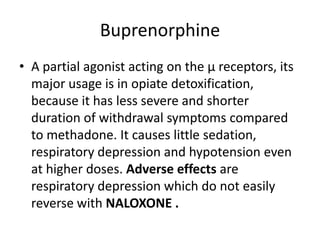
Buprenorphine
• A partial agonist acting on the µ receptors, its
major usage is in opiate detoxification,
because it has less severe and shorter
duration of withdrawal symptoms compared
to methadone. It causes little sedation,
respiratory depression and hypotension even
at higher doses. Adverse effects are
respiratory depression which do not easily
reverse with NALOXONE .
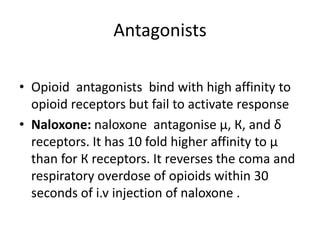
Antagonists
• Opioid antagonists bind with high affinity to
opioid receptors but fail to activate response
• Naloxone: naloxone antagonise µ, К, and δ
receptors. It has 10 fold higher affinity to µ
than for К receptors. It reverses the coma and
respiratory overdose of opioids within 30
seconds of i.v injection of naloxone .
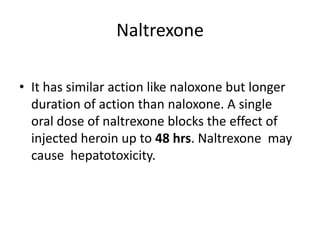
Naltrexone
• It has similar action like naloxone but longer
duration of action than naloxone. A single
oral dose of naltrexone blocks the effect of
injected heroin up to 48 hrs. Naltrexone may
cause hepatotoxicity.

OPOIDS by Dr. Nadeem Korai

  • 1.
    OPIOIDS Dr. Nadeem akhtar MBBS.M.Phil Asst.Professor Pharmacology Amna Inayat Medical College Shaikhupura
  • 2.
    History • Opium isthe source of morphine obtained from poppy, Papaver somniferum and P album • It was isolated in 1803 and was named after Morpheus, the Greek god of dreams.
  • 3.
  • 4.
    Classification • 1) Agonist: •Strong---Morphine, Heroin,Mepridine, - Methadone, Fentanyl, Sufentanil. • Moderate---Codeine, Oxycodone, Hydrocodone, Pholcodeine • Weak---Propoxyphene • 2) MixedAgonist/Antagonist: Pentazocine,Nalbuphine,Buprenorphine, Butorphenol • Antagonist: Naloxone, Naltrexone,Nalorphine
  • 5.
    • Pure agonist:has affinity for binding plus efficacy • Pure antagonist: affinity for binding but no efficacy • Mixed agonist: antagonist produces an agonist effect at one receptor and antagonist at other • Partial agonist: has affinity for binding but low efficacy.
  • 6.
    Opioid receptors • In1973 a graduate student Candance pert used radioactive morphine to evaluate the location of site of action of morphine, and he found that drug attaches to very specific areas of brain dubbed as opioid receptors
  • 7.
    Opioid receptors • Thereare opioid receptors within the CNS as well as throughout the peripheral tissues. These receptors are normally stimulated by endogenous peptides (endorphins,enkephalins and dynorphins)
  • 8.
    Opioid Receptors • Mu:µ • Kappa: К • Delta: δ
  • 9.
    Functions of opiodreceptors • Mu (µ): supraspinal and spinal analgesia, sedation, inhibition of respiration, slow gastrointestinal transit, modulation of hormone and neurotransmitter release • Kppa (К): supraspinal and spinal analgesia, psychotomimetic effects, slowed gastrointestinal transit • Delta (δ): supraspinal and spinal analgesia, modulation of hormone and neurotransmitter release
  • 10.
    Functions of opiodreceptors • All these receptors possess strong affinity for endogeneous opioid peptides e.g endorphins, enkephalins, and dynorphins
  • 11.
    Organ system effectsof morphine and its surrogates • 1)CNS: due to the affinity for µ receptors, they produce analgesia, euphoria, sedation, and respiratory depression and tolerance occur with repeated use. • a) analgesia: opioid analgesics are unique to reduce both aspects (sensory and affective) of pain. • b) euphoria: intravenous drug users usually experience pleasant floating sensations with less anxiety ad distress
  • 12.
    • c) sedation:induce sleep particularly in elderly as well as with combination of other CNS depressing agents like sedatives & hypnotics • d) respiratory depression: all opioids produce respiratory depression by inhibiting brain stem respiratory mechanism and depressed response to CO2 challenge. • e) cough suppression: suppresses cough reflex in this respect codeine is most effective
  • 13.
    • f) miosis:constriction of pupils have been seen with all opioid agonists • g) truncal rigidity: intensification of tone in large trunk muscles have been noted with number of opioids, may be due to spinal action of these drugs. • h) nausea & vomiting: opioid analgesics can activate chemoreceptors and produce nausea and vomiting.
  • 14.
    • i) temperature:homeostatic regulation of body temperature is mediated in part b action of the action of endogenous peptides in the brain. • 2)Peripheral effects: • a)CVS: no significant effect observed on cvs with the exception of meperidine which may produce tachycardia.
  • 15.
    • b)G.I.T: inlarge intestine peristaltic waves diminished and causes constipation, more opioids are successfully used for the treatment of the diarrhea (loperamide). • c) biliary tract: opiods contract biliary smooth muscles which can result in biliary colic. • d) renal: opioids depress renal function, µ opioids have anti-diuretic action. Ureteral and bladder tone increased due to opioids administration
  • 16.
    • e) uterus:peripheral and central actions of opioids reduce uterine contractions and prolong labor. • f) neuroendocrine: opioids increase the release of ADH, prolactin and somatostatin but inhibit the release of luteinizing hormone. • g) pruritus: opioids induced pruritus and urticaria more prominently by parenteral use.
  • 17.
    Clinical uses ofopioid analgesics • Analgesia: severe pain associated with cancer or other terminal illnesses may be treated successfully. Opioids are often used in obstetric labor. • Pulmonary edema: morphine can be particularly useful in treating painful myocardial ischemia with pulmonary edema • Cough: on lower doses cough suppression effect can be obtained.
  • 18.
    • Diarrhea: syntheticsurrogates diphenoxylate or loperamide are available to control non- infecteous diarrhea. • Applications in anesthesia: opioids are used in cardiovascular and other high risk surgeries, in which primary goal is to minimize cardiovascular depression.
  • 19.
    Mechanism of action •Activation of peripheral nociceptive fibres causes release of substance P an other pain signaling neurotransmitters from nerve of terminals in the dorsal horn of spinal cord. • Release of pain signaling neurotransmitters is regulated by endogenous endorphins or by exogenous opioid agonists by acting pre- synaptically to inhibit substance P release causing analgesia.
  • 20.
    • Involves changesin transmembrane ion conductance • Increase potassium conductance • In-activation of calcium channels
  • 21.
    Adverse effects • Severerespiratory depression can occur and may result in death. Other effects include vomiting, dyphoria, histamine enhanced hypotensive effects, increased intracranial pressure, cerebral and spinal ischemia. Care should be taken while prescribing morphine in CLD, CRF.
  • 22.
    Tolerance and dependence •Repeated use produce tolerance to analgesic, euphoric, respiratory and sedative effects of morphine. Physical and psychological dependence readily occur with morphine and other agonists. Withdrawal effects include rhinorrhea, lacrimation, yawning, hyperventilation, hyperthermia, mydriasis, muscular aches and vomiting.
  • 23.
    Meperidine • A syntheticopioid structurally unrelated to morphine. • Mechanism of action: binds to µ and К receptors. • Clinical uses: indicated for acute nature of pain, not recommended for long term use • Adverse effects: large doses can cause anxiety, tremor, muscle twitches.
  • 24.
    Methadone • A syntheticopioid orally effective induces less euphoria and longer duration of action. • Mechanism of action: acts on µ and NMDA receptors. • Clinical uses: used as analgesic in neurogenic pain, controlled withdrawal in morphine and heroin abusers. • Adverse effects: withdrawal effects ,but less toxic than morphine.
  • 25.
    Fentanyl • A syntheticopioid and 100 times more potent than morphine use in anesthesia. The drug has rapid short duration (15-30 mnts). Administered by i.v route but oral mucosal preparations and transdermal patches also available. This is often used in cardiac surgery due to its negligible effects on myocardial contractility. • Adverse effects: are those of µ receptor agonists
  • 26.
    Heroin • Also calleddiacetylmorphine three fold increased in potency than morphine. Due to its greater solubility it cross BBB more rapidly than morphine causing more euphoria. It has no accepted medical use in USA, but it is used in other countries in severe cancer pain. • Heroin users experience more severe withdrawal symptoms than morphine
  • 27.
  • 28.
    Moderate agonist: Codeine •The analgesic potency of codeine is much less than the morphine, however it shows good anti-tussive activity at doses that do not causes analgesia. Codeine is often used in combinations with aspirin and acetaminophen
  • 29.
    Mixed agonist-antagonist &partial agonist • Mixed agonist-antagonist: shows agonistic activity and are used to relieve pain. • Pentazocine: it acts as agonist on К receptors and weak agonist at µ and δ receptors. Pentazocine promotes analgesia activating receptors in spinal cord. It can precipitate withdrawal symptoms in morphine users. Tolerance and dependence develops with repeated use.
  • 30.
    Buprenorphine • A partialagonist acting on the µ receptors, its major usage is in opiate detoxification, because it has less severe and shorter duration of withdrawal symptoms compared to methadone. It causes little sedation, respiratory depression and hypotension even at higher doses. Adverse effects are respiratory depression which do not easily reverse with NALOXONE .
  • 31.
    Antagonists • Opioid antagonistsbind with high affinity to opioid receptors but fail to activate response • Naloxone: naloxone antagonise µ, К, and δ receptors. It has 10 fold higher affinity to µ than for К receptors. It reverses the coma and respiratory overdose of opioids within 30 seconds of i.v injection of naloxone .
  • 32.
    Naltrexone • It hassimilar action like naloxone but longer duration of action than naloxone. A single oral dose of naltrexone blocks the effect of injected heroin up to 48 hrs. Naltrexone may cause hepatotoxicity.